
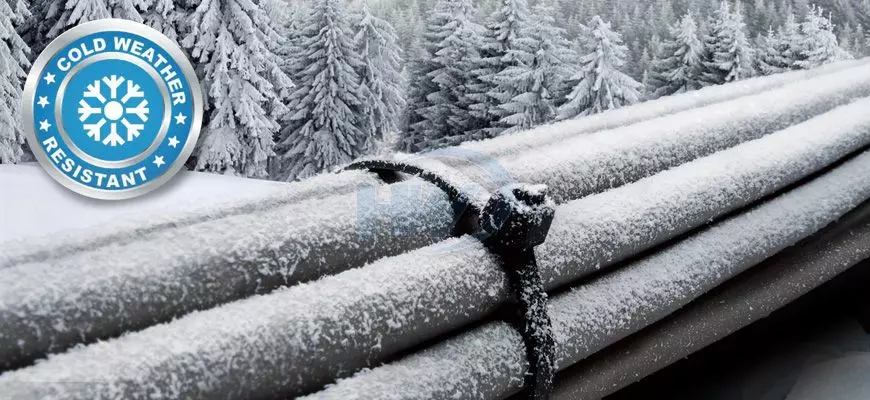
Why Do Cable Ties Break in Cold Weather? (Engineering Guide)
Every winter, maintenance crews and electrical contractors open their toolboxes to find cable ties that snap like dry twigs. It is not bad luck — it is polymer physics. The same nylon cable tie that cinched comfortably at 25°C can shatter at −20°C. As a senior electrical engineering perspective, this guide explains exactly why cable ties break in cold weather, how far you can trust temperature ratings, and how to specify cable ties that hold through winter.
Short answer: Standard nylon cable ties (PA6 / PA66) break in cold weather because the polymer crosses its glass-transition threshold. The molecular chains freeze, the strap loses ductility and turns glassy, absorbed moisture freezes into micro-cracks, and thermal contraction adds internal stress — so the tie snaps under tension it would normally absorb. The fix is low-temperature modified PA66, PA12, or stainless steel ties, installed correctly.

The 5 Engineering Reasons Cable Ties Break in Cold Weather
1. The glass transition (Tg): nylon turns from ductile to glassy. Every nylon has a glass-transition temperature — roughly 45°C for PA6 and 50°C for PA66 in dry-as-molded state. Below freezing, the polymer chains lose mobility and pack together tightly. The material no longer absorbs mechanical stress through elastic deformation; instead, stress concentrates at microscopic flaws and cracks propagate instantly. Polymer testing shows standard Nylon 66 can lose up to 60% of impact strength when temperature drops from 20°C to −20°C. This is the same mechanism that makes a rubber hose stiff in winter, only nylon has no margin left to yield.

2. Frozen moisture inside the polymer. Nylon is hygroscopic: it naturally absorbs up to roughly 2.5–3% moisture by weight. At room temperature, absorbed water acts as a plasticizer that keeps the strap supple. But when that moisture freezes, it forms ice crystals inside the polymer structure, creating internal stress points that concentrate load and crack the strap from within. Properly dried ties (below 0.5% humidity) can withstand roughly three times more freeze–thaw cycles before cracking. This is why cold-weather storage matters as much as cold-weather selection.
3. Thermal contraction and stress concentration. As temperature falls, nylon contracts. On a tie already cinched under tension, contraction raises internal stress; on a tie being installed, the forced bending and tightening load lands on a material that can no longer distribute it. The result is micro-crack initiation at the strap–pawl junction, followed by sudden, catastrophic failure rather than gradual yielding.
4. Over-tensioning during installation. In cold weather, installers instinctively pull harder on a strap that feels “loose,” but a brittle strap cannot take the same cinch torque as a warm one. Field studies attribute a large share of nylon tie failures to improper tensioning — the teeth on the strap or the pawl crack under the extra load. A cold tie must be snugged, not yanked.
5. UV aging and oxidation — the hidden multiplier. Years of sunlight break the polymer chains and oxidize the surface until the strap turns chalky and stiff. An aged or degraded tie is brittle at much higher temperatures than a new one — cold weather is simply the trigger. This is why outdoor installations should always specify UV-stabilized black nylon, and why an old white tie on a solar rack is the most likely winter casualty.
Cable Tie Material Comparison for Cold Weather
The table below is the decision tool procurement engineers and contractors should use when specifying cold-weather cable ties.
| Material | Min. Operating Temp | Cold Installation Temp | Tensile Retention @ −20°C | Best For | TONFUL Series |
|---|---|---|---|---|---|
| Nylon 6 (PA6) | −10°C (14°F) | ~0°C (32°F) | 45–50% | Indoor, mild climates | Standard |
| Nylon 66 (PA66) | −20°C (−4°F) | ~−5°C (23°F) | 55–65% | General outdoor | Professional |
| Low-temp modified PA66 | −40°C (−40°F) | ~−30°C (−22°F) | 75–85% | Cold-climate installs | Arctic |
| Nylon 12 (PA12) | −50°C (−58°F) | ~−40°C (−40°F) | 80–90% | Extreme cold, freezers | Polar |
| Stainless steel 304/316 | −60°C (−76°F) | Any temperature | 95–100% | Marine, chemical, arctic | Stainless |
A critical distinction: minimum operating temperature is not the same as cold installation temperature. A tie rated for operation at −20°C can still snap during installation at −5°C, because bending, threading, and cinching impose far more stress than static holding. Always check the installation rating, not just the service rating.

Standards and Ratings You Should Know
When sourcing cable ties, look for recognized standards rather than marketing claims. UL 62275 covers cable ties and wire management, and flammability ratings follow UL 94 (most nylon ties are V-2; V-0 available on request). A “−40°C” printed rating usually refers to the operating floor, not the installation floor — verify with the manufacturer’s data sheet. For ties that must perform from extreme cold to high heat with zero polymer brittleness, stainless steel cable ties remove temperature limits entirely, and our 304 vs 316 stainless steel guide explains which grade suits corrosive winter-road and marine environments. TONFUL’s standard Nylon 66 cable ties are UL-recognized, operate from −40°C to +85°C, and span 18 lbs up to 250+ lbs tensile strength.
How to Choose Cable Ties for Cold Weather
Use this selection table as your starting point, then confirm with tensile strength and size data.
| Application / Environment | Recommended Cable Tie Material |
|---|---|
| Indoor panels, HVAC, mild climates | PA6 or standard PA66 |
| Outdoor winter, general bundling (down to −20°C) | Low-temperature modified PA66 |
| Freezers, refrigerated logistics, arctic (down to −40°C) | PA12 |
| Marine, chemical plants, road-salt exposure | Stainless steel 304/316 |
| Solar racks, long outdoor exposure + UV | UV-stabilized black nylon |
For deep cold and UV-stressed solar and outdoor runs, our nylon 66 vs nylon 12 comparison covers the material trade-offs in detail, and the cable tie tensile strength guide helps you size the strap correctly for the load. If you are upgrading existing winter installations, our cold-weather cable ties winter solutions guide walks through practical replacement strategies.
Installation Best Practices in Cold Weather
Even the right cable tie fails if handled wrong at −20°C. Follow these rules:

- Store ties warm. Keep unopened bags above 20°C until use, and avoid moisture absorption by resealing bags — see our cable tie moisture and storage guide.
- Pre-warm before cinching. For small jobs, warm the ties (body heat, a warm pocket, or warm water for ~30 minutes) to restore flexibility before installation.
- Do not over-tension. Snug the strap; let the cold material do the holding. If you need consistent tension, use a calibrated tensioning tool rather than muscle.
- Avoid sharp edges and hard bends. Route and install so the strap never bears on corners or acute bends where stress concentrates.
- Dress the tail. Trim the excess tail flush so nothing catches and applies leverage at the head.
- Schedule installs in shelter where feasible, or work during the warmest part of the day.

FAQ: Cable Ties in Cold Weather
At what temperature do cable ties break? Standard Nylon 66 ties begin to show brittle behavior and snap risk around −10°C to −15°C during installation, with high failure risk below −20°C. Nylon 6 ties become brittle even above 0°C. Low-temperature PA12 and stainless steel ties remain reliable down to −40°C to −60°C.
What is the temperature range of a cable tie? Standard Nylon 66 cable ties are typically rated from −40°C to +85°C for service, but the installation floor is higher — expect brittle behavior when installing below about −5°C. Stainless steel ties operate far beyond either limit.
Are cable ties affected by moisture or freezing? Yes. Nylon absorbs moisture that freezes inside the material at low temperatures, forming ice crystals that act as internal stress points. Dry storage and low-moisture formulations significantly improve cold-weather life.
What is the best cable tie for cold weather? For most winter applications, Nylon 12 (PA12) offers the best balance of flexibility, cost, and performance down to −40°C. For arctic, marine, or chemical environments, stainless steel ties are the definitive solution since metal does not suffer polymer brittleness.
Can I make standard cable ties flexible in winter? Temporarily, yes — warm them to above room temperature before cinching and avoid over-tensioning. For permanent reliability, replace them with cold-rated cable ties rather than relying on workarounds.
Choosing the Right Partner
Winter failures cost downtime, rework, and sometimes safety incidents. The difference between a tie that survives a February night and one that shatters usually comes down to material specification and honest rating data. TONFUL Electric manufactures cable ties from 100% virgin Nylon 66 and 304/316 stainless steel, in standard, low-temperature, UV-resistant, and custom configurations, with factory-direct OEM support. Explore the full cable ties product line to find the right cold-weather solution, or contact our engineering team for a specification review.