
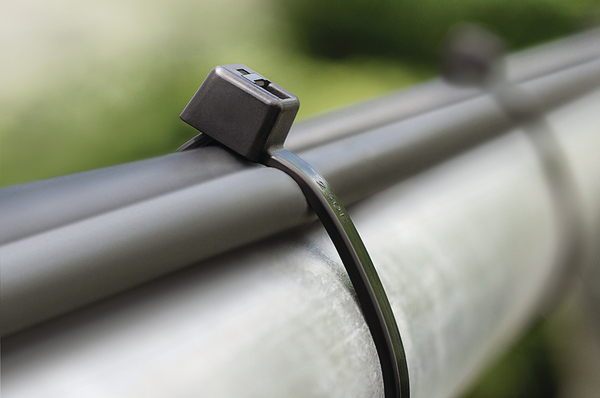
When engineers, electricians, and procurement teams ask whether cable ties are waterproof, the honest answer is: it depends entirely on the material, the rating, and the environment. The question matters more than ever in 2026, because cable ties now secure critical infrastructure in solar farms, marine vessels, EV battery packs, and outdoor telecom towers—locations where water, UV, and salt spray work together to destroy ordinary fasteners.
This guide breaks down the water-resistance performance of every major cable tie material, explains the difference between “water-resistant” and “waterproof,” and tells you exactly which tie to specify for wet, submerged, or corrosive environments.
The Short Answer
Standard natural nylon 6/6 cable ties are water-resistant but not waterproof. They absorb up to 2.5–8% moisture by weight, which plasticizes the material and lowers tensile strength. However, they will not rust, corrode, or disintegrate in damp conditions. For continuous immersion, salt spray, or 25-year outdoor service life, you need specialized materials: UV-stabilized black nylon 6/6, Nylon 12, ETFE (Tefzel), or stainless steel (304/316).

Understanding Cable Tie Materials and Water Behavior
Cable ties are not a single product. They are a family of fasteners manufactured from different polymers and metals, each with a distinct relationship to water. The table below summarizes how the most common materials perform when exposed to moisture.
| Material | Water Absorption (24h, ASTM D570) | Continuous Wet Rating | Typical Outdoor Lifespan | Best Use Case |
|---|---|---|---|---|
| Natural Nylon 6/6 | 1.5–2.5% (up to 8% at saturation) | Water-resistant, not waterproof | 1–2 years (degrades under UV) | Indoor bundling, panel wiring |
| UV-Stabilized Black Nylon 6/6 | 1.5–2.5% | Water-resistant, weather-resistant | 5–7 years (temperate) | Outdoor electrical, telecom |
| Nylon 12 (PA12) | <1.0% | Highly water-resistant | 7–10 years | Solar, automotive engine bays |
| ETFE / Tefzel | <0.03% | Near-waterproof | 15–20+ years | Chemical plants, nuclear, aerospace |
| Polypropylene (PP) | <0.01% | Highly water-resistant | 3–5 years (UV-weak) | Damp indoor, irrigation |
| 304 Stainless Steel | 0% | Waterproof (corrosion-vulnerable in salt) | 20–25 years | Food, beverage, general outdoor |
| 316 Stainless Steel | 0% | Waterproof, salt-spray resistant | 25+ years | Marine, offshore, solar 25-yr assets |
To understand the waterproof question at a structural level, you have to look inside the tie itself.

Water-Resistant vs. Waterproof: The IP Rating Reality
The term “waterproof” has no single engineering definition for cable ties because ties are fasteners, not enclosures. When waterproofing matters, the industry references the IP (Ingress Protection) rating system defined by IEC 60529. Cable ties themselves are not IP-rated—instead, they secure cables entering IP-rated enclosures.
What matters for a cable tie is whether it maintains tensile strength, loop tensile strength, and locking integrity after prolonged water exposure. Here is how the IP scale maps to cable tie selection:
| IP Rating | Protection Level | Relevant Cable Tie Application | Recommended Material |
|---|---|---|---|
| IPX1–IPX4 | Dripping to splashing water | Indoor HVAC, general electrical | Natural Nylon 6/6 |
| IPX5–IPX6 | Water jets | Outdoor telecom, industrial washdown | UV Black Nylon 6/6, Nylon 12 |
| IPX7 | Temporary immersion (1m, 30 min) | Junction boxes, pump pits | Nylon 12, 304 Stainless |
| IPX8 | Continuous immersion | Submersible pumps, marine | 316 Stainless, ETFE |
| IPX9K | High-pressure, high-temp jets | Off-road, food processing | 316 Stainless, ETFE |
For a full breakdown of enclosure standards, see our guide on NEMA vs. IP ratings for waterproof enclosures, and for sealed termination components, our IP67 vs. IP68 waterproof wire nut comparison.

Material-by-Material Waterproof Performance
Nylon 6/6 (PA66)
The default material for roughly 90% of cable ties worldwide. Nylon 6/6 absorbs moisture from humid air—it will physically gain weight and become slightly more flexible in damp environments. This is not failure; it is the polymer’s chemistry. In fact, a small amount of moisture improves toughness and reduces brittleness. The real enemy is UV radiation combined with water, which embrittles the tie over 1–2 years outdoors. Learn more in our cable tie moisture content and storage guide.
UV-Stabilized Black Nylon 6/6
Adding approximately 2% carbon black by weight (per ASTM D6779) gives nylon 6/6 a UV shield that extends outdoor life to 5–7 years in temperate zones. The carbon black absorbs UV photons across the 290–400 nm spectrum and converts them to harmless heat. This is the workhorse for outdoor electrical and solar applications.
Nylon 12 (PA12)
Nylon 12 absorbs less than 1.0% moisture—roughly half of PA66—making it markedly more dimensionally stable in wet conditions. It is the preferred material for solar DC cable management and automotive engine bays where heat, fuel, and moisture converge. Compare both grades in our Nylon 66 vs. Nylon 12 solar cable ties guide.
ETFE / Tefzel
ETFE (ethylene tetrafluoroethylene) absorbs less than 0.03% water—effectively waterproof. It resists acids, solvents, UV, and radiation up to 100 megarads, with a service temperature range of −60°C to +170°C. For nuclear plants, chemical processing, and aerospace, nothing else comes close. Explore our Tefzel ETFE cable ties for these aggressive environments.
Stainless Steel (304 vs. 316)
Stainless steel cable ties are truly waterproof—zero water absorption, no UV degradation, and no polymer breakdown. The choice between 304 and 316 matters mainly for saltwater: 316 contains molybdenum that resists chloride pitting, making it the standard for marine and offshore use. Read our 304 vs. 316 stainless steel cable ties guide and our stainless steel vs. plastic cable ties comparison for the full breakdown.

Applications Where Waterproof Cable Ties Matter
Choosing the right tie for a wet environment is an engineering decision, not a purchasing preference. Here is where the choice becomes critical:
- Solar farms (25-year asset life): UV-stabilized PA66 for 5–7 year cycles; 316 stainless for full-life installations. Many EPC firms now default to stainless for DC cable management.
- Marine and offshore: Only 316 stainless or ETFE survive saltwater plus UV. Nylon ties fail within months on deck.
- Submersible pumps and direct burial: Continuous immersion demands 316 stainless or ETFE. Nylon is unsuitable.
- Food and beverage processing: Stainless ties survive CIP (clean-in-place) washdown cycles that would destroy nylon. See our metal detectable cable ties for food safety.
- Cold chain and refrigeration: Standard nylon becomes brittle below −40°C. Cold-weather-grade ties stay flexible. Our cold weather cable ties guide covers winter solutions.
- Automotive engine bays: Heat, fuel, and moisture require PA12 or heat-stabilized nylon (up to +125°C).
For the broader applications landscape, see what cable ties are used for.

Best Practices for Wet Environments
Even the most waterproof tie fails if installed incorrectly. Follow these engineering rules:
- Match material to the full environment, not just water. Salt, UV, chemicals, and temperature interact. A tie that survives freshwater may fail in salt spray.
- Size for tensile margin. Wet nylon loses 10–15% tensile strength at saturation. Oversize by one grade for immersion applications. Check our cable tie tensile strength guide.
- Store nylon ties properly. PA66 in a dry warehouse becomes brittle. Condition ties at 50–60% relative humidity before installation. Details in our moisture content storage guide.
- Use stainless for permanent outdoor assets. For 25-year solar or offshore installations, 316 stainless eliminates the UV and water question entirely.
- Combine with sealed connectors. A waterproof tie securing a non-sealed connector still leaves the system vulnerable. Pair with waterproof wire nuts or heat shrink tubing for complete protection.
Short FAQ
Are standard nylon cable ties waterproof?
No. Natural nylon 6/6 ties are water-resistant—they will not rust or dissolve—but they absorb moisture (up to 2.5% in 24 hours, 8% at saturation) and are not rated for continuous immersion. Use UV-stabilized black nylon, Nylon 12, ETFE, or stainless steel for wet environments.
Can cable ties be submerged in water?
Only specific materials. 316 stainless steel and ETFE (Tefzel) tolerate continuous immersion. Nylon ties are suitable for splashing and humidity, not permanent submersion.
Do cable ties degrade in rain?
Standard natural nylon degrades in 1–2 years outdoors due to UV-moisture interaction. UV-stabilized black nylon lasts 5–7 years. 316 stainless and ETFE last 15–25+ years regardless of rain.
What cable tie is best for marine use?
316 stainless steel. The molybdenum content resists chloride pitting from saltwater. ETFE is the alternative when non-metallic is required.
Are stainless steel cable ties truly waterproof?
Yes. Stainless steel has zero water absorption, no UV degradation, and no polymer breakdown. 316 grade additionally resists saltwater corrosion. Browse our stainless steel cable ties manufacturer page.
Can I use cable ties underground or in direct burial?
Only 316 stainless steel or ETFE. Nylon ties absorb groundwater and degrade. For sealed underground connections, pair stainless ties with direct burial waterproof connectors.
Conclusion
The question “are cable ties waterproof?” has no single answer because cable ties are not one material. Natural nylon 6/6 is water-resistant and perfectly adequate for indoor and covered outdoor use. UV-stabilized black nylon and Nylon 12 push outdoor life to 5–10 years. ETFE (Tefzel) approaches true waterproofing with near-zero moisture absorption. Stainless steel—especially 316 grade—is genuinely waterproof and UV-immune for 25-year service life.
The engineering principle is simple: match the material to the environment’s full stress profile—water, UV, salt, temperature, and chemical exposure. When you do, cable ties become a reliable, decades-long fastening solution in even the harshest wet environments. Browse the complete TONFUL cable ties catalog to find the exact grade your application demands.