
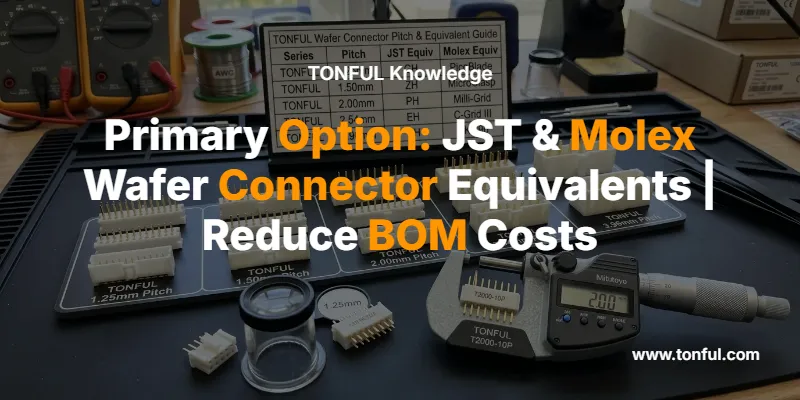
When your PCB assembly budget is under pressure and lead times for brand-name connectors stretch into months, knowing how to source reliable wafer connector equivalents becomes a critical competitive advantage. For procurement managers and design engineers working on cost-sensitive projects, understanding the cross-reference landscape between JST, Molex, and alternative manufacturers like TONFUL can unlock 15-30% BOM cost reductions without compromising electrical performance or reliability.
This comprehensive guide breaks down the technical specifications, cross-reference frameworks, and sourcing strategies you need to make informed decisions about wafer connector equivalents for your next PCB assembly project.
What Are Wafer Connectors and Why Do They Matter?
Wafer connectors are wire-to-board interconnect systems consisting of two mating halves: a PCB-mounted wafer header (male) and a wire-terminated crimp housing (female). Unlike traditional pin headers where wires are soldered directly to the board, wafer systems use crimped terminals inserted into polarized plastic housings, enabling fast field assembly, reduced labor costs, and improved connection reliability in production environments.
The global shift toward miniaturization and higher circuit density has made wafer connectors indispensable across consumer electronics, automotive systems, industrial controls, and medical devices. However, relying exclusively on premium OEM brands creates supply chain vulnerabilities and inflates production costs—challenges that engineered equivalents are specifically designed to address.

Understanding Wafer Connector Pitch: The Foundation of Cross-Referencing
Pitch—the center-to-center distance between adjacent pins—is the single most critical parameter when cross-referencing wafer connectors. A mismatch of even 0.04mm can cause progressive pin misalignment in multi-pin configurations, leading to intermittent connections or permanent damage.
Standard Pitch Families and Their Applications
| Pitch Size | Common OEM Series | TONFUL Equivalent | Typical Current Rating | Primary Applications |
|---|---|---|---|---|
| 1.25mm | JST GH, Molex PicoBlade | TONFUL GH-1.25, PB-1.25 | 1A @ 50V | Wearables, smartphones, compact IoT devices |
| 1.5mm | JST ZH, JST ACH | TONFUL ZH-1.5, ACH-1.5 | 1.5A @ 50V | Portable medical devices, handheld instruments |
| 2.0mm | JST PH, Molex Micro-Latch | TONFUL PH-2.0, ML-2.0 | 2A @ 100V | Battery packs, LED drivers, sensor modules |
| 2.5mm | JST XH | TONFUL XH-2.5 | 3A @ 250V | RC vehicles, 3D printers, power distribution |
| 2.54mm | Molex KK, TE AMP-LATCH | TONFUL KK-2.54, AL-2.54 | 3A @ 250V | Industrial PLCs, Arduino shields, legacy systems |
| 3.96mm | Molex Mini-Fit Jr. | TONFUL MF-3.96 | 9A @ 600V | HVAC controls, motor drives, power supplies |
Critical Note: JST XH is nominally 2.5mm pitch, not 2.54mm. While a 2-pin XH housing may physically mate with a 2.54mm header, a 10-pin XH housing will have the last pin offset by 0.4mm—enough to cause connection failure. Never use XH as a 2.54mm substitute in production.

JST Wafer Connector Equivalents: Series-by-Series Cross-Reference
JST (Japan Solderless Terminal) manufactures some of the most widely specified wire-to-board connectors in the electronics industry. However, their premium pricing and occasional supply constraints make equivalent alternatives attractive for cost-sensitive projects.
JST PH Series (2.0mm Pitch) Equivalents
The JST PH series is the workhorse connector for compact battery-powered devices. With a 2.0mm pitch and current rating of 2A at 100V, it’s found in everything from lithium battery packs to LED control boards.
TONFUL PH-2.0 Series offers drop-in compatibility with:
- Matching 2.0mm pitch and pin diameter
- Phosphor bronze terminals with tin or gold plating options
- PA66 UL94V-0 rated housing material
- Friction-lock retention mechanism
- Available in 2-16 pin configurations
- Through-hole (THT) and surface-mount (SMT) header options
Cost Advantage: TONFUL PH-2.0 equivalents typically cost 40-60% less than JST originals in volumes above 10,000 pieces, with lead times of 2-3 weeks versus 12-16 weeks for JST during supply shortages.
JST XH Series (2.5mm Pitch) Equivalents
The JST XH series handles higher current loads (3A at 250V) and is prevalent in RC hobby electronics, 3D printer control boards, and industrial sensor arrays. The larger 2.5mm pitch provides better current capacity and easier manual assembly compared to 2.0mm alternatives.
TONFUL XH-2.5 Series specifications:
- Exact 2.50mm pitch (not 2.54mm)
- Current rating: 3A per circuit
- Voltage rating: 250V AC/DC
- Operating temperature: -25°C to +85°C
- Contact resistance: ≤20mΩ
- Insulation resistance: ≥500MΩ
Application Note: When designing PCB footprints for XH equivalents, verify that your CAD library specifies 2.50mm pitch, not the common 0.1″ (2.54mm) grid. This mistake accounts for approximately 30% of connector-related assembly failures in contract manufacturing.

Molex Wafer Connector Equivalents: Breaking Down the Premium
Molex commands significant market share in industrial and automotive connectors, but their pricing structure reflects brand premium rather than pure manufacturing cost. Understanding which Molex series have reliable equivalents can unlock substantial savings.
Molex KK Series (2.54mm Pitch) Equivalents
The Molex KK 254 system is the industry standard for 0.1″ pitch wire-to-board connections, particularly in industrial controls and legacy equipment retrofits. Its positive-latch retention mechanism provides superior vibration resistance compared to friction-lock designs.
TONFUL KK-2.54 Series matching specifications:
- 2.54mm (0.100″) pitch
- Positive latch with audible click feedback
- Current rating: 3A per circuit
- Voltage rating: 250V
- Available in single-row (2-24 pin) and dual-row configurations
- Straight and right-angle PCB orientations
Compatibility Verification: While TONFUL KK-2.54 headers are dimensionally compatible with Molex KK housings, always verify latch geometry and housing width against your specific PCB footprint before committing to production substitution. Minor dimensional differences between brands can affect mating force and retention.
Molex Micro-Fit Series (3.0mm Pitch) Equivalents
Molex Micro-Fit connectors are designed for higher current applications (up to 5A per circuit) with excellent contact reliability. They’re commonly specified in power distribution, motor control, and automotive auxiliary systems.
TONFUL MicroFit-Compatible Series features:
- 3.0mm pitch for higher current capacity
- Dual-beam contact design for gas-tight connections
- Current rating: 5A per circuit (AWG 18-24)
- Voltage rating: 600V
- Temperature range: -40°C to +105°C
- Color-keyed housings to prevent mis-mating
Cost Comparison: In a typical 5,000-unit production run, switching from Molex Micro-Fit to TONFUL equivalents can reduce connector costs from $1.20 to $0.45 per assembly—a $3,750 savings on connectors alone.
Technical Verification: Ensuring Equivalent Performance
Substituting wafer connectors requires more than matching pitch and pin count. Responsible engineering practice demands verification across multiple parameters to ensure long-term reliability.
Critical Verification Checklist
| Parameter | Verification Method | Acceptance Criteria |
|---|---|---|
| Pitch Accuracy | Caliper measurement, CMM inspection | ±0.05mm tolerance |
| Contact Resistance | 4-wire Kelvin measurement | ≤20mΩ initial, ≤30mΩ after thermal cycling |
| Insertion/Withdrawal Force | Force gauge testing | Within OEM spec ±20% |
| Current Capacity | Temperature rise test at rated current | ≤30°C rise above ambient |
| Vibration Resistance | MIL-STD-202 Method 204 | Zero intermittent contacts |
| Thermal Cycling | -40°C to +85°C, 100 cycles | No cracking, <10% resistance increase |
| Salt Spray Resistance | ASTM B117, 48 hours | No corrosion on contact surfaces |
TONFUL Electric subjects all wafer connector series to these verification protocols and provides test reports upon request for qualification purposes. For automotive applications requiring USCAR-21 compliance, additional terminal push-out force testing and vibration testing are performed.

BOM Cost Reduction Strategies Using Wafer Connector Equivalents
Strategic connector substitution is one of the most effective levers for reducing PCB assembly costs without redesigning circuit functionality. Industry data shows that connectors often represent 8-15% of total BOM cost in electromechanical assemblies, making them prime targets for optimization.
Three-Tier Sourcing Strategy
Tier 1: Direct OEM Replacement
For mission-critical applications (medical devices, aerospace, automotive safety systems), maintain OEM connectors where regulatory compliance or liability concerns outweigh cost savings. Typical cost premium: 100-200% over equivalents.
Tier 2: Qualified Equivalents
For commercial and industrial applications, use qualified equivalents from manufacturers like TONFUL that provide test reports and maintain ISO 9001/ISO 14001 certification. Typical cost savings: 40-65% versus OEM pricing. This tier represents the optimal balance of cost reduction and risk mitigation for most B2B applications.
Tier 3: Generic Alternatives
For non-critical consumer products and prototyping, generic wafer connectors from commodity suppliers may suffice. Typical cost savings: 70-80% versus OEM, but with higher variability in dimensional tolerances and plating quality.
Volume-Based Pricing Analysis
| Order Quantity | JST PH 2-Pin (USD) | TONFUL PH-2.0 2-Pin (USD) | Savings per Unit | Total Savings |
|---|---|---|---|---|
| 1,000 pcs | $0.45 | $0.28 | $0.17 | $170 |
| 5,000 pcs | $0.38 | $0.22 | $0.16 | $800 |
| 10,000 pcs | $0.32 | $0.18 | $0.14 | $1,400 |
| 50,000 pcs | $0.28 | $0.15 | $0.13 | $6,500 |
Pricing based on 2026 market rates for 2-pin 2.0mm pitch connectors with tin plating. Actual pricing varies by configuration and order terms.
Hidden Cost Factors Beyond Unit Price
When evaluating wafer connector equivalents, consider total cost of ownership beyond the purchase price:
- Lead Time Impact: Extended lead times (12-16 weeks for JST/Molex during shortages) can delay product launches and tie up working capital. TONFUL’s 2-3 week standard lead time reduces inventory carrying costs and improves cash flow.
- Minimum Order Quantities: OEM manufacturers often impose MOQs of 5,000-10,000 pieces per part number. Alternative suppliers typically offer MOQs of 1,000 pieces, reducing obsolescence risk for low-volume products.
- Tooling and Setup Fees: Some OEM connectors require custom tooling fees ($500-$2,000) for non-standard configurations. Equivalent manufacturers often waive these fees to win business.
- Assembly Labor: Connectors with easier insertion characteristics (lower mating force, better tactile feedback) can reduce assembly time by 15-30 seconds per unit—significant in high-volume production.
Design Considerations When Specifying Wafer Connector Equivalents
Successful connector substitution begins at the design stage, not during procurement crisis management. Forward-thinking engineers build flexibility into their PCB designs to accommodate multiple equivalent sources.
PCB Footprint Best Practices
- Use Industry-Standard Footprints: Design PCB land patterns to IPC-7251 standards rather than manufacturer-specific footprints. This ensures compatibility with multiple equivalent sources.
- Verify Pitch in CAD Libraries: Confirm that your component library specifies exact pitch (2.50mm for JST XH, not rounded 2.54mm). This single error causes more connector assembly failures than any other design mistake.
- Allow Clearance for Housing Variations: Different manufacturers’ housings may vary by ±0.5mm in width and height. Maintain 2mm minimum clearance around connector keep-out zones to accommodate variations.
- Consider Right-Angle Alternatives: Right-angle headers can reduce overall assembly height and may offer better cost-performance ratios than straight headers for equivalent current capacity.
Latch Mechanism Selection
Wafer connectors use two primary retention mechanisms:
Friction Lock: Simple tab that provides resistance during insertion. Adequate for stationary equipment but may loosen under vibration. Found in JST PH, JST XH, and basic Molex series.
Positive Lock: Mechanical latch with audible/tactile click feedback. Superior retention under vibration and thermal cycling. Found in Molex KK, TE AMP-LATCH, and automotive-grade series.
For applications subject to vibration (automotive, industrial machinery, robotics), specify positive-lock equivalents even if the original design used friction-lock connectors. The marginal cost increase (typically $0.05-$0.10 per connector) is negligible compared to field failure costs.

Sourcing Wafer Connector Equivalents: Supplier Qualification
Not all connector equivalents are created equal. Responsible procurement requires supplier qualification beyond price comparison.
Supplier Qualification Criteria
Manufacturing Capabilities:
- Automated crimping and assembly equipment (manual crimping introduces high defect rates)
- In-house mold fabrication for custom configurations
- Statistical process control (SPC) with Cpk ≥1.33 for critical dimensions
- Clean room or controlled environment for final assembly
Quality Certifications:
- ISO 9001:2015 (quality management)
- ISO 14001:2015 (environmental management)
- UL recognition for component materials (UL94V-0 housing, UL-listed terminals)
- RoHS and REACH compliance documentation
Testing and Validation:
- 100% continuity testing on assembled housings
- Sample-based dimensional inspection (CMM or optical comparator)
- Periodic material composition verification (XRF analysis for plating thickness)
- Thermal cycling and vibration testing per IEC 60512 standards
Supply Chain Transparency:
- Documented material traceability (lot codes, date codes)
- Conflict minerals compliance (Dodd-Frank Section 1502)
- Counterfeit prevention measures (authorized distributor networks)
TONFUL Electric maintains all these qualifications and supplies major contract manufacturers including Foxconn, Flex, and Jabil with connector components for global brands.
Integration with Existing TONFUL Product Ecosystem
Wafer connectors are one component in a complete wire-to-board interconnect strategy. TONFUL’s broader PCB connector portfolio enables consolidated sourcing and improved supply chain efficiency.
Complementary Product Lines
For complete PCB assembly solutions, consider these related TONFUL product families:
- Pin Header Connectors: Standard 2.54mm pitch headers for breadboarding and development boards
- Female Header Connectors: Socket strips in 1.27mm, 2.0mm, and 2.54mm pitch
- Box Header Connectors: Shrouded headers for ribbon cable applications
- FPC/FFC Connectors: Flat flexible cable connectors for space-constrained designs
- Automotive Terminals & Connectors: Sealed connectors for harsh environment applications
Wire Harness Assembly Integration
Wafer connectors are typically specified as part of custom wire harness assemblies. TONFUL offers complete custom wire harness assembly services including:
- Wire cutting and stripping to specification
- Terminal crimping with pull-force verification
- Housing insertion and continuity testing
- Heat shrink tubing and cable management
- Final assembly testing and quality documentation
This integrated approach reduces your supplier count, simplifies quality management, and often yields better pricing through consolidated purchasing.
Frequently Asked Questions
Q: Are TONFUL wafer connectors direct drop-in replacements for JST and Molex series?
A: TONFUL wafer connectors are engineered to match the pitch, housing outline, and electrical ratings of major OEM series. For most standard configurations, they function as drop-in replacements. However, always verify the specific latch geometry and housing width against your PCB footprint before committing to production substitution—minor dimensional differences between brands can affect mating force and retention.
Q: What is the difference between JST XH (2.5mm) and Molex KK (2.54mm)?
A: The 0.04mm pitch difference is invisible to the naked eye but causes progressive pin misalignment in multi-pin connectors. A 2-pin XH housing may physically mate with a 2.54mm header, but a 10-pin XH housing will have the last pin offset by 0.4mm—enough to cause intermittent contact or permanent damage. Never use XH as a 2.54mm substitute in production.
Q: Can I use 2.0mm wafer connectors for power distribution?
A: JST PH and equivalent 2.0mm connectors are rated for 2A per circuit at 100V. This is adequate for low-power distribution (LED strips, sensor power, logic-level circuits) but insufficient for motor drives or high-current applications. For power distribution above 3A per circuit, specify 2.54mm (3A rating) or 3.96mm (9A rating) pitch connectors.
Q: How do I verify connector equivalents meet my quality requirements?
A: Request sample connectors and test reports from your supplier covering insertion/withdrawal force, contact resistance, and thermal cycling performance. Perform incoming inspection on first article samples measuring pitch accuracy (±0.05mm tolerance), contact resistance (≤20mΩ), and visual inspection for plating quality. For critical applications, conduct accelerated life testing per IEC 60512 standards.
Q: What lead times should I expect for wafer connector equivalents?
A: Standard TONFUL wafer connector configurations (2-16 pin, common pitches) typically ship within 2-3 weeks for quantities up to 50,000 pieces. Custom configurations (non-standard pin counts, special plating, color-coded housings) may require 4-6 weeks for initial tooling and production. This compares favorably to 12-16 week lead times for JST and Molex during supply chain disruptions.
Conclusion: Strategic Connector Sourcing for Competitive Advantage
In today’s cost-competitive electronics manufacturing environment, every component decision impacts your bottom line and time-to-market. Wafer connector equivalents from qualified manufacturers like TONFUL represent a proven strategy for reducing PCB assembly BOM costs by 40-65% while maintaining the electrical performance and mechanical reliability your applications demand.
The key to successful connector substitution lies in thorough technical verification, supplier qualification, and design flexibility. By understanding pitch specifications, current ratings, and latch mechanisms—and by building multi-source capability into your PCB designs from the start—you can navigate supply chain disruptions while protecting your profit margins.
For B2B procurement managers and design engineers seeking to optimize connector costs without compromising quality, TONFUL’s comprehensive range of JST and Molex wafer connector equivalents provides a reliable foundation for cost-effective PCB assembly. With ISO-certified manufacturing, comprehensive testing protocols, and responsive technical support, TONFUL delivers the quality assurance and supply chain stability that modern electronics production demands.
Ready to reduce your PCB assembly costs? Contact TONFUL Electric for technical specifications, sample connectors, and volume pricing on wafer connector equivalents tailored to your application requirements.
TONFUL Electric specializes in manufacturing high-reliability electrical connectors, terminals, and wire harness assemblies for global electronics manufacturers. Our product portfolio includes wafer connectors, automotive connectors, PCB connectors, and complete custom wire harness solutions.