
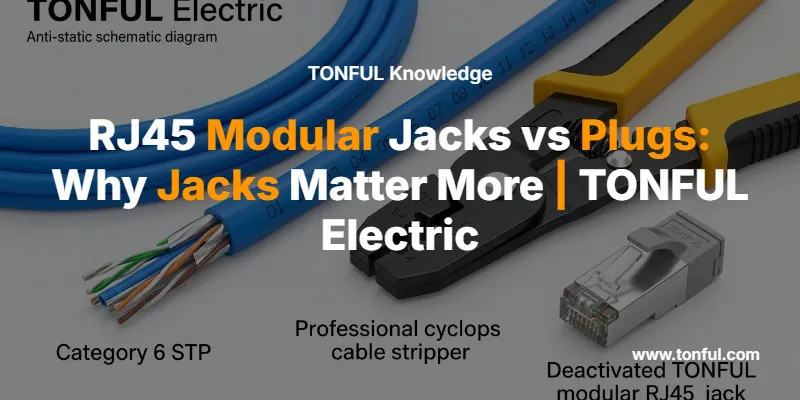
When procurement professionals search for “RJ45 connector,” they typically find results dominated by plug-type connectors—the male ends crimped onto Ethernet cables. However, this search bias obscures a critical truth: in professional network infrastructure, RJ45 modular jacks are far more important than plugs for ensuring reliable, scalable, and maintainable connectivity. Understanding this distinction is essential for B2B buyers, network engineers, and electrical contractors who specify components for data centers, industrial automation systems, and structured cabling installations.
Understanding the RJ45 Terminology Confusion
The term “RJ45 connector” creates widespread confusion in the electrical and networking industries. Technically, RJ45 refers to Registered Jack 45, a specific wiring standard originally designed for telephone systems. In modern practice, the networking industry uses “RJ45” as shorthand for 8P8C (eight position, eight contact) modular connectors—a broader category that includes both male plugs and female jacks.
Plugs vs. Jacks: Defining the Components
RJ45 Plugs (Male Connectors):
- Crimped or field-terminated onto the ends of Ethernet cables
- Feature eight exposed metal contacts
- Designed as consumable, replaceable components
- Primarily used in patch cords and temporary connections
RJ45 Modular Jacks (Female Connectors):
- Mounted on devices, patch panels, wall plates, or PCBs
- Receive and secure the male plug
- Built into permanent infrastructure
- Engineered for thousands of insertion cycles
The confusion stems from consumer-level networking where plugs receive more visibility. However, in professional B2B applications—from industrial Ethernet switches to data center patch panels—the modular jack determines network reliability, performance, and longevity.

Why Modular Jacks Matter More: The Infrastructure Perspective
In structured cabling and network infrastructure, modular jacks serve as the permanent foundation of connectivity. While plugs can be replaced in minutes, jacks are integrated into walls, panels, and devices—making their selection a long-term investment decision.
1. Durability and Insertion Cycle Rating
Professional-grade RJ45 modular jacks are engineered for 750 to 1,000+ insertion cycles, compared to plugs that may fail after dozens of re-crimps or cable replacements. In high-traffic environments like data centers or manufacturing floors, jack durability directly impacts:
- Mean time between failures (MTBF)
- Maintenance costs and downtime
- Network availability guarantees (SLAs)
For automotive terminals and connectors and custom wire harness assemblies, TONFUL Electric applies the same durability engineering principles to ensure long-term reliability.
2. Signal Integrity and Performance Standards
Modular jacks incorporate PCB-based contact systems that maintain precise impedance matching and minimize crosstalk—critical for Cat6, Cat6a, and Cat7 performance. Unlike field-terminated plugs where installation quality varies, factory-manufactured jacks provide:
- Consistent 100-ohm impedance
- Reduced return loss and insertion loss
- Compliance with TIA/EIA-568 standards
- Support for 10GBASE-T and PoE+ applications

3. Scalability and Infrastructure Flexibility
Modular jack systems enable scalable network architecture through:
- Keystone jack modularity: Individual jacks can be replaced without disturbing adjacent infrastructure
- Patch panel integration: Centralized management of hundreds of connections
- Future-proofing: Jack housings accommodate upgraded contact systems as standards evolve
This modularity is particularly valuable in industrial automation systems where network topology changes frequently to accommodate new equipment.
4. Maintenance and Troubleshooting Advantages
When network issues arise, modular jacks offer distinct advantages:
- Individual replacement: Damaged jacks can be swapped without re-pulling cables
- Testing accessibility: Jacks provide stable test points for cable certification
- Visual inspection: Jack contacts are easier to inspect than crimped plug contacts
- Reduced labor costs: Jack replacement requires basic tools versus specialized crimping equipment
RJ45 Modular Jack Selection Criteria for B2B Applications
Selecting the right modular jack requires evaluating multiple technical and application-specific factors. The following table compares key jack types:
| Jack Type | Termination Method | Installation Speed | Best Application | Typical Cost |
|---|---|---|---|---|
| Punch-Down (IDC) | Requires punch-down tool | Moderate | Permanent installations, patch panels | Low to Medium |
| Tool-Less | Lever-actuated clamping | Fast | Field deployments, rapid installations | Medium |
| PCB Mount (SMT/THT) | Soldered to circuit board | N/A (factory) | Network devices, switches, routers | Medium to High |
| Shielded (STP) | Punch-down + grounding | Moderate | Industrial environments, EMI-sensitive areas | High |
Mounting Orientation Considerations
180° (Straight) Jacks:
- Simplest design with parallel contact alignment
- Used in wall plates and horizontal patch panels
- Optimal for standard structured cabling
90° (Right-Angle) Jacks:
- Vertical PCB mounting saves board space
- Common in network switches and routers
- Reduces cable strain in tight enclosures

Shielding and EMI Protection
In industrial environments with high electromagnetic interference, shielded modular jacks are essential:
- Metal housing: Provides 360° EMI shielding
- Grounding tabs: Connect shield to chassis ground
- Cable compatibility: Requires shielded twisted pair (STP) cables
- Applications: Factory automation, medical equipment, military systems
For similar EMI protection needs in custom data cable assemblies, TONFUL Electric offers shielded solutions with proper grounding design.
Power over Ethernet (PoE) Considerations
Modern RJ45 modular jacks must support PoE (IEEE 802.3af) and PoE+ (IEEE 802.3at) standards, which deliver up to 30W of power alongside data. Critical specifications include:
- Contact current rating: Minimum 1.5A per contact pair
- Temperature rise: Must remain within safe limits under continuous load
- Contact plating: Gold plating (typically 6-50 µ-inch) for reliable current delivery
- Integrated magnetics: Some jacks include built-in transformers for space savings
PoE Application Table:
| PoE Standard | Power Delivery | Typical Applications | Jack Requirements |
|---|---|---|---|
| IEEE 802.3af (PoE) | Up to 15.4W | IP cameras, VoIP phones | Standard contacts, 1.0A rating |
| IEEE 802.3at (PoE+) | Up to 30W | PTZ cameras, wireless APs | Enhanced contacts, 1.5A rating |
| IEEE 802.3bt (PoE++) | Up to 90W | LED lighting, displays | High-current contacts, 2.0A+ rating |

Quality and Reliability Factors
When sourcing RJ45 modular jacks for B2B applications, evaluate manufacturers based on these quality indicators:
Material and Plating Standards
Contact Plating Options:
- Gold plating (6-50 µ-inch): Superior corrosion resistance, low contact resistance, preferred for high-reliability applications
- Nickel plating: Mid-tier option, adequate for most commercial applications
- Tin plating: Economy option, suitable for low-insertion-cycle applications
Housing Materials:
- Thermoplastic (PC, PBT): Standard for commercial jacks, UL94 V-0 flame rating
- Metal-reinforced: Enhanced durability for industrial environments
- Transparent housings: Allow visual inspection of contact alignment
TONFUL Electric’s electrical PCB connectors utilize similar material selection principles to ensure long-term reliability.
Compliance and Certification
Professional-grade modular jacks should meet:
- TIA/EIA-568-C.2: Performance standards for twisted pair cabling
- IEC 60603-7: International connector standards
- RoHS compliance: Restriction of hazardous substances
- UL certification: Safety and flammability ratings
- FCC Part 15: EMI/RFI emissions compliance
Testing and Quality Control
Reputable manufacturers perform:
- Insertion/extraction force testing: Ensures proper plug retention
- Contact resistance measurement: Verifies low-resistance connections
- Dielectric withstanding voltage: Tests insulation integrity
- Mechanical durability: Validates insertion cycle ratings
- Environmental testing: Temperature cycling, humidity, salt spray

Application Scenarios in B2B and Industrial Contexts
Data Centers and Server Rooms
Requirements:
- High-density patch panels with 24-48 ports per rack unit
- Cat6a or Cat7 jacks for 10GBASE-T support
- Tool-less jacks for rapid moves/adds/changes
- Color-coded housings for circuit identification
Industrial Automation and Control Systems
Requirements:
- Shielded jacks for EMI immunity in factory environments
- IP67-rated jacks for harsh environments (when combined with appropriate enclosures)
- Wide operating temperature range (-40°C to +85°C)
- Vibration-resistant mounting for mobile equipment
Similar to automotive combination switches used in heavy-duty vehicles, industrial RJ45 jacks must withstand extreme environmental conditions.
Building Management Systems (BMS)
Requirements:
- PoE+ support for IP-based sensors and controllers
- Keystone jack modularity for flexible wall plate configurations
- Plenum-rated housings for air-handling spaces
- Long-term reliability (15-20 year building lifecycle)
Telecommunications and Carrier Equipment
Requirements:
- Carrier-grade jacks with 1,000+ insertion cycle ratings
- Integrated magnetics for space-constrained equipment
- Compliance with NEBS (Network Equipment-Building System) standards
- Enhanced ESD protection
Sourcing Strategy: Choosing the Right Manufacturer
When selecting an RJ45 modular jack supplier for B2B procurement, consider:
Manufacturing Capabilities
- In-house tooling: Ensures quality control and customization flexibility
- Automated assembly: Reduces variability and improves consistency
- Testing infrastructure: On-site certification and validation
- Supply chain stability: Consistent lead times and inventory management
Customization Options
Professional manufacturers should offer:
- Custom contact plating thickness
- Branded housing colors and logos
- Modified pin configurations for specialized applications
- Integrated LED indicators for link/activity status
TONFUL Electric provides comprehensive customization for terminals and connectors with flexible MOQ and rapid prototyping.
Technical Support
Look for suppliers who provide:
- Application engineering assistance
- PCB footprint recommendations and 3D models
- Compliance documentation and test reports
- Failure analysis and root cause investigation
Comparison: Modular Jacks vs. Field-Terminated Plugs
| Factor | RJ45 Modular Jacks | Field-Terminated Plugs |
|---|---|---|
| Installation Location | Permanent infrastructure (panels, walls, devices) | Cable ends (patch cords, device connections) |
| Durability | 750-1,000+ insertion cycles | 50-100 re-terminations |
| Signal Integrity | PCB-based, factory-controlled | Field-dependent, variable quality |
| Maintenance | Individual replacement without cable work | Requires re-crimping or cable replacement |
| Cost per Unit | Higher ($2-$15) | Lower ($0.10-$1.00) |
| Installation Skill | Moderate (punch-down) to low (tool-less) | Moderate to high (crimping) |
| Scalability | Excellent (modular systems) | Limited (point-to-point only) |
| Standards Compliance | Factory-certified | Depends on installer skill |
This comparison demonstrates why professional network installations prioritize jack quality over plug selection—the jack determines long-term infrastructure performance.
Frequently Asked Questions (FAQ)
Q1: What is the difference between an RJ45 plug and an RJ45 modular jack?
An RJ45 plug is the male connector crimped onto the end of an Ethernet cable, while an RJ45 modular jack is the female receptacle mounted on devices, patch panels, or wall plates. The jack is the permanent infrastructure component, while the plug is the consumable cable termination.
Q2: Why are RJ45 modular jacks more important than plugs in professional networks?
Modular jacks form the permanent foundation of network infrastructure and are engineered for 750-1,000+ insertion cycles, superior signal integrity through PCB-based contacts, and scalable maintenance. Plugs are consumable components that can be easily replaced, making jack selection the critical long-term investment decision.
Q3: What is the difference between shielded and unshielded RJ45 jacks?
Shielded jacks feature metal housings and grounding tabs that provide 360° EMI protection, essential for industrial environments with high electromagnetic interference. Unshielded jacks are suitable for standard commercial applications where EMI is not a concern. Shielded jacks must be used with shielded twisted pair (STP) cables.
Q4: How do I choose between punch-down and tool-less RJ45 jacks?
Punch-down jacks require an IDC punch-down tool and are preferred for permanent installations due to lower cost and proven reliability. Tool-less jacks use lever-actuated clamping for faster installation without special tools, ideal for rapid field deployments or situations where installation speed is critical.
Q5: What does PoE compatibility mean for RJ45 modular jacks?
PoE-compatible jacks have enhanced contact current ratings (1.5A+ per contact pair) and thermal management to safely deliver power alongside data. Standard PoE (IEEE 802.3af) delivers up to 15.4W, while PoE+ (IEEE 802.3at) delivers up to 30W. Jacks must be rated for the power level required by connected devices.
Q6: What is the typical lifespan of a professional-grade RJ45 modular jack?
Professional-grade jacks are rated for 750-1,000+ insertion cycles and can last 15-20 years in typical commercial installations. Lifespan depends on environmental factors (temperature, humidity, vibration), insertion frequency, and maintenance practices. Industrial-grade jacks in harsh environments may require replacement every 5-10 years.
Q7: Can I use Cat6 jacks with Cat5e cable, or vice versa?
While physically compatible, using mismatched components limits performance to the lowest-rated component. Cat5e jacks with Cat6 cable will perform at Cat5e levels (1 Gbps max), while Cat6 jacks with Cat5e cable similarly limit performance. For optimal results and future-proofing, match jack and cable categories and always use the same or higher-rated jacks than your cable infrastructure.
Conclusion: Invest in the Infrastructure That Matters
When specifying components for professional network installations, RJ45 modular jacks deserve far more attention than plugs. As the permanent infrastructure foundation, jacks determine network reliability, performance, scalability, and total cost of ownership over 15-20 year lifecycles. While plugs are consumable components that can be replaced in minutes, jack selection is a long-term investment decision that impacts:
- Network uptime and mean time between failures
- Signal integrity and compliance with performance standards
- Maintenance costs and troubleshooting efficiency
- Scalability and future upgrade paths
For B2B procurement professionals, network engineers, and electrical contractors, understanding this distinction is essential. Prioritize jack quality, manufacturer reputation, and application-specific requirements—from PoE power delivery to EMI shielding to insertion cycle ratings.
TONFUL Electric brings decades of experience in precision electrical connectors and custom cable assemblies to every RJ45 modular jack specification. Our engineering team provides comprehensive support from initial design through production, ensuring your network infrastructure delivers reliable performance for years to come.
Ready to specify the right RJ45 modular jacks for your next project? Contact TONFUL Electric’s technical team for application engineering support, custom solutions, and competitive B2B pricing on professional-grade connectivity components.