
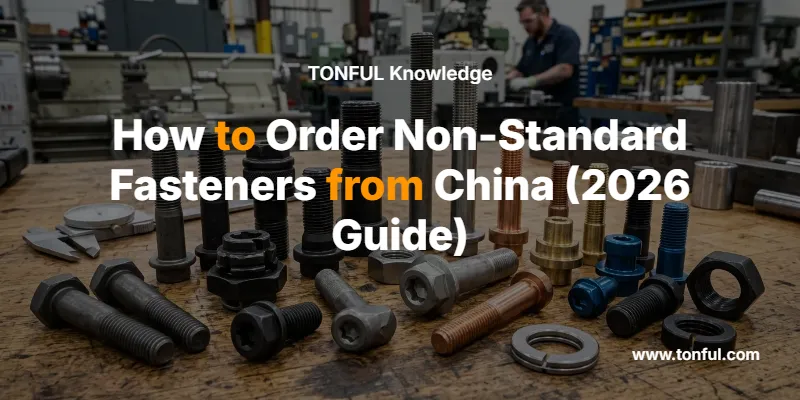
When standard fasteners cannot meet your specific structural, strength, or environmental requirements, non-standard fasteners become the only viable solution. As global manufacturing evolves, China has emerged as the world’s core production hub for custom fasteners, offering integrated solutions from design and engineering analysis to mass production. This comprehensive guide walks you through the entire procurement process for sourcing non-standard fasteners from Chinese manufacturers in 2026.

Understanding Non-Standard Fasteners
Non-standard fasteners are specialized hardware components designed for unique applications where off-the-shelf solutions fall short. Unlike mass-produced standard fasteners optimized for low unit cost and broad availability, non-standard fasteners are build-to-print components manufactured to specific engineering drawings with tight tolerances and custom geometries.
These custom fasteners serve as structural or kinematic elements within assemblies, often functioning as axles, shear pins, precision locators, or flow restrictors. Common applications include extended bolts, ultra-short screws, special head structures, and completely irregular-shaped fasteners for space-constrained scenarios with unique mechanical requirements.
Industries that rely heavily on non-standard fasteners include aerospace, automotive racing, industrial machinery, marine engineering, and custom wire harness assembly applications where precision and durability are critical.

Standard vs. Non-Standard Fasteners: Key Differences
| Aspect | Standard Fasteners | Non-Standard Fasteners |
|---|---|---|
| Geometry | Fixed dimensions, broad tolerance ranges (commercial grade) | Custom geometries, tight tolerances (g6/h6), CNC precision |
| Production Method | High-speed cold heading, mass production | CNC turning, Swiss machining, custom tooling |
| Tolerance Range | ±0.2mm to ±0.5mm typical | ±0.01mm to ±0.05mm achievable |
| Engineering Role | General fastening, clamping force only | Structural/kinematic elements, precision positioning |
| Lead Time | Immediate availability | 2-6 weeks (prototyping), 4-8 weeks (mass production) |
| MOQ | Single units available | Typically 500-5,000 units depending on complexity |
| Unit Cost | $0.05-$0.50 | $0.50-$15.00+ depending on specifications |
| Customization | None | Full design flexibility |
Why Source Non-Standard Fasteners from China?
China’s position as the global fastener manufacturing hub extends beyond cost advantages to encompass a complete industrial ecosystem built over decades.
Complete Process Chain: Chinese manufacturers possess end-to-end capabilities including cold heading, hot forging, CNC turning, thread rolling, and heat treatment. High-strength bolts requiring quenching and tempering can be processed entirely within a single facility, ensuring quality control and faster turnaround times.
International Standards Expertise: Chinese fastener factories have long served European and American markets, making them highly familiar with ISO, DIN, ANSI, JIS, and BS standards. This familiarity reduces communication costs and technical errors during the specification phase.
Advanced Surface Treatment Options: Manufacturers offer industrial-grade surface treatments including zinc plating, nickel plating, chrome plating, black oxide coating, and specialized treatments for corrosion resistance—critical for marine wire harness assemblies and outdoor applications.
Engineering Support: Professional custom fastener manufacturers provide complete engineering support capabilities, from design validation and finite element analysis (FEA) to material selection consultation and assembly optimization.
Material Selection Guide for Non-Standard Fasteners
Selecting the appropriate material is fundamental to fastener performance. Material choice impacts strength, corrosion resistance, temperature tolerance, and overall lifecycle cost.
Material Comparison Table
| Material | Strength Grade | Corrosion Resistance | Temperature Range | Typical Applications | Relative Cost |
|---|---|---|---|---|---|
| Carbon Steel | 4.8, 8.8, 10.9, 12.9 | Poor (requires coating) | -40°C to 400°C | General machinery, industrial equipment | $ |
| Stainless Steel 304 | A2-70 | Excellent | -200°C to 400°C | Food processing, chemical equipment, marine | $$$ |
| Stainless Steel 316 | A4-80 | Superior (molybdenum-enhanced) | -200°C to 450°C | Offshore, high-chloride environments | $$ |
| Brass | Medium | Good | -200°C to 200°C | Electrical connectors, decorative, non-sparking | $$ |
| Titanium (Grade 5) | High | Exceptional | -200°C to 600°C | Aerospace, racing, medical devices | $$$$ |
| Aluminum Alloy | Medium | Good (anodized) | -200°C to 200°C | Lightweight structures, aerospace | $$ |
Carbon Steel: Divided into low, medium, and high carbon grades based on carbon content. Common strength grades include 4.8 and 8.8. Carbon steel fasteners suit general mechanical structures but require surface treatments like galvanizing in humid or corrosive environments.
Stainless Steel: Outstanding in corrosion and oxidation resistance. Grade 316 and 316L contain molybdenum for enhanced corrosion resistance, making them ideal for shipping, chemical equipment, and waterproof wire connector applications in high-humidity or chemically corrosive environments.
Brass: Offers excellent electrical conductivity and corrosion resistance, commonly used in automotive electrical connectors and terminals connectors where both mechanical strength and electrical performance matter.
Titanium: Combines extreme strength, light weight, and superior corrosion resistance. While expensive, titanium fasteners are essential for aerospace applications and high-performance automotive systems where weight reduction is critical.

Technical Specifications and Tolerance Standards
Dimensional tolerances are tightly controlled in non-standard fasteners to prevent failure under extreme stress. Understanding tolerance standards is crucial for creating accurate RFQs and ensuring part compatibility.
Tolerance Standards Comparison
| Standard | Region | Tolerance Class | Typical Range | Application Focus |
|---|---|---|---|---|
| ISO 286 | International | IT6 to IT11 | ±0.01mm to ±0.1mm | General precision engineering |
| DIN 7168 | German/European | Fine, Medium, Coarse | ±0.05mm to ±0.3mm | Mechanical engineering, automotive |
| ANSI B4.1 | United States | Class 1A/2A/3A | ±0.001″ to ±0.010″ | Aerospace, military applications |
| JIS B 0401 | Japanese | Grade 5-7 | ±0.02mm to ±0.15mm | Electronics, precision machinery |
| GB/T 1800 | Chinese | IT6 to IT12 | ±0.01mm to ±0.12mm | Domestic manufacturing |
Critical Tolerance Zones: For non-standard fasteners, pay special attention to thread pitch tolerance, head height tolerance, and shank diameter tolerance. Thread engagement issues often arise from loose length tolerances causing threads to enter the shear plane, leading to premature failure.
Fit Classifications: Understand the difference between clearance fit (loose), transition fit (snug), and interference fit (press) applications. Custom geometries allow for optimized fillet radii to reduce stress concentration factors, extending fatigue life in cyclic loading applications.
For custom CNC turning parts, TONFUL Electric maintains tight tolerances down to ±0.01mm, ensuring precision fit in critical assemblies.

The Complete Ordering Process
Successfully sourcing non-standard fasteners from China requires a structured approach from initial specification to final delivery.
Step 1: Prepare Detailed Technical Drawings
Provide comprehensive 2D or 3D CAD drawings in standard formats (STEP, IGES, DWG, or PDF). Include:
- Complete dimensional specifications with tolerance callouts
- Thread specifications (pitch, class, length of engagement)
- Material grade and heat treatment requirements
- Surface finish specifications (Ra values, coating type, thickness)
- Mechanical property requirements (tensile strength, hardness, yield strength)
- Quantity requirements and delivery timeline
- Special testing or certification needs
Pro Tip: When sourcing custom stainless steel dowel pins or precision components, specify inspection methods (CMM, optical comparator, thread gauges) to ensure quality alignment.
Step 2: Request for Quotation (RFQ)
Submit your RFQ to multiple qualified manufacturers. A complete RFQ should include:
- Technical drawings with all specifications
- Annual volume forecast and initial order quantity
- Target unit price (if applicable)
- Required certifications (ISO 9001, IATF 16949, AS9100)
- Material certifications needed (mill test reports, material composition analysis)
- Delivery terms (FOB, CIF, DDP) and destination port
- Payment terms expectations
- First article inspection (FAI) requirements
Chinese manufacturers typically respond within 24-48 hours with preliminary quotations. For complex custom designs, expect 3-5 business days for detailed engineering review and pricing.
Step 3: Design Review and Engineering Validation
Reputable manufacturers will conduct a design for manufacturability (DFM) review, identifying potential issues:
- Undercuts or features requiring special tooling
- Tolerance stack-up concerns
- Material availability and lead times
- Cost optimization opportunities through design modifications
- Alternative manufacturing methods for cost or quality improvement
This collaborative phase is critical. Manufacturers familiar with custom brake lining rivets or solid vs semi-tubular rivets assembly can provide valuable insights into design optimization.
Step 4: Prototyping and First Article Inspection
Before committing to mass production, request prototypes:
- Rapid Prototyping: CNC machining for 5-50 pieces (1-2 weeks)
- Pilot Production: Small batch using production tooling for 100-500 pieces (2-3 weeks)
Conduct thorough first article inspection (FAI) including:
- Dimensional verification against drawings (100% inspection)
- Material composition testing (spectrometer analysis)
- Mechanical property testing (tensile, hardness, torque)
- Surface finish verification (coating thickness, adhesion)
- Functional testing in actual assembly
Document all findings in a FAI report following AS9102 or equivalent standards.
Step 5: Mass Production and Quality Control
Once prototypes are approved, proceed to mass production. Establish clear quality control protocols:
In-Process Inspection: Statistical process control (SPC) during manufacturing with defined control limits and sampling frequencies.
Final Inspection: 100% visual inspection plus statistical sampling for dimensional and mechanical properties (typically AQL 1.5 or 2.5 depending on criticality).
Testing Standards: Ensure compliance with relevant testing standards such as ASTM B117 for salt spray testing (marine applications), ASTM F606 for mechanical testing of fasteners, or ISO 898 for mechanical properties.
For automotive terminals connectors and related fastening systems, TONFUL Electric implements rigorous quality control aligned with automotive industry standards.
Step 6: Logistics and Delivery
Coordinate shipping logistics based on order volume and urgency:
- Air Freight: 5-10 days, suitable for urgent small batches
- Sea Freight: 20-45 days depending on destination, cost-effective for large volumes
- Express Courier: 3-7 days for samples and small urgent orders
Consider customs clearance requirements, import duties, and documentation needs (commercial invoice, packing list, certificate of origin, material certifications).

Quality Certifications and Compliance
When sourcing non-standard fasteners from China, verify manufacturer certifications to ensure quality and compliance:
Essential Certifications
| Certification | Scope | Industry Relevance | Verification Method |
|---|---|---|---|
| ISO 9001 | Quality management system | All industries | Request certificate copy, verify on ISO website |
| IATF 16949 | Automotive quality management | Automotive tier suppliers | Critical for automotive applications |
| AS9100 | Aerospace quality management | Aerospace and defense | Required for aerospace fasteners |
| ISO 14001 | Environmental management | All industries | Increasingly important for ESG compliance |
| RoHS | Restriction of hazardous substances | Electronics, electrical | Material composition testing reports |
| REACH | Chemical substance regulation | EU market | Compliance declaration required |
Material Certifications: Request mill test reports (MTRs) or material test certificates (MTCs) documenting chemical composition, mechanical properties, and heat treatment records. For critical applications, third-party testing by SGS, TÜV, or Intertek provides additional assurance.
DFARS Compliance: For U. S. defense applications, ensure raw materials originate from approved countries per Defense Federal Acquisition Regulation Supplement (DFARS) requirements.
Similar to CE vs UL certification for electrical terminals, fastener certifications demonstrate compliance with regional safety and quality standards.
Cost Optimization Strategies
Non-standard fasteners carry higher unit costs than standard parts, but strategic approaches can optimize total cost of ownership:
Design Standardization: Where possible, standardize custom fastener designs across multiple products to increase volume and reduce tooling costs.
Tolerance Rationalization: Specify the loosest acceptable tolerances. Moving from IT6 to IT7 tolerance can reduce costs by 15-30% without compromising function in many applications.
Material Substitution: Evaluate whether lower-cost materials with appropriate surface treatments can meet performance requirements. For example, high-strength carbon steel with proper coating may substitute for stainless steel in some applications.
Volume Consolidation: Combine orders across product lines or coordinate with other divisions to achieve better pricing through vendor consolidation.
Long-Term Agreements: Establish annual purchase agreements with volume commitments for 10-20% better pricing and priority production scheduling.
Value Engineering: Work with manufacturers on VAVE wire harness assembly BOM cost reduction principles applicable to fastener design optimization.
Common Pitfalls and How to Avoid Them
Insufficient Specification Detail: Vague or incomplete drawings lead to misinterpretation and costly revisions. Always provide complete dimensional, material, and finish specifications.
Ignoring Cultural and Communication Differences: Time zone differences and language barriers can cause delays. Establish clear communication protocols, use visual aids, and confirm understanding through detailed written summaries.
Skipping Prototype Phase: Proceeding directly to mass production without prototype validation risks expensive tooling investments for potentially flawed designs.
Inadequate Quality Control Planning: Define inspection criteria, acceptance standards, and testing methods upfront. Ambiguous quality expectations lead to disputes and rejections.
Underestimating Lead Times: Custom tooling, material procurement, and production scheduling require realistic timelines. Rush orders incur premium costs and may compromise quality.
Neglecting Intellectual Property Protection: Use non-disclosure agreements (NDAs) and consider design registration in China to protect proprietary designs from unauthorized reproduction.
Frequently Asked Questions
Q: What is the typical MOQ for non-standard fasteners from Chinese manufacturers?
A: Minimum order quantities vary by complexity and manufacturing method. Simple custom fasteners may have MOQs of 500-1,000 pieces, while complex CNC-machined components might require 1,000-5,000 pieces. Some manufacturers offer lower MOQs for prototyping (50-100 pieces) at higher unit costs. Discuss your volume needs during the RFQ phase to find manufacturers aligned with your requirements.
Q: How long does it take to receive non-standard fasteners from China?
A: Total lead time includes prototyping (1-3 weeks), approval and tooling (1-2 weeks), mass production (2-4 weeks), and shipping (1-6 weeks depending on method). Typical end-to-end timeline ranges from 6-12 weeks for first orders. Repeat orders with existing tooling reduce lead time to 3-6 weeks.
Q: Can Chinese manufacturers meet aerospace and military fastener standards?
A: Yes, qualified Chinese manufacturers can produce fasteners meeting NAS, MS, MIL-SPEC, and AS standards. However, verify certifications (AS9100), request material certifications, and ensure DFARS compliance for U. S. defense applications. Third-party testing and inspection provide additional assurance for critical applications.
Q: What surface treatments are available for non-standard fasteners?
A: Chinese manufacturers offer comprehensive surface treatment options including zinc plating (clear, yellow, black), nickel plating, chrome plating, black oxide, phosphate coating, anodizing (for aluminum), passivation (for stainless steel), and specialized coatings like Teflon or Xylan for low-friction applications. Specify coating thickness and salt spray resistance requirements based on your application environment.
Q: How do I protect my custom fastener designs when working with Chinese manufacturers?
A: Implement multiple protection strategies: execute comprehensive NDAs before sharing designs, consider registering design patents in China, work with established manufacturers with reputation to protect, watermark technical drawings, limit distribution of complete specifications to qualified finalists only, and establish clear contractual terms regarding intellectual property ownership and non-compete clauses.
Q: What payment terms are typical for non-standard fastener orders?
A: For first-time orders, expect 30-50% deposit with balance before shipment (T/T payment). Established relationships may negotiate 30-60 day payment terms. Letter of credit (L/C) provides security for both parties on large orders. Prototype orders typically require 100% payment upfront. As trust builds, more favorable terms become negotiable.
Conclusion
Sourcing non-standard fasteners from China offers significant advantages in cost, capability, and customization when approached strategically. Success requires detailed technical specifications, thorough supplier qualification, rigorous quality control, and clear communication throughout the process.
By following this comprehensive guide—from material selection and tolerance specification through prototyping, production, and delivery—you can confidently navigate the complexities of international custom fastener procurement. The key lies in treating your Chinese manufacturing partner as a collaborative engineering resource rather than merely a low-cost supplier.
TONFUL Electric brings decades of experience in precision manufacturing and international B2B partnerships, offering comprehensive solutions from custom wire harness assembly to specialized fastening systems. Our commitment to quality, engineering support, and customer success ensures your non-standard fastener requirements are met with precision and reliability.
For expert guidance on your next non-standard fastener project or to discuss your specific requirements, contact TONFUL Electric’s engineering team today.