
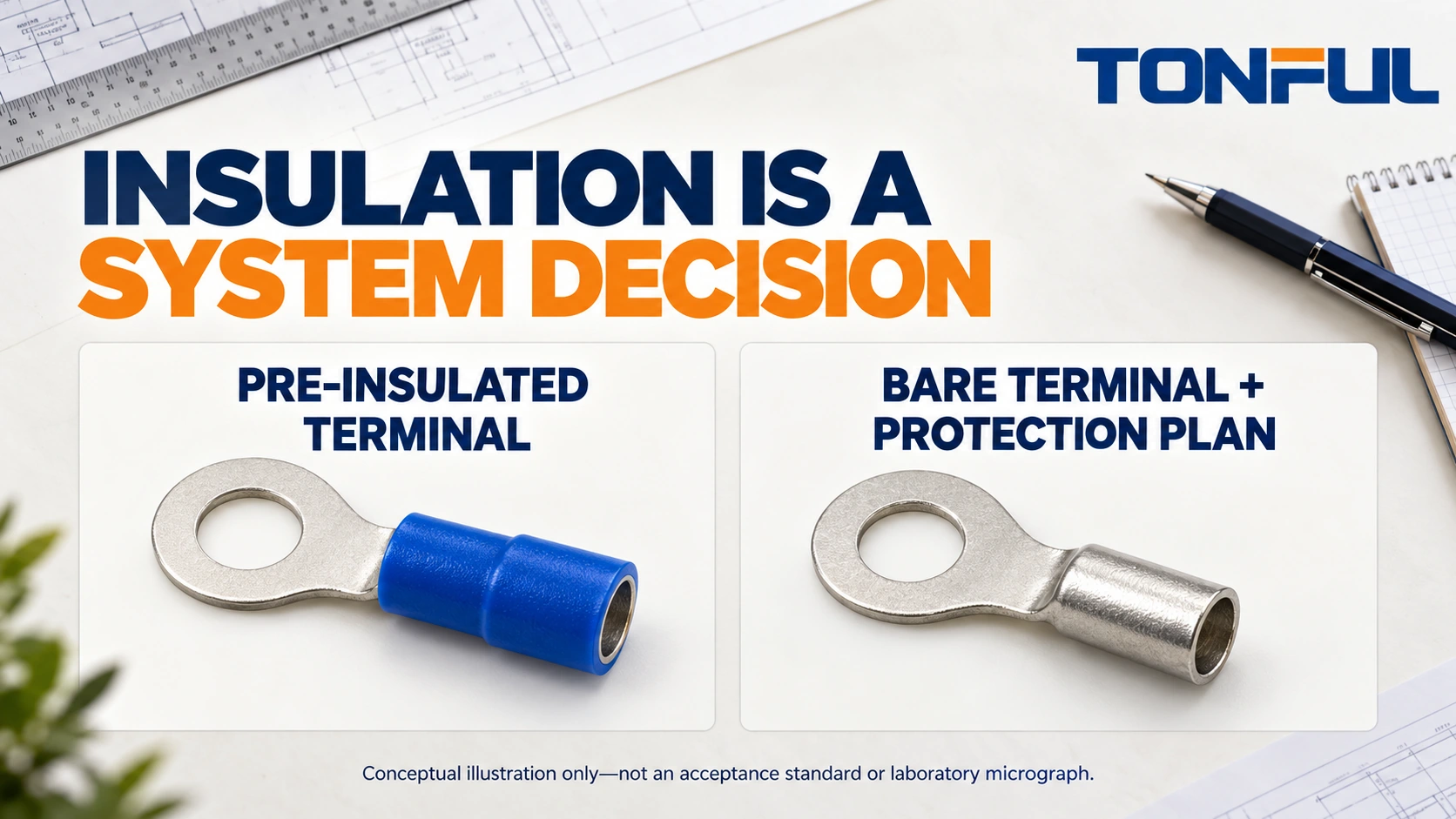
Insulated vs non-insulated terminals is an assembly decision, not a contest between colored plastic and exposed metal. A pre-insulated terminal supplies a sleeve as part of the purchased component. A non-insulated terminal leaves protection to the surrounding design or an additional operation. Neither description establishes the suitability of the completed connection.
Specify the termination by working backward from the connection point, conductor, environment and assembly process. Then decide where insulation belongs and how its presence will be verified. The useful purchasing question is not simply which terminal costs less, but which complete arrangement can be assembled, inspected and maintained against an approved drawing.
Jump to: Protection | Comparison | Tooling | Environment | Release record | Sourcing
Insulated vs Non-Insulated Terminals: Start With Protection
Identify what the sleeve actually covers
On many insulated ring and fork terminals, the sleeve covers the barrel while the tongue remains exposed. That is different from a fully insulated disconnect whose housing also surrounds the mating region. Describe the covered surfaces rather than relying on the word insulated in a purchase order. Ask for an outline drawing showing where the metal remains accessible after installation.
Protection against accidental contact, conductor-to-conductor contact, moisture and abrasion are separate requirements. A barrel sleeve can help separate adjacent barrels without sealing the wire entry or covering a stud. A bare terminal inside a suitable enclosure may fit the design, while a sleeved terminal outside that enclosure may still leave unacceptable exposure. Assess the actual assembly, including covers removed during maintenance.
Insulation is not permission to work live
Perform assembly and inspection with the equipment safely isolated, stored energy controlled and absence of voltage verified by qualified personnel. In applicable US workplaces, OSHA’s electrical work-practice requirements address deenergization, isolation and verification. A colored sleeve does not replace those procedures or make an ordinary crimp tool suitable for energized work.
For a preliminary component shortlist, compare the constructions shown in TONFUL’s nylon-insulated terminal category. Use that category to locate candidate parts, not as evidence that every listed part meets the same electrical, environmental or approval requirements.

Compare the Complete Assembly
Compare equivalent interfaces
Hold the connection point and wire specification constant before comparing prices or assembly times. A ring terminal with a closed barrel and a fork terminal with an open barrel are not equivalent alternatives merely because one has insulation. Compare the same tongue geometry, wire compatibility and attachment arrangement first; otherwise the insulation decision becomes mixed with unrelated design changes.
| Decision factor | Pre-insulated terminal | Non-insulated terminal | Evidence to request |
|---|---|---|---|
| Conductor range | Confirm exact barrel and wire combination | Confirm exact barrel and wire combination | Drawing and application instruction |
| Crimp operations | Follow specified conductor and support operations | Follow specified barrel operations | Tooling instruction, not appearance |
| Tool cavity | Must accommodate the specified sleeve construction | Must match bare-barrel construction | Terminal-to-tool compatibility record |
| Installed envelope | Include sleeve diameter and transition | Include any added boot or tubing | Assembly drawing and trial fit |
| Sealing | Do not assume a standard sleeve seals | Requires a separately defined sealing solution if needed | Complete system documentation |
| Inspection | Sleeve can conceal parts of the barrel | Metal deformation may be more visible | Approved inspection sequence |
| Repair | Replacement may require the same sleeved part | Additional protection may need replacement too | Service procedure |
| Inventory | Terminal carries its insulation variant | Terminal and protection may be separate stock items | Controlled bill of materials |
TONFUL’s non-insulated terminal category is the corresponding starting point for bare constructions. Do not assume that removing a sleeve from an insulated item creates the listed non-insulated equivalent. Barrel dimensions, support features and intended tools can differ between product families.
Count operations rather than declaring a winner
A pre-insulated part can eliminate a separate insulation-installation step, but it may require a different cavity or inspection method. A bare part with tubing adds cutting, positioning and recovery operations when that protection is specified. If a boot is reusable, document whether service personnel may reuse it and how damage is checked. Do not treat reuse as automatic.
For purchasing, build a route sheet containing picking, stripping, crimping, inspection, protection installation and final verification. Add rework disposition and consumables. Measure actual cycle times on the intended line before claiming a productivity advantage. A comparison based on terminal unit price alone hides the cost of separate protection and its control points.
For example, when replacing a sleeved ring with a bare candidate inside an enclosed assembly, review the enclosure protection and the manufacturing route separately. The enclosure may address access while the changed barrel still needs another tool or inspection sequence. Record each changed item and its approval reference. This is a hypothetical review example, not evidence of cost savings or permission to substitute the part.
Match the Wire and Tooling
Wire range does not describe every wire
Record conductor material, nominal cross-section, strand construction and insulation outside diameter. Two wires with the same nominal conductor area can enter a sleeve differently because their insulation and strand construction differ. The barrel must accept the conductor, while any insulation support must match the outside jacket. Do not reduce the conductor by trimming strands to obtain insertion.
Color is a picking aid only after the product system has been identified. It is not a universal wire-size standard across suppliers and terminal families. Keep the part number, marked range and approved wire list visible in the work instruction. If inventory is repacked into bins, carry that identification forward rather than retaining only a color label.
Specify the cavity and orientation
A cavity intended for one insulated construction may damage another sleeve or produce the wrong metal deformation. Likewise, a bare-terminal die is not automatically appropriate for every non-insulated barrel. Nichifu’s terminal handling guidance explicitly distinguishes tooling for insulated and non-insulated terminals. Use that as manufacturer context, not approval of a TONFUL combination. Specify tool model, die or cavity identification, locator where required, orientation and completion method. A ratchet indicates a tool mechanism; it does not prove compatibility with the component.
Use TONFUL’s crimping-tool information to frame a compatibility request. Ask for the matching terminal instruction and approved wire combination rather than selecting a tool solely from handle color or a broad advertised size range. Keep strip length and inspection criteria tied to the chosen part and tool.
Keep ferrules in their own selection path
A ferrule collar and a ring-terminal sleeve do not perform identical jobs. A ferrule prepares a conductor end for a compatible clamping terminal; it is not a stud tongue or a general-purpose splice. If the destination is a terminal block, review the cord-end terminal family and the receiving terminal’s instructions before carrying ring-terminal assumptions into the design.
Check the Installed Environment
Draw the space around the connection
Check adjacent terminals, barriers, fastener access, wire bend direction and the enclosure cover. A sleeve that fits an isolated bench sample may interfere with a neighboring pole or prevent a cover from closing. A bare barrel with later-added protection can also become wider or longer than expected. Review the finished envelope, not only the metal drawing.
Inspect service access as well as initial installation. Ask whether a technician can identify the wire, operate the fastener and restore protection without pulling on the conductor. Where the wiring must flex near the terminal, provide an appropriate support and routing design; do not expect the sleeve itself to absorb every cable movement.
Define exposure without inventing a rating
List temperature conditions, fluids, condensation, washdown, contaminants, vibration and access by personnel. Obtain product-specific evidence for the relevant material and exposure. A generic claim about nylon, PVC or heat shrink does not establish the rating of a particular terminal assembly. Neither a bare nor an ordinary pre-insulated terminal should be described as waterproof without applicable evidence.
If a separately applied protective sleeve is proposed, review overlap, installed position, compatibility and inspection access as a system. Do not borrow an ingress rating from an unrelated enclosure or tubing datasheet. Where an applicable equipment standard sets spacing or insulation requirements, have the responsible designer apply that standard to the actual arrangement.
Decide when the alternative is preferable
Pre-insulated parts are candidates when the specified sleeve fits the process and installed protection plan. Bare terminals are candidates where the equipment supplies suitable guarding, where another approved protection arrangement is required, or where direct access to the barrel is needed during manufacture. These are selection prompts, not automatic approvals or evidence of superior reliability.
Build a Specification Release Record
Make substitution review executable
Use a short release record for each termination family. Populate it with actual document references; blank fields mean the selection is unfinished. The record below is an editorial template, not a mandatory standard or a report of completed testing.
| Release field | Information to enter | Substitution trigger |
|---|---|---|
| Electrical interface | Equipment connection and permitted terminal geometry | New stud, clamp or barrier |
| Terminal identity | Manufacturer, part number and drawing revision | Supplier or construction change |
| Conductor | Wire part, size, material and strand construction | New wire source or construction |
| Insulation fit | Outside diameter and permitted support arrangement | Jacket or sleeve change |
| Process | Tool, cavity, strip instruction and operation sequence | Tooling or location change |
| Protection | Covered surfaces and assembly protection reference | Boot, sleeve or enclosure change |
| Verification | Inspection instruction and qualification reference | New acceptance document |
| Authorization | Engineering and quality signoff, date and owner | Unresolved deviation |

Stage inspection before protection hides evidence
Where later-applied insulation covers the crimp, define which visual and dimensional checks occur beforehand. Then define the final checks after protection is installed. These stages answer different questions: one examines the termination, while the other confirms coverage, position and freedom from interference. Photographing a finished sleeve cannot substitute for evidence of the concealed crimp.
Qualification should address the actual wire-terminal-tool combination and the installed environment under the applicable plan. Do not copy universal pull-force, crimp-height or temperature limits into a purchasing comparison. Record the governing document and let the responsible engineering team specify samples, methods and acceptance criteria. Resolve conflicts between supplier and customer instructions before production starts.
Source the Approved System
Turn the decision into a complete inquiry
Send the candidate terminal drawing, wire details, connection-point dimensions, protection requirement and intended tooling to TONFUL. Include photos or a drawing of nearby barriers and the cover where space is tight. Explain whether the assembly is new production or a service replacement; repair constraints can change what is practical even when the electrical interface is unchanged.
Ask TONFUL’s wire-terminal sourcing team to identify suitable candidates and the documents needed to evaluate them. Request part-specific evidence for any required ratings or approvals, and confirm that the proposed tool applies to the chosen construction. Release the terminal, protection and work instruction together so purchasing does not substitute one item while leaving the rest of the system unchanged.