
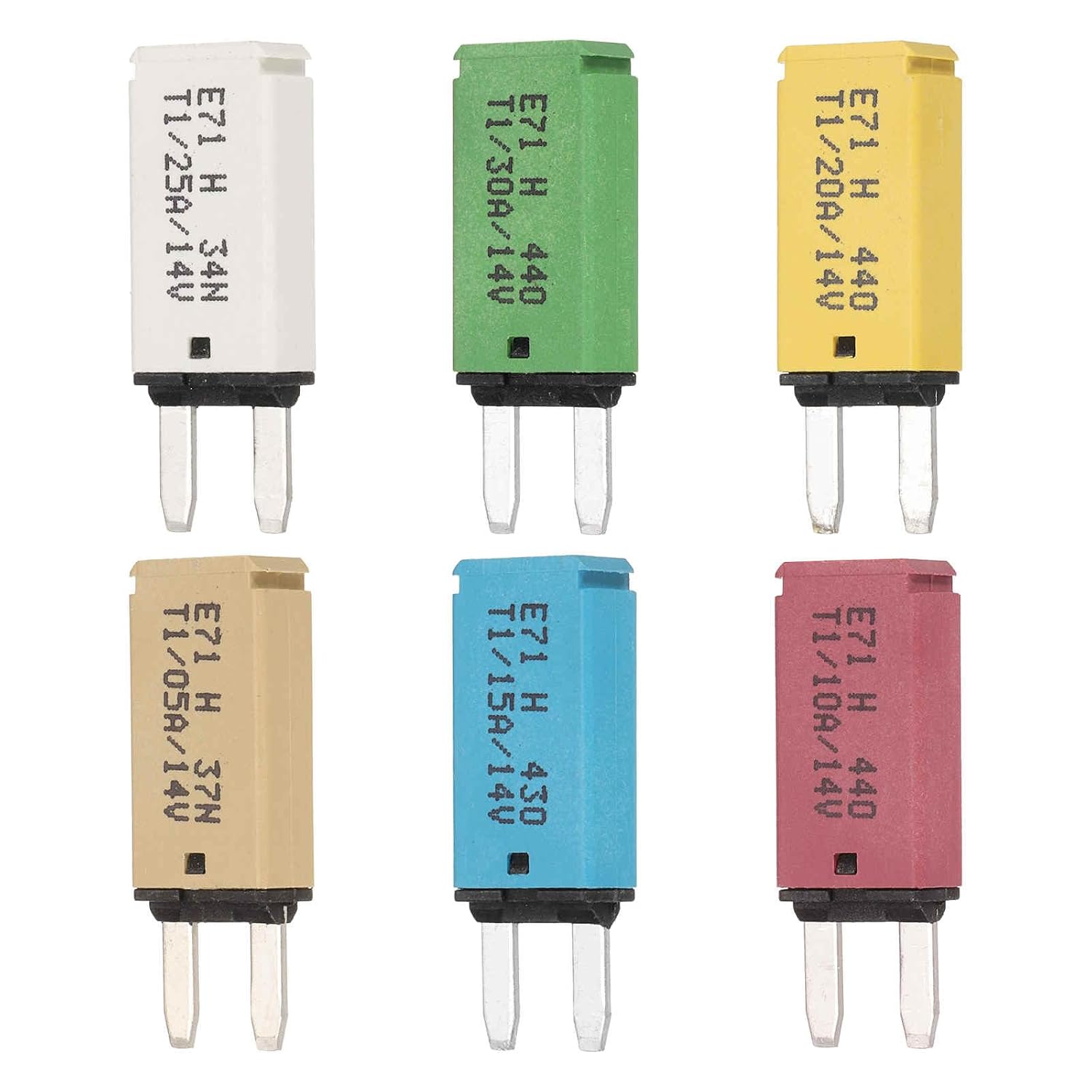
MINI · ATC · UCB/FCB/CBB footprints
TONFUL ELECTRIC / AUTOMOTIVE CIRCUIT PROTECTION
Automotive Blade Circuit Breakers Manufacturer
Source plug-in thermal circuit breakers for automotive fuse blocks in Type I automatic, Type II modified and Type III manual reset configurations. Compare MINI, ATC and related blade footprints by current rating, system voltage and fault-reset behavior.
Share the existing part number, fuse-block geometry, required amperage and vehicle system voltage. TONFUL will use those details to discuss model selection, samples, documentation and a quotation.
3 reset behaviors
Type I automatic, Type II modified and Type III manual reset options.
Multiple blade footprints
MINI, ATC and related 280-type fuse-block configurations.
3A–30A listed families
Current and voltage limits must be confirmed for the selected model.
PRODUCT RANGE
Automotive blade circuit breaker families
The catalog page groups the products by footprint and reset behavior. Select by the complete electrical and mechanical specification rather than by housing color or appearance alone.
MINI / 280-Type Footprint
Models: E71, E72, E73, E77, E78 and E7D.
The listed family includes automatic, modified and manual reset constructions, plus a diode-integrated option. Published families cover 5–30A selections, with 14V DC and 28V DC ratings assigned by model group. Verify the exact footprint, centerline spacing and diode requirement before ordering.
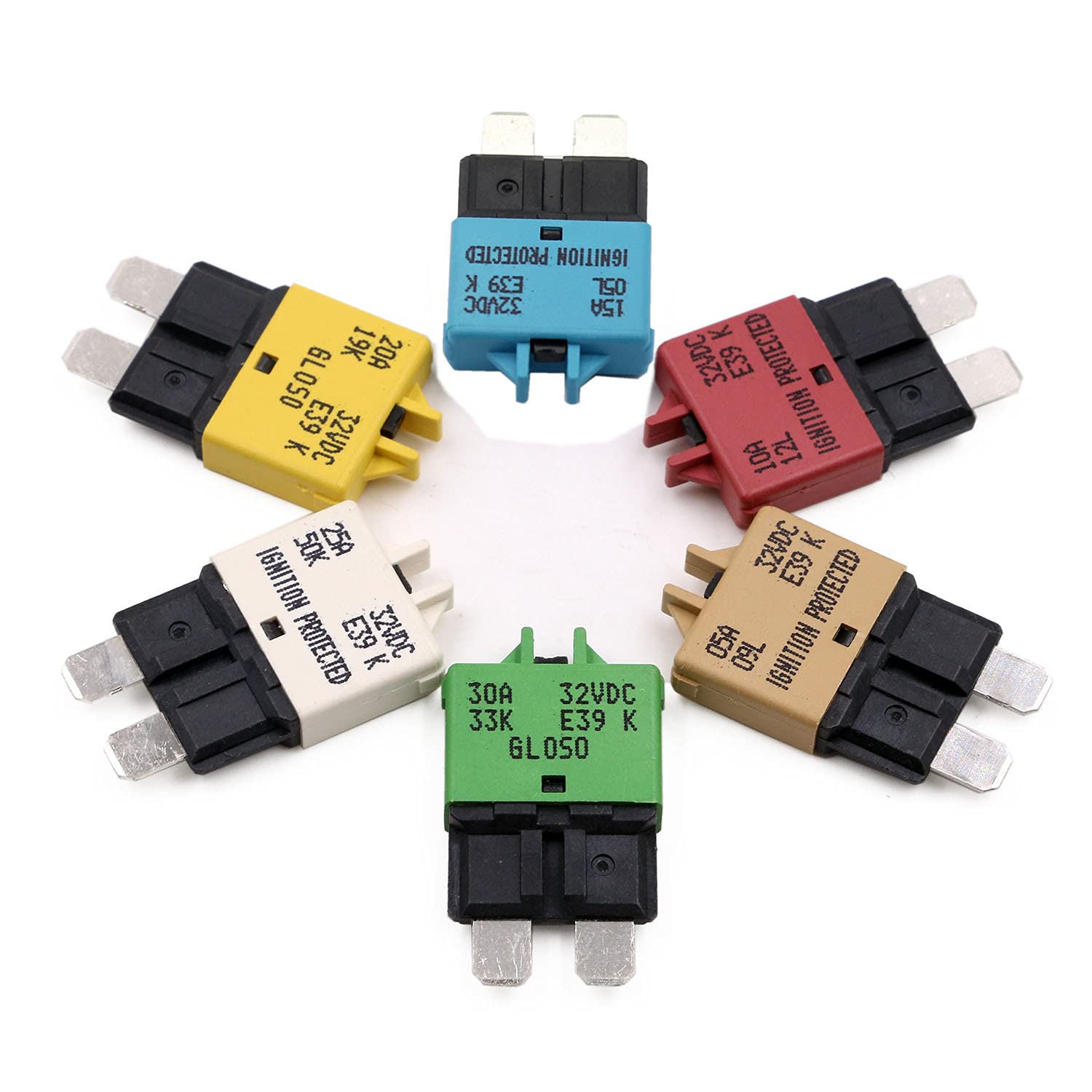
ATC / 227 Footprint
Models: E37, E38 and E39.
This group provides Type I automatic, Type II modified and Type III manual reset versions. The catalog lists a 3–30A range at 28V DC, with a 32V option. It also identifies 5.2mm blades for ATC-type fuse blocks. Confirm the chosen rating, test conditions and fuse-block fit in the final drawing.

UCB / FCB / CBB and ATC Options
Models: E311, E312, E32, E87, E88 and E89.
The group combines related plug-in formats with automatic, modified and manual reset choices. The catalog lists 5–30A families with 14V DC or 28V DC ratings depending on the model. Terminal construction and dimensional compatibility must be checked against the target fuse block.
RESET BEHAVIOR
Choose Type I, Type II or Type III by fault response
The reset type controls what happens after an overcurrent opens the circuit. This choice affects service access, automatic re-energization and fault investigation.
Type I — Automatic Reset
The breaker can cool and reconnect automatically. If the fault remains, cycling may continue. Use it only where automatic re-energization is acceptable under the equipment specification.
Type II — Modified Reset
The breaker opens under overcurrent and is designed to avoid continuous cycling. The exact reset condition depends on the model and system; confirm the datasheet before defining the service procedure.
Type III — Manual Reset
The breaker remains open until an operator resets it. The installation needs safe physical access, and the fault should be investigated before power is restored.
Reset type does not determine the correct amperage, voltage rating or interrupting capacity. Those parameters must be selected independently from the circuit and protection requirements.
QUICK SELECTION
Compare the listed blade circuit breaker families
This table is a sourcing guide derived from the supplied catalog page. The approved quotation, drawing and model-specific datasheet should control the final order.
| Family | Models | Reset Types | Published Current / Voltage | Footprint / Terminal | Key Confirmation |
|---|---|---|---|---|---|
| MINI / 280 | E71, E72, E73 | I / II / III | 5–30A; 14V or 28V DC by group | 280-type; 8.1mm listed centerline | Match model, voltage and reset behavior |
| MINI variants | E77, E78, E7D | I / II / diode option | 5–30A listed for E77/E78 group | MINI-style blade footprint | Confirm diode polarity and electrical specification |
| ATC / 227 | E37, E38, E39 | I / II / III | 3–30A at 28V DC; 32V option listed | 5.2mm blades; ATC-type block | Confirm optional rating and test evidence |
| UCB / FCB / CBB | E311, E312, E32 | I / II | 5–30A at 14V DC listed | 280-type; terminal option | Verify retention and dimensional fit |
| ATC alternatives | E87, E88, E89 | I / II / III | 5–30A; 14V or 28V DC by model | ATC-style footprint | Verify voltage assignment for each model |
The catalog shows different interrupting-capacity values for different groups and current ratings. Do not apply a maximum value from one model to every breaker in the range. Request the model-specific test conditions when interrupt rating is a design requirement.
COLOR IDENTIFICATION
Use color as an identification aid
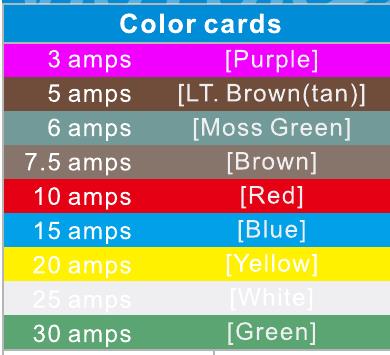
The ATC catalog color guide covers 3A purple, 5A light brown/tan, 6A moss green, 7.5A brown, 10A red, 15A blue, 20A yellow, 25A white and 30A green.
Do not select by color alone. Check the printed rating, model code, voltage rating and datasheet. Similar colors can appear differently under lighting, printing or material variations, and other product families may use a different marking system.
CIRCUIT BREAKER OR FUSE?
A compatible footprint is only one part of the decision
A blade circuit breaker can offer reset capability after a trip, while a conventional blade fuse is replaced after operation. The correct choice depends on the vehicle specification, fault response, interrupt rating, thermal behavior and service strategy.
Reset and service
A breaker follows its Type I, II or III reset behavior. A conventional fuse uses a one-time melting element and normally requires replacement after clearing a fault.
Mechanical compatibility
Blade width and nominal footprint are not enough. Check centerline spacing, body clearance, insertion depth, retention and heat effects in the target fuse block.
Electrical coordination
Confirm operating current, conductor protection, system voltage, fault current, trip behavior and the equipment maker’s requirements. Never increase amperage simply to stop nuisance trips.
For one-time fuse sourcing, review TONFUL’s automotive blade fuse range. For a breaker substitution, provide the original device data and fuse-block information for review.
SELECTION WORKFLOW
Six inputs for a useful circuit breaker inquiry
A model number alone may not describe the actual duty. Send the electrical, mechanical and documentation requirements together so the proposed part can be reviewed as a system component.
01 / System voltage
Identify the normal and maximum system voltage. A product listed for one DC voltage should not be assumed suitable at a higher voltage.
02 / Circuit requirement
Provide load current, wire size, inrush behavior and the protection objective. The breaker must protect the intended circuit under the governing vehicle or equipment specification.
03 / Reset behavior
Choose Type I, II or III based on whether automatic re-energization, power-cycle reset or manual intervention is acceptable.
04 / Footprint and terminals
Confirm MINI, ATC or related 280-type geometry, blade width, centerline spacing, insertion depth and body clearance.
05 / Fault and trip data
Check interrupt rating, overload trip behavior, ambient conditions and any required trip curve. Use model-specific data rather than a family maximum.
06 / Qualification records
Define the applicable standards, reports, drawings, material declarations and validation evidence required by your customer or application.
APPLICATION REVIEW
Where plug-in blade breakers may fit
Passenger and commercial vehicles
Fuse-block circuits where the approved electrical architecture permits a resettable thermal breaker and the selected footprint fits the block.
RV and caravan systems
Low-voltage accessory and distribution circuits that need a defined reset strategy, accessible service and model-specific voltage and interrupt ratings.
Motorcycle, ATV and utility equipment
Compact blade-footprint circuits where vibration, moisture, enclosure and service access are included in the qualification plan.
Automotive wire harnesses
Harness programs requiring controlled part numbers, blade geometry, marking, traceability and documented compatibility with the intended holder.
Construction and agricultural equipment
Vehicle-based DC circuits that require an appropriate current rating and fault response under the equipment manufacturer’s specification.
Aftermarket fuse-panel service
Cross-reference projects where the original footprint, voltage, amperage, reset behavior and fault rating can be verified before substitution.
Application names do not establish approval. Ignition-protection, ingress-protection or compliance claims should be tied to the exact model and supporting report.
QUALITY & DOCUMENTATION
Define the evidence required for the selected model
A buyer should connect every important rating to a part number, test condition and acceptance source. Discuss the following items before samples or bulk orders are approved.
Dimensional and visual checks
Confirm blade dimensions, centerline spacing, housing size, polarity or diode marking, reset-button identification and current-rating marks against the drawing.
Electrical and trip verification
Define the test current, ambient condition, trip behavior, voltage drop or contact resistance, temperature rise and interrupt-test requirement for the project.
Documents and traceability
Request the applicable datasheet, dimensional drawing, available trip data, material declarations, model-specific test reports and batch-identification method.
The supplied catalog references SAE J553, SAE J1171, RoHS and, for some groups, TÜV. These references should appear on the public page only with model-specific evidence and scope confirmation.
OEM & CROSS-REFERENCE
Build the quotation around the exact product requirement
Cross-reference review
Send the original part number, photos, drawing and application data. A similar shape is not proof of electrical, thermal or dimensional interchangeability.
Marking and packaging
Discuss current-rating marks, labels, barcodes, blister or carton packing, assortment quantities and private-label artwork. Availability is confirmed in the quotation.
Engineering changes
Changes to amperage, trip behavior, diode configuration or internal construction require engineering review and appropriate validation, not only a label change.
For faster review, include target annual volume, destination, sample quantity, packaging format and the list of documents your customer requires.
BUYER QUESTIONS
Frequently asked questions
Can a blade circuit breaker directly replace an automotive fuse?
Only when the vehicle or equipment specification permits it and the electrical and mechanical requirements match. Check footprint, voltage, current, interrupt rating, trip behavior, body clearance and holder compatibility.
What is the main difference between Type I, II and III?
Type I resets automatically after cooling, Type II uses a modified reset behavior intended to avoid continuous cycling, and Type III requires manual reset. Confirm the exact model procedure in its datasheet.
How should I choose the amperage?
Use the circuit design, conductor protection requirement, normal load, inrush and applicable specification. Do not select a higher value simply because the original protection device trips.
Are all models suitable for 28V or 32V systems?
No. The supplied catalog assigns different voltage ratings to different model groups. The selected model and quotation must explicitly state the applicable voltage rating.
What information is needed for a cross-reference?
Send the original model, amperage, voltage, reset type, dimensional drawing, fuse-block details, interrupt rating, trip data and required approvals or test reports.
Can I request samples and private-label packaging?
Include the required models, ratings, quantities, destination and packaging brief in the inquiry. Sample, branding, minimum quantity and delivery terms are confirmed with the quotation.
REQUEST A QUOTE
Share the circuit and fuse-block requirements
Send the footprint, current, voltage, reset type and existing part number. Those details let the sales and product team discuss the relevant models, sample availability and documentation.
Helpful files to prepare: original datasheet, fuse-block drawing, product photos, trip requirements, packaging artwork and required report list.