
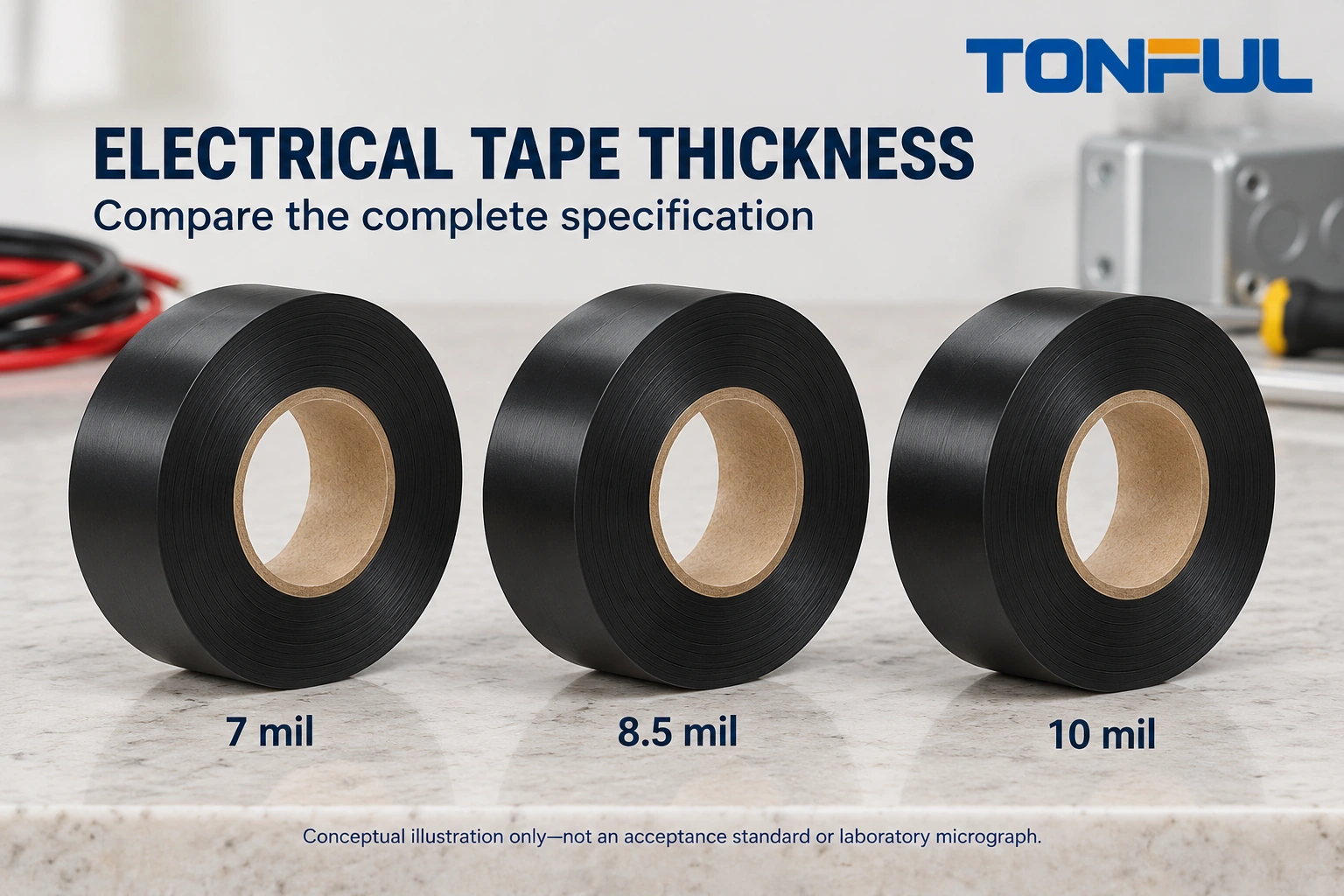
Seven-mil, 8.5-mil and 10-mil electrical tapes describe nominal thickness options, not three universal safety grades. A thicker roll is not automatically suitable for a higher voltage, a wet location or an engine compartment. The exact construction, product documentation and installed application must support those uses.
Thickness still matters. It influences how tape builds around a joint, conforms to contours and fits inside an enclosure. The practical decision is to choose the documented tape that meets the application with a repeatable wrapping process, rather than buying the thickest material available.
Contents:
- Understand Electrical Tape Thickness
- Compare 7, 8.5 and 10 mil Options
- Evaluate the Installed Wrap
- Verify Samples and Incoming Rolls
- Compare Cost and Control Substitutions
- Prepare a TONFUL Tape Specification
Understand Electrical Tape Thickness
What a mil means
A mil is one thousandth of an inch. It is not a millimeter. Because one inch equals 25.4 mm, one mil equals 0.0254 mm. The following conversions are mathematical equivalents of the nominal values, not measurements of a particular roll.
| Nominal thickness | Equivalent inches | Equivalent millimeters | Information still needed |
|---|---|---|---|
| 7 mil | 0.0070 in | 0.1778 mm | Product tolerance and thickness definition |
| 8.5 mil | 0.0085 in | 0.2159 mm | Product tolerance and thickness definition |
| 10 mil | 0.0100 in | 0.2540 mm | Product tolerance and thickness definition |
Suppliers may round these values in catalogs. A rounded metric label does not establish the allowable production tolerance. For incoming inspection, use the nominal value, tolerance, measurement method and conditioning specified for the exact product, rather than rejecting material against an unagreed conversion precision.
Identify what is included
Confirm whether a datasheet describes backing thickness, adhesive thickness or total tape thickness. Comparing one product’s backing alone with another product’s total construction can produce a false purchasing conclusion. Also distinguish the roll’s outside diameter from the thickness of an individual tape layer.
The 3M vinyl electrical tape selection guide discusses properties such as elongation, elasticity and dielectric performance alongside product selection. It illustrates why thickness should be reviewed with other characteristics. Those products’ claims do not establish the performance or approval of a TONFUL candidate.
For a broader explanation of material families and uses, consult TONFUL’s electrical tape guide. This comparison concerns nominal vinyl-tape thickness options; rubber splicing tapes, mastics and other constructions require their own application instructions.
Compare 7, 8.5 and 10 mil Options
Use thickness as a design input
Within a suitably comparable construction, thinner tape can offer a lower-profile wrap, while thicker tape can add material with each turn. However, backing formulation, adhesive, width and stretch behavior can change the result. Do not turn those tendencies into guaranteed rankings across unrelated products.
| Option | Reason to investigate it | Main review question | What the label does not prove |
|---|---|---|---|
| 7 mil | Limited space or detailed contours | Can the specified wrap deliver the required protection? | Universal conformability or electrical suitability |
| 8.5 mil | A different build and handling balance | Does the actual product improve the approved process? | Automatic equivalence to another professional tape |
| 10 mil | More nominal material per layer | Will build, handling and enclosure clearance remain acceptable? | A higher circuit-voltage rating or waterproof joint |
Treat the middle option as a candidate, not an automatic compromise. A particular 8.5-mil tape might meet the job well, but its suitability must come from its own data and installation trial. The same discipline applies to both thinner and thicker alternatives.
Separate protection from product claims
Electrical insulation, protective overwrapping, identification and harness bundling are different functions. State the intended role before comparing products. A tape used as an outer jacket may not be the material providing the underlying electrical insulation or environmental seal.
Do not calculate an allowable circuit voltage by multiplying a laboratory dielectric-strength value by nominal tape thickness or wrap count. A material test and an installed insulation system have different boundaries. Use the product’s stated application scope and the equipment’s requirements.
Likewise, thickness does not demonstrate flame behavior, outdoor suitability, chemical resistance or storage life. Request the applicable evidence for the exact construction and market. A black color, familiar roll size or certification symbol in a sales brochure cannot replace a model-specific document.
Evaluate the Installed Wrap
Account for overlap and stretching
Installed build depends on overlap, number of passes, tape tension, stretch, contour and the starting substrate. An unstretched thickness measurement cannot tell you the final outside diameter of every wrapped joint. Local overlaps and transitions can create higher spots than a simple layer-count estimate suggests.
Use a trial representing the actual geometry. Record tape width, preparation, wrapping instruction, overlap and termination method. Inspect clearance with the cover, routing clips and neighboring conductors in place. A neat open-bench sample may interfere with the completed enclosure.
Do not prescribe a universal overlap or stretch percentage from this comparison. The selected tape and system instructions govern. Stretching more aggressively to make a thicker tape behave like a thinner one can change its dimensions and adhesion behavior without demonstrating an acceptable installation.
Check surfaces and end termination
Surface contamination, moisture and an unsuitable installation temperature can undermine a wrap even when thickness is correct. Follow the product’s cleaning and application instructions, including restrictions on solvents or substrate materials. Do not assume that extra turns compensate for an unprepared surface.
A lifted tape end is a different investigation from inadequate bulk thickness. TONFUL’s tape flagging causes and prevention guide addresses related handling and adhesion questions. Check wrapping technique, end tension, contamination and storage condition before changing thickness as an unverified remedy.
When a connection needs a specified sealed sleeve or another protection architecture, compare that requirement directly. The electrical tape versus heat-shrink selection guide helps distinguish access and process tradeoffs. Neither material name automatically establishes a waterproof assembly.
Maintain the repair safety boundary
Work on electrical insulation belongs within the equipment’s authorized repair procedure. Qualified personnel should isolate all relevant supplies, verify the safe state and address stored energy before exposing conductors. This article is not permission to wrap a live or damaged connection.
Burning, melted insulation or recurring overheating requires investigation of the connection and load. Adding thicker tape can hide evidence without correcting the fault. Follow the equipment manufacturer’s repair or replacement instructions, and do not modify certified or safety-related assemblies through an informal tape substitution.
Verify Samples and Incoming Rolls
Define a usable inspection method
Agree the sampling plan before inspection: lots represented, rolls selected, locations within a roll, conditioning and any destructive specimens. There is no universal sample quantity for every supplier or application. Identify the document authorizing the plan and who may approve exceptions.
Specify a suitable thickness instrument, range, resolution, accuracy and calibration status. The contact geometry, applied pressure and method can affect a compressible adhesive-backed specimen. Follow the agreed procedure rather than squeezing tape between arbitrary caliper jaws and treating the result as a contractual acceptance test.
Record the test environment and specimen handling. Avoid folds, trapped debris or stacked layers unless the method specifically requires them. Establish invalid-test and retest rules in advance, so a damaged specimen can be distinguished from an actual out-of-tolerance result.

Keep dimensions and application evidence separate
Thickness inspection establishes one dimensional characteristic. Depending on the requirement, adhesion, elongation, unwind behavior, aging, electrical performance or environmental evaluation may also be relevant. Define their methods and acceptance sources separately; a thickness pass cannot substitute for those results.
For an installation trial, retain the tape lot, substrate, preparation, instruction revision and operator details. Compare initial condition with any required aged condition using a defined exposure and recovery sequence. A brief demonstration on a clean cable is not evidence of unrestricted outdoor service life.
| Record field | Required entry |
|---|---|
| Product identity | Exact tape model, construction, color and revision |
| Lot and sampling | Supplier lot, roll IDs, selected locations and rationale |
| Thickness definition | Total or backing thickness, nominal and tolerance |
| Method and equipment | Procedure, instrument, pressure conditions and calibration |
| Conditioning | Temperature, humidity, duration and specimen preparation |
| Measurements | Individual readings, units and authorized calculation |
| Application trial | Substrate, wrapping instruction, installed envelope and observations |
| Acceptance | Requirement source, exceptions, disposition, reviewer and date |
Compare Cost and Control Substitutions
Compare accepted jobs, not roll price alone
Roll price is meaningful only with verified width, usable length, construction and the approved process. Compare material consumed per accepted job, labor, inspection, scrap and rework. A thicker tape may change turns or handling, but do not assume fewer wraps are permitted without reviewing the application instruction.
A practical model is: cost per accepted job equals allocated tape cost plus application labor, inspection and incremental rework. Keep the same cost boundary for each candidate. Do not count rejected material twice if material consumption already includes production scrap.
Validate claimed labor savings with a representative trial. Identify geometry, operator experience, tools and the number of accepted assemblies. Purchasing should not turn one faster demonstration into a universal efficiency promise for every line.
Release a controlled change
For a substitution, compare exact product identities, thickness definition, adhesive, backing, width, roll length, documentation and wrapping instructions. Record which existing evidence remains applicable and which requirements need renewed review. A shared nominal thickness does not make two tapes interchangeable.
Control the implementation date, labels, remaining stock and work-instruction revision. Train operators if handling changes. Preserve lot traceability so a later flagging or clearance complaint can be connected to the material actually installed, rather than a generic description such as black electrical tape.

Prepare a TONFUL Tape Specification
Send the nominal thickness and tolerance together with the required construction, width, usable length, color, substrate and application role. Include installation and service environments separately, required documentation, sampling expectations and the wrapping process that the sample must support.
TONFUL’s electrical tape manufacturing page provides a starting point for discussing candidate products and packaging. Confirm the exact offered model and supporting data rather than transferring another manufacturer’s ratings or assuming every listed thickness is available in every construction.
Choose 7, 8.5 or 10 mil only after the part and process requirements align. A useful RFQ ends with an identified tape, an agreed inspection method and a documented application trial. That combination provides a stronger purchasing basis than thickness, roll price or appearance alone.
Share the specification and required sample evidence through TONFUL’s project enquiry page to keep the quotation and engineering review tied to the same requirement.