
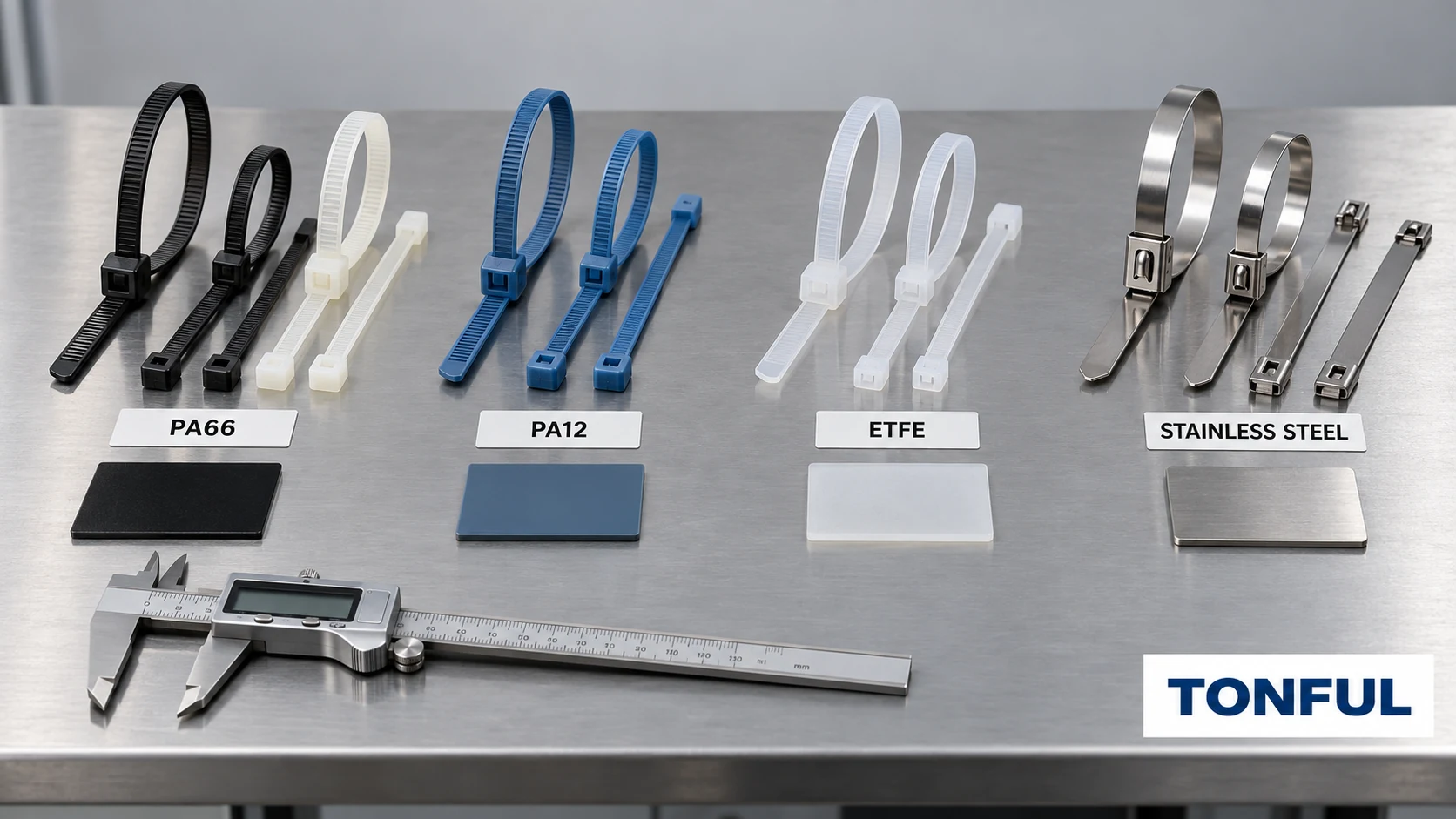
Cable tie material names are useful starting points, but they are not complete specifications. Two products described as PA66 can use different resin grades, stabilizers, pigments, conditioning processes and locking geometry. “ETFE” does not prove that a finished tie has the same properties as a film or another molded part. “Stainless steel” does not identify the alloy, coating or corrosion environment.
This guide compares PA66, PA12, ETFE and stainless steel for engineering and sourcing decisions. The goal is to identify the evidence needed for a finished cable tie, not to publish universal temperature, life or strength values that may not apply to the selected product.
Material Selection at a Glance
| Material family | Typical reason to consider it | Main variables to verify | Common selection error |
|---|---|---|---|
| PA66 | General-purpose molded ties with broad design availability | Grade, moisture condition, UV/heat stabilization, color and geometry | Treating all nylon 66 ties as equivalent |
| PA12 | Lower moisture uptake and dimensional stability needs | Exact grade, additives, low-temperature behavior, UV and chemical evidence | Assuming PA12 is automatically superior in every property |
| ETFE | Demanding chemical, radiation, temperature or electrical environments | Resin grade, molding process, product tests and application-specific exposure | Transferring raw-resin or film data directly to a tie |
| Stainless steel | Heat, weather, fire context, corrosion or high mechanical demand | Alloy, lock, edge, coating, galvanic contact and tool | Calling every metal tie “316” or “corrosion proof” |
The IEC 62275 scope includes metallic, non-metallic and composite cable ties and associated fixing devices. It provides a standards context for product requirements and tests, but the exact edition, classification and evidence must match the purchased item and installation.
PA66 Cable Ties
Why PA66 Is Widely Used
Polyamide 66 can be injection molded into a one-piece strap, teeth, pawl and head, supporting many lengths, widths, colors and mounting designs. Its balance of flexibility, locking performance and manufacturing efficiency makes it a common choice for harnesses, equipment, packaging and general industrial routing.
PA66 is hygroscopic. Moisture can change dimensions and mechanical behavior, so the conditioning state matters when comparing test results or incoming lots. A dry, recently molded tie can behave differently from a conditioned product. The specification should identify the state used for dimensional inspection, loop testing, packaging and release.
The cable tie moisture and storage guide explains why sealed packaging, storage history and conditioning controls affect nylon ties. Do not invent one moisture target for every product; use the resin, drawing, process and approved test plan.
Stabilizers and Color
Natural or black color does not by itself establish indoor or outdoor suitability. UV stabilizers, heat stabilizers, pigments and other additives can affect performance. Require the exact material designation and product evidence. If recycled content, regrind or a resin change is permitted, define limits and validation rather than relying on appearance.
PA66 can be an efficient choice when the documented environment is controlled, the bundle benefits from a flexible polymer strap and the project can manage conditioning. It should not be selected for severe chemicals, heat or long outdoor exposure without specific evidence.
PA12 Cable Ties
Moisture and Dimensional Stability
PA12 is a long-chain polyamide considered when lower moisture uptake, flexibility or dimensional stability is valuable. Arkema’s official PA12 material overview describes lower water absorption relative to shorter-chain polyamides such as PA6 or PA66. That supports the material-selection principle, but it does not certify any cable tie made from PA12.
The finished tie still depends on resin grade, additives, color, molding, tooth and pawl design, conditioning and test method. A supplier should provide the material declaration and product-specific evidence. Do not copy values from a PA12 tubing, film or generic resin brochure into a cable-tie specification.
Where PA12 Can Add Value
PA12 can be considered for humid, outdoor or low-temperature applications where stable geometry and flexibility are important. The decision should include UV exposure, chemicals, required loop strength, installation tension and aging. The existing nylon 6/6 versus nylon 12 solar guide provides an application-focused comparison.
Higher material cost does not automatically mean lower lifecycle cost. Compare expected service, failure consequences, qualification, installation and supply continuity. A PA66 product with adequate documented stabilization may be appropriate in one application, while PA12 may reduce risk in another.
ETFE Cable Ties
Specialty Fluoropolymer Use
ETFE is considered for combinations of chemical exposure, temperature, radiation, weathering and electrical requirements beyond common polyamides. Chemours publishes Tefzel ETFE material information, showing ETFE as a high-performance fluoropolymer family. Material-family information is useful for screening, but a molded cable tie needs its own grade, process and product evidence.
Do not assume every ETFE grade is intended for injection molding or for the same service. Film, powder, wire-insulation and molded grades can have different processing and property data. The finished tie’s thin strap, teeth and locking pawl create stress concentrations not represented by a bulk resin specimen.
The ETFE cable tie guide covers chemical and radiation selection in more detail. A project should document actual chemicals and concentrations, temperature, exposure duration, radiation type and dose where relevant, installation load and required post-aging function.
Qualification Boundaries
ETFE should not be specified only as a premium upgrade. Confirm that its benefit addresses a defined exposure and that installation tools, stiffness, bundle contact and supply controls fit the assembly. If flame, smoke or electrical classifications matter, verify the finished product’s applicable evidence rather than citing generic fluoropolymer behavior.

Conceptual material comparison only; approve the exact grade, product construction and application evidence.
Stainless Steel Cable Ties
Alloy, Lock and Surface
Stainless ties address conditions where a polymer may not meet the required heat, weather, fire context, corrosion or mechanical demand. The material family includes different alloys and constructions. Confirm whether the product is 304, 316 or another grade using controlled supplier evidence, not a marketplace description.
The official worldstainless corrosion overview explains that stainless resistance comes from a passive chromium-rich film and that pitting, crevice, stress-corrosion and galvanic mechanisms can still occur. Chlorides, deposits, temperature, geometry, surface condition and dissimilar-metal contact affect selection.
The lock design, strap edges and cutoff are as important as the alloy. A ball-lock design, coated strap or other construction must be evaluated as a complete tie. The 304 versus 316 stainless cable tie guide provides a focused corrosion comparison.
Bundle Protection and Electrical Review
Metal straps can concentrate pressure on insulation, conduct electricity and create sharp cut tails if installed improperly. Validate tension and cutoff with the approved tool. Review grounding, clearance and contact with aluminum or painted steel where relevant. Coatings can protect the bundle but add requirements for identity, adhesion, coverage, chemical compatibility and temperature.
Compare the Complete Product, Not Only the Material
Material selection must be integrated with geometry. Strap width, thickness, head size, tooth pitch, locking element and minimum loop affect performance. A strong material cannot compensate for incomplete engagement, damaged molding or a poor installation tool.
A material declaration should trace from the finished-part lot to the resin or metal input and the approved specification. Review the grade name, producer or controlled equivalent, certificate or incoming record, internal batch number and manufacturing date. For compounded polymers, identify relevant stabilizer, pigment and regrind controls without demanding proprietary formulation details that are not needed for approval. For stainless products, connect the strip or wire lot to the stated alloy and coating process. If a distributor cannot connect the certificate to the delivered lot, the document is background information rather than product traceability.
When alternative raw-material sources are allowed, define equivalence by controlled properties and validation, not by the same generic family name. Supplier changes should be reviewed for molding behavior, dimensions, locking action, conditioning and required environmental performance before serial use.
Use production-intent samples around the real minimum and maximum bundles. Inspect installation access, head orientation, bundle pressure, cutoff and nearby components. Then apply the environmental sequence required by the project and recheck locking, slip, damage and appearance.
| Qualification field | Required entry |
|---|---|
| Product identity | Part number, revision, manufacturing site and lot |
| Material identity | Polymer family and grade/additives, or alloy/coating |
| Construction | Dimensions, head, teeth/pawl or metal lock and edge condition |
| Conditioning | Initial state, preconditioning and storage |
| Environment | Temperature profile, UV, moisture, chemicals, corrosion and radiation if applicable |
| Installation | Bundle, tool, setting, cutoff and orientation |
| Tests | Method, sample allocation, equipment and acceptance source |
| Results | Initial, conditioned and aged results plus failure modes |
| Approval | Application scope, deviations, approver and date |
Build a Defensible Test Plan
Allocate independent samples or a documented sequential group for dimensional, loop tensile, environmental and destructive checks. Retain an unaged reference. State sample quantity, conditioning, fixture, test speed, equipment range and accuracy, invalid-test rules and acceptance source. Do not use one passing sample to claim all colors, sizes, grades or manufacturing sites.
For chemicals, record the fluid, concentration, temperature, exposure mode and duration. For UV or thermal aging, record the method and post-aging checks. For corrosion, define the alloy, coating, mating materials, deposits, drainage and inspection criteria. Acceptance values must come from the controlled drawing, customer specification, approved plan or applicable standard.

Material declarations must be connected to the exact cable tie, manufacturing lot and approved test evidence.
Receiving Inspection and Change Control
Verify the part number, revision, lot, packaging, material designation, color or coating, dimensions and representative locking function. Inspect nylon for brittleness, incomplete fill, flash and damaged teeth. Inspect metal ties for burrs, lock deformation, coating gaps and mixed alloy identity where traceability is required.
Require change notification for resin producer or grade, additives, pigments, regrind policy, alloy or strip source, coating, dimensions, mold or forming tool, conditioning process, manufacturing site, test method and packaging. A supplier part number that remains unchanged does not prove the material system is unchanged.
Work With TONFUL
TONFUL’s cable tie range includes polymer and stainless constructions for different environments. Send the bundle range, installation drawing, exact exposures, required evidence, test plan, tool method, quantity and packaging needs. TONFUL can review available material options and production-intent samples; final approval remains limited to the controlled part and application.