
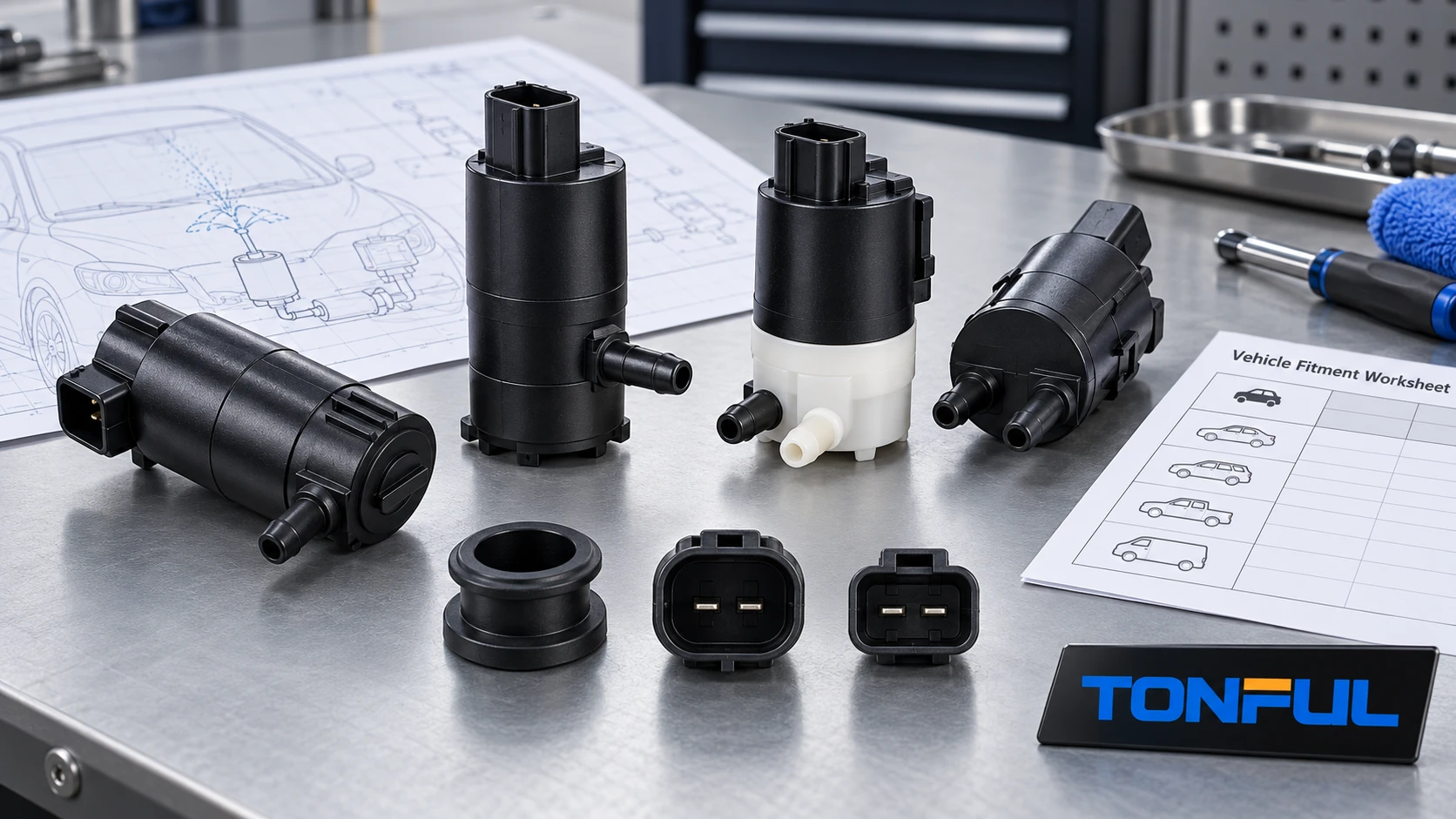
An automotive washer pump should not be selected from voltage, connector shape or a similar-looking body alone. It must fit the vehicle and reservoir, serve the correct cleaning circuit, match approved electrical conditions, use the correct outlet arrangement and reproduce the required system performance. A part that plugs in can still leak, route fluid incorrectly or deliver inadequate spray.
Begin with the full OE reference and vehicle record, then compare the removed pump with the candidate. OEM and fleet projects also need controlled drawings, validation evidence and change control. Each TONFUL claim must remain tied to the exact model and approved application.
On this page: Define the application | Verify identity | Compare interfaces | Approve performance | Release checklist
Define the Washer System Before Selecting a Pump
Identify the Cleaning Circuit
Record whether the pump supplies the front windshield, rear window, headlamp cleaner, camera, sensor or another approved cleaning circuit. These applications may look similar at the reservoir but can require different flow, pressure, duty, outlet routing or control behavior. A headlamp washer pump should not be treated as interchangeable with a windshield pump unless the drawing and validated system evidence support that use.
Determine whether the vehicle uses one pump per circuit, two independent pumps, or one reversible pump with two outlets. In a reversible arrangement, changing motor polarity can direct fluid through different hydraulic paths. The vehicle switch or control module, hose routing and check valves must agree with that architecture. The TONFUL automotive washer pump product category is the commercial starting point; request the exact model record before treating any configuration as available.

Conceptual application map; the vehicle diagram and approved pump drawing determine the actual circuit architecture.
Separate the Pump From the Rest of the System
The washer function also depends on the fuse, wiring, reservoir, grommet, hose, valves, nozzles and fluid. Restrictions, air leaks, frozen liquid or split hoses can imitate a weak pump; a silent pump may lack power or ground.
Use the wiper switch failure and replacement guide when the command side is uncertain, and inspect the hydraulic path before ordering a replacement. This avoids approving a new pump against a vehicle-side fault.
Verify Vehicle and OE Identity
Build a Complete Vehicle Record
Record make, model, generation or chassis, model year, production date, market, body style and VIN where available. Body style matters because a hatchback, wagon or SUV may need rear-window washing while a sedan from the same model family may not. Equipment such as headlamp cleaning, heated washer systems or camera cleaning can create additional variants.
NHTSA’s vPIC system can support manufacturer-reported VIN and basic vehicle identification data for applicable U.S.-market vehicles. It does not confirm washer-pump OE numbers, supersession, connector pinout, grommet fit, outlet routing or product acceptance. Use the vehicle manufacturer’s parts and service information, an authorized catalog record, or equivalent controlled evidence for those decisions.
Classify Every Number Before Cross-Referencing
Capture the complete number exactly as shown, including spaces, prefixes and suffixes. Then classify it. An OE service number, supplier number, engineering number, molded housing code, customer SKU and marketplace reference do not have the same authority. A molded number on a plastic body may identify only a housing or tool, not the complete finished pump.
When one number replaces another, record the direction and scope. A -> B is not automatically the same as A <-> B. A new service part may replace an older part only for selected vehicles or only when supplied with a new grommet, connector lead or hose. Public fitment data should contain only records supported by an identifiable source and approval status. Unverified marketplace mappings belong in a research queue, not in a customer-facing compatibility table.
| Identity field | Required entry | Evidence example |
|---|---|---|
| Vehicle | Make, model, chassis, year, body and market | Vehicle record or controlled catalog |
| Installation | Front, rear, headlamp or other approved circuit | Service diagram and removed-part location |
| Source number | Full number and number type | Original label or controlled document |
| Replacement number | Full number and supersession direction | OE catalog or authorized notice |
| TONFUL item | Exact offered model and revision | Controlled drawing and sample label |
| Status | Verified, conditional or unverified | Approval record and reviewer/date |
Confirm Voltage and Control Conditions
Vehicle Nominal Voltage Is Only the First Check
A passenger car may use a nominal 12 V electrical system, while a truck or bus may use a nominal 24 V system. That label alone does not define the pump’s complete operating envelope. Confirm the specified voltage range, polarity, protection, command method and vehicle abnormal-voltage conditions from controlled project documents. Do not connect a nominal 12 V pump to a 24 V system, or the reverse, because the connector happens to fit.
ISO’s official page for ISO 16750-2:2023 explains that the standard addresses electrical loads for road-vehicle electrical and electronic equipment and that wiring impedance can affect those loads. It does not provide a universal washer-pump rating or automatically qualify a TONFUL product. It also excludes EMC. Use the customer or OEM specification and the approved validation plan to define applicable electrical tests, severities and acceptance criteria. Circuit protection is also application-specific; TONFUL’s automotive blade fuse range can support a vehicle electrical BOM discussion, but fuse type and rating must come from the approved circuit design rather than the pump’s nominal voltage alone.
Identify Direct and Module-Controlled Designs
Some systems switch pump current directly through a relay or switch path. Others use a body control module, a dedicated control module or pulse-width modulation. An Audi technical bulletin hosted by NHTSA, for example, describes a vehicle-specific wet-arm system with a washer-pump control module, LIN communication and PWM pump activation. That example demonstrates why a generic two-wire assumption is unsafe; it is not a universal architecture or pinout.
Never apply external power to an unidentified cavity. Bench testing should use confirmed power and ground terminals, correct polarity, current limiting, suitable fluid supply and a protected breakout harness. Resistance or continuity mode must not be used on an energized circuit. The test procedure must define when to stop for abnormal current, stalled operation, leakage, excessive noise or loss of flow.
Compare Every Physical and Electrical Interface
Reservoir Inlet, Grommet and Installation Depth
The pump inlet and reservoir grommet form both a fluid seal and a mechanical support. Compare the reservoir-hole geometry, grommet outside and inside features, filter or screen, pump inlet diameter, insertion depth, locating shoulders and nearby clearance. Reusing a hardened, swollen, cut or distorted grommet can create a leak even when the new pump is correct. Conversely, a thicker replacement seal can prevent full insertion or stress the reservoir boss.
Record material compatibility with the approved washer fluid and temperature range. Do not identify an elastomer by color or appearance alone. If a pump is supplied with a grommet, confirm whether that seal is mandatory for the stated fitment and whether the reservoir requires a separate filter.
Outlet Count, Diameter and Direction
Count the outlets and document their diameter, length, angle and orientation relative to the connector and inlet. A single-outlet pump normally serves one path, but application still depends on the vehicle design. A dual-outlet body may be reversible, may contain internal check features or may have a different function. Do not infer operation solely from the number of nipples.
Compare hose retention, bend radius and clearance. Stretching a hose over an oversized outlet can split it; an undersized outlet can leak. The wrong outlet direction can kink the hose after reservoir installation.

Conceptual fitment comparison; final dimensions and orientation must come from the controlled pump and reservoir drawings.
Connector Shell, Keying and Terminals
Compare connector end views in the same orientation. Record shell family, terminal count, populated cavities, keying, latch position, terminal size and harness strain direction. Check for backed-out terminals, heat damage, corrosion, spread contacts and damaged seals on the vehicle connector. A mating shell does not prove correct polarity, current capacity or module compatibility.
For a replacement sample, create a simple terminal record rather than relying on wire color:
| Cavity | Removed pump function | Candidate function | Evidence source | Result |
|---|---|---|---|---|
| 1 | Project-specific entry | Project-specific entry | Diagram/test record | Pass/fail |
| 2 | Project-specific entry | Project-specific entry | Diagram/test record | Pass/fail |
| Additional cavities | If present | If present | Controlled source | Pass/fail |
The automotive electrical connector guide can support connector-family discussions, while final pump approval must use the actual mating interface and current requirement.
Validate Performance in the Real System
Do Not Compare Free Flow Alone
Flow measured into an open container can identify gross differences, but the installed system also includes hose length, elevation, check valves, tees and nozzle restrictions. Define the test fluid, fluid temperature, supply voltage at the pump terminals, inlet condition, outlet restriction or backpressure, collection time, instrument accuracy and sample identity. Record both flow and current under the specified operating point.
Pressure and flow are related through the complete hydraulic circuit. A pump with a high free-flow value may perform poorly against the installed restriction, while a pump with a higher closed pressure may not deliver the required flow at the nozzles. Use an agreed operating point or system-level spray requirement rather than ranking pumps by one uncontrolled number.
Approve Noise, Leakage and Endurance With Conditions
Noise depends on mounting, reservoir fill, fluid, voltage, hose loading and measurement position. If it is a requirement, define background level, microphone distance, fixture, operating state and reporting method. Investigate cavitation, air ingestion, mounting and interference before attributing every sound to the motor.
Leakage inspection should cover the inlet seal, pump body, outlet joints and reservoir after conditioning. Endurance testing should define sample allocation, fluid, cycle sequence, on/off time, temperature, voltage, load path and interim measurements. State whether the same samples proceed through electrical, climatic and mechanical conditioning, whether an unaged control is retained, how destructive analysis samples are assigned, and who approves replacement of an invalid sample. Acceptance limits must come from the product specification, customer requirement or approved qualification plan.

Conceptual validation setup; it is not a laboratory report or a source of universal acceptance limits.
Confirm Vehicle-Level Washer Performance
The official 49 CFR section 571.104 addresses vehicle-level windshield wiping and washing requirements for applicable U.S.-market vehicles. It does not certify an individual replacement pump or prove interchangeability. Final vehicle approval should verify fluid delivery, spray coverage, hose routing, leaks, electrical behavior, diagnostic status and all affected washer functions under the applicable project procedure.
Compare Supplier Offers on the Same Basis
Require each quotation to identify the exact model, drawing revision, voltage definition, application, connector, grommet, outlet configuration, packaging and supplied evidence. Commercial fields should cover samples, MOQ, price breaks, tooling or NRE, lead time, capacity assumptions, labels and change notification.
Compare total sourcing risk, including receiving inspection, installation, diagnostics, returns and warranty handling.
The custom wire harness and cable assembly capability is relevant when a project also needs a controlled pump pigtail or mating harness, but the harness and pump should retain separate drawings, validations and release status.
Washer Pump Release Checklist
| Decision field | Required project entry |
|---|---|
| Vehicle identity | Make, model, chassis, year, production date, body, market and VIN context |
| Washer application | Front, rear, headlamp, camera/sensor or other approved circuit |
| OE evidence | Number type, source, supersession direction and verification date |
| Pump identity | TONFUL item, revision, sample ID and lot |
| Electrical | Nominal system, pump voltage range, polarity, protection, command and current test |
| Hydraulic | Outlet count, routing, fluid, flow/pressure operating point and check-valve context |
| Reservoir fit | Inlet, grommet, filter, insertion depth, orientation and leakage result |
| Connector | End view, keys, cavities, terminals, latch and strain direction |
| Validation | Sample allocation, fixtures, conditions, equipment, acceptance source and results |
| Vehicle confirmation | Installed operation, spray coverage, leaks, diagnostics and all affected functions |
| Supply control | Packaging, labels, traceability, approved sample and change notification |
| Final disposition | Rejected, conditional sample review or production-approved scope |
Sample approval is not automatic mass-production approval. Conditional approval must identify the deviation, scope, owner, closure date and required evidence. Resolve conflicting drawings, labels or test results before release.
Discuss an Automotive Washer Pump Project With TONFUL
Send TONFUL the full OE reference, vehicle and body information, washer location, nominal electrical system, connector end-view photographs, reservoir inlet and grommet dimensions, outlet layout, performance requirements, quantity, packaging and destination market. TONFUL can review the request against its documented automotive washer-pump range and propose a sample-confirmation path. Final release should remain tied to the controlled drawing, approved sample and vehicle-level validation.