
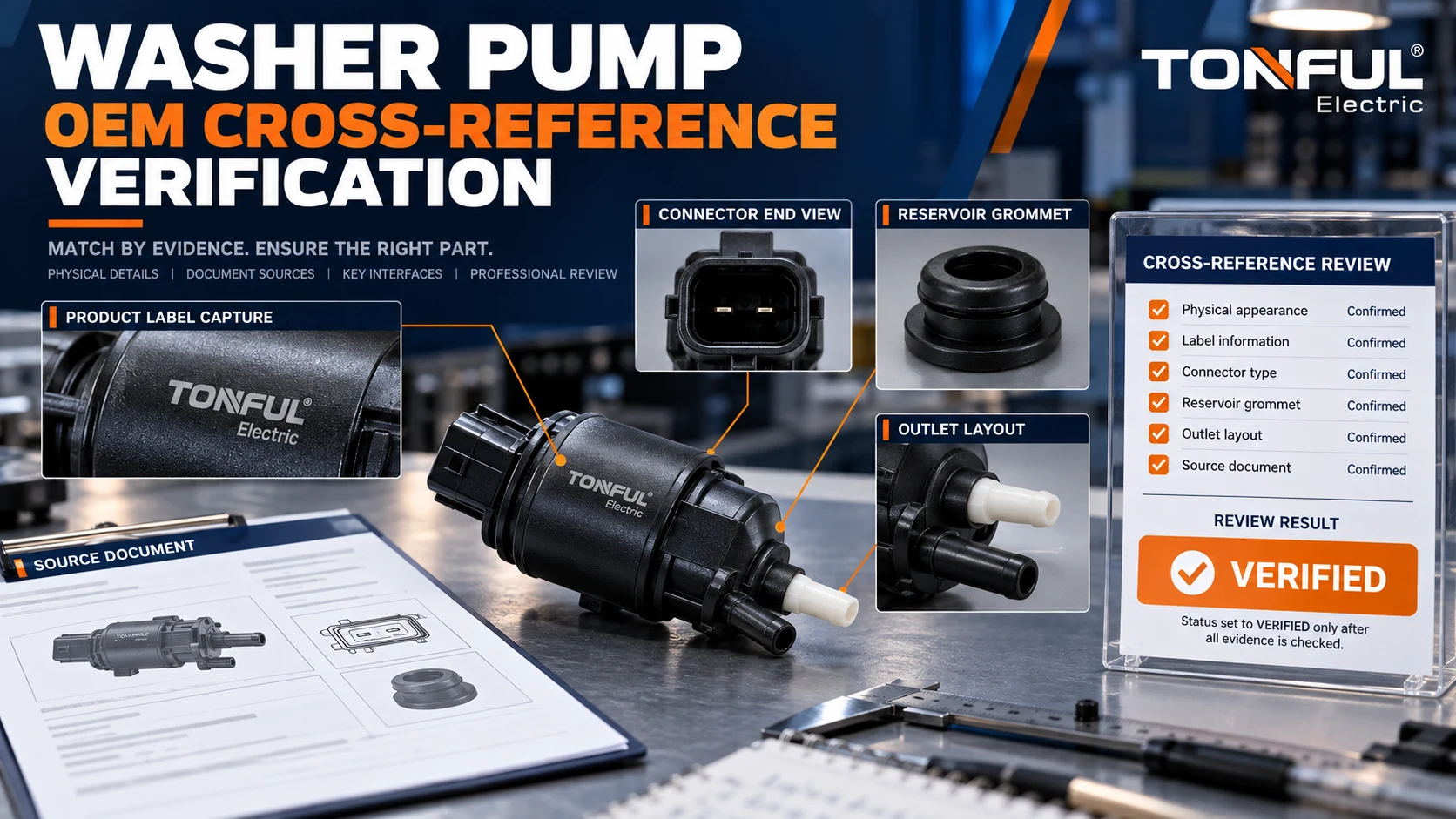
Cross-referencing a washer pump should not begin and end with one printed number, a product photograph or an unverified marketplace listing. The same vehicle name may use different pumps by market, production date, reservoir, front/rear/headlamp circuit or electrical architecture. A molded housing number may identify only a shared subcomponent, while an old service number may have been replaced in one direction by a newer assembly.
This guide explains how to build a defensible washer-pump cross-reference. It intentionally does not publish an unverified list of real OE mappings. A public table should contain only records supported by controlled source evidence, TONFUL sample identity, interface comparison, functional validation, reviewer and verification date. Conditional and unverified leads belong in an internal investigation register, not in a public fitment claim.
On this page: Number types | Verification sequence | Record template | Fit and function | Status rules | Governance
Classify the Number Before Cross-Referencing
Record every character, spacing, prefix, suffix and revision mark exactly as shown. Do not normalize two numbers into one until the source type is understood.
| Number Type | Practical Meaning | Evidence Warning |
|---|---|---|
| OE service number | Vehicle-brand service-channel number for a complete service part | Application and supersession may vary by market, date or vehicle configuration |
| Superseded OE number | Older service number replaced by another number | Direction matters; A replaced by B does not automatically prove B was replaced by A |
| Supplier/manufacturer number | Pump maker’s own complete-product reference | Do not relabel it as a vehicle-brand OE number without evidence |
| Engineering/drawing number | Controlled design or revision identifier | It may not be orderable through the service channel |
| Housing/molded number | Number on a casing, mold or subcomponent | It may be shared across pumps with different motors, outlets or connectors |
| Customer SKU | Distributor, importer or buyer inventory code | It proves only that catalog owner’s internal identity |
| Unverified marketplace number | Number copied from a listing or third-party database | Investigation lead only; not public interchange evidence |
A photo can help capture a label, but the label must be tied to the complete pump. Photograph the full part, number location, connector end view, grommet interface and outlet layout in one controlled sample record. TONFUL’s automotive washer pump category establishes the product-family context, not the accuracy of an individual cross-reference.

Conceptual illustration only. A number’s position or appearance does not establish its source type.
Understand Supersession and Relationship Direction
Use explicit relationship codes. Avoid the vague symbol “=” unless controlled evidence proves full equivalence within the stated scope.
| Relationship | Meaning | Public Use |
|---|---|---|
| A → B | A is replaced by B for the documented scope | Publish only with source, direction, scope and date |
| A ↔ B | Two-way service interchange has been confirmed | Rare; requires evidence for both directions |
| Conditional | Relationship holds only for named market, date, reservoir or function | Do not place in the public cross-reference table until the condition is resolved into a verified scope |
| Related, not superseded | Numbers identify related variants or components | Keep separate; do not imply interchange |
| Unverified | Repeated association lacks sufficient evidence | Internal investigation only |
| Rejected | Hardware, electrical, hydraulic or vehicle evidence disproves interchange | Preserve the rejection reason to prevent re-entry |
Supersession can change the supplied kit, grommet, connector adapter or reservoir assembly. Record whether the new service number replaces only the pump or a broader assembly. Also confirm whether old inventory remains valid and whether replacement instructions impose additional parts or installation steps.
Use a Complete Cross-Reference Verification Sequence
Follow one controlled path:
Capture the number exactly → classify the number type → identify source, revision and market → verify supersession direction → define vehicle and washer circuit → compare complete hardware → verify connector and electrical behavior → verify hydraulic routing and performance → approve the production-intent sample → approve the installed application → assign status, reviewer and date.
For U.S.-market vehicles, NHTSA vPIC can support manufacturer-reported VIN and basic identification data. It does not confirm washer-pump OE numbers, supersessions, connectors, hydraulic performance or interchangeability. Use the controlling vehicle-brand parts system, service information or authorized source for the specific application.
If sources conflict, quarantine the mapping. Do not choose the source that produces the broadest application list. Record each source, its revision, access date and exact statement; then resolve the conflict through stronger evidence and sample testing.

Conceptual illustration only—not a source of OE mappings or supersession claims.
Copyable Washer Pump Cross-Reference Record
Use one row per proposed relationship and keep blank fields unresolved rather than assumed.
| Record Field | Required Entry |
|---|---|
| Source number | Exact characters, number type and photographed location |
| Candidate/replacement number | Exact characters and number type |
| Relationship direction | A → B, A ↔ B, related, rejected or unverified |
| Source organization | Vehicle maker, authorized catalog, pump supplier, TONFUL record or third party |
| Source document | URL/system, document ID, revision, market and access date |
| Vehicle scope | Make, model, market, production range and VIN context |
| Washer circuit | Front windshield, rear window, headlamp or other approved circuit |
| Pump construction | Single outlet, reversible dual outlet, separate outlets or module assembly |
| TONFUL identity | Sample/SKU, drawing revision, label photograph and inventory status |
| Mounting interface | Reservoir opening, grommet, insertion, retention, orientation and clearance |
| Connector evidence | End view, shell/keying, cavities, populated terminals and mating part |
| Electrical evidence | Voltage domain, polarity, terminal function, control method and loaded result |
| Hydraulic evidence | Outlet layout, hose routing, restriction, flow/pressure context and leakage result |
| Installed result | Named vehicle/sample, all functions, diagnostics and observations |
| Validation status | Verified, Conditional, Unverified or Rejected |
| Governance | Reviewer, approver, last verified date and next review trigger |
This table is a record structure, not a blank promise that all fields are already available. TONFUL should link every public row to its internal evidence package and remove or downgrade a claim when its supporting source becomes obsolete.
Verify More Than the Number
Vehicle and Washer-Circuit Scope
Identify market, production date or VIN range, body configuration and the exact cleaning circuit. Front, rear and headlamp pumps may share a supplier family but differ in mounting, outlet orientation, hydraulic demand and duty. Do not transfer an approval from one circuit to another without evidence.
Mounting, Grommet and Reservoir
Compare reservoir opening, grommet dimensions and material, insertion depth, retention feature, orientation and nearby clearance. A pump can share the same motor housing yet use a different inlet or seal. Leakage or weak retention may not appear during a short open-bench test.
Connector and Electrical Architecture
Record the connector end view from a defined orientation, shell keying, cavity numbering, populated terminals, polarity and terminal function. TONFUL’s automotive electrical connectors page provides connector-family context; it does not confirm the pump’s exact housing or pinout. If a pigtail is required, treat the custom wire harness assembly as a separate controlled interface.
Nominal vehicle voltage is not the entire definition. Compare voltage at the pump under load, current behavior, polarity reversal, protection and control path. A matching connector does not prove that the motor direction, terminal load or module behavior is correct.
Hydraulic and Installed Function
Confirm outlet quantity, diameter/profile, direction, hose retention, check-valve boundary and routing. Compare performance under controlled fluid, temperature, voltage and restriction. Verify the installed spray target, response, leakage, noise, diagnostics and all front/rear/headlamp commands.
The TONFUL blade fuse range and auto combination switch range show adjacent system components, but neither validates a pump cross-reference. Fuse, switch, harness, relay/module and pump approvals remain separate within the complete vehicle circuit.
Publish Only Verified Cross-References
Use one rule consistently: the public cross-reference page contains only Verified records. A Verified mapping needs a controlled source, defined vehicle scope, complete TONFUL sample identity, hardware/interface comparison, functional evidence, installed result where required, reviewer and verification date.
Conditional records may be discussed in a controlled RFQ or sample-approval process, but they should not appear as public fitment relationships. Unverified marketplace associations and rejected mappings stay in the internal database with their source and reason. This prevents the same unsupported number from re-entering through another catalog import.
| Status | Internal Action | Public Catalog Action |
|---|---|---|
| Verified | Maintain evidence and review triggers | Publish only the defined scope |
| Conditional | Resolve condition through source or sample evidence | Do not publish as interchange |
| Unverified | Investigate; keep evidence gaps visible | Do not publish |
| Rejected | Preserve mismatch and rejection reason | Exclude and prevent re-import |
Build a Controlled Approval Package
One successful installation does not prove every year, market or reservoir variant. The approval record must name the exact vehicle, pump revision, source documents, test conditions and limits of inference. Sample approval also does not authorize production from a different factory, motor source, seal, impeller, connector, tooling or assembly process.
Before release, review label accuracy, packaging, barcode, country/market information, mixed-part controls and catalog export. Confirm that the customer-facing title, URL, image ALT, structured data and downloadable files use the same approved identity. A correct engineering record can still create returns if the storefront displays the wrong photograph or abbreviated number.

Conceptual illustration only. Status requires review of the underlying evidence package.
Maintain the Record After Release
Assign an owner and review trigger for every Verified row. Recheck when the vehicle maker supersedes a number, the supplier changes the pump, a connector or reservoir changes, field returns reveal a mismatch, or a catalog conflict is found. Keep old numbers searchable, but preserve their direction and historical scope instead of silently overwriting them.
Track complaint recurrence by exact mapping. A return labeled “wrong pump” should be separated into wrong vehicle scope, wrong number type, connector mismatch, grommet/mounting mismatch, outlet routing, electrical behavior, hydraulic performance or packaging error. Correct the public catalog and affected inventory together.
Work With TONFUL
Send TONFUL the complete source number, source type, vehicle and washer-circuit context, removed-part label, connector end view, grommet/mounting and outlet photographs. TONFUL can build the candidate record and arrange sample comparison without converting an unverified lead into a public claim. Only the scoped, reviewed and dated Verified result should enter the customer-facing cross-reference.