
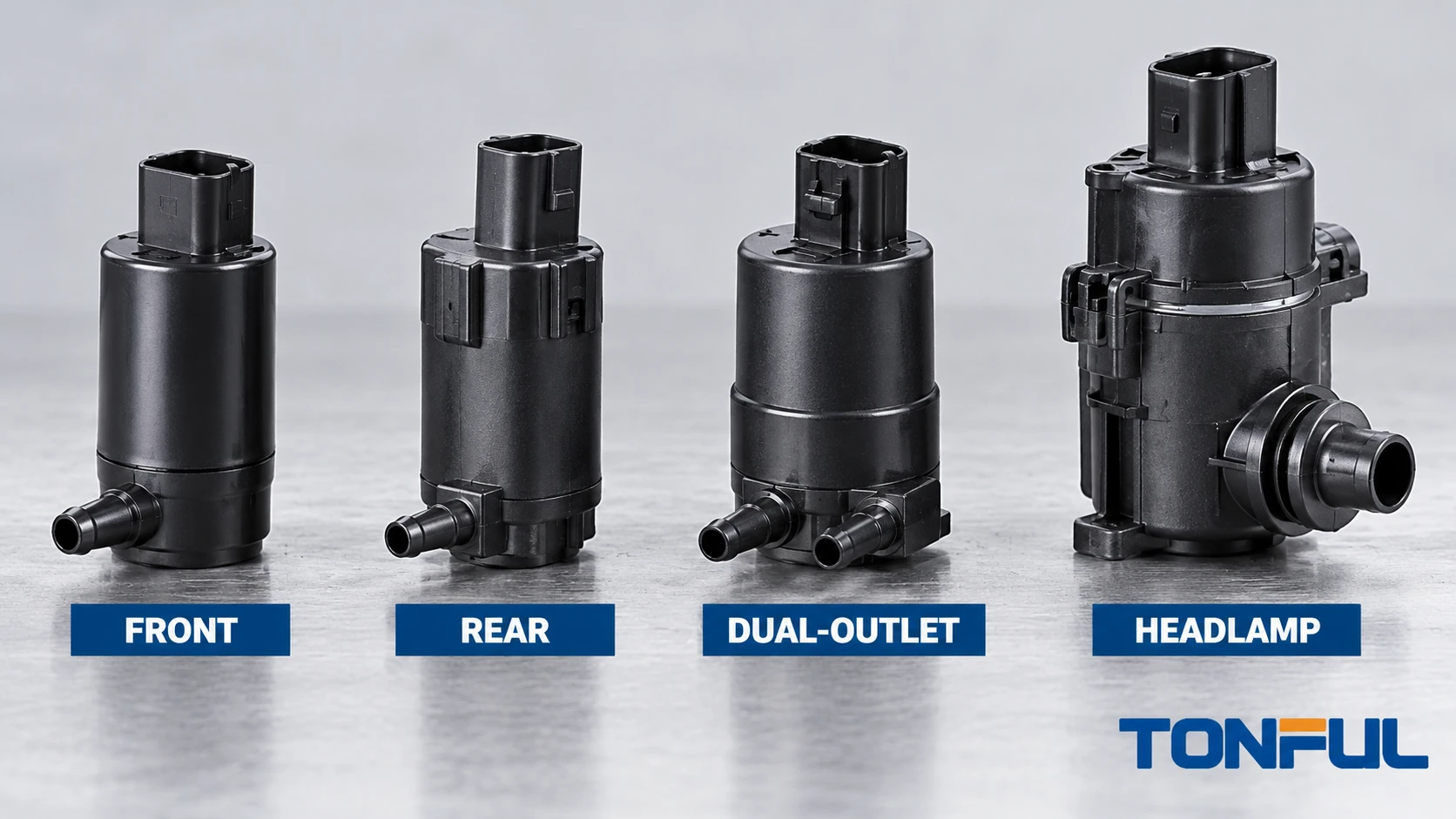
Automotive washer pumps can be classified by cleaning application, hydraulic layout, electrical architecture and mounting interface. These dimensions overlap. A front pump may be single-outlet, while one reversible dual-outlet pump may serve both front and rear glass. A headlamp pump is defined by its system role and validated performance, not simply by a larger-looking body. The correct category therefore cannot be determined from appearance or voltage alone.
For replacement and sourcing work, classify the removed part first, then verify the vehicle and OE record, connector, reservoir interface, outlets and control method. It does not assign universal pressure, flow, current or life values because requirements vary by vehicle, nozzle system and approved specification.
On this page: Classification dimensions | Front and rear | Single and dual outlet | Headlamp pumps | Comparison matrix | Approval
Classify Pumps on More Than One Dimension
The term “type” can refer to several different product attributes. Treating them as one mutually exclusive list causes selection errors.
| Classification dimension | Common alternatives | Why it matters |
|---|---|---|
| Cleaning application | Front windshield, rear window, headlamp, camera or sensor | Defines the served system and vehicle-level performance |
| Hydraulic architecture | Single outlet, dual outlet, reversible, multiple independent pumps | Defines hose routing and direction control |
| Electrical system | Nominal 12 V, nominal 24 V, module-controlled or other specified design | Defines supply and control validation |
| Reservoir interface | Grommet-mounted, filtered inlet, remote mount or pump-reservoir assembly | Defines sealing, retention and installation geometry |
| Fitment strategy | OE-specific direct fit or controlled universal installation | Defines mounting, connector and validation work |
A product may belong to several groups at once: for example, a nominal 12 V reversible dual-outlet pump may be grommet-mounted in one reservoir and supply both front and rear windows. A 24 V single-outlet pump may serve a truck windshield. The category name never replaces the controlled drawing or application record.

Conceptual classification map; one pump may occupy several categories and still requires model-level evidence.
The current TONFUL automotive washer pump category provides a starting point for sourcing discussions. Confirm which exact types and models are available before creating public fitment claims, because a category page alone does not establish model-level performance or compatibility.
Front Windshield and Rear Window Pumps
Front Windshield Washer Pumps
A front windshield pump supplies washer fluid to the nozzles that clean the driver’s primary forward view. It may be a dedicated single-outlet pump or one side of a reversible front/rear design. Selection fields include vehicle and OE number, reservoir position, inlet and grommet, outlet orientation, connector, control architecture and the performance required at the installed nozzles.
The official U.S. regulation in 49 CFR 571.104 addresses vehicle-level windshield wiping and washing requirements for applicable vehicles. It does not certify an individual pump or prove that two pumps are interchangeable. Pump approval must remain part-specific and must be followed by system-level confirmation.
Front systems can include check valves, heated hoses, wet-arm delivery, multiple nozzles or module-controlled activation. An Audi technical bulletin available through NHTSA describes a vehicle-specific wet-arm arrangement using a control module and PWM pump activation. This is a useful reminder that “front washer pump” does not always mean a simple two-wire motor that can be powered without identifying its circuit.
Rear Window Washer Pumps
Rear-window washing is common on hatchbacks, wagons, SUVs, vans and other vehicles where airflow deposits contamination on vertical or near-vertical rear glass. The pump may be dedicated, may share the main reservoir, or may be one direction of a reversible dual-outlet pump. Body style and production configuration therefore matter as much as model name.
Rear hose runs are often longer and may pass through hinges, roof structures or liftgate boots. A complaint at the rear nozzle may result from a split hose, damaged liftgate conduit, blocked check valve or leak inside the body, even when the pump is functional. When selecting a replacement, identify whether the removed pump exclusively serves the rear circuit and whether the vehicle uses an intermediate valve.
Do not assume that front and rear single-outlet pumps are interchangeable. Their inlet depth, outlet angle, connector keying, polarity, mounting and required operating point may differ. The label “rear” should be supported by the OE record and installation evidence, not by a seller’s category alone.
Single-Outlet and Reversible Dual-Outlet Pumps
Single-Outlet Pumps
A single-outlet pump has one discharge nipple, but the physical feature does not establish the final application. It can serve a front windshield, rear window, headlamp circuit or another approved cleaning function. Some vehicles use two separate single-outlet pumps in the same reservoir; others use one pump only.
For a single-outlet replacement, compare the discharge diameter, angle and hose retention, then verify electrical polarity and whether any internal check feature is present. Confirm that the reservoir has the correct pump opening and grommet. Two pumps with matching connectors can still have different inlet seating, outlet geometry or load behavior.
Single-outlet architecture can simplify diagnosis because one pump normally serves one path, but the system may still involve a relay or body module. If the pump is silent, check the command, automotive fuse protection, wiring and ground before declaring the motor failed.
Reversible Dual-Outlet Pumps
A reversible dual-outlet pump commonly uses motor direction and internal hydraulic features to send fluid to one outlet or the other. In a typical front/rear application, the vehicle control reverses polarity according to the driver’s request. This description is a common architecture, not a universal wiring instruction. Some dual-outlet products or vehicle systems may use different arrangements.
Verification must cover both polarities, both outlet paths and the corresponding vehicle commands. Record which polarity supplies each outlet, but do not publish a universal terminal diagram. The switch, module or relay strategy must agree with the pump. If polarity or hose routing is reversed, a front-wash request may operate the rear circuit.
Internal check behavior also matters. The inactive path must not create unacceptable backflow, drain-back or cross-flow under the specified conditions. Check valves may be inside the pump, installed separately, or integrated into nozzle and hose assemblies. A bench demonstration with open hoses cannot replace installed-system validation.

Conceptual hydraulic paths only; verify polarity, outlet identity and check-valve behavior from controlled product and vehicle documentation.
Headlamp Washer Pumps
Headlamp cleaning systems should be treated as a separate application class. They may use telescopic jets, dedicated valves or short high-demand spray events. A pump that looks similar to a windshield pump cannot be accepted for headlamp cleaning without evidence that it meets the required operating point, duty, interfaces and system behavior.
UNECE publishes UN Regulation No. 45, which concerns approval of headlamp cleaners and vehicles with regard to headlamp cleaners. The regulation addresses the cleaner and vehicle context; it does not mean that any standalone pump is approved merely because it is sold for headlamp use. Confirm the applicable market, regulatory scope, complete cleaning system and approval evidence.
Selection should compare reservoir location, pump inlet and seal, outlet count, hose size, connector, electrical conditions, flow-pressure behavior and duty cycle. A headlamp system may impose a different restriction than a windshield nozzle circuit. Free-flow volume by itself is not enough; testing should reproduce the approved fluid, voltage, temperature and hydraulic load.
For projects where the washer command originates in a steering-column control, TONFUL’s automotive combination switch range can support a separate switch discussion. Switch approval and pump approval must remain distinct, and neither alone proves that the complete cleaning system complies with vehicle requirements.
Integrated Pump and Reservoir Assemblies
Some sourcing projects cover the pump together with a reservoir, cap, level sensor, filter, grommet, brackets or hoses. This is not merely a pump type; it is a higher-level assembly whose mounting points and packaging can determine fitment. Record reservoir volume and geometry only from the controlled drawing, and verify clearance against surrounding vehicle parts.
Assembly validation should include pump orientation, sealing, sensor function where present, hose routing, fill access, venting, leakage and shipping protection. A pump approved separately does not automatically approve a new reservoir interface. Conversely, a reservoir that fits the vehicle may carry the wrong pump or connector revision.
Universal and Direct-Fit Pumps
Direct-fit describes an intended replacement relationship that should be supported by a vehicle and OE record, matching interfaces and vehicle-level testing. It should not be used merely because the pump can be inserted into a reservoir. A direct-fit release should define the exact vehicle scope, OE reference, installation position, connector, grommet and outlet arrangement.
A universal pump can be useful for controlled retrofit, classic-vehicle, non-road or service applications, but it shifts more responsibility to the installer or system integrator. The project may need a bracket, grommet, hose adapter, wiring pigtail, fuse protection and documented polarity. A universal label does not mean “fits every vehicle.”
Where a project needs a dedicated mating lead, TONFUL’s custom wire harness capability can be evaluated separately. The pigtail must use the correct connector, terminal, wire, seal and circuit protection, and its validation should not be inferred from the pump test.
Emerging Camera and Sensor Cleaning Pumps
Camera and ADAS sensor cleaning can require accurately controlled fluid delivery, compact packaging, valves, filtration, short response time or coordination with software. These requirements can differ significantly from conventional glass washing. Do not relabel an ordinary windshield pump as an ADAS cleaning pump without a defined system architecture and validated evidence.
Establish the sensor contamination case, nozzle coverage, permitted obscuration, fluid, pressure-flow operating point, response time, electrical interface and fault handling. Component validation alone cannot establish safe performance of the completed driver-assistance system. TONFUL should present such a product publicly only after confirming a real model, controlled specification and relevant testing.
Washer Pump Type Comparison Matrix

Conceptual selection check; each offered model still requires its own controlled interface record.
| Pump type | Typical system role | Key interfaces | Critical validation question |
|---|---|---|---|
| Front single-outlet | Dedicated windshield circuit | Reservoir inlet, one outlet, connector | Does installed spray meet the vehicle requirement? |
| Rear single-outlet | Dedicated rear-window circuit | Reservoir or remote mount, long hose path | Are hose routing and rear-body leaks excluded? |
| Reversible dual-outlet | One pump serving two selected circuits | Two outlets, polarity, internal hydraulic path | Does each command feed only the intended outlet? |
| Headlamp washer | Headlamp cleaner system | Higher-demand hydraulic path, connector, reservoir | Is performance validated under the complete system load? |
| Pump-reservoir assembly | Integrated fluid-storage and pumping module | Vehicle mounting, fill, sensor, pump and hoses | Are all assembly interfaces and shipping controls approved? |
| Universal pump | Controlled retrofit or non-OE installation | Bracket, adapters, pigtail and protection | Has the integrator validated fit, wiring and performance? |
| Camera/sensor pump | Defined cleaning subsystem | Valve, filter, nozzle, electronic command | Is the completed sensing system validated, not only the pump? |
Select and Approve the Correct Type
First identify the vehicle and cleaning circuit. Then capture the full OE number and classify its source. Compare the removed and candidate pump’s inlet, grommet, mounting depth, connector end view, terminals, outlet count, diameter and direction. Confirm nominal voltage and the actual control method before energizing anything.
The automotive electrical connector range can assist with connector-family sourcing, but a mating shell alone does not prove polarity, current capacity or pump compatibility. Bench tests should use confirmed terminals, current limiting and fluid supply. Never power an unidentified cavity or run the pump dry unless a controlled test specifically permits it.
Performance approval should state sample quantity and allocation, fluid, temperature, voltage at the pump, hydraulic restriction, flow and pressure method, current, leakage, noise, cycle sequence, invalid-test rules and acceptance source. Finish with installation in the defined vehicle or representative system. Record spray function, leaks, current behavior, diagnostics and every affected cleaning circuit.
Release only the tested scope. A sample approved as a front pump on one reservoir is not automatically approved for a rear, headlamp, dual-outlet or 24 V application. If TONFUL offers multiple types, each public model should carry its own drawing, interface record, validated claims and change history.
Discuss Washer Pump Types With TONFUL
Send TONFUL the vehicle, full OE reference, cleaning location, nominal electrical system, removed-pump photos, connector end view, reservoir and grommet dimensions, outlet arrangement and quantity requirement. TONFUL can compare the request with its documented washer-pump range and identify the sample evidence needed. Final approval should remain tied to the exact model, drawing revision and validated system application.