
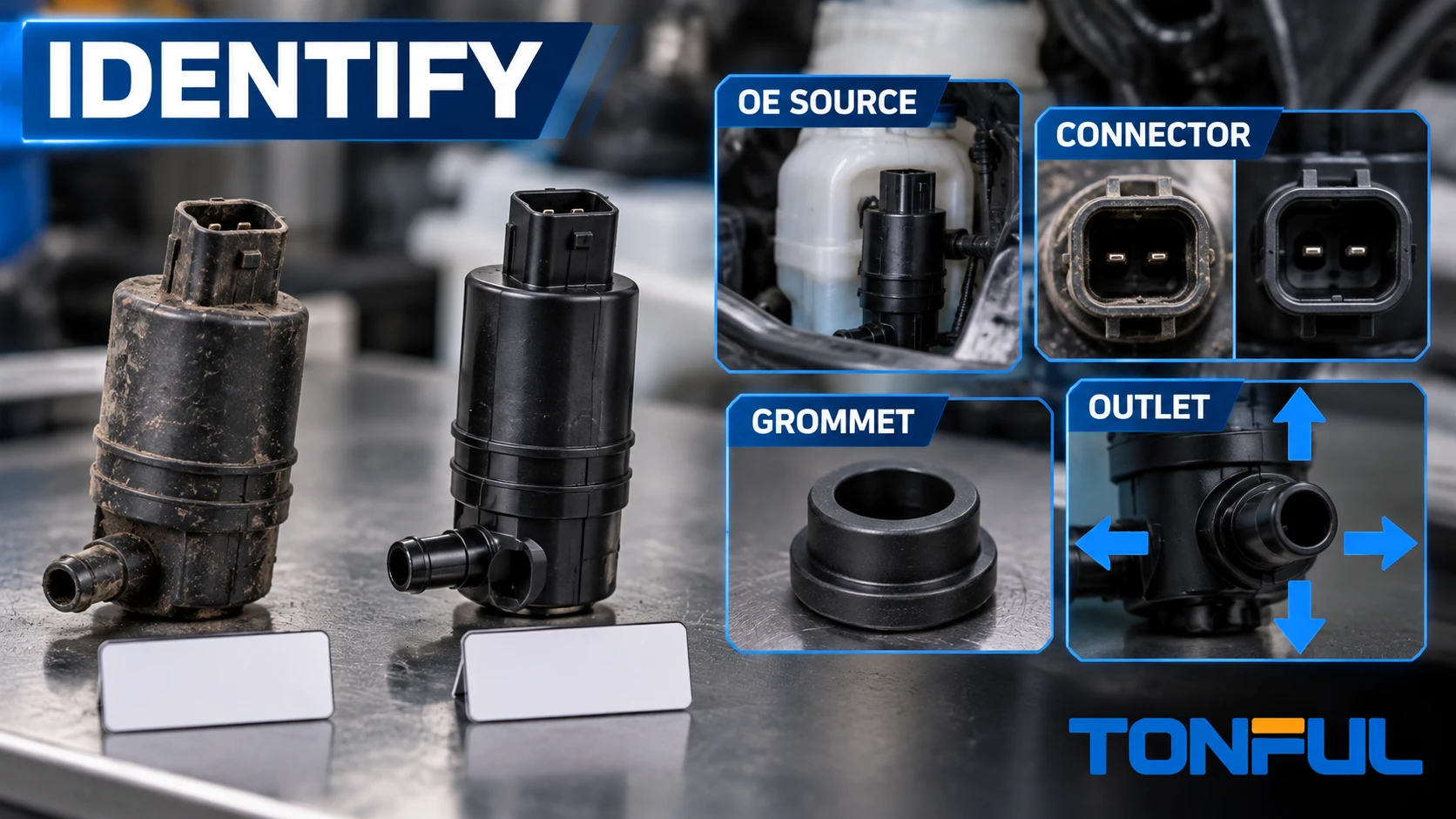
The correct washer pump cannot be identified from one catalog number, one photograph or a connector that appears to mate. A reliable match combines vehicle identity, number type, installation location, electrical conditions, connector end view, reservoir grommet, inlet depth, outlet layout and functional evidence. If any of those fields conflict, stop the release and resolve the source.
This workflow is suitable for aftermarket replacement, wholesale cataloging, private-label sourcing and sample approval. It intentionally avoids publishing unverified OE mappings. TONFUL should place a number into a public fitment table only after the offered pump, vehicle scope and supporting evidence have been reconciled.
On this page: Capture identity | Classify numbers | Compare connector | Compare grommet | Approve sample
Capture the Vehicle and Removed Part
Record make, model, generation or chassis, model year, production date, market, body style and VIN context. Body style can change the washer system: a sedan may have only a front pump, while a hatchback or wagon from the same model family may add rear washing. Headlamp cleaning, heated fluid delivery and camera cleaning can add further variants.
NHTSA’s vPIC service can support manufacturer-reported VIN and basic identification data for applicable U.S.-market vehicles. It does not confirm a washer-pump OE number, supersession, connector, polarity, grommet or product acceptance. Use controlled manufacturer parts information or an authorized catalog record for those decisions.
Before cleaning the removed pump, photograph it in the reservoir, its hose routing and the connector latch direction. Then record all labels and markings. Take connector end views straight on, not at an angle, and photograph the reservoir opening and seal after removal. Keep the removed grommet if it can be extracted without damage; its geometry may be as important as the pump body. If the washer command itself is uncertain, separate switch-side evidence with the wiper switch diagnostic guide before condemning the pump.

Conceptual evidence set; retain original photographs and source records for the actual approval.
Classify the Number Before Cross-Referencing
Number Types Are Not Interchangeable
A pump can carry several numbers. Identify what each number represents before using it as a cross-reference.
| Number type | Practical meaning | Evidence warning |
|---|---|---|
| OE service number | Vehicle-brand service-channel reference | Verify vehicle scope and supersession in the applicable market |
| Superseded OE number | Earlier service number replaced by another | Record the direction and any installation conditions |
| Supplier/manufacturer number | Pump maker’s product reference | Does not automatically equal the vehicle OE number |
| Engineering or drawing number | Design or revision identity | May not be orderable as a complete service part |
| Housing or molded code | Tool, housing or subcomponent identity | Must not be assumed to identify the complete pump |
| Customer SKU | Distributor or private-label inventory number | Requires a link to the controlled source record |
| Marketplace reference | Third-party listing or seller mapping | Treat as unverified until independently confirmed |
Capture spaces, prefixes, suffixes and revision marks exactly. Do not shorten a number because another listing omits a digit. If an old number is replaced by a new one, record old -> new, not an unsupported two-way equivalence. A successor may require a new seal, connector lead or hose adapter, or may apply only after a production break.
Volvo Trucks’ official PartsASIST description illustrates an important identification principle: its parts search can use VIN, unit and vehicle details and can present alternate-part recommendations. This supports VIN-based parts research, but it does not verify a TONFUL mapping unless the actual vehicle record, offered sample and interface evidence are preserved.
Use Verification Statuses
Use Verified only when the defined vehicle scope, number source, TONFUL item, interfaces and sample results are approved. Conditional means a named item remains unresolved and should be limited to controlled inquiry or engineering review. Unverified means the relationship is research only. Only verified relationships should appear as public fitment claims.
The current TONFUL automotive washer pump category can receive verified products after that process. A category listing by itself is not evidence that every number found online is supplied or interchangeable.
Compare the Connector End View
Establish a Common Viewing Direction
Orient both connectors from the mating face with the latch or primary key at the same clock position. Record shell shape, cavity count, populated cavities, terminal orientation, key ribs, polarization features, secondary locks and seal details. A side photograph can hide a key difference; a mating-face photograph makes the comparison auditable.
The TONFUL automotive electrical connector range can support connector-family and mating-component discussions. However, a matching shell does not prove correct polarity, current capacity, terminal plating, module compatibility or pump function. The pump’s circuit must be verified from controlled documentation or a protected test.
Build a Cavity Record
Do not rely solely on wire color because harness revisions, repairs and markets may differ. Use a cavity table:
| Field | Removed pump | Candidate sample | Evidence | Result |
|---|---|---|---|---|
| Connector orientation | Latch/key reference | Latch/key reference | End-view photographs | Pass/fail |
| Cavity population | Count and blank positions | Count and blank positions | Visual record | Pass/fail |
| Terminal function | Controlled entry | Controlled entry | Diagram or protected test | Pass/fail |
| Polarity/direction | Defined result | Defined result | Approved test record | Pass/fail |
| Latch and retention | Mating result | Mating result | Fit check | Pass/fail |
Never apply external power to an unidentified cavity. Bench power is acceptable only after power, ground, voltage, polarity and current limit are confirmed. Use a fused or current-limited supply, a fluid source and protected breakout leads. Do not run resistance or continuity mode on an energized circuit.
Verify the Reservoir Grommet and Inlet
The Seal Is Also a Mounting Interface
The grommet usually seals the reservoir opening and supports the pump inlet. Compare the reservoir hole and boss, grommet outside profile, inside bore, lips or grooves, filter screen, pump inlet diameter, insertion depth, locating shoulder and installed orientation. Visual similarity is not sufficient when small geometry changes determine leakage or retention.
A NHTSA-hosted FCA recall repair document for a specific windshield-washer-pump campaign lists a pump package that includes both the pump and a windshield-washer-pump grommet. That vehicle-specific example demonstrates that the seal can be part of the intended repair set. It does not establish a universal replacement rule or TONFUL fitment.
Inspect the removed grommet for cuts, hardening, swelling, flattening, contamination and an embedded filter. Reusing a damaged seal can create a leak that is incorrectly blamed on the new pump. Conversely, installing an incorrect thick or stiff seal can prevent full seating or stress the reservoir.

Conceptual interface comparison; use measured production parts and the controlled drawing for acceptance.
Confirm Material and Fluid Compatibility
Do not identify grommet material by color. Washer fluids can contain water, alcohols, detergents, dyes and regional formulations. The approved project should define the fluid or fluid families, temperatures, exposure duration and acceptance criteria. Examine swelling, hardness change, cracking, leakage and retention after conditioning when required.
Compare Outlet Layout and Pump Function
Count the outlets, then record each nipple’s outside diameter, retention bead, length, angle and clocking relative to the connector and inlet. Verify hose fit and bend radius after the reservoir is installed. An outlet that points a few degrees differently can kink a short hose or interfere with nearby components.
For a reversible dual-outlet pump, identify outlet A and outlet B and document which approved polarity or command operates each path. Test for unintended cross-flow or drain-back under the specified conditions. Do not infer reversible operation merely from two nipples. A dual-port housing can have a different internal purpose.
For a single-outlet pump, confirm whether it serves the front, rear, headlamp or another circuit. One outlet does not define the application. The TONFUL auto combination switch range may be relevant when the washer command is integrated into the steering-column switch, but switch approval does not establish pump fitment.
Confirm Voltage and Control Architecture
Record the vehicle’s nominal electrical system and the pump’s specified operating conditions. A nominal 24 V truck does not prove that an unidentified terminal should receive 24 V; some systems use a relay, body module, PWM driver or dedicated controller. A nominal 12 V label also does not establish connector pinout or performance.
ISO’s ISO 16750-2:2023 page describes electrical loads for road-vehicle electrical and electronic equipment and explicitly excludes EMC. It does not supply a universal washer-pump test plan. Use the customer or OEM specification to define voltage conditions, polarity protection, current limits, abnormal operation and recovery. For the circuit BOM, TONFUL’s automotive blade fuse range may be discussed separately, but fuse selection must follow the approved circuit design.
Approve the Sample in a Controlled Sequence
Use this order:
- Capture the vehicle and removed-part identity.
- Classify each number and verify the source.
- Confirm installation location and washer-system architecture.
- Compare pump housing, inlet, grommet and insertion geometry.
- Compare connector end view, cavities, terminals and latch.
- Compare outlets, hose routing and check-valve context.
- Confirm electrical conditions and protected bench-test method.
- Test flow, pressure or system delivery at the approved operating point.
- Inspect current, noise and leakage under defined conditions.
- Install the sample and verify every affected washer function.
- Record disposition, approver, date and released scope.

Conceptual workflow; final acceptance criteria must come from controlled project documents.
The test record should identify sample and lot, drawing revision, fluid, temperature, voltage at the pump, fixture, instruments, hydraulic load, results and acceptance source. If samples are allocated across endurance, environmental and destructive analysis, define whether they are independent or sequentially aged. Retain an unaged control when the qualification plan requires comparison.
Installed confirmation should check hose routing, leakage, spray delivery, front/rear direction, headlamp function where present, electrical behavior and diagnostics. Sample approval is not automatic production approval. Production release also requires packaging, labels, lot traceability and change-notification control.
Copyable Identification Record
| Record field | Required entry |
|---|---|
| Vehicle | Make, model, chassis, year, production date, body, market and VIN context |
| Application | Front, rear, headlamp or other approved cleaning circuit |
| Source number | Exact number, number type and source document |
| Supersession | Direction, conditions, source revision and date |
| Removed pump | Label photographs, housing, connector, inlet, grommet and outlets |
| Candidate | TONFUL item, drawing revision, sample ID and lot |
| Connector | End-view orientation, cavities, terminals, key and latch |
| Reservoir interface | Hole, grommet, filter, inlet and insertion geometry |
| Hydraulic interface | Outlet count, dimensions, direction, hose and valve context |
| Electrical | Nominal system, operating conditions, polarity/control and protection |
| Validation | Test conditions, results, acceptance source and approver |
| Disposition | Verified scope, conditional action or rejected reason |
Discuss Washer Pump Identification With TONFUL
Send TONFUL the full vehicle record, every visible number, removed-pump label photographs, connector mating face, reservoir opening and grommet, outlet layout and quantity requirement. TONFUL can compare the evidence with its documented washer-pump range and prepare a candidate sample record. Final compatibility should be released only after the exact item, interfaces and installed functions are validated.