
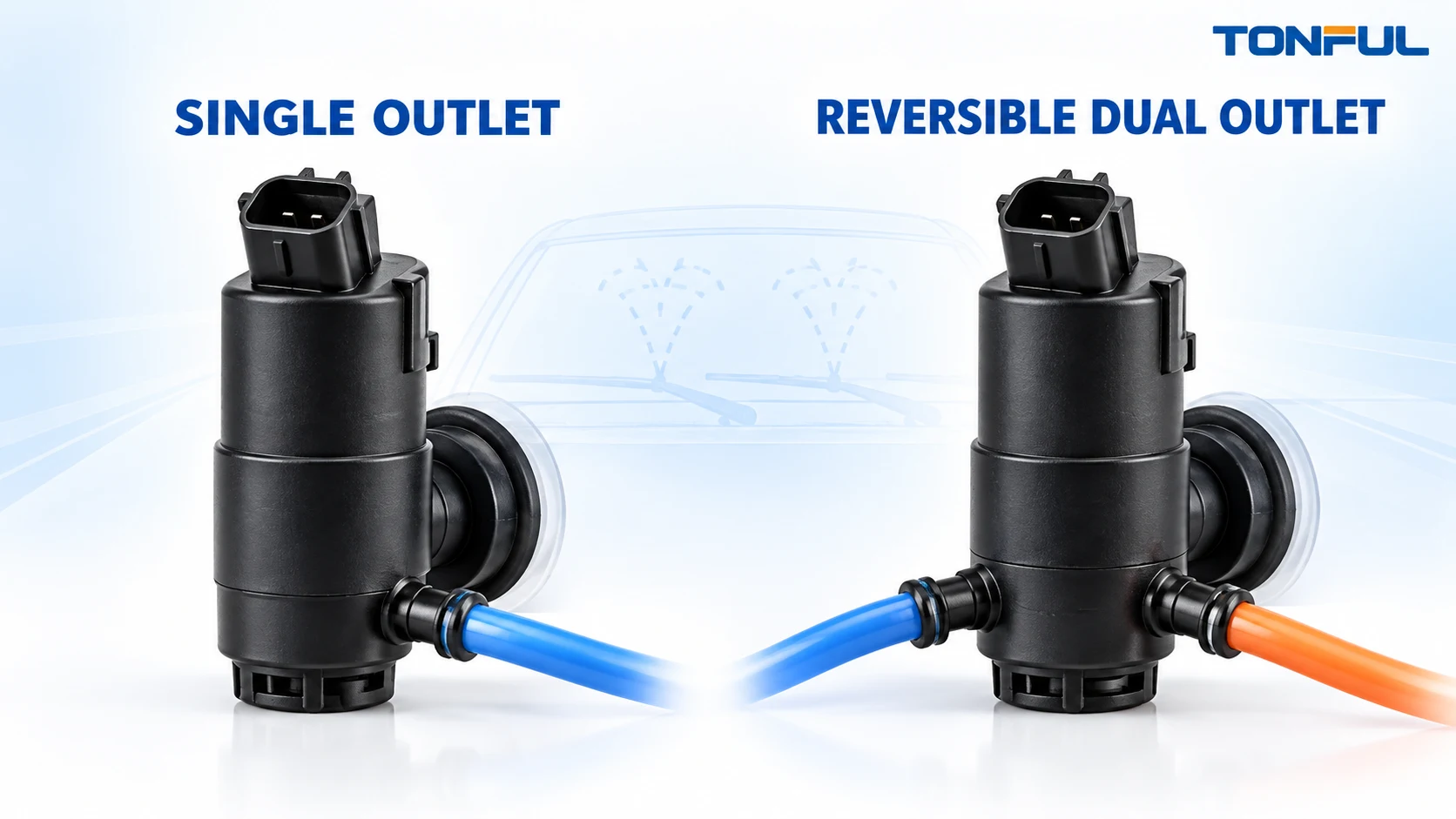
A single-outlet washer pump and a reversible dual-outlet pump are different hydraulic architectures, not simply one-nipple and two-nipple versions of the same part. A single-outlet pump normally feeds one defined circuit. A reversible dual-outlet pump can use motor direction and internal hydraulic features to select between two paths, often front and rear washing. The correct design depends on the vehicle circuit, reservoir, polarity control, hose routing, valves and required system performance.
Counting outlets is only the first identification step. Two pumps can share voltage, connector shape and reservoir opening but behave differently because of internal porting, check features or motor polarity. Selection and testing must therefore reproduce both the electrical command and the hydraulic system.
On this page: Architecture | Selection differences | Direction control | Valves | Testing | Release record
How the Two Architectures Work
Single-Outlet Pump
A single-outlet pump has one discharge connection and generally supplies one approved fluid path. The vehicle may use one such pump for the front windshield, another for the rear window and a separate higher-demand pump for headlamp cleaning. Other vehicles use only one front pump. The outlet count does not determine the cleaning location; the OE record and system diagram do.
The pump may be switched directly, through a relay or by a body control module. Its electrical polarity can be fixed even though another single-outlet pump with the same connector uses a different terminal assignment. Compare the mating face, cavity function and approved wiring before energizing a candidate.
Reversible Dual-Outlet Pump
A reversible dual-outlet pump commonly contains two discharge nipples and internal hydraulic features that favor one outlet when the motor runs in one direction and the other outlet when direction reverses. This allows one motor to serve two selected circuits. Front/rear washing is common, but the actual outlet assignment must be established from the vehicle and pump documentation.
An Audi technical bulletin hosted by NHTSA describes a vehicle-specific wet-arm system using a dual pump that supplies different wiper-arm jets according to rotation direction. That example confirms that directional operation exists in production systems, but it is not a universal front/rear layout, pinout or test procedure. Each vehicle remains specific.

Conceptual illustration only—not an acceptance standard or laboratory micrograph. Internal valves and passages vary by product and require a controlled drawing.
The TONFUL automotive washer pump category can support model discussions after the architecture is identified. Request an exact product drawing and sample rather than assuming every two-outlet item is reversible.
Selection Differences That Matter
| Selection field | Single outlet | Reversible dual outlet | Evidence required |
|---|---|---|---|
| Served circuits | One defined path per pump | Two selected paths from one pump | Vehicle diagram and application record |
| Outlet count | One | Two | Physical sample and drawing |
| Direction logic | Usually one approved direction | Direction/polarity selects outlet | Protected polarity-to-outlet test |
| Hose routing | One discharge hose | Two hoses with identified destinations | Installed routing photographs |
| Valve behavior | Separate or integrated as specified | Internal and/or external directional control | Backflow and drain-back test |
| Failure impact | One pump path affected | One pump can affect both paths | Symptom-to-circuit diagnosis |
| Replacement risk | Wrong application despite one outlet | Reversed paths or cross-flow | Vehicle-level function test |
Also compare voltage version, inlet stem, grommet, seating shoulder, installation depth, connector keying, terminal capacity, outlet diameter and clocking. A dual-outlet pump can fit the reservoir yet place one hose against the body or reverse front and rear functions.
Existing TONFUL pages for automotive electrical connectors and custom wire harness assemblies can support mating-component discussions, but neither proves pump fitment. Use the controlled vehicle record, exact pump drawing and approved sample as the fitment evidence.
Verify Polarity and Direction Control
Do Not Publish a Universal Pinout
For a reversible pump, create a model-specific polarity map. Identify the confirmed power and ground terminals, apply the approved voltage through a current-limited protected setup and record which outlet flows in each direction. Label outlets by physical orientation and final vehicle destination. Do not rely only on wire color.
Never power an unidentified cavity. Do not use resistance or continuity mode on an energized vehicle circuit. If a body control module or electronic driver is involved, use the vehicle service procedure and an appropriate high-impedance instrument. A test lamp or direct jumper can overload a module output.
The washer request may originate in a steering-column switch. TONFUL’s auto combination switch range and wiper switch diagnostic guide can help separate command-side sourcing and diagnosis, but switch approval does not establish pump polarity or hydraulic direction.
Record the Complete Command Path
Document switch or module request, fuse, relay or driver, pump terminals, outlet assignment and nozzle destination. A front request that produces rear flow can result from reversed wiring, swapped hoses, incorrect outlet labeling, an incompatible pump or a control fault. Compare evidence in that order rather than reversing connectors experimentally.

Conceptual illustration only—not an acceptance standard or laboratory micrograph. Terminal identities and voltage conditions must come from the exact vehicle and product records.
Check Valves, Backflow and Prime Retention
Washer systems may use internal pump valving, separate non-return valves, nozzle-integrated valves or combinations. Their purposes can include reducing drain-back, limiting cross-flow and retaining fluid near the nozzles for acceptable response. Valve location and behavior are system-specific.
With a reversible dual-outlet pump, the inactive path must not discharge beyond the project’s allowance when the other path operates. When the pump stops, fluid behavior should also meet the defined requirement. An open-hose demonstration may look acceptable but fail after hoses, elevation, tees and nozzles are installed.
Do not add a generic check valve without reviewing cracking pressure, flow restriction, orientation, fluid compatibility and freeze behavior. Extra restriction can reduce spray at the nozzle or alter current. Likewise, removing an original valve because a replacement pump “already has one” requires controlled evidence.
Diagnose Architecture Before Replacing the Pump
| Symptom | More likely investigation direction | Next evidence |
|---|---|---|
| Front and rear both inoperative | Supply, fuse, command, common wiring or shared pump | Voltage/current under request and scan data where applicable |
| Front works, rear does not | Rear hose, outlet, valve, nozzle or one direction | Polarity-to-outlet flow and rear line isolation |
| Rear works, front does not | Front path or opposite pump direction | Compare command and outlet A/B response |
| Requests operate opposite windows | Swapped hoses, reversed polarity map or wrong pump | Connector record, hose routing and model identity |
| Fluid emerges from both paths | Internal or external valve issue, incorrect architecture | Backflow test and section/teardown if authorized |
| Delayed spray after parking | Drain-back, leak or check-valve behavior | Prime-retention and leak inspection |
A silent pump is not automatically failed. Verify command, fuse, supply and ground. A running pump with no spray can have empty or frozen fluid, an inlet air leak, blocked pickup, split hose or nozzle restriction. Isolate the fault before ordering a different architecture.
Test the Complete Hydraulic Behavior
Test Setup
Record sample ID, model and revision, fluid, fluid temperature, supply voltage at the pump, current instrument, reservoir fixture, hose dimensions, outlet restrictions and collection method. For a dual-outlet pump, test both directions with the same controlled conditions unless the project defines different loads.
Measure flow and pressure at the approved operating point, not only free flow. Record inactive-outlet leakage or cross-flow, current, noise, priming behavior and visible leaks. If valves are external, test the approved assembled circuit as well as the pump when required.
The official 49 CFR 571.104 establishes vehicle-level windshield wiping and washing requirements for applicable U.S.-market vehicles. It does not certify an individual single- or dual-outlet pump. Installed spray performance remains a vehicle-level confirmation.
Sample Allocation and Failure Rules
Define whether electrical, environmental and endurance tests use independent samples or a sequentially aged group. Retain an unaged control if the qualification plan requires comparison. Allocate destructive teardown samples before testing, and state who may authorize replacements when a fixture or operator error invalidates a run.
Failure criteria should address loss of required flow, incorrect direction, excessive current, leakage, unacceptable cross-flow, failure to start, abnormal noise and physical damage according to the product drawing or customer-approved plan. Do not insert generic limits simply to complete a report.

Conceptual illustration only—not an acceptance standard or laboratory micrograph. Each result needs traceable equipment, conditions and an acceptance-source document.
Installation and Vehicle Confirmation
Install the candidate with the approved grommet, hoses, clamps and connector. Check that hose bends do not collapse after the reservoir is fixed in the vehicle. Operate each request separately, confirm the intended nozzles, inspect the inactive path and look for leaks at the reservoir and outlets.
For module-controlled vehicles, check diagnostic trouble codes and current behavior under the service procedure. Confirm all related functions after the repair. A bench-passing pump is not production-approved until the defined vehicle or representative system demonstrates correct direction and spray delivery.
Release Record for Single and Dual Outlet Pumps
| Record field | Required entry |
|---|---|
| Pump identity | Manufacturer, exact model, revision, sample and lot |
| Architecture | Single outlet or reversible dual outlet |
| Vehicle scope | Make, model, chassis, year, body and washer circuits |
| Electrical | Nominal system, approved range, control and protection |
| Direction map | Polarity/command, outlet A/B and vehicle destination |
| Hydraulic circuit | Hoses, valves, tees, nozzles and elevations |
| Interfaces | Connector, inlet, grommet, outlets and installed clearance |
| Test evidence | Flow/pressure, current, leakage, cross-flow, noise and endurance |
| Vehicle result | Correct functions, spray, leaks and diagnostics |
| Approval | Status, scope, approver, date and change control |
Release only the tested architecture. A single-outlet approval does not cover a reversible sibling, and a dual-outlet pump approved for one front/rear system does not automatically fit another vehicle with the same connector.
Discuss Single and Dual Outlet Pumps With TONFUL
Send TONFUL the vehicle and OE reference, removed-pump photos, outlet count and orientation, connector end view, grommet interface, nominal voltage, front/rear hose layout and required quantity. TONFUL can review the request against its documented washer-pump range and propose a controlled sample plan. Final approval should remain tied to the exact pump, polarity map and installed hydraulic system.