
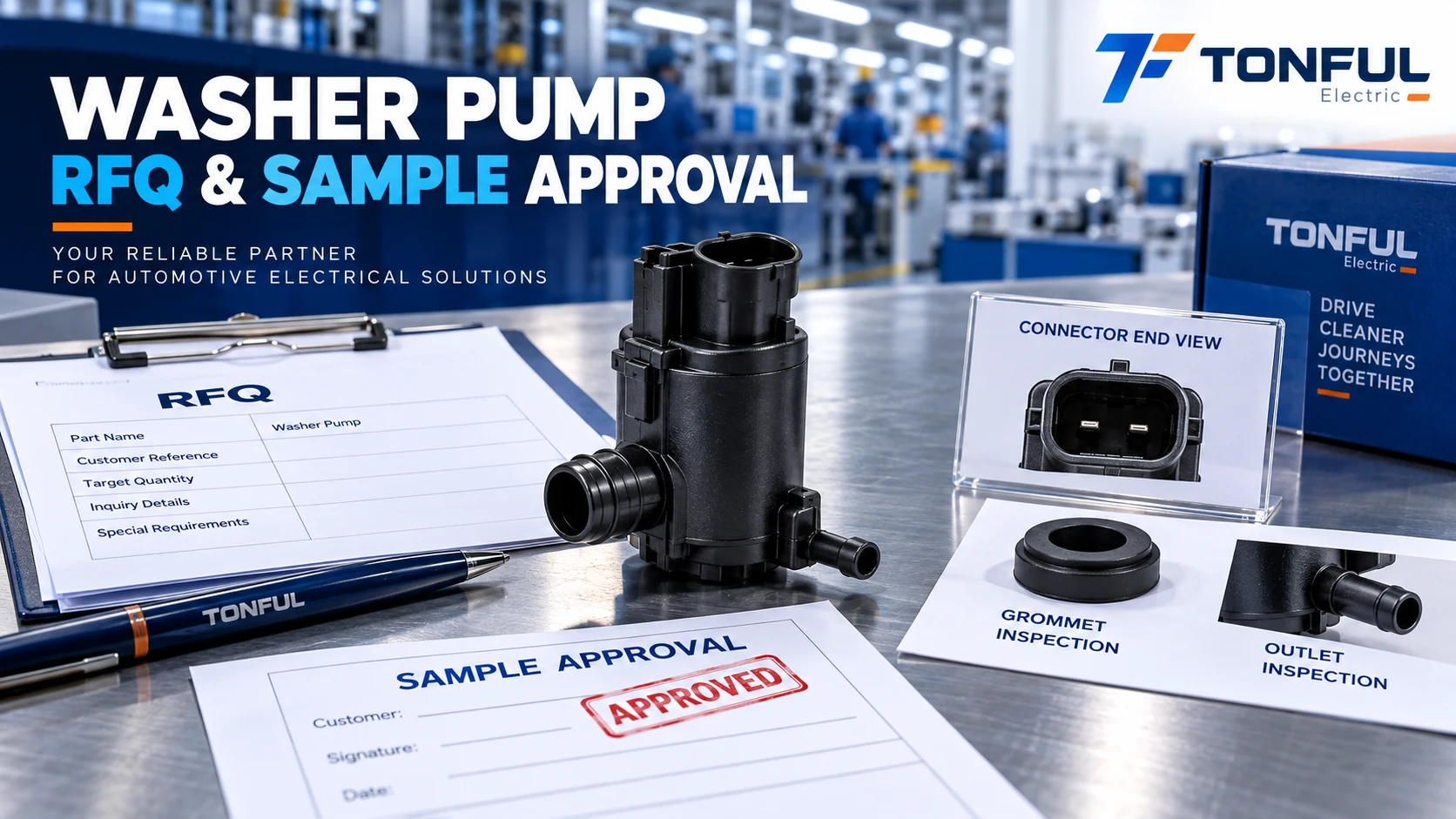
A washer pump quotation is only comparable when every supplier receives the same technical, validation and commercial definition. A photograph, vehicle model or OE reference may start the discussion, but none of them defines the complete pump. Reservoir mounting, connector keying, voltage domain, control architecture, outlet geometry, hose interface, hydraulic duty and environmental exposure can change within one vehicle name or model year.
This checklist turns an inquiry into a controlled release process: define the application, issue the RFQ, approve representative samples, close deviations and release only the agreed production scope. It does not create universal performance limits. Numeric requirements must come from the customer drawing, vehicle documentation, product specification or an approved project test plan.
On this page: Application definition | Copyable RFQ | Sample plan | Validation | Approval | Commercial release
Define the Application Before Requesting Price
Start with the exact washer circuit rather than the general vehicle name. Identify whether the pump serves the front windshield, rear window, headlamp washer or another approved cleaning function. State whether it is a single-outlet pump, a reversible dual-outlet design, a pump with two independent outlets or part of an assembled reservoir module. The TONFUL automotive washer pump range provides product-family context, but the exact sample still requires project evidence.
Record the vehicle make, model, market, production date or VIN range and installation position. NHTSA vPIC can support manufacturer-reported VIN and basic vehicle identification data for applicable U.S.-market vehicles. It does not confirm washer-pump OE numbers, connector pinout, mounting, hydraulic performance or interchangeability.
The buyer should provide the removed-part label, complete OE reference and known supersession direction without treating a housing number as a complete-pump service number. Add end-view connector photographs, cavity numbering, mounting details, seal location, outlet orientation and surrounding clearance. A connector that physically mates can still have the wrong terminal assignment, polarity, retention or current capacity.

Conceptual illustration only—not a universal fitment record. Confirm every field against controlled project evidence.
Copyable Washer Pump RFQ Template
The following fields can be copied into an inquiry, spreadsheet or supplier portal. Mark unknown values as unresolved; do not let a supplier silently fill them with assumptions.
| RFQ Field | Required Entry |
|---|---|
| Buyer and project | Company, contact, project code, market and confidentiality status |
| Vehicle/application | Make, model, production range, VIN context and washer circuit |
| Reference identity | OE/service number, supersession evidence, removed-part label and customer SKU |
| Pump construction | Single outlet, reversible dual outlet, two independent outlets or reservoir module |
| Nominal system | Vehicle voltage plus approved pump operating range, polarity and protection |
| Control architecture | Direct switch, relay, BCM/module, polarity reversal or other controlled logic |
| Connector | Supplier, family, keying, cavity count, populated cavities and terminal assignment |
| Mounting | Reservoir interface, grommet/seal, insertion depth, orientation and retention requirement |
| Hydraulic interface | Outlet quantity, diameter/profile, direction, hose type and check-valve boundary |
| Performance conditions | Fluid, temperature, supply voltage at pump, hose/nozzle restriction and duty cycle |
| Acceptance source | Drawing, specification, customer standard or approved validation plan |
| Environmental scope | Electrical, climatic, mechanical, chemical and ingress conditions as applicable |
| Marking and traceability | Part number, revision, lot/date code, cavity/line trace and label content |
| Packaging | Quantity, protection, label, barcode, shelf/storage constraints and destination |
| Forecast | Prototype, annual volume, peak demand, program duration and service requirement |
| Commercial terms | MOQ, price breaks, currency, Incoterm, delivery location and quotation validity |
| Timing | Sample quantity, sample lead time, tooling/NRE timing and production lead time |
| Change control | Advance notification, approval authority and affected-stock disposition |
| Deviations | Open assumptions, proposed exceptions, owner and required closure date |
Include the mating connector and harness boundary when relevant. TONFUL’s automotive electrical connector and custom wire harness assembly capabilities may support a broader interface discussion, but each connector, terminal, wire and seal still needs its own approved definition.
Separate Electrical and Hydraulic Requirements
Do not describe a pump only as “12 V” or “24 V.” Record the voltage measured at the pump under the specified operating condition, allowable polarity, protection strategy, steady and transient load profile, current measurement method and recovery behavior after abnormal supply conditions. If the circuit is module controlled, define diagnostic behavior and any permitted current monitoring.
ISO 16750-2:2023 describes electrical loads for road-vehicle electrical and electronic equipment and explicitly does not cover EMC. It does not supply a universal washer-pump voltage range or acceptance limit. If the pump or integrated assembly contains electronics, define separate customer-approved EMC and ESD requirements.
Hydraulic data is meaningful only with controlled conditions. State the washer fluid or approved surrogate, fluid temperature, supply voltage at the pump, inlet condition, outlet restriction, hose/nozzle configuration, measurement locations and stabilization time. Flow without pressure or restriction context cannot be compared fairly. Also define leakage locations, check-valve scope, reverse-flow expectations, priming condition, permissible noise method and duty cycle.
Protection devices must match the circuit design. The TONFUL blade fuse guide can help frame fuse-family discussions, but a fuse rating cannot be selected from pump current alone; wire size, inrush, fault behavior, ambient conditions and vehicle requirements must be evaluated together.
Sample Planning and Allocation
A sample request should identify how many parts are needed, how they are selected and what each part will undergo. Separate appearance/measurement samples, functional samples, environmental sequences, endurance samples and destructive-analysis samples. Retain at least one controlled reference when the validation plan requires comparison with aged units.
State whether the same samples will be tested sequentially or whether independent groups are required. Test order can matter because climatic, mechanical or chemical conditioning may change later electrical and hydraulic results. Record the production lot, line, shift, molding cavity, motor lot and assembly date where available. Supplier-selected “golden samples” should not be the only evidence for production approval.
Define replacement-sample rules before testing. A failed sample must not be quietly replaced. Record the failure, preserve evidence, investigate assignable laboratory or fixture causes and obtain buyer approval before declaring a test invalid or authorizing a repeat. The approved sample quantity and allocation should be signed by the responsible customer engineering or quality function.

Conceptual illustration only. Sample quantities, test sequences and retest rules require project approval.
Sample Validation and Test Records
Build the validation matrix from the approved requirements rather than copying generic limits. ISO 16750-3:2023 addresses mechanical loads and ISO 16750-4:2023 addresses climatic loads for applicable road-vehicle equipment. Their use, editions, mounting location, severity and acceptance criteria must be defined by the project; citing the standards does not prove compliance.
| Validation Area | Record and Evidence Required |
|---|---|
| Identity and dimensions | Sample ID, revision, label, connector, mounting, outlet and controlled measurement results |
| Electrical baseline | Voltage at pump, current waveform/reading, polarity, protection and instrument details |
| Hydraulic baseline | Fluid, temperature, restriction, pressure/flow points, leakage and priming condition |
| Mechanical interface | Grommet fit, insertion, retention, outlet/hose retention and installed clearance |
| Functional operation | Front/rear/headlamp routing, polarity reversal, valve behavior and vehicle command response |
| Environmental sequence | Sample group, order, conditioning parameters, recovery and interim measurements |
| Endurance | Cycle definition, powered load, fluid circuit, monitoring, failure criteria and final teardown |
| Final disposition | Raw data, deviations, failure analysis, acceptance source, reviewer and date |
Vehicle commands may originate at a stalk or other driver control, but approval of TONFUL’s auto combination switch range does not establish washer-pump compatibility. Bench approval of the pump likewise does not replace installed-vehicle validation. Confirm actual spray coverage, hose routing, reservoir sealing, electrical command, diagnostics and interference in the intended vehicle configuration.

Conceptual illustration only—not an approval certificate. The responsible buyer must review the underlying records.
Define the Approval Status
Use explicit states so that a passing sample is not mistaken for unrestricted production approval.
| Approval Status | Meaning | Purchase Consequence |
|---|---|---|
| Rejected | Mandatory identity, fit, function or evidence requirement failed | No release; segregate and resolve the failure |
| Conditional | A documented deviation has an owner, risk decision, scope and expiry | Limited purchase only within the written condition |
| Sample approved | Named samples passed the agreed review and tests | Does not automatically approve mass production |
| Production approved | Production-intent evidence and required closure are accepted | Purchase only within the approved part, factory, process and revision scope |
An approval must name the part number, revision, factory, manufacturing process, approved deviations and evidence package. Changes to motor source, brushes, resin, impeller, seal, connector, terminal, tooling, assembly line, software or test method may require notification and revalidation. The buyer should define what constitutes a major change and who can authorize release.
Quotation, Packaging and Production Release
Compare quotations using the same volume, currency, Incoterm and delivery point. Request MOQ and price breaks, sample charges and refund conditions, tooling/NRE cost and ownership, quotation validity, expected sample and production lead times, capacity assumptions, peak-season constraints, service-part support, warranty boundaries and claim handling. Do not publish or infer fixed TONFUL commercial values where no project quotation exists.
Packaging approval should cover part protection, orientation, quantity, label data, barcode, mixed-part prevention, moisture/storage needs and transport validation where required. Receiving inspection should verify the approved identity and risk characteristics without becoming a substitute for supplier process control.
The release package should contain the final RFQ response, approved drawing/specification, deviation log, sample IDs, validation report, appearance standard, packaging specification, change-notification agreement and signed approval status. When a requirement remains unknown, keep it open or limit the release scope; do not resolve conflict by selecting the easiest source.
Work With TONFUL
Send TONFUL the completed application record, removed-part evidence, connector end view, mounting and outlet details, electrical definition, volume and validation expectations. TONFUL can organize the quotation and sample discussion around the controlled fields above. Final release should depend on the approved sample and project evidence, not on a catalog photograph or broad product-family statement.