
Heat shrink tubing testing should begin with a controlled specification, not with a heat gun and a pass/fail opinion. Recovery dimensions, dielectric performance, tensile properties and flame response answer different questions, require different specimens and may use different conditioning. A tube can recover neatly yet fail an electrical or mechanical requirement; a material certificate cannot prove that a finished production lot meets every application requirement.
This guide explains how buyers, engineers and quality teams can build a repeatable test plan without inventing universal limits. The applicable product drawing, customer specification, recognized standard and approved qualification plan must define the method edition, specimen count, conditioning, equipment, acceptance criteria and decision rules.
On this page: Plan | Recovery | Dielectric | Tensile | Flammability | Records
Define the Test Plan and Sample Allocation
Start by identifying the exact tubing family, part number, nominal expanded size, wall construction, material, color, lot, manufacturing date and drawing revision. Include the liner designation for dual-wall tubing. Do not combine colors, sizes or constructions under one sample identity unless the approved plan explicitly permits that grouping.
The plan should state its purpose. Qualification demonstrates a defined product against a controlled requirement. Periodic production monitoring checks continuing control at an agreed frequency. Incoming verification confirms selected characteristics of a delivered lot. These activities are not interchangeable. A receiving diameter check does not replace qualification, and a supplier qualification report does not remove the need for agreed lot controls.
Allocate Samples Before Testing
Record the quantity assigned to every test and whether specimens are independent or exposed sequentially. Keep unaged reference specimens when aged change must be calculated. Reserve samples for destructive sectioning or failure analysis. If one specimen receives thermal aging before dielectric and tensile tests, document that sequence because earlier exposure can affect later results.
The customer, responsible engineer or qualification authority should approve sample quantity and allocation based on the governing requirement, product variation and consequence of failure. Define replacement-sample rules before execution. A damaged specimen is not automatically replaceable: record why it became invalid, preserve evidence where practical and obtain authorization for any substitute. A valid failure must remain a failure unless the controlled decision rule permits a retest.

A controlled allocation prevents the same convenient specimens from being reused across incompatible tests.
Control Equipment and Conditioning
For every instrument, record model, serial number, range, resolution, stated accuracy and calibration status. Select a range appropriate to the expected result; a device that merely displays a number may still lack the necessary accuracy. Identify mandrels, electrodes, grips, ovens, heat sources, timers, temperature sensors and flame-test fixtures by asset or drawing number.
State preconditioning time, temperature, humidity and storage orientation when required by the method. Record actual laboratory conditions. Define recovery heating medium, setpoint, exposure time and specimen support. Air ovens, liquid baths and controlled hot-air systems do not necessarily produce equivalent results. Use the method required by the applicable document.
The TONFUL heat shrink tubing product hub can support a sourcing discussion, but project-specific tests and values must be confirmed for the selected item.
Recovery and Dimensional Testing
Recovery testing verifies how the tubing changes from supplied dimensions after a defined heating process. The record should include expanded inside diameter, recovered inside diameter, recovered wall thickness and longitudinal change when these characteristics apply. Measure at the locations and with the tools required by the governing method; avoid compressing soft tubing with excessive gauge force.
Cut specimens square and identify their original orientation. Record initial length and measurement positions before heating. Recover them using the specified temperature, time and support condition, then cool and condition them before final measurement. A tube measured while warm can give a misleading result. For adhesive-lined products, state whether the reported wall includes the liner and how uneven liner flow is handled.
Calculate dimensional change only with the formula defined by the applicable procedure. Do not infer compliance from the nominal shrink ratio. A 3:1 label describes a size relationship for selection; it does not replace measured recovered diameter, wall or longitudinal-change requirements. The heat shrink ratios guide explains this distinction, while the heat shrink sizing guide covers pass-over and recovered-fit calculations.
Inspect for splitting, scorching, trapped air, excessive eccentricity, liner displacement and surface defects after recovery. Visual observations supplement dimensional results but do not create an unapproved acceptance criterion.
Dielectric Performance Testing
Dielectric testing evaluates electrical insulation behavior under a specified arrangement. “Dielectric strength,” “dielectric withstand” and “breakdown voltage” must not be treated as identical claims. The procedure should define electrode geometry, specimen preparation, medium, voltage waveform and frequency, ramp or dwell, endpoint and calculation.
Record the tubing wall used in the calculation and whether the result is a withstand decision, breakdown voltage or normalized dielectric strength. Where a conductive mandrel and external electrode are used, document their dimensions, contact length and placement. Control air gaps, moisture, contamination and sharp electrode edges because they can trigger flashover that is not representative of bulk insulation.
Use equipment with a suitable voltage range, current trip behavior and verified accuracy. Establish a protected test area, interlocks, discharge procedure and competent operator requirements. High-voltage testing presents shock and stored-energy hazards; the laboratory’s safety procedure and equipment instructions govern execution.
The official UL insulating tubing testing and certification overview identifies dielectric withstand and breakdown among the evaluated properties for applicable tubing categories. It also makes clear that conditions of acceptability and optional ratings are product-specific. A result from one construction, wall, color or size cannot be extended automatically to the complete catalog.
Tensile Strength and Elongation
Tensile testing measures how a prepared specimen responds to controlled extension. Report the test standard and edition, specimen geometry, cutting direction, thickness method, gauge length, grip type, machine capacity, load-cell range, accuracy and crosshead speed. Do not publish tensile strength or elongation values without the corresponding method and condition.
Prepare specimens without nicks, heat damage or distorted edges. If the tubing must be slit and flattened, document the preparation method. Curved specimens can slip or receive uneven stress in inappropriate grips. For very small tubing, the governing procedure may require a different specimen arrangement than for a broad recovered sleeve.
Record maximum force, calculated tensile strength, elongation at break and failure location as applicable. A break at the grip may be invalid under the controlled method, but it must be recorded rather than silently discarded. Define invalidity and retest rules in advance. If results are measured after heat aging, fluid exposure or other conditioning, report initial and aged values plus the calculated change; retain an unaged comparison group when required.
Material family alone does not establish the result. The heat shrink tubing material guide explains why polyolefin, PVC, fluoropolymer, elastomer and silicone constructions require product-level evidence.
Flammability Testing and Claim Boundaries
Flammability tests describe specimen response under defined laboratory conditions. They do not predict every real fire scenario and do not by themselves establish the fire safety of a completed harness, enclosure or vehicle. Record the exact method, orientation, specimen dimensions, conditioning, burner or flame source, application sequence, timing, observations and acceptance source.
Use the required chamber, ventilation condition, fixture and calibrated timing equipment. Record afterflame, afterglow, dripping, specimen damage and ignition of indicators only when called for by the method. Photographs should identify sample ID and stage without replacing the official observation record.

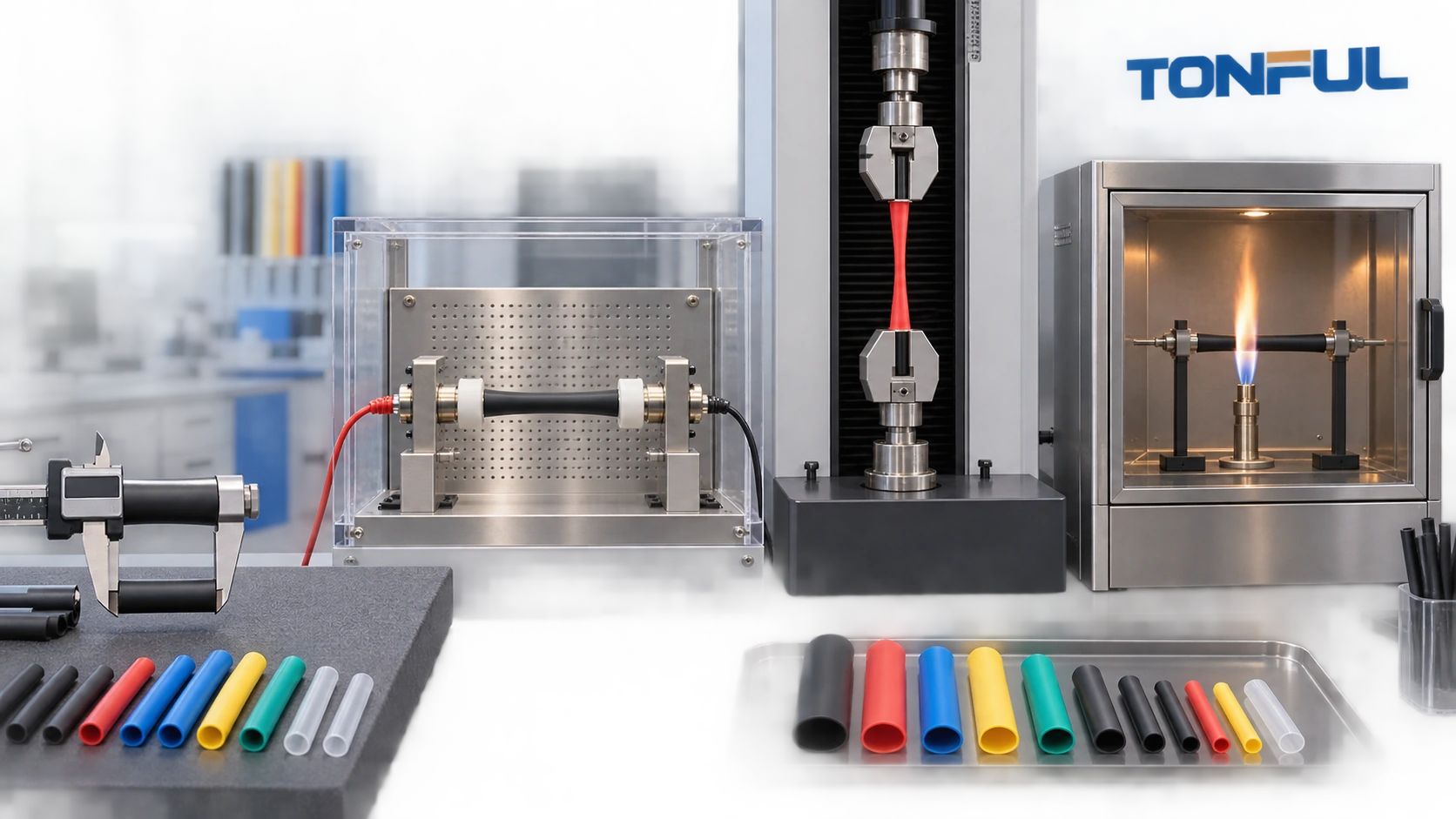
Conceptual illustration only—not an acceptance standard or evidence of a completed laboratory test.
Do not describe a product as flame-retardant, VW-1, self-extinguishing or compliant merely because an internal screening specimen stopped burning. Verify the exact product, color, wall construction, size range, marking, certification record and conditions of acceptability. UL notes that insulating-tubing categories can differ in intended use and evaluated properties; a flame-retardant tubing category is not automatically an electrical-insulation approval for contact with live parts.
Build an Integrated Evidence Matrix
Each claim should map to one controlled test and one acceptance source. Avoid a report that lists results but omits the decision basis.
| Claim or characteristic | Essential controlled conditions | Evidence to retain | Acceptance source |
|---|---|---|---|
| Expanded and recovered dimensions | Specimen locations, heating method, cooling and gauge force | Raw measurements and calculation | Product drawing or approved specification |
| Longitudinal change | Initial length, cut orientation and recovered length | Before/after values and formula | Applicable test method and product requirement |
| Dielectric withstand or breakdown | Electrode arrangement, medium, waveform, ramp/dwell and endpoint | Equipment traceability and raw voltage/current record | Applicable standard, drawing or qualification plan |
| Tensile strength and elongation | Specimen geometry, thickness, grips, speed and conditioning | Stress/strain data and failure location | Applicable method and product requirement |
| Flammability classification | Exact method, specimen, conditioning and flame sequence | Timed observations, photos and certification evidence | Applicable standard/category and product record |
ASTM lists D2671-21 as an active test-method reference for heat-shrinkable tubing. Obtain the controlled standard and confirm the contracted edition rather than copying values from an old summary or unrelated product data sheet.
Usable Heat Shrink Test Record
Use a vertical record that remains readable on mobile devices and can be transferred into a laboratory form.
| Record field | Required entry |
|---|---|
| Project and acceptance source | Customer specification, drawing, standard edition and qualification-plan revision |
| Sample identity | Product, size, color, construction, lot, date code and specimen ID |
| Sample allocation | Quantity per test, independent/sequential exposure, reference samples and destructive reserve |
| Conditioning | Time, temperature, humidity, medium and actual laboratory conditions |
| Equipment | Asset ID, range, resolution, accuracy, calibration status and fixture ID |
| Recovery setup | Heating medium, setpoint, exposure, support, cooling and measurement locations |
| Dielectric setup | Electrode geometry, medium, waveform/frequency, ramp/dwell and endpoint |
| Tensile setup | Geometry, direction, thickness, gauge length, grips, load cell and speed |
| Flammability setup | Method, orientation, flame source, sequence, timing and chamber condition |
| Results | Individual raw values, calculations, observations and initial/aged change |
| Invalid or retest event | Specimen ID, reason, evidence, authorization and replacement rule |
| Decision | Requirement, pass/fail, deviation, reviewer and date |

A vertical record connects each result to its sample, method, equipment and acceptance document.
Review Failures Without Hiding Variation
Quarantine affected samples and associated product when a valid failure occurs. Confirm identification and traceability before repeating the test. Review raw data, calibration, conditioning, specimen preparation and method execution. If laboratory error is demonstrated, document it and apply the approved invalid-test rule. If the failure is valid, investigate material, extrusion, irradiation or cross-linking, expansion, liner application, storage and recovery process as relevant.
Do not average away a failed specimen unless the governing plan explicitly defines that calculation and individual acceptance rule. Report all valid results, including outliers. A passing retest does not erase the original result; the disposition authority must evaluate both.
Trend production-monitoring data by product, size, color, material lot, line and date. Shifts inside the specification can still warn of process drift. Connect reaction plans to containment, review of prior lots, corrective action and release authority.
Release the Exact Tested Scope
A laboratory report should state exactly what was tested and what was not. Approval covers only the defined product, construction, size/color scope, material, process, test conditions and acceptance document. Changes to resin, additive, pigment, liner, dimensions, irradiation, manufacturing site or critical process may require review or requalification according to the approved change-control plan.
For installation-specific sealing decisions, use the adhesive-lined heat shrink tubing guide and validate the completed assembly rather than relying on tubing data alone.
Work With TONFUL
Send TONFUL the application, substrate dimensions, tubing construction, material preference, drawing revision, required test methods, acceptance-source documents, sample quantity and reporting format. TONFUL can discuss heat shrink tubing options and sample requirements for evaluation. Final ratings, certifications and acceptance criteria must be confirmed for the exact quoted product and approved project scope.
—