
Buying electrical tools in bulk creates more decisions than choosing a model and multiplying its unit price. A distributor needs saleable packs, identifiable spare parts and a replenishment plan. A panel shop needs tools that match approved tasks and replacements that do not interrupt production. Both need an order record that explains what was approved and who handles a discrepancy.
The practical starting point is a line-by-line purchase specification. Separate the tool, accessories, spare parts, packaging and commercial terms. Then connect each line to a sample or document that can be checked before shipment and again at receipt.
This guide provides a working structure for that order. It does not announce TONFUL’s minimum order quantities, pricing, lead times, warranty terms or spare-parts commitments. Those terms must be quoted and agreed for the actual models and destination.
Contents: Order definition; Samples; Spare parts; Packaging; Replenishment; Claims and release.
Define the Bulk Order Before Requesting Prices
A useful RFQ tells the supplier what each order line must contain. Begin with the intended application and exact model or proposed model family. TONFUL’s electrical tools product range separates different tool functions, which helps prevent a mixed enquiry from becoming an ambiguous request for a generic electrician’s kit.
For each model, state the required task, conductor or consumable construction, relevant terminal details and destination. If the model is not yet selected, describe the application and ask for supporting documents. Do not treat a product-family heading as approval of every model for the same work.
Make quantities and price bases explicit
Ask whether the quotation is per individual tool, set, case or other sales unit. List what is included and what is excluded. A low set price cannot be compared fairly with another quotation until dies, blades, accessories, batteries where applicable and packaging are aligned.
| Commercial field | What the buyer should enter or request |
|---|---|
| Line identity | Buyer SKU, supplier model, description and revision |
| Quantity basis | Tools or sets per line; separate spare quantities |
| Minimums | Requested quantity; supplier-confirmed MOQ and pack multiples |
| Price | Currency, unit basis, quantity breaks and quotation validity |
| Delivery basis | Agreed trade term, named place and applicable version |
| Timing | Sample, approval, production and dispatch milestones |
| Payment | Deposit, balance trigger, charges and agreed documents |
| Freight scope | Who books carriage, insures and handles destination costs |
| Evidence | Sample reference, specification, packing and inspection records |
Keep requested terms separate from accepted terms. A buyer’s desired delivery date is not the supplier’s confirmed dispatch date, and dispatch is not arrival. Ask what event starts the quoted schedule: payment, technical approval, packaging approval or another agreed release. Record dependencies rather than allowing different teams to work from different assumptions.
Approve Samples Against the Intended Order
A sample should answer a defined question. Is the tool compatible with the intended task? Does the kit contain the agreed accessories? Can the package survive the planned handling and remain identifiable? These questions may require different samples or documents; one attractive demonstration tool does not answer them all.
Define the sample model, revision, included items, packaging level and intended verification. Distinguish an early evaluation sample from a production-intent sample. If the supplier proposes a substitute, record the difference before evaluation so approval does not accidentally extend to untested features.
Test the combination, not the category name
For a crimper, identify the terminal, conductor and die or cavity, with acceptance criteria from the governing documents. TONFUL’s crimping tools range separates ferrule and other terminal applications. A completed ratchet cycle is not proof that every termination produced by that tool is acceptable.
For a stripper, provide representative insulation and conductor constructions. The stripping tool selection page is a starting point for model discussions, not evidence of damage-free processing on every wire. Evaluate the actual material, setup and resulting preparation under an approved plan.
Record sample quantity, inspection method, acceptance-source revision and disposition. Determine these through the buyer’s risk assessment and agreed plan, not an invented universal sample count. Define how invalid tests, failures and retests are handled. A replacement sample must not silently erase evidence that the original sample failed.
Keep a retained reference where practical and identify who holds it. Photographs can show included accessories and packaging arrangements, but they cannot replace compatibility evidence or demonstrate an internal mechanism’s durability. State exactly what approval covers and what remains open before releasing the bulk quantity.

Buy Spare Parts by Identity and Service Risk
Spare parts should be ordered against the model and assembly revision, not by approximate appearance. A blade with the same outline may have a different mounting feature or material. A die that fits the frame may still be unsuitable for the intended terminal. Require a part identifier, description and documented compatibility before adding it to the purchase order.
Separate consumable wear items, service assemblies and complete backup tools. Their stock policies differ. Blades may be replaced under an approved maintenance instruction; a damaged frame or hydraulic assembly may require qualified service rather than a field repair. Review the hydraulic tools family separately when identifying powered or pressure-operated service needs. Do not assume every internal part is user-serviceable.
Build a spare-parts record
| Spare field | Information to obtain |
|---|---|
| Parent model | Exact tool model and relevant revision |
| Part identity | Supplier part number, drawing or exploded-view reference |
| Compatibility | Approved models and restrictions |
| Replacement method | User-replaceable or qualified-service requirement |
| Order terms | Separately quoted quantity, minimum and price basis |
| Availability | Confirmed supply status and replenishment conditions |
| Storage | Manufacturer instructions and any shelf-life restrictions |
| Responsibility | Person maintaining stock and recording use |
Choose stock levels from expected consumption, downtime exposure and confirmed replenishment conditions. A universal percentage of the initial order can overstock rarely used tools while leaving a frequently replaced blade unavailable. If consumption history is absent, agree a provisional policy and review it after actual use rather than presenting a guess as a tested requirement.
Include service documents in the enquiry. TONFUL’s existing crimping tool maintenance guidance introduces maintenance topics, but the exact model manual and approved quality plan govern service and verification. Do not import broad performance claims from a general article into a purchase acceptance standard.
Keep maintenance safety separate from spare availability. Follow manufacturer instructions for isolation, battery removal and stored-energy release before blade or die access where applicable. Tools are not universally insulated or suitable for energized work. A stocked spare does not authorize an untrained operator to dismantle a hazardous mechanism.
Specify Packaging for Receipt, Storage and Resale
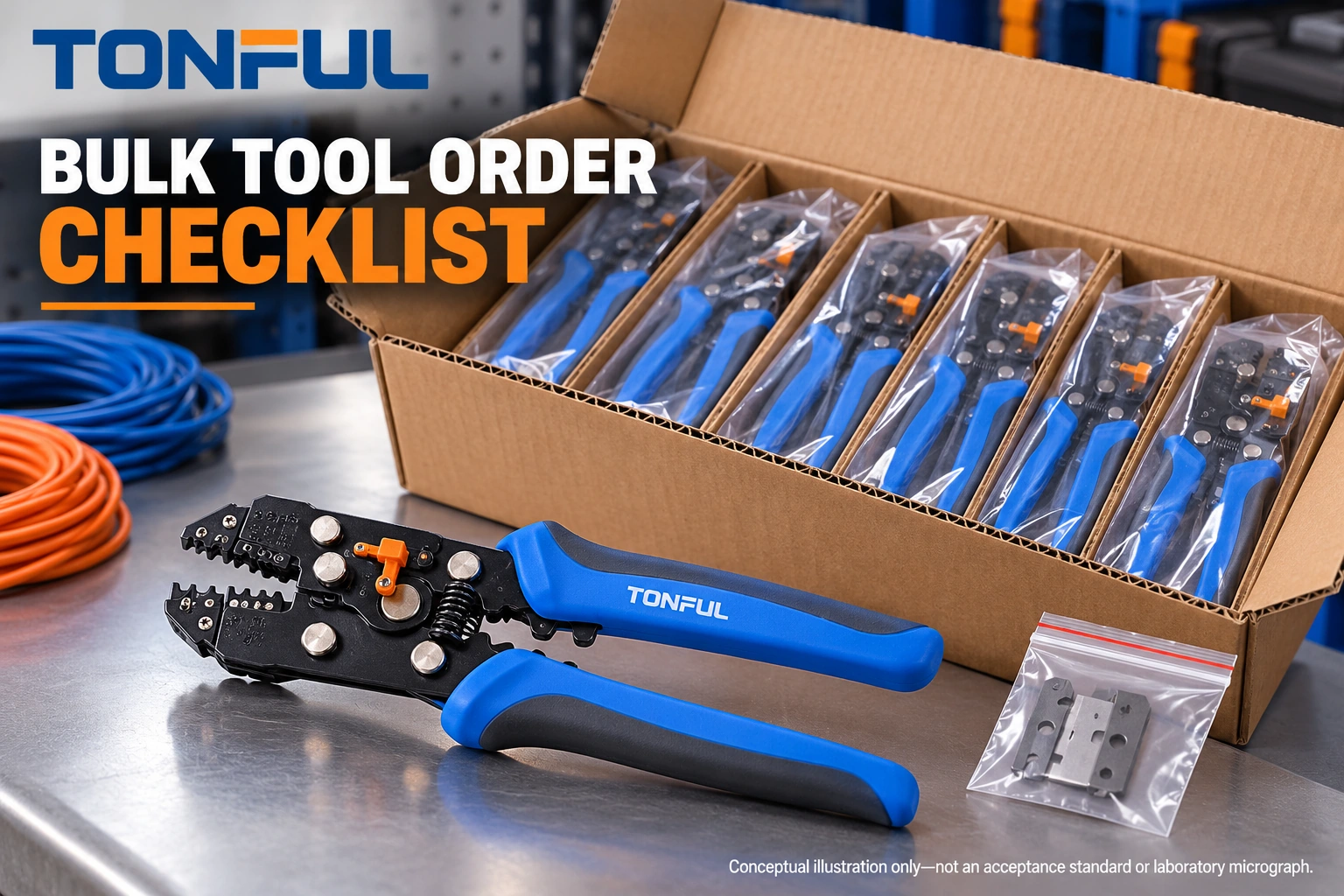
Packaging is part of the order configuration. Decide whether the tools will be issued directly to a workstation, stocked individually or resold as complete kits. The answer changes inner protection, identification and the information needed on each pack. Request a packaging proposal for review instead of assuming the catalogue photograph defines the shipping arrangement.
State which accessories belong with each tool and how loose items are restrained. Protect cutting edges and prevent small parts from escaping during handling. Where corrosion protection, moisture control or transport testing is required, define the environment, method and acceptance source with the supplier; do not label an unspecified package export-proof.
Make packing information match the order
Identify tool model, buyer SKU, contents, quantity basis, lot or traceability reference where agreed and destination labeling requirements. Specify label location and readable content. Barcodes need an agreed data format and scan check, not simply an image of a code on the artwork.
The US International Trade Administration’s packing-list guidance explains that a packing list itemizes package contents. Use that distinction to reconcile physical cartons with the commercial documents; a packing list is not a substitute for the invoice or for destination-specific customs advice.
Agree how carton numbers, inner packs and mixed-model cartons are recorded. Ask for agreed weight and dimensional information at the relevant shipping stage rather than inventing freight costs from product weights alone. Have the responsible logistics party confirm destination documents, tariff classification and any transport restrictions for the actual shipment.
Approve packaging evidence separately from tool performance evidence. A correct tool in an incorrect kit can still create a receiving discrepancy or resale problem. Keep a dated record of the accepted packing configuration and mark any change that needs renewed approval.
Plan Replenishment and Control Changes
Bulk purchasing works best when the next order is considered before the first one is exhausted. Separate demand forecast, committed purchase quantity and release schedule. A forecast helps discussion but should not become a binding quantity unless the parties explicitly agree that effect.
Review stock by model and spare, not by total tools on the shelf. A warehouse may have enough units overall but none of the model needed for an urgent panel build. Track usage, open orders and service withdrawals so the replenishment signal reflects usable stock rather than the purchasing system’s headline quantity.
Define the change-notification boundary
Ask which changes require notification and buyer approval: model substitutions, blade or die design, accessory content, packaging, labeling or relevant manufacturing changes. Record how the changed item will be identified. Do not accept a promise of same function as a substitute for reviewing a change that can affect compatibility or service stock.
Specify how old and new revisions will be segregated during transition. Decide whether the retained sample remains representative and whether existing spares are still compatible. Update the order record, workstation documents and receiving instructions together. Otherwise the warehouse can receive a formally accepted revision that the maintenance team cannot support.
Confirm replenishment terms afresh when conditions change. Earlier sample approval does not freeze price, quantity availability or dispatch timing indefinitely. Record quotation validity and approval status so repeat purchases remain controlled without restarting unnecessary private-label development work.

Assign Claim Responsibility and Release the Order
Agree a discrepancy process before goods move. Distinguish transit damage, shortage, wrong model, missing accessories and functional nonconformity. These categories need different evidence and may involve different parties. Allocation of costs and remedies belongs in the agreed terms, not in an assumption that the supplier, carrier or importer always pays.
Name the buyer’s receiving owner, supplier contact and logistics contact. Agree notification windows, evidence requirements and who authorizes return, repair, replacement, credit or disposal. Preserve relevant packaging and traceability information. Do not dismantle a failed tool before agreeing the investigation method if doing so could destroy evidence or create a safety hazard.
At receipt, quarantine affected stock and record carton identity, quantity, model, revision, photographs and the observed issue. Link the claim to the order line and acceptance requirement. Resolve whether unaffected stock may be released under the buyer’s process; do not automatically treat an entire mixed shipment as either conforming or unusable.
Before final order release, confirm that technical approval, commercial acceptance, spare compatibility, packing approval and claim ownership all have named owners. Mark unresolved items explicitly. Send TONFUL the model list, quantities, application evidence, spare-parts requests, packing needs and destination, then request a written quotation and confirmation of the open terms for buying electrical tools in bulk.