
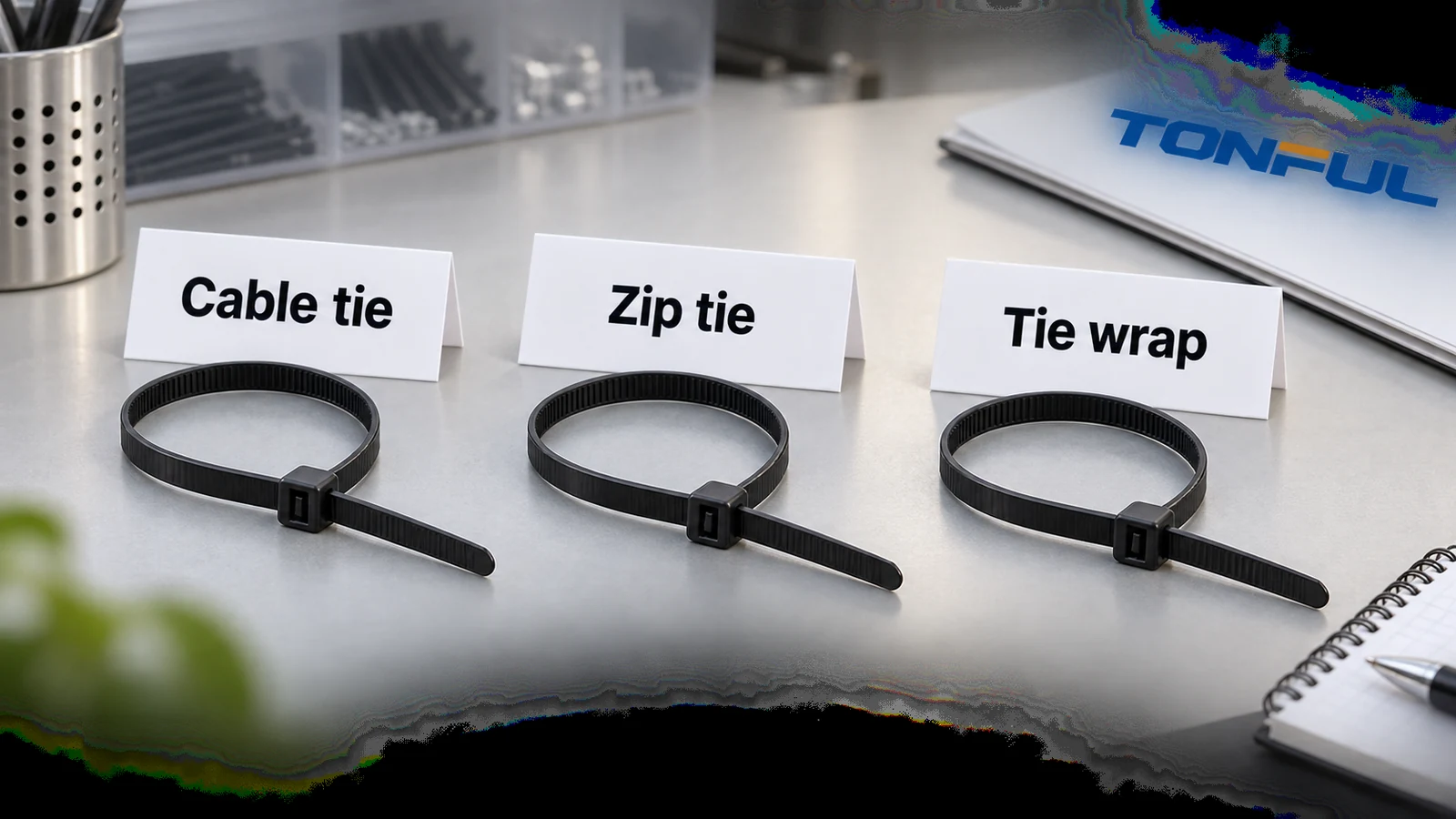
In ordinary conversation, “cable tie,” “zip tie” and “tie wrap” often mean a strap tightened around a bundle. The trouble starts when equivalent names are treated as equivalent products. A reusable wrap, nylon ratchet tie and stainless locking band can appear under similar search terms but are not interchangeable.
The short answer is that the three names commonly overlap, not that every item bearing them has the same construction or rating. HellermannTyton describes cable ties as also known as zip ties or tie-wraps. For electrical purchasing, however, the controlling part number, drawing, material and installation evidence matter more than the nickname. This guide explains the language and provides a specification checklist so engineers, distributors and installers can order the intended product. The TONFUL cable-tie range shows several families; a family name alone does not approve a particular installation.
Three Names, One Common Starting Point
“Cable tie” is the technical umbrella term most useful in drawings and product standards. It can cover polymer, metal and composite designs, depending on the applicable document and product class. “Zip tie” is a widespread everyday name, often associated with the familiar one-piece plastic ratchet. “Tie wrap” or “tie-wrap” is another colloquial name for a strap used to gather or secure items. In a casual conversation about organizing cords, the distinction may not matter.
In an RFQ, “heavy-duty zip tie” could mean wider nylon or stainless steel, while “cable wrap” could mean hook-and-loop. A mounting tie adds a fixing interface. Ask for the exact drawing and design rather than buying from a synonym.
The official IEC 62275:2022 title and scope use “cable ties” for products and associated fixing devices that manage or secure wiring systems in electrical installations. The scope includes metallic, non-metallic and composite cable ties. It does not say that all ties bearing a familiar name meet the standard, nor that all cable-management products have the same approved support function. An installation requirement must be checked against the exact part and any associated fixing device.
| Term in a conversation | Usual intent | What still needs confirmation |
|---|---|---|
| Cable tie | Strap-and-head fastening product | Material, geometry, rating, fixing and application |
| Zip tie | Often a one-piece ratcheting tie | Whether the requested design is actually permanent/releasable, plastic/metal |
| Tie wrap | Often a tie or wrapping fastener | Whether it is a ratchet tie, hook-and-loop wrap or other construction |
| Cable wrap/bundling wrap | Cable-management wrap | Closure method, reuse, pressure and applicable category |
| Mounting cable tie | Tie with integral or separate mount | Mating surface and fixing strength |
This is a practical language map, not a legal definition of product names or trademarks. Read the actual catalog drawing before substituting one item for another.
Construction Matters More Than the Nickname
A standard polymer tie uses a toothed strap and locking pawl; many are removed by cutting. Head and strap geometry control bundle range, profile and tool access. Equal nominal lengths can hide different usable lengths or head clearances. The TONFUL size and bundle guide separates these dimensions.
A releasable tie is not merely a loosely installed standard tie. It incorporates a release feature, and its useful repeat cycles depend on the design and conditions. A hook-and-loop wrap is another serviceable option, but it closes by contact between mating textile-like surfaces rather than a molded ratchet head. It may be preferable for access or sensitive cable jackets in some sites, while its own width, holding force, contamination and reuse condition still need control. For maintenance-oriented choices, consult the TONFUL releasable-tie guide and the site cable-management specification.
Stainless-steel ties use a metal strap and a different lock. They may address some temperature or corrosion demands beyond a selected polymer, but can introduce sharp-edge, tool and cable-jacket protection issues. The term “zip tie” does not tell you whether the strap is polymer or metal. The TONFUL nylon-versus-stainless guide compares material decisions; it does not make every stainless tie suitable for every marine, outdoor or electrical location.
A push mount, edge clip, screw tab or marker head changes function. The TONFUL types-of-cable-ties guide distinguishes these families. Specify mounting and marking rather than assuming a search term conveys them.

Conceptual product-family illustration only. Use each manufacturer’s drawing and part-specific evidence for selection.
The Standard Uses More Precise Categories
UL Solutions’ cable-tie application guide identifies cable ties, fixing devices, bundling wraps, cable wraps and wiring ducts as related positioning products. The guide explains that product suitability depends on the certified mechanical and environmental conditions and on how the device is installed. In other words, similar purpose does not mean identical evaluation or authorization.
This is particularly important when a tie is expected to support cable or conduit weight. Securing cables together, positioning them against a support and serving as the primary support are different functions. An ordinary loop tensile figure cannot be treated as a safe suspended load. Where an electrical installation requires a support-rated arrangement, check the appropriate product classification, compatible fixing device, mounting hardware and installation instructions. The words “heavy-duty tie wrap” do not supply any of those details.
UV, temperature, corrosion and fire claims belong to exact products, not a name or color. Specify polymer formulation or stainless grade/coating. Verify certification by model, rating and application rather than transferring a family claim to another SKU.
Translate Informal Requests Into a Real Specification
When a requester writes “100 black zip ties,” ask about bundle range, permanent versus serviceable use, mounting, sun, heat, chemicals, salt, tool and any required product class.
Use the TONFUL cable ties buying guide for the full material-size-strength workflow. A concise purchase line can then state: “Polymer ratchet cable tie; specified material grade and color; controlled overall and usable length; strap width; head envelope; approved bundle range; required mechanical property and test method; installation conditions; bag quantity and lot marking.” Add mounting and certification fields when the application calls for them. This is more reliable than “same as a large black tie wrap.”
| Specification field | Why it prevents a wrong substitution |
|---|---|
| Part number and revision | Links every delivery to an approved drawing |
| Product family and head | Distinguishes ratchet, releasable, marker and mounting designs |
| Material and condition | Separates nylon grades, stainless alloys and storage-sensitive products |
| Dimensions and bundle range | Confirms minimum and maximum installed fit |
| Strength and method | Makes ratings comparable under defined conditions |
| Environment | Connects UV, heat, chemical or corrosion evidence to use |
| Installation | Names tool, head orientation and allowed cable-jacket condition |
| Packaging and traceability | Enables receiving checks and lot containment |
Specify the acceptance source for each value. A property without a method, condition or limit source may be impossible to compare. Do not copy a competitor’s entire datasheet into a buyer drawing simply to make a “match”; derive necessary limits from the actual assembly and approval plan.
Compare Similar-Looking Products on the Assembly
Suppose a service team uses “zip tie” for a standard nylon tie in an equipment cabinet. A distributor offers a bag labeled “tie wraps” with the same nominal length. Before substitution, compare the head height near connectors, usable loop at both bundle limits, strap width against cable insulation, tool compatibility, color identification, material and temperature evidence. The bag names may be synonymous, but these dimensions and conditions may not be.
Build first pieces with both products. Inspect head seating, jacket marks, retention, cut quality and access. Include the fixing device and substrate where used. A hand-closed desk loop does not prove production-tool fit; retain sample and lot identities.
Switching to hook-and-loop may improve service access but change the envelope and restraint. Stainless may suit heat yet need insulation protection and a different cutter. Approve the changed assembly and instruction, not only a catalog cross-reference.
If a supplier says “equivalent,” ask which characteristic, test condition, evidence document and allowed application support that word. A color or nominal size match alone says little.
Avoid Common Installation Mistakes
Neither the word cable tie nor zip tie tells an installer how tight to pull. Excess tension can indent insulation or flatten data cable jackets; inadequate retention can allow movement or abrasion. Follow the project work instruction and cable maker’s constraints. A tool setting must be validated on the actual bundle and tie, not selected by matching a tie’s maximum loop-strength number.
Trim tails according to the approved tie-and-tool design and inspect for a sharp projection or damaged locking head. Do not assume every head must be cut absolutely flush or that every design must retain the same tail length. A releasable tie needs access to its release tab, while a permanent tie should be removed with a method that protects the cable beneath it. A metal tie requires attention to cut edges and tool compatibility. These practical differences matter more than the search keyword used to buy the part.
Store bulk product according to its material and supplier instructions. For nylon, packaging and moisture condition can affect handling; for metal, contamination and corrosion-related controls may matter. Keep part numbers and lots separated in bins even when workers call both products “zip ties.” Mixing bags during replenishment defeats the specification and makes a complaint investigation much harder.
A Quick Decision Path for Buyers
Use common language to start the conversation, then move to a controlled decision:
- Identify the task: bundle, mount, mark, temporarily hold or provide specified support.
- Identify the design: permanent ratchet, releasable ratchet, hook-and-loop wrap, metal tie or special head.
- Measure the application: bundle range, head clearance, mating surface and movement.
- Identify the environment: temperature, UV, moisture, chemicals, cleaning and fire context.
- Require part-specific evidence: drawing, test method, certifications where applicable and lot traceability.
- Trial the installed assembly with the intended tool and record the approved part and revision.
This sequence works whether the request says “cable tie,” “zip tie” or “tie wrap.” It also creates a useful record for the next buyer, who will not have to guess what the original shorthand meant.

Illustrative purchasing review; the names on packaging do not replace a part drawing or application approval.
Ask TONFUL for the Exact Product, Not Just a Name
Send TONFUL the bundle measurements, required product family, material and environment, head or fixing interface, installation method, test property and packaging needs. The team can compare these with named items in the TONFUL cable-tie range and provide drawings and samples for review. Do not assume that a product called a zip tie is automatically approved because a cable tie previously worked in the location.
The practical answer is simple: the names often mean the same general fastening category, but the parts may differ substantially. A good purchase order translates the nickname into a precise, testable and traceable product description.
Technical Sources
- HellermannTyton cable ties and fixings: official manufacturer use of cable tie, zip tie and tie-wrap as overlapping names.
- IEC 62275:2022: official cable-tie and fixing-device scope.
- UL Solutions cable-tie application guide: distinction among related positioning devices and part-specific installation conditions.