
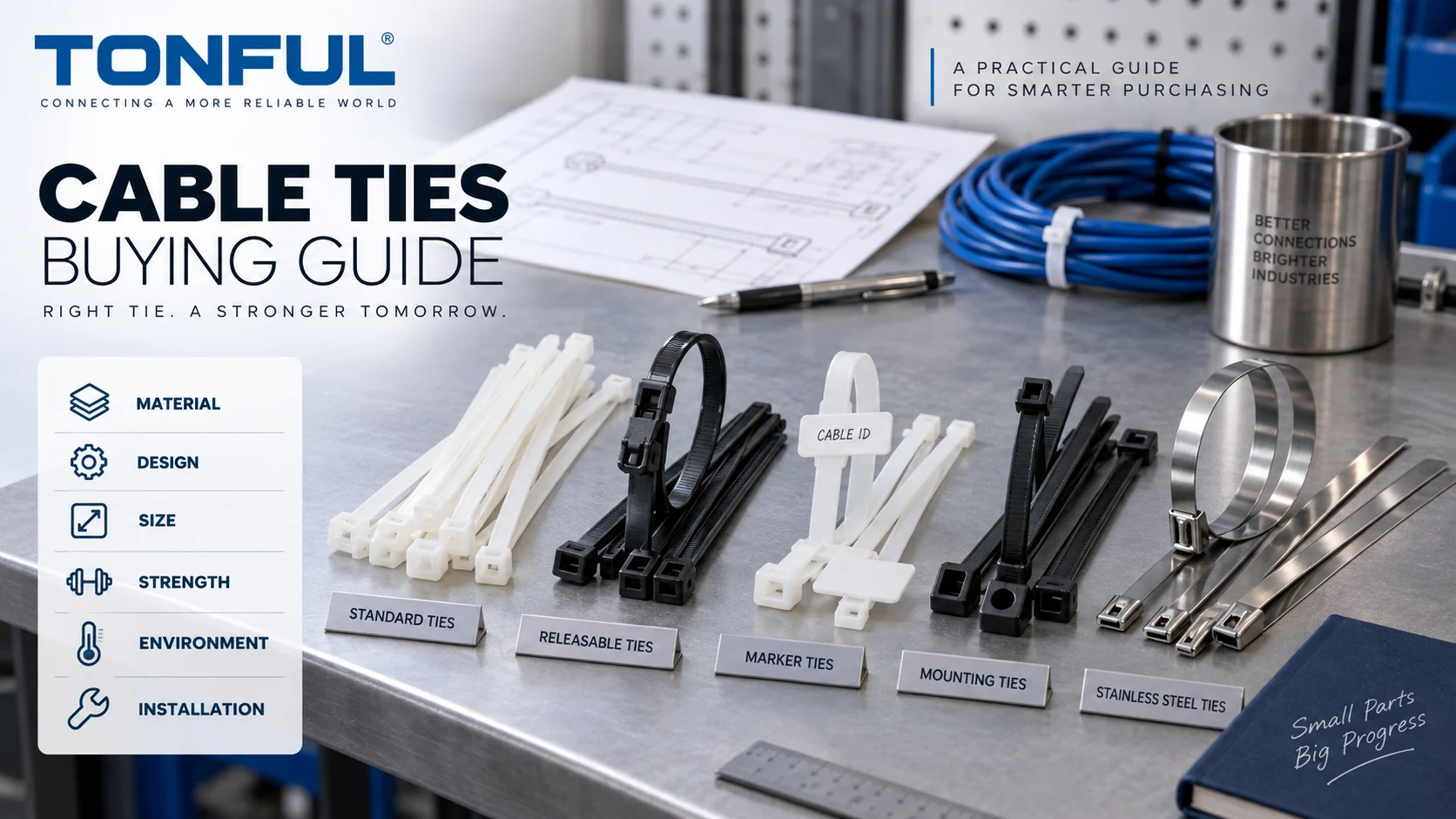
Choosing a cable tie is not simply a matter of matching length and color. The tie must fit the actual bundle, tolerate installation without damaging insulation, retain the bundle under service loads and remain suitable for temperature, moisture, sunlight, chemicals, vibration and maintenance. A visually similar substitute can have a different resin, locking design, usable bundle range or verified performance.
This cable ties buying guide gives engineers, harness teams, distributors and OEM buyers a repeatable selection process. It does not provide universal load, temperature or service-life values. Final requirements must come from the application specification, applicable installation rules, controlled manufacturer data and an approved sample.
On this page: Define the Application | Choose Material and Design | Select Size and Strength | Validate the Purchase
Define the Application
Decide Whether the Tie Bundles, Positions or Supports
First define the function. A tie may organize conductors inside equipment, position a harness on a panel, restrain a hose, identify a circuit or secure a bundle during assembly. Those tasks do not automatically make the tie an approved structural support.
The IEC page for IEC 62275 describes requirements for metallic, non-metallic and composite cable ties and associated fixing devices used for management and support of wiring systems in electrical installations. The applicable product classification, installation condition and local code still need confirmation. Do not assume every packaged zip tie is suitable for electrical-installation support.
Record whether failure would create clutter, abrasion, loss of clearance, contact with heat or moving parts, or a safety-related wiring condition. Criticality affects evidence, inspection and redundancy, not just tie size.
Capture the Real Environment
List continuous and short-duration temperatures, indoor/outdoor exposure, sunlight, water, humidity, salt, cleaning agents, fuels, oils, process chemicals, radiation, vibration, shock and fire-performance requirements. Include installation temperature because a polymer can behave differently during tightening than after conditioning.
For outdoor work, color alone does not prove UV resistance. For wet service, low water absorption does not prove that a tie is “waterproof” or suitable for every chemical. The cable-tie water and material guide explains these boundaries.
Choose Material and Design
Compare Material Families
| Material family | Typical reason to consider it | Evidence to request | Common selection mistake |
|---|---|---|---|
| PA66 nylon | General indoor bundling, broad design availability and economical processing | Grade, conditioning, temperature and strength data | Treating all nylon grades and moisture states as identical |
| PA12 nylon | Lower moisture uptake and selected outdoor or low-temperature applications | Exact compound, UV stabilization and project qualification | Assuming PA12 is automatically suitable for every solar installation |
| ETFE | Chemical, radiation or elevated-temperature applications where specified | Resin identity, environment-specific data and test evidence | Using a generic “high temperature” claim without duration or exposure details |
| 304 stainless steel | High strength and environments beyond polymer capability | Grade evidence, locking design, edge condition and corrosion context | Assuming 304 and 316 provide equal coastal resistance |
| 316 stainless steel | Marine, coastal or more corrosive environments when supported | Material verification and installed-system review | Ignoring contact with dissimilar metals or coated-cable damage |
Use the PA66 versus PA12 solar guide and 304 versus 316 stainless guide for deeper material comparisons. Material name alone is not a release criterion; additives, colorants, processing, conditioning and geometry also affect performance.
Select the Head and Mounting Design
Standard one-piece self-locking ties suit permanent bundles. Releasable designs help with temporary routing or repeated access, but reuse cycle life and retained locking performance require product-specific evidence. Marker ties combine fastening and identification. Mountable-head, push-mount, fir-tree and edge-clip designs position a bundle relative to a hole, stud or panel edge.
For panel mounting, verify hole or edge dimensions, panel thickness, insertion force, retention, orientation, harness offset and removal needs. Adhesive bases add surface preparation, adhesive compatibility, cure and environmental-aging questions. The edge-clip cable tie guide shows why clip and panel geometry must be treated as an interface.
Stainless ties can use ball-lock or other locking arrangements and may be coated to reduce direct metal contact. Confirm tail handling and cut-edge condition. A high-strength metal tie can damage insulation if installed without the correct tool, protection or design clearance.

Conceptual selection matrix only; use controlled product and application requirements for approval.
Select Size and Strength
Start With Usable Bundle Diameter
Measure the bundle at the installation location and include tolerance, branch transitions, coverings and future additions permitted by the design. Compare the result with the manufacturer’s minimum and maximum usable bundle diameter, not merely the tie’s nominal length.
Length must provide enough tail for controlled installation and tooling, but excessive unused length increases waste and handling. Width and thickness influence stiffness, head size, contact area and tool compatibility. A wider tie may distribute pressure better, yet it can be unsuitable near small-radius wires, connectors or narrow routing channels.
The UL application guide for positioning devices notes that manufacturer-recommended bundle diameter is a product-selection consideration. Use the exact recognized or specified product data; do not calculate maximum bundle solely from tie length.
Understand Minimum Loop Tensile Strength
Minimum loop tensile strength is a controlled test property of a closed tie loop under specified conditions. It is not the same as safe suspended weight, installed harness support capacity or long-term load rating. The result depends on the complete tie, including strap, teeth, pawl and head.
Use the cable-tie tensile-strength guide to distinguish test property from application capacity. Request the test method, conditioning, sample quantity, equipment, loading rate, failure mode and acceptance source. Do not compare two catalog numbers when one result is conditioned and the other is dry-as-molded or tested by another method.
Control Installation Tension
More tension is not automatically better. Excessive tightening can deform insulation, concentrate stress, restrict cable movement, mark hoses or damage optical and data cables. Too little tension can permit movement, abrasion, noise or locking-tooth disengagement. Define the intended bundle condition and use a suitable tensioning tool where repeatability matters.
Place the head and trimmed tail where they will not create an abrasion or service hazard. A flush-cut tool should not leave a sharp projection. For sensitive bundles, verify pressure and routing after thermal movement and vibration rather than judging only the initial appearance.

Measure the real bundle and document the strength method, conditioning and installation control before approving a cable tie.
Do Not Use Color as a Performance Specification
Natural and black are common cable-tie colors, while red, blue, green, yellow and other colors may support assembly identification. Color does not independently prove resin type, UV stabilization, flame performance, chemical resistance or temperature capability. A black pigment can be present without the formulation and exposure evidence required for an outdoor project, and a custom color can change optical inspection, marking contrast or material behavior.
Specify the color purpose separately from the performance requirement. If color identifies voltage, circuit, inspection status or production line, control the approved color reference, viewing conditions and change process. For outdoor or regulated applications, require the material and test evidence in addition to the visual color. The colored cable ties guide explains how identification value and material limits should be reviewed together.
Include Packaging, Storage and Installation State
Cable ties arrive as a packaged product, not an isolated molded part. Bag seal, quantity, label, lot identity and storage condition can affect assembly reliability and traceability. Nylon ties can change moisture condition after packaging is opened or stored in a dry environment. Do not restore flexibility by applying an uncontrolled liquid or process; follow the supplier’s approved conditioning and storage instructions.
Define receiving checks for damaged bags, mixed sizes, incorrect labels, contamination and brittle handling. State whether partially used bags may return to stock, how long they may remain open and how lots are segregated. Installation trials should use material in the approved storage and conditioning state, because a sample prepared differently from production stock does not demonstrate line performance.
Qualify Alternatives by Function, Not Appearance
When replacing an existing tie, compare the application requirement rather than copying one brand’s catalog line. Match material and stabilization, usable bundle range, head and strap envelope, locking direction, minimum loop tensile requirement, mounting interface, installation tool and environmental evidence. Confirm that the alternative fits nearby connectors, edges and service access.
Use production-intent samples and the same approved conditioning and test methods. A candidate that achieves a similar tensile result can still differ in stiffness, insertion force, pawl engagement, cut-tail quality or long-term environmental behavior. Record deviations and approve only the named part, revision and scope; visual similarity is not equivalence.
Validate the Purchase
Use a Copyable Selection Record
| Selection field | Required entry |
|---|---|
| Application and function | Bundle, position, mount, identify or specified support role |
| Bundle definition | Diameter range, conductors, covering and allowed future content |
| Material | Exact polymer compound or stainless grade and coating |
| Design | Standard, releasable, marker, mounting or application-specific head |
| Size | Length, width, thickness, head envelope and usable bundle range |
| Strength | Required property, method, conditioning and acceptance source |
| Environment | Temperature profile, UV, moisture, chemicals, vibration and fire context |
| Installation | Manual/tool method, tension setting or control, tail treatment and access |
| Mounting interface | Hole, panel edge, thickness, fastener, adhesive or fixing-device details |
| Evidence | Drawing, datasheet, test report, sample ID, lot and approval status |
Review Samples and Supplier Evidence
Inspect molding quality, head fill, strap edges, teeth, pawl, straightness, color consistency and contamination. Verify dimensions and locking direction. Test production-intent samples using the approved method and conditioned state. Record failure mode: strap break, tooth damage, pawl release, head fracture or mounting-device pullout can require different corrective actions.
For bulk orders, define resin or alloy traceability, conditioning and packaging controls, inspection sampling, labeling, shelf/storage conditions and change notification. Nylon moisture condition can affect installation behavior, so use the moisture conditioning and storage guide when planning warehouse and receiving controls.
Final Buying Checklist
- The tie’s role and failure consequence are defined.
- Material and stabilization match the documented environment.
- Head style and mounting interface fit the assembly process.
- Usable bundle range covers tolerance without relying on nominal length alone.
- Strength evidence uses a stated method and conditioning.
- Installation tension protects the bundle while controlling movement.
- Tool, cut-tail and service-access requirements are documented.
- Product, lot, packaging and change-control evidence is available.
- The approved sample represents the intended production configuration.
Work With TONFUL
TONFUL’s cable tie product range includes multiple material and design families shown on the current site. Send the bundle range, environment, mounting interface, required test evidence, installation method, quantity and packaging needs. TONFUL can review the sourcing request against current products and sample options; final selection remains tied to the approved specification and application validation.