
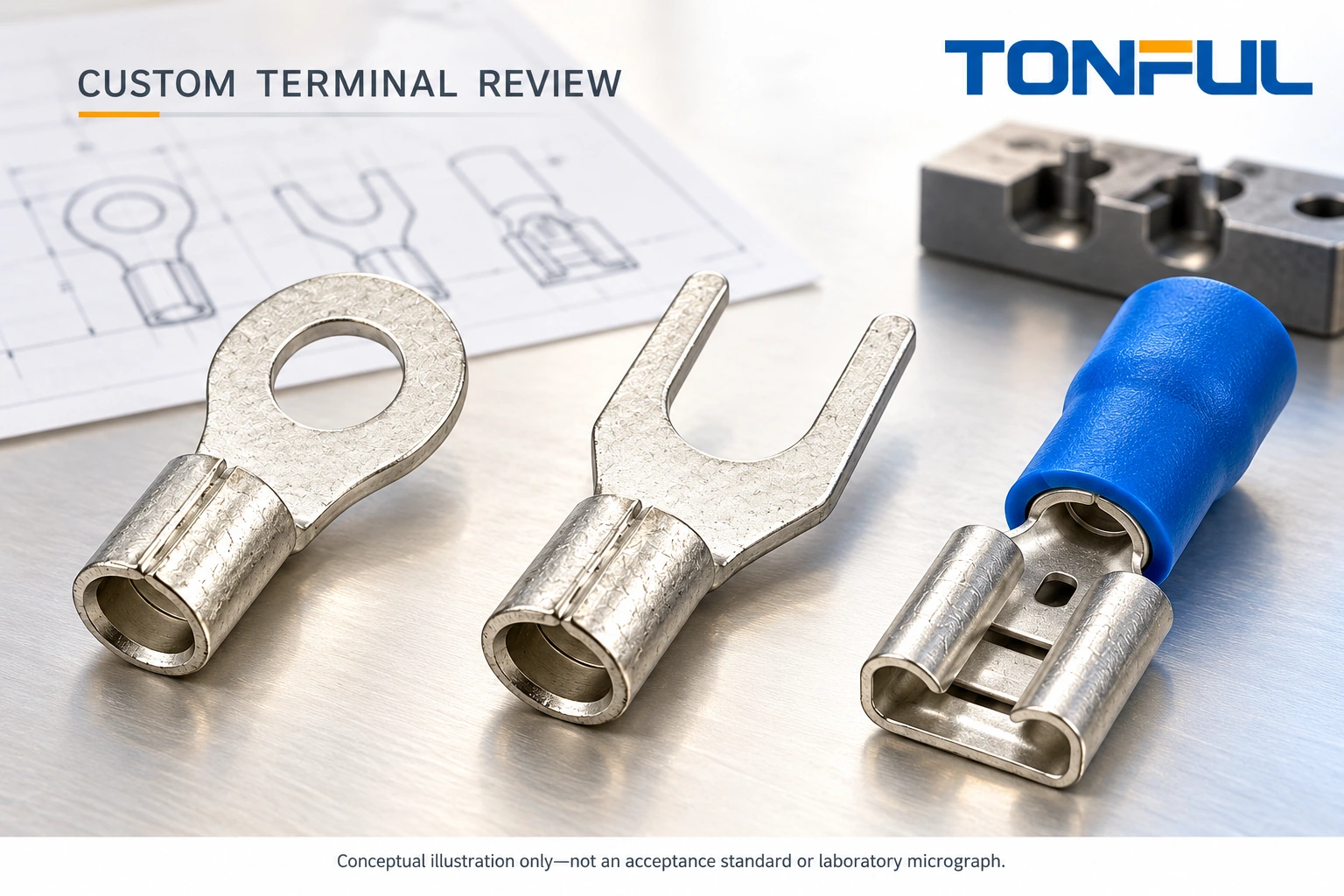
Custom electrical terminals should begin with a controlled interface requirement, not a request to copy the shape of a loose sample. The sample may conceal material, plating, tolerance or mating details that determine whether the new part works. A visually similar terminal can create a different crimp process or fail to engage the intended equipment interface.
Before committing to tooling, agree who owns the drawing, which dimensions matter, how the termination will be assembled and what evidence releases production. The workflow below provides decision gates and record fields for buyers, design engineers and quality teams. It does not imply that a custom construction, approval or production capability has already been confirmed by TONFUL.
Jump to: Custom scope | Drawing review | Tooling | Samples | Design freeze | TONFUL inquiry
Decide What Really Needs to Be Custom
Separate a new terminal design from a packaging change, an existing-part selection or a wire-harness process change. If a standard part already fits the documented interface and application, custom tooling may add cost and control work without improving the result. Ask the supplier to explain the standard option before authorizing a new geometry.
Write a Functional Brief
State the connection function, mating component, conductor construction, operating environment and assembly method. Explain the problem the custom part must solve: restricted installed height, a specific tab or stud interface, retention needs, access or another measurable constraint. Avoid adjectives such as stronger or better unless the project defines what will be measured.
TONFUL’s wire terminal manufacturing overview can support an initial family review. Request a written distinction between an existing catalog model, a modified construction and a genuinely new part. Each route may require different evidence, commercial commitments and change controls.
Establish Design Authority
Name the person or organization authorized to approve dimensions, materials and deviations. Clarify whether TONFUL is reviewing a customer-controlled design or proposing a supplier-controlled candidate. Commercial agreement on a price does not mean engineering has approved the design.
If the project includes safety-related, vehicle restraint, traction-voltage or other regulated equipment interfaces, use the responsible OEM’s development and qualification route. A general terminal-development workflow is not authorization to substitute parts in those systems. Review samples in a safe, deenergized setup; any energized evaluation needs its own approved procedure and qualified personnel.
Review Custom Electrical Terminals Against the Mating System
Review the terminal in its installed relationship to the wire and mating component. For a receptacle, include the actual mating tab width, thickness, engagement length and retention feature. For a ring terminal, include the stud and hardware stack. For a clamp-preparation sleeve, include insertion depth, opening and accepted crimp profile.
| Drawing topic | Information to resolve | Consequence if missing |
|---|---|---|
| Identity and revision | Part number, drawing owner and revision rule | Samples cannot be tied to release |
| Mating interface | Functional dimensions, orientation and datum scheme | Apparent fit may hide poor engagement |
| Wire accommodation | Conductor material, area, stranding and insulation envelope | Barrel or support may not accept actual wire |
| Material construction | Alloy or grade, condition and relevant material controls | Forming and service assumptions remain unclear |
| Plating | Specified finish, coverage and evidence method | Surface appearance becomes the only reference |
| Edges and features | Burr direction, cutoffs, seams and critical formed areas | Assembly or insulation damage may be overlooked |
| Inspection | Characteristics, methods and acceptance documents | Buyer and supplier inspect different things |
Distinguish Critical Dimensions From Reference Geometry
Not every dimension has the same functional importance. Identify dimensions controlling mating, wire entry, retention and installed clearance. Agree a datum scheme and measurement method that can reproduce the intended relationship. Avoid placing an unnecessarily tight tolerance on every feature; it may complicate manufacture while leaving a critical interface poorly defined.
A photograph or scan can support discussion but should not be the only authority. Where a retained sample helps communicate appearance, identify its limitations and link it to the drawing. Do not reverse-engineer a material grade or plating thickness from color alone.
For a candidate based on TONFUL’s non-insulated terminals, review the metal geometry and application separately from any later sleeve or enclosure. If a nylon-insulated construction is proposed, include the insulation envelope, assembly sequence and required evidence in the drawing review.

Separate Part Tooling From Application Tooling
Tooling that makes the terminal is not the same as tooling that attaches it to a wire. The project may involve forming, stamping or other manufacturing tools, plus a crimp applicator, die, locator or service tool. Identify which items are actually required instead of assuming one tooling charge covers the whole process.
Define the Manufacturing Tool Agreement
Document tooling ownership, permitted use, storage, maintenance responsibility and the conditions for transfer or retirement. Agree who approves repairs or modifications that can affect product characteristics. Include what records are available to demonstrate the tool’s identity and the configuration used for samples.
Discuss loose-piece versus strip or reel supply where relevant. Carrier geometry, feed direction and cutoff features can affect both manufacture and downstream assembly. A terminal approved as a loose piece may need additional review before it can run on an automatic applicator.
Define the Termination Process
TE’s official application-tooling overview distinguishes tooling tasks such as crimping terminals to wires and processing other interconnections. Use the same discipline in your project: specify the actual termination task and obtain part-specific application information, rather than treating all crimp tools as interchangeable.
Ask TONFUL’s crimping tool team about the exact candidate, wire and proposed production method. Record cavity, locator, setup and inspection instructions. If samples use different equipment from production, identify the difference and require a justified transfer plan.
For a custom sleeve related to cord end terminals, review compatibility with the accepting clamp as well as the crimp. A successful sleeve crimp alone does not prove that the completed conductor end fits the equipment opening or seats to the required depth.
Approve Samples With an Evidence Matrix
Before samples are made, agree what they represent: appearance models, dimensional prototypes, process-development pieces or production-intent parts. These categories are not interchangeable. A prototype can answer a packaging question without representing the final alloy, finish or production process.
Define the Sample Plan Before the Results
Specify the required sample quantity and its rationale, manufacturing source, tool configuration, wire combinations and evaluation conditions in the project plan. State acceptance documents and the responsible reviewer. Do not choose a quantity or passing limit after seeing favorable samples.
Where testing is required, use the applicable method and competent personnel. The plan should state the fixture, conditioning, equipment capability, invalid-test rules and acceptance source appropriate to that test. This is a development-release checklist, not a substitute for a complete pull-force, resistance or environmental-test procedure.

| Approval gate | Evidence to retain | Release question |
|---|---|---|
| Drawing baseline | Approved revision and unresolved-question list | Is the intended construction fully defined? |
| Sample identity | Lot, tool configuration, material and process record | What was actually supplied? |
| Dimensional review | Characteristic-level results and measurement basis | Do functional features meet the drawing? |
| Application review | Actual wire, mating component and assembly record | Does the termination fit and assemble as intended? |
| Required evaluations | Approved reports linked to sample identities | Does evidence cover the agreed duty and environment? |
| Disposition | Accepted scope, deviations and responsible signatures | Is production authorized, limited or still blocked? |
Handle Deviations Explicitly
If a sample uses a temporary finish or a different wire source, do not mark the whole design approved. Record what the evidence supports and what remains open. Temporary acceptance must identify quantity or scope, responsible authority and the required next action, rather than becoming an undocumented production standard.
Keep rejected samples and superseded records identified. A retained reference sample can explain appearance or assembly intent, but it cannot override a drawing requirement. Release should be based on the agreed evidence matrix, not the fact that the sample was delivered on time.
Freeze the Configuration and Control Changes
Design freeze is a defined baseline, not a promise that nothing will ever change. Link the approved terminal drawing to material, finish, manufacturing source, application tooling, wire and relevant process documents. Record which elements are controlled by the customer and which by the supplier.
Make Production Handover Reproducible
Transfer the approved setup and inspection requirements into production instructions. Define first-piece verification and the response to tool changes, material changes, restarts and other relevant events. Specify how nonconforming work is segregated and how the affected lot is identified.
Agree packing orientation, reel or loose-piece identification and protection of functional surfaces. Packaging is part of preserving the accepted construction, not just a freight decision. Include labeling that connects received parts to the approved model, revision and lot without inventing a universal label format.
Define Change Notification
List changes requiring prior review, such as material grade, plating, geometry, manufacturing location or application-tool configuration. Require the proposed change, reason, affected items and supporting evidence. A supplier’s unchanged sales number does not demonstrate that the termination system remains identical.
Purchasing should keep engineering deviations separate from commercial concessions. A price reduction cannot close an unresolved functional issue. Likewise, a successful repeat order does not extend the approval to a new mating component or wire construction without review.
Resolve Tooling Exit Conditions
Before the first production order, agree what happens if the project pauses, the tool needs major repair or supply is transferred. Identify the records and physical items available for handover, and distinguish ownership from the practical right to use a tool at another site. A transferred tool may require installation review and new process evidence; ownership alone does not establish an equivalent termination. Include responsibility for preserving drawings, setup records and retained samples. These are proposed commercial and technical discussion points, not a statement that TONFUL offers a particular transfer arrangement. Obtain the actual agreement in writing for the project.
Request a Documented Feasibility Review From TONFUL
Send TONFUL the functional brief, controlled drawing, mating-component information and actual wire specification. Include expected supply form, assembly method, required evidence and the design authority’s contact. Identify target constraints as requests for assessment, not as capabilities the supplier has already confirmed.
Ask for a written feasibility response covering standard alternatives, open drawing questions, tooling scope, sample stages and the proposed approval route. Commercial terms, timing and custom options must be confirmed for the project. Do not infer them from a general manufacturing page.
Use the drawing table and sample matrix to agree the next gate with TONFUL. Authorize production only after the responsible engineering and quality teams accept the exact configuration and its evidence, with tooling responsibilities and future change controls recorded in the project file.