
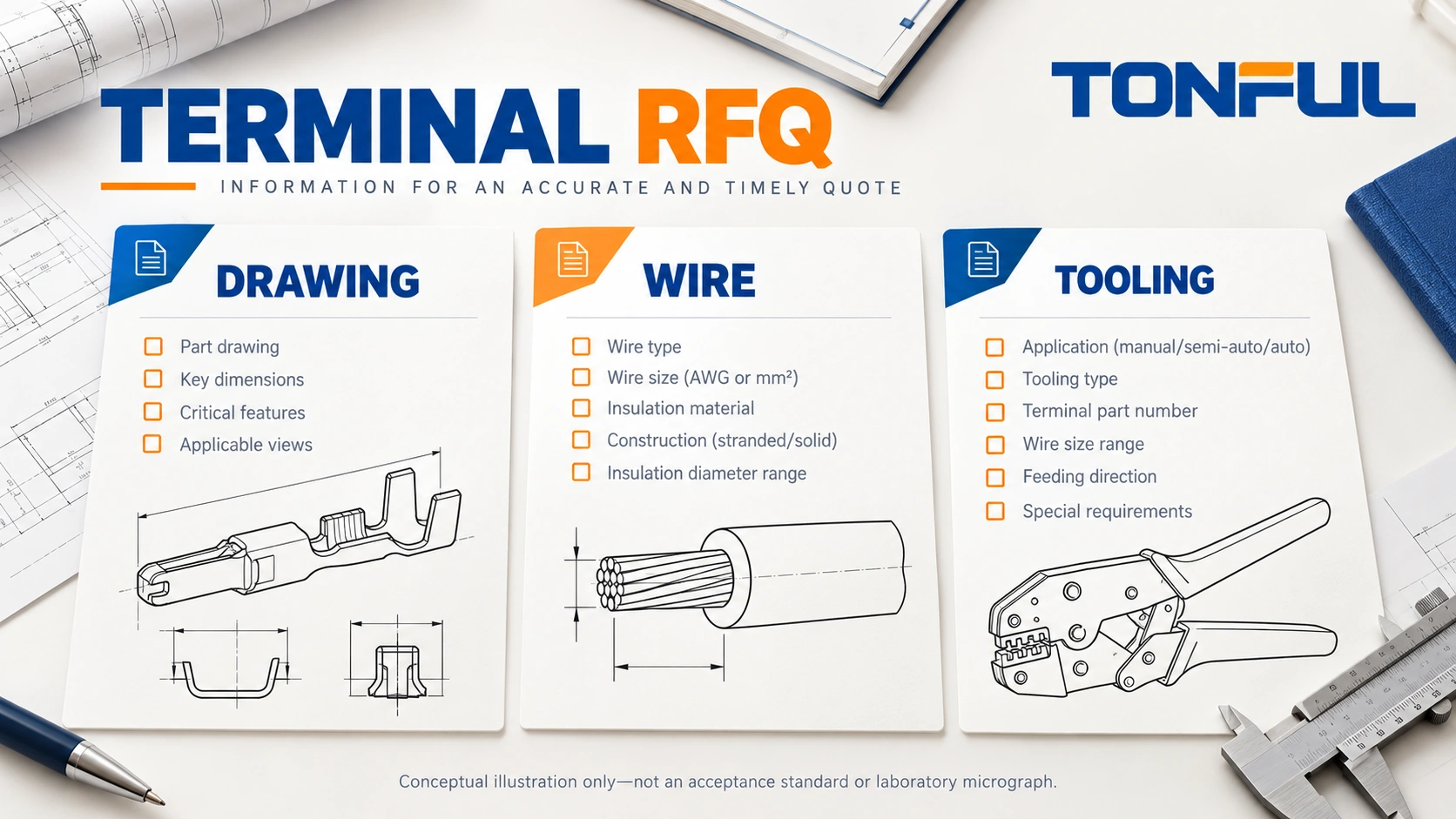
An electrical terminal and connector RFQ checklist should remove the assumptions that make quotations impossible to compare. A supplier needs more than a terminal photograph, a wire gauge and an annual quantity. The quote must identify the connection interface, conductor construction, approved crimp process, delivery format and evidence expected before production release.
Use the records below as a controlled RFQ attachment. They are an editorial procurement framework, not a universal product specification. Engineering owns technical acceptance; purchasing owns commercial comparison; quality owns the evidence needed for release. Keep unanswered questions visible instead of allowing each bidder to fill the gaps differently.
Jump to: Scope and identity | Drawing register | Wire schedule | Tooling matrix | Packaging and commercial records | Quote and sample release
Scope and Identity
Define the item being purchased
Identify whether the purchase covers loose terminals, strip terminals, a connector housing and contacts, insulated splices, or completed harness assemblies. A connector housing without contacts is not a complete terminated connection. State which party supplies seals, locks, insulation sleeves and installation tooling. Separate production parts from development samples so a sample quotation is not mistaken for a production commitment.
Start with the relevant TONFUL wire terminal product scope and name the intended family in the RFQ. Ask the supplier to return a proposed part number and drawing, not merely a statement that the photograph looks familiar. Where a proprietary mating system is involved, require the equipment owner’s compatibility decision before accepting an alternative.
Assign document precedence
List the purchase specification, approved drawing, wire schedule, application instruction and inspection plan in an agreed order of precedence. If two documents disagree, require a written clarification before quotation approval. A note saying “equivalent acceptable” needs an approval route: who compares dimensions, materials, tooling and qualification evidence, and who signs the deviation?
Record the destination market and equipment application without claiming that a general terminal category satisfies every installation rule. Qualification requirements for machinery, appliances, vehicles and building wiring can differ. Safety-critical functions, traction systems and restraint circuits require system-specific authorization; a commodity terminal substitution is not an acceptable shortcut.
Drawing Register
Describe the complete interface
Request a dimensioned drawing with a revision, units and applicable tolerances. For a ring terminal, identify the stud interface and tongue envelope. For a quick disconnect, identify mating tab width, thickness and retention features. For a pin terminal, identify pin section and insertion length. Include clearance around the completed crimp, not just the uncrimped terminal outline.
Photographs support identification but do not establish fit. Add an interface drawing or the mating component part number. If the supplier cannot see the entire equipment drawing, issue a controlled extract containing the necessary dimensions and constraints. Preserve ownership and confidentiality requirements on every attachment.
| Drawing register field | Buyer entry | Supplier response required |
|---|---|---|
| Item and revision | Buyer part number and current revision | Quoted manufacturer part and revision |
| Mating interface | Stud, tab, socket or clamp identification | Compatibility basis and exceptions |
| Envelope | Installation and service space | Finished assembly outline |
| Materials and finish | Requirement or engineering approval route | Proposed material and finish document |
| Critical characteristics | Features identified by engineering | Inspection method and evidence reference |
| Deviations | Separate numbered request | Explicit acceptance or exception |
Compare non-insulated terminal options when insulation will be provided elsewhere in the assembly. For covered terminations, review nylon-insulated terminal families without assuming that insulation material alone establishes a voltage, temperature or sealing rating.
Resolve undocumented legacy parts
If the incumbent drawing is missing, label reverse-engineering work as a development task. Send a retained reference sample with identification and permitted handling instructions. Agree which dimensions and functional interfaces must be reconstructed, and obtain an approved replacement drawing before production. Do not convert a worn field sample into the dimensional master without an engineering review.

Wire Schedule
Specify more than nominal cross-section
Give the wire manufacturer’s designation, conductor material, nominal area or AWG, strand construction and insulation outside diameter range. State plating or special strand construction where relevant. Two wires with the same nominal area can behave differently during stripping, insertion and insulation support. Do not treat an approximate AWG conversion as proof of terminal compatibility.
Include the intended wire population rather than only the easiest sample. If several wire suppliers are approved, list their variants separately. Engineering should decide whether one qualification covers them or additional evaluation is necessary. Identify flexible conductors, unusual insulation walls and any special handling constraints before the supplier chooses a barrel or die.
| Wire schedule field | Record to attach | Question resolved |
|---|---|---|
| Wire identity | Supplier, part and revision | Which actual wire will be crimped? |
| Conductor construction | Material, strands and nominal size | Is the barrel approved for this conductor? |
| Insulation envelope | Material and diameter range | Can the support and sleeve accommodate it? |
| Combination | Number and identity of wires per barrel | Is this exact combination authorized? |
| Preparation | Strip requirement and handling note | What process must the tooling support? |
| Application | Temperature, motion and exposure requirements | What evidence is needed for the assembled system? |
Separate ferrules from other wire pins
If the destination is a terminal block, establish whether its manufacturer accepts bare conductors, ferrules or another pin termination. Review cord end terminals only after that interface decision. A ferrule and a solid pin terminal are not interchangeable simply because both can enter an opening.
For multiple conductors, request the exact permitted combination and approved assembly method. Adding conductor areas can help describe the request, but it cannot authorize a multi-wire crimp. Do not invent a capacity from barrel diameter, sleeve color or a nominal wire range. Unknown combinations stay on the engineering query list until resolved.
Tooling Matrix
Quote the termination process as a system
Ask for terminal, wire, tool, die, cavity and application instruction references on one line. Include locator and positioner where the process needs them. State whether the work will use hand tools, a bench press or an automated line. A price for loose parts may be unsuitable if the production line requires strip feed, a different reel orientation or an unavailable applicator.
The manufacturer’s application tooling guidance describes tooling selection by terminal part number. Use that principle to request a documented tool match; it does not prove cross-brand tooling compatibility or certify a TONFUL termination.
Review the TONFUL crimping tools range with the proposed terminal drawing available. Require confirmation for the exact terminal and wire, rather than ordering a tool solely by insulation color. Identify whether existing customer tooling can be used and what evidence would establish that decision.
Allocate ownership and maintenance
The matrix should identify tool ownership, supply responsibility, setup approval and maintenance responsibility. For dedicated tooling, ask about storage, identification, replacement components and change notification. Request the startup verification method and the records retained after a tool change or repair. Commercial ownership does not replace technical authorization to use a die.
Specify which inspection outputs the buyer requires: visual checks, dimensional results, mechanical validation and electrical evaluation as applicable. Require acceptance documents and revisions rather than a vague promise to “test quality.” Sample quantities, fixtures, conditioning and limits belong in the agreed validation plan, not in an improvised quotation note.
Packaging and Commercial Records
Define the delivery unit
State loose piece, strip, reel, bag or kit requirements. Record quantity per inner pack, carton identification and how partial packs are labeled. For reels, agree feed direction, carrier orientation, reel interfaces and handling limits with the production line owner. Packaging that protects a part but cannot feed the line still creates an implementation problem.
Ask for lot segregation, label content and links between package labels and certificates or inspection records where required. Define whether mixed lots may share a carton and how they remain identifiable. Packaging claims about moisture protection or storage life need an applicable packaging specification; a closed plastic bag is not proof of environmental protection.

Keep commercial assumptions comparable
Request itemized part cost, tooling cost, samples, validation charges, packaging and transport terms. State the order currency, delivery location, forecast basis and quotation validity required. Ask suppliers to declare their own MOQ and lead-time assumptions; do not insert an unsupported standard figure into the RFQ.
Separate forecast volume from a purchase commitment. Identify launch demand, repeat demand and spare-parts needs. Ask how engineering changes, canceled orders and obsolete packaging will be handled. The cheapest unit price may exclude a dedicated die or required inspection report, so compare the total quoted scope before ranking offers.
Quote and Sample Release
Use a closed-loop comparison record
Create one row per requirement with columns for requirement ID, offered solution, evidence reference, deviation, owner and decision. Mark responses as confirmed, exception or unresolved. Silence is unresolved, not acceptance. Send the same clarification to every affected bidder when it changes the specification; preserve the dated response and revised quotation together.
Before sample approval, verify part identity, drawing revision, actual wire, tooling identity and the agreed inspection record. Keep physical samples linked to their lot and process setup. A hand-built sample made with different tooling cannot automatically represent the intended production process. Record any permitted differences and the additional work needed before production release.
Use a separate exception register for exclusions that alter total scope. For example, identify whether a quote excludes dies, inspection reports, mating components or special labels. Assign each exclusion to a requirement ID and a responsible buyer reviewer. Do not merge a technically compliant offer and a cheaper conditional offer into the same ranking until the missing work is costed or the requirement is formally changed. This makes the comparison auditable without pretending that all quotations answer the same question.
Release only the approved configuration
Close the RFQ with an approved configuration list and a separate open-action register. Each action needs a named owner, due date and closure evidence. Stop release where compatibility, safety or acceptance criteria remain undecided. After approval, control changes to material, plating, sub-supplier, wire, tooling and packaging through the agreed notification process.
Installation and evaluation must use isolated, safely de-energized equipment under the site’s authorized procedures. This checklist is not permission to probe live connections or modify a regulated circuit. Keep production approval distinct from field-service authorization.
Send TONFUL the drawing register, complete wire schedule, tooling matrix and packaging record when requesting a quotation. Ask for a proposed terminal configuration, documented exceptions and a sample evidence plan so engineering and purchasing can evaluate the same deliverable before placing the production order.