
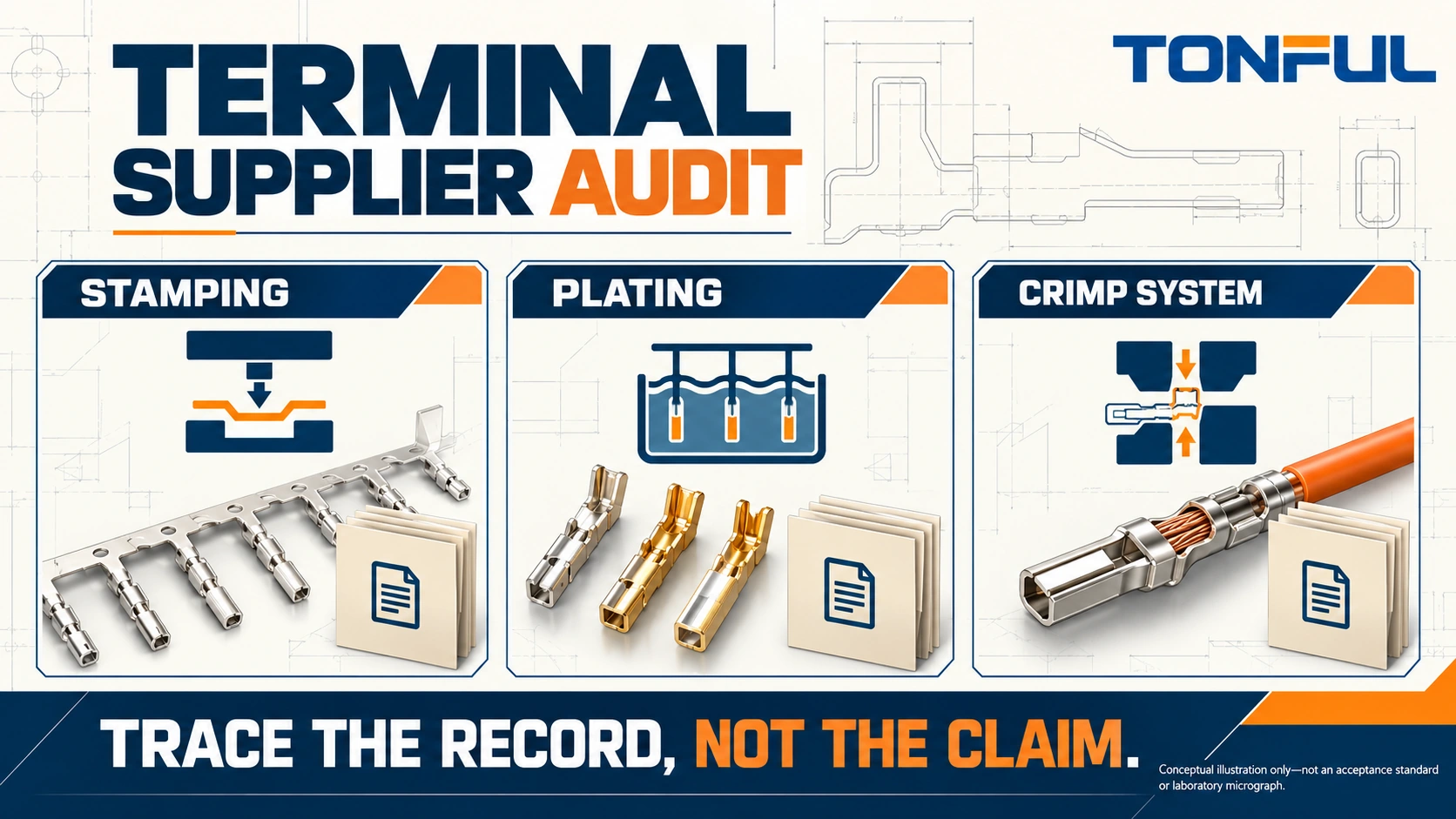
An electrical terminal manufacturer audit should establish whether a supplier can repeatedly deliver the approved configuration and identify affected product when a process changes or fails. A clean factory tour and a certificate photograph do not answer that question. Follow actual lots from incoming metal through stamping, finishing, packaging and the approved wire termination process.
The method below is a proposed buyer audit protocol. Its sample counts, weights and decision thresholds are editorial starting points to agree before the visit, not universal requirements or claims about TONFUL. Adapt the scope to the product, application risk and contracted acceptance criteria. Qualification of a supplier does not by itself qualify every terminal, wire or tool combination.
Jump to: Scope and criteria | Score and sampling rules | Executable audit matrix | Follow the process trail | Traceability and performance | Closure and sourcing decision
Scope and Criteria
Identify what the audit covers
Record site address, product families, manufacturing routes, shifts, outsourced operations and the buyer’s intended application. Include the specific drawings and revisions sampled. Separate factory manufacture from distribution and subcontracted work; an audit cannot silently credit a supplier with operations performed elsewhere. Define access to relevant sub-supplier records in advance.
Use the TONFUL terminal manufacturing overview to frame product discussions, not as evidence that a process has passed an audit. For each claimed capability, request a document or observed record tied to the item being sourced. Certification claims need valid scope and issuer verification; marketing language is not certification evidence.
Agree criteria before observation
The criteria should include the purchase specification, approved drawings, applicable customer requirements and the supplier’s controlled process documents. The official ISO 19011 overview describes guidance for management-system auditing. It is useful background for audit planning, but does not supply terminal acceptance limits or mandate the buyer scorecard below.
Assign competent auditors and identify technical questions requiring a specialist. Observe production safely without bypassing guards or interrupting an uncontrolled cycle. Any installation demonstration must use safely isolated equipment and authorized procedures. This audit is not authorization to modify energized, traction or other safety-critical circuits.
Score and Sampling Rules
Use a defined evidence scale
Score each applicable matrix row from zero to five. Zero means absent or contradictory control; one means a documented intention without implementation; two means partial implementation with important gaps; three means implemented with sampled records but incomplete effectiveness evidence; four means consistent implementation with a satisfactory sampled trail; five adds demonstrated effectiveness over changes and repeat production. These are buyer definitions, not certification grades.
Use the row weights below, totaling 100. Calculate the normalized score as 100 multiplied by the sum of each applicable weight times its score divided by five, divided by the sum of applicable weights. Document why an item is not applicable and remove its weight from both numerator and denominator. Outsourced plating remains applicable even when the supplier has no plating line.
Not Evaluated is different from N/A. An applicable item without access or time receives no points and remains in the denominator. Restrict the conclusion to the evaluated scope and do not award full supplier approval while essential items remain Not Evaluated. Report scope coverage alongside the score so a high number cannot conceal missing evidence.
Separate numerical results from blockers
Proposed approval threshold: at least 85/100, with no open Major, no knockout and all essential scope evaluated. A Major is a missing or failed control with potential to release nonconforming product or defeat traceability; a Minor is an isolated lapse within an otherwise effective control. A Major cannot be offset by high scores elsewhere. Conditional approval must name restricted products, containment and expiry, not imply unrestricted qualification.
Proposed independent knockouts are falsified evidence, intentional shipment of known nonconforming product without authorization, inability to identify affected lots, or refusal to disclose a relevant outsourced process. Stop approval regardless of score and escalate under the buyer’s supplier policy. These are decision rules to agree contractually, not automatic legal findings.
Executable Audit Matrix
Copy the matrix into the audit workbook
The proposed counts are minimum evidence samples for this protocol, not statistical lot acceptance plans. Select across dates, shifts, operators and changes; increase coverage when discrepancies appear. Record actual count, population and selection rationale. E01 through E16 identify evidence to collect, not reviewed documents. Use these statuses: Conforming, Major, Minor, Observation, N/A or Not Evaluated. Observation means an improvement opportunity without demonstrated nonconformity; do not use it to downgrade a breached requirement. Status and numerical score are separate fields.
| ID | Audit Question | Risk | Evidence to Sample | Sample Size Requirement | Finding | Score | NC Level | Owner | Due Date | Closure Evidence |
|---|---|---|---|---|---|---|---|---|---|---|
| E01, weight 6 | Are material and drawing identities controlled? | Wrong alloy/revision | Receiving and revision trail | Three lots | Enter evidence | 0-5 | Select status | Name | Date | Verified identity trail |
| E02, weight 7 | Are stamping tools and burrs controlled? | Interface damage | Wear and dimensional records | Three lots | Enter evidence | 0-5 | Select status | Name | Date | Later inspection records |
| E03, weight 5 | Are setup and restart verified? | Startup escapes | First-piece and restart approvals | Two events | Enter evidence | 0-5 | Select status | Name | Date | Observed restart |
| E04, weight 8 | Is plating traceable, including outsourcing? | Wrong finish | Processor approval and lot release | Three lots | Enter evidence | 0-5 | Select status | Name | Date | Processor-to-lot trail |
| E05, weight 5 | Is insulation assembly controlled? | Damage/misalignment | Assembly and damage checks | Two variants | Enter evidence | 0-5 | Select status | Name | Date | Later assembly records |
| E06, weight 12 | Is the crimp combination authorized? | Unapproved wire/die | Part-wire-tool validation | Three combinations | Enter evidence | 0-5 | Select status | Name | Date | Approved matrix |
| E07, weight 7 | Are MSA and calibration adequate? | False acceptance | Studies and traceable calibration | Three systems | Enter evidence | 0-5 | Select status | Name | Date | Rechecked measurement |
| E08, weight 6 | Do SPC and reactions work? | Undetected drift | Charts, capability and containment | Two characteristics | Enter evidence | 0-5 | Select status | Name | Date | Reaction effectiveness |
| E09, weight 7 | Is the document chain aligned? | Missing control | Flow through inspection record | Two risks | Enter evidence | 0-5 | Select status | Name | Date | Aligned revisions |
| E10, weight 5 | Are operators authorized? | Setup error | Competency and task authorization | Three operators | Enter evidence | 0-5 | Select status | Name | Date | Demonstrated competence |
| E11, weight 5 | Is rework revalidated? | Hidden damage | Disposition and reinspection | Two rework events | Enter evidence | 0-5 | Select status | Name | Date | Approved rework evidence |
| E12, weight 5 | Are packages protected from mixup? | Wrong shipment | Repacking and label reconciliation | Three packages | Enter evidence | 0-5 | Select status | Name | Date | Reconciled pack trail |
| E13, weight 8 | Does traceability support recall? | Unknown affected lots | Both-way trace and mock recall | Two drills | Enter evidence | 0-5 | Select status | Name | Date | Repeated containment drill |
| E14, weight 6 | Do performance and 8D prevent recurrence? | Repeat escapes | Complaints and later-lot review | Three cases or all if fewer | Enter evidence | 0-5 | Select status | Name | Date | Effectiveness evidence |
| E15, weight 5 | Are changes approved before use? | Silent substitution | Material/tool/source changes | Two changes | Enter evidence | 0-5 | Select status | Name | Date | Buyer approval trail |
| E16, weight 3 | Are capacity and contingency evidenced? | Disrupted supply | Actual load, bottlenecks, recovery plan | One route and disruption drill | Enter evidence | 0-5 | Select status | Name | Date | Verified recovery action |

Follow the Process Trail
Stamping and plating evidence
At stamping, select a dimensional characteristic affecting the mating interface and another affecting the wire barrel. Follow material identity, tool condition, first-piece approval, in-process sampling and reaction to drift. Inspect how a tool change, material change or restart triggers verification. Ask operators what happens after an out-of-control result; compare their answer with actual containment records.
For non-insulated terminals, inspect handling and finish controls without treating the exposed appearance as a complete corrosion assessment. At plating, identify the specified finish and its evidence source. Review outsourced processor approval, purchase requirements, lot transfers, inspection and rejected-lot handling. Do not accept a generic processor certificate in place of the required lot evidence.
Crimp-system and measurement control
Trace Process Flow -> PFMEA -> Control Plan -> Work Instruction -> Inspection Record for a selected termination risk. The risk named in the PFMEA should lead to an identifiable control, frequency, reaction and recorded result. Check that revised tooling or wire construction has not left the control plan behind the actual line.
Review crimp tooling by tool and cavity identity, maintenance status and terminal-wire authorization. Examine first-piece and changeover approval, invalid-test rules and retest authority. Review MSA or GR&R appropriate to variable measurements and agreement evidence for visual decisions. Calibration traceability alone does not demonstrate that an operator can measure the characteristic consistently.
Where SPC is used, review subgroup logic, control limits, reactions and records of special causes. Review capability evidence only against the applicable specification and a justified, stable process population. Do not impose a universal capability threshold here. For nylon-insulated terminals, confirm that insulation damage and support are evaluated, not just the hidden metal crimp.
Traceability and Performance
Run a trace drill and mock recall
Choose a finished package without advance supplier selection. Trace it back to metal, finish, manufacturing lot, inspection status and relevant tools. Then select an incoming or processor lot and trace forward to work in progress, stock and shipments. Record elapsed time as an observation against the agreed target, not a fabricated pass result.
Reconcile quantities, split lots, rework and scrap. A lot number printed on a bag has little value if repacking breaks the relationship to the original record. Run a mock recall using a defined defect scenario, identify affected recipients and inventory, and test who has authority to block shipment. Preserve the drill’s gaps and closure actions.

Review recurrence, not just response speed
Request supplier performance trends with defined denominators: incoming defects, delivery performance, concessions, complaints and repeat escapes. Separate a low shipment volume from genuine improvement. Examine the selected complaints through containment, root cause, escape cause, corrective action and effectiveness review; an 8D report title does not establish that the action worked.
Look for the same mechanism returning under another defect code, product or shift. Verify that relevant changes reached PFMEA, instructions, training and sub-supplier controls. If there have been no complaints, sample internal nonconformances and preventive controls rather than inventing customer outcomes. Record limitations when the available history is short.
Closure and Sourcing Decision
Verify corrective action on later evidence
Every finding needs the unmet criterion, objective evidence, affected scope, owner and due date. Distinguish immediate containment from permanent correction. Close a documentary gap by checking implementation at the line; close an effectiveness gap with later representative records. A revised procedure and a training signature alone may not resolve an uncontrolled process.
Use cord end terminal applications as a separate audit scope where relevant: terminal-block compatibility, ferrule geometry and tooling require their own evidence, not a borrowed approval from another terminal family. Issue a conclusion naming approved site, families, processes, limitations and re-audit triggers. Material, plating-source or tooling changes may require renewed review under the buyer agreement.
Share the intended audit scope, drawings and evidence matrix with TONFUL before a sourcing discussion. Request the relevant process trail and a product-specific sample plan. That creates a useful qualification conversation without implying that this article is an audit report, a certification or a claim about any factory’s actual results.