
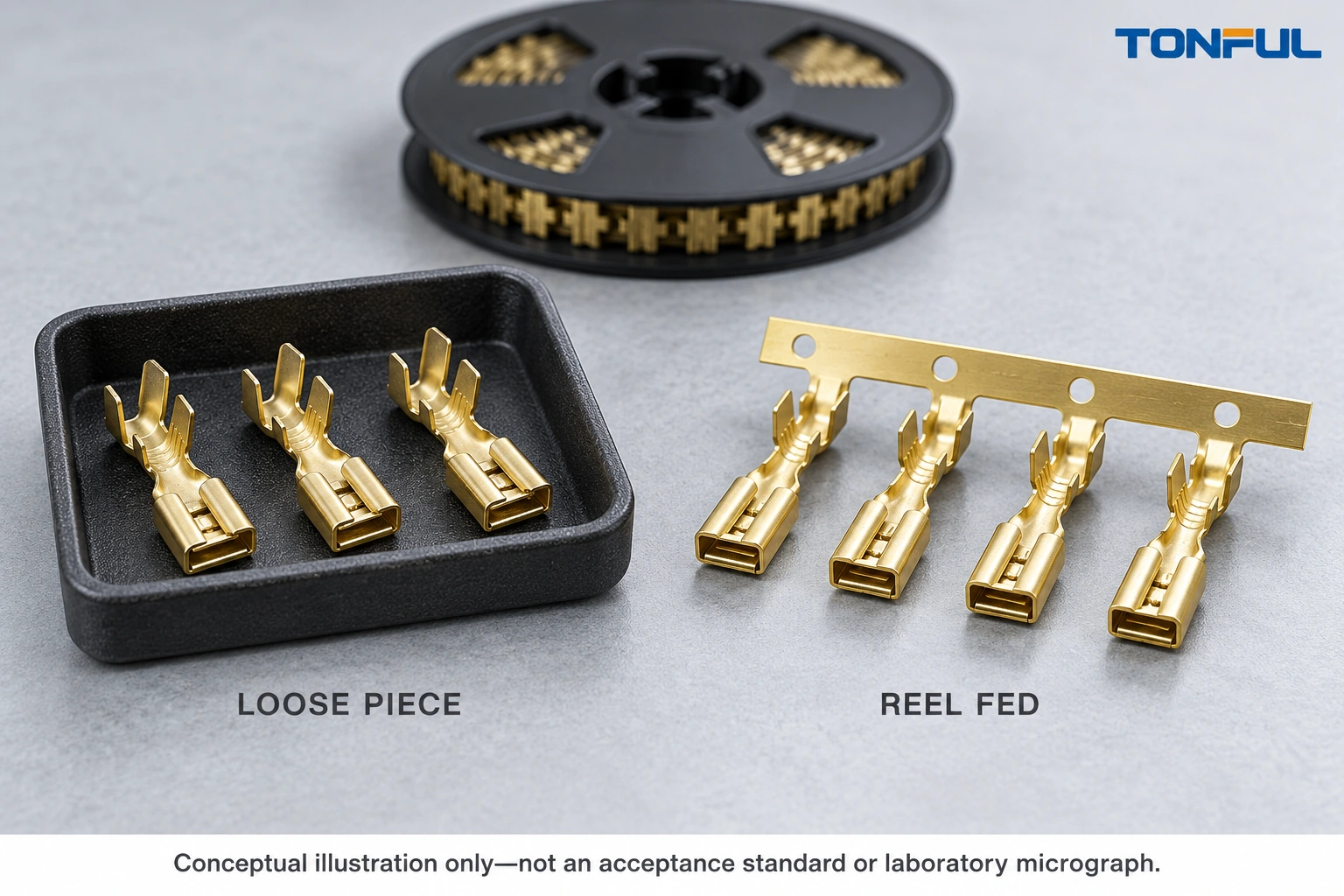
Loose-piece vs reel-fed terminals is a production-system decision, not merely a packaging choice. Loose parts may suit changing product mixes, repairs and controlled manual assembly. Reel-fed parts can support repeatable feeding into compatible production tooling. Neither option is automatically cheaper per acceptable connection.
Compare the complete route from material receipt to accepted output. A reel price excludes setup, applicator ownership, inspection, scrap and changeover. A hand-tool price excludes loading time, operator workload and capacity constraints. The relevant result is cost per accepted termination for your actual order mix.
This guide provides a comparison matrix, cost model and trial record. It does not invent unit prices, cycle rates, labor savings or an order quantity at which automation always pays. Those inputs must come from quotations and controlled observations on the intended terminal and wire combination.
Jump to: Check equivalence, Compare routes, Build the model, Run a trial, Control inventory, Make the decision.
Check Part Equivalence Before Comparing Cost
Packaging can change the orderable identity
Start with the exact part number for each supply form. Confirm terminal material, plating, barrel construction, wire range and functional interface. Two parts described as the same terminal may have different ordering suffixes or handling requirements. A catalog outline is not enough to establish that both versions meet the released drawing.
For strip-fed terminals, identify carrier arrangement, feed direction, pitch and cut-off requirements from the supplier’s controlled information. These determine applicator compatibility and handling. Do not assume a loose-piece tool can simply accept a strip version, or that any press can run any applicator.
Ask whether separating a terminal from its carrier requires a controlled operation and whether that operation affects functional geometry. Do not manually clip strip contacts for production use without an approved method. A damaged cut-off edge, distorted locking feature or changed orientation can defeat a comparison before crimp quality is considered.
The TONFUL wire-terminal range is a place to begin a supply-form discussion. Confirm actual loose-piece and reel availability for the chosen part rather than assuming every family is offered in both formats.
Keep family-specific routes separate
An economic comparison must compare the same intended electrical connection. A ferrule applied to a clamp is not a cheaper version of an open-barrel contact installed in a housing. Likewise, a ring terminal and a plug contact cannot be exchanged merely because both fit the conductor.
Use the non-insulated terminal category to identify candidate part families, then create separate routing sheets for each approved interface. Changes in installed length, insulation support, sealing or inspection access belong in the engineering review, not hidden inside a purchasing comparison.
Compare Loose-Piece and Reel-Fed Process Routes
Describe the operations people actually perform
A loose-piece route can include part picking, orientation, wire loading, crimping, unloading and inspection. A reel-fed route can include reel loading, strip threading, feed adjustment, applicator setup, first-piece approval, wire presentation and output handling. Both routes still require material identification and controlled wire preparation.
TE’s official application-tooling overview distinguishes tooling and production-equipment options. Use that as evidence that tooling is a system choice, not as evidence of a particular machine’s throughput or compatibility with an unrelated terminal.
| Comparison item | Loose-piece route | Reel-fed route | Evidence to request |
|---|---|---|---|
| Part presentation | Individual loading and orientation | Controlled strip presentation | Part and feed drawings |
| Tooling | Approved hand or bench system | Compatible applicator and equipment | Tooling list and instructions |
| Changeover | Part and setup changes still apply | Reel, feed and applicator changes may apply | Observed changeover record |
| Crimp operations | Determined by terminal design | Determined by terminal and applicator design | Released routing sheet |
| Inspection | Access and handling depend on station | Access and sampling depend on line layout | Control plan |
| Repair work | Can suit isolated approved operations | May need a separate service route | Authorized repair instruction |
| Inventory | Loose bins require identity control | Partial reels require identity and storage control | Lot-trace procedure |
Avoid assumptions about crimp count and quality
One terminal may have distinct conductor and support crimps formed together by its approved tooling; another route may use separate operations. Count the actual operations instead of assuming one hand squeeze or one machine stroke defines every product. Include loading and inspection in time studies.
Reel feeding does not automatically improve every quality characteristic. Manual handling does not automatically create defects. Compare observed outcomes from controlled trials using the same acceptance criteria. If either route has not been approved for the part, its apparent cost advantage is provisional.

Calculate Cost per Accepted Termination
Define the numerator and denominator together
For a stated planning period, calculate total relevant route cost divided by accepted terminations. Include purchased material consumed, setup labor, run labor, allocated equipment and tooling ownership, inspection, maintenance and disposition costs. Avoid counting the same cost twice when scrap already appears in material consumption.
Accepted output means conforming terminations released by the defined process. It is not press strokes, pieces loaded or wires started. Keep reworked output identifiable and include the labor and materials needed to achieve acceptance. Record the treatment of recoverable material and work in progress.
| Cost-model input | How to obtain it | Common accounting trap |
|---|---|---|
| Terminal consumption | Issued material minus controlled returns | Counting only accepted parts purchased |
| Setup labor | Timed representative changeovers | Omitting first-piece approval |
| Run labor | Observed staffing and productive time | Assuming stroke speed equals labor rate |
| Ownership allocation | Finance-approved planning basis | Charging all capital to one small batch |
| Inspection and rework | Actual route records | Hiding rework inside normal output |
| Maintenance | Scheduled and observed activities | Treating maintenance as zero |
| Accepted output | Released count with traceability | Dividing by gross machine cycles |
Use a bounded break-even model
Where one route has greater fixed cost but lower measured variable cost, an approximate break-even quantity is the difference in fixed costs divided by the variable cost difference per accepted termination. This simplified relationship only works when the variable difference is positive and the assumed cost behavior remains valid.
Calculate by product mix and batch pattern, not annual quantity alone. The same annual demand split into frequent short runs can carry a different setup burden from a stable long run. Include a sensitivity check for demand, labor availability, acceptance yield and changeover frequency without presenting assumptions as factory performance.
For nylon-insulated terminals, verify the actual supply and tooling options before including either route in the model. For cord-end terminals, confirm the feeder and application system rather than importing an open-barrel contact cost assumption.
Run a Representative Production Trial
Use the expected production mix
Select representative terminal sizes, wire constructions and changeovers. Identify what the trial excludes. A demonstration using a convenient wire and a pre-adjusted tool does not establish the cost of your regular mixed production. Record sample quantities and observation duration according to the decision risk and approved trial plan.
Separate setup time from steady running, then retain both. Include locating materials, loading, adjustment, first-piece inspection and documented release. Record stoppages by reason: material handling, feed problems, wire preparation, inspection hold or equipment fault. Do not remove inconvenient events from the dataset without explaining the exclusion.
Use the same acceptance documents for both routes and capture terminal, wire, tool, die or applicator identities. Define inspection and any required destructive-test allocation before the trial starts. Compare accepted output only after the quality reviewer confirms that the results represent conforming work.
Preserve a usable observation record
| Trial record field | Required entry |
|---|---|
| Configuration | Part, wire, supply form and tooling revision |
| Batch pattern | Planned quantity and changeover sequence |
| Timing boundary | Setup start, production start and completion definition |
| Resources | Operators, equipment and inspection activities |
| Output | Started, accepted, held, scrapped and reworked counts |
| Interruptions | Reason, duration and authorized exclusions |
| Quality release | Acceptance document, sample evidence and approver |
| Model transfer | Assumptions valid for forecast and known exclusions |

Include Inventory, Maintenance and Change Risk
Material storage is part of the route
Loose-piece bins need part and lot identity, protection against damage and rules for returning unused stock. Partial reels need equivalent controls, including identification after separation from outer packaging. Mixing lots to save shelf space can destroy the traceability needed to investigate a defect.
Record usable reel balance, minimum practical run constraints and the treatment of residual stock in the purchasing plan. Do not invent a minimum order or reel quantity. Obtain those values for the exact orderable part and distinguish a supplier quotation from a permanent technical limit.
Ownership continues after installation
Ask about spare wear components, maintenance instructions, setup expertise and equipment support. Check whether the organization can verify a repaired applicator before returning it to production. A low acquisition price can be unattractive if the approved route depends on unavailable support or undocumented replacement parts.
Review changes in terminal supplier, plating, wire construction or feed configuration before carrying an old cost model forward. A change can affect setup time or acceptance yield even if the nominal connection remains the same. Update the trial evidence where the changed variable matters.
Prepare a Documented Sourcing Decision
Choose a route with explicit boundaries
The decision record should name the released part and route, forecast assumptions, cost-model revision, trial evidence and approval owners. Note where an alternate route remains useful, such as an authorized repair or short-run process. A mixed strategy can be preferable to forcing every order through one method.
Review the TONFUL tooling options alongside the terminal request. Send part drawings, wire details, product mix, batch pattern, target inspection plan and available equipment. Ask TONFUL to confirm supply forms and compatible tooling information before comparing commercial offers.
Test the assumptions before approving capital
Keep the commercial forecast separate from the observed trial. The trial establishes what occurred under identified conditions; the forecast estimates how often those conditions will occur. Ask the planner to identify which orders share tooling, which require separate setups and which are uncertain. Do not distribute ownership cost across speculative output without making that assumption visible.
Review the decision under a lower-demand case and a more frequent-changeover case. Use actual quotations and measured trial inputs in each case, not invented savings percentages. Where the preferred route changes, document the trigger for a later review rather than declaring a permanent winner. A route can be technically acceptable yet economically unsuitable for the current mix.
Select loose-piece or reel-fed supply on demonstrated fit and cost per accepted termination, not an unsupported automation threshold. The resulting record should let procurement explain the price, production explain the process, and quality explain exactly what was approved.