
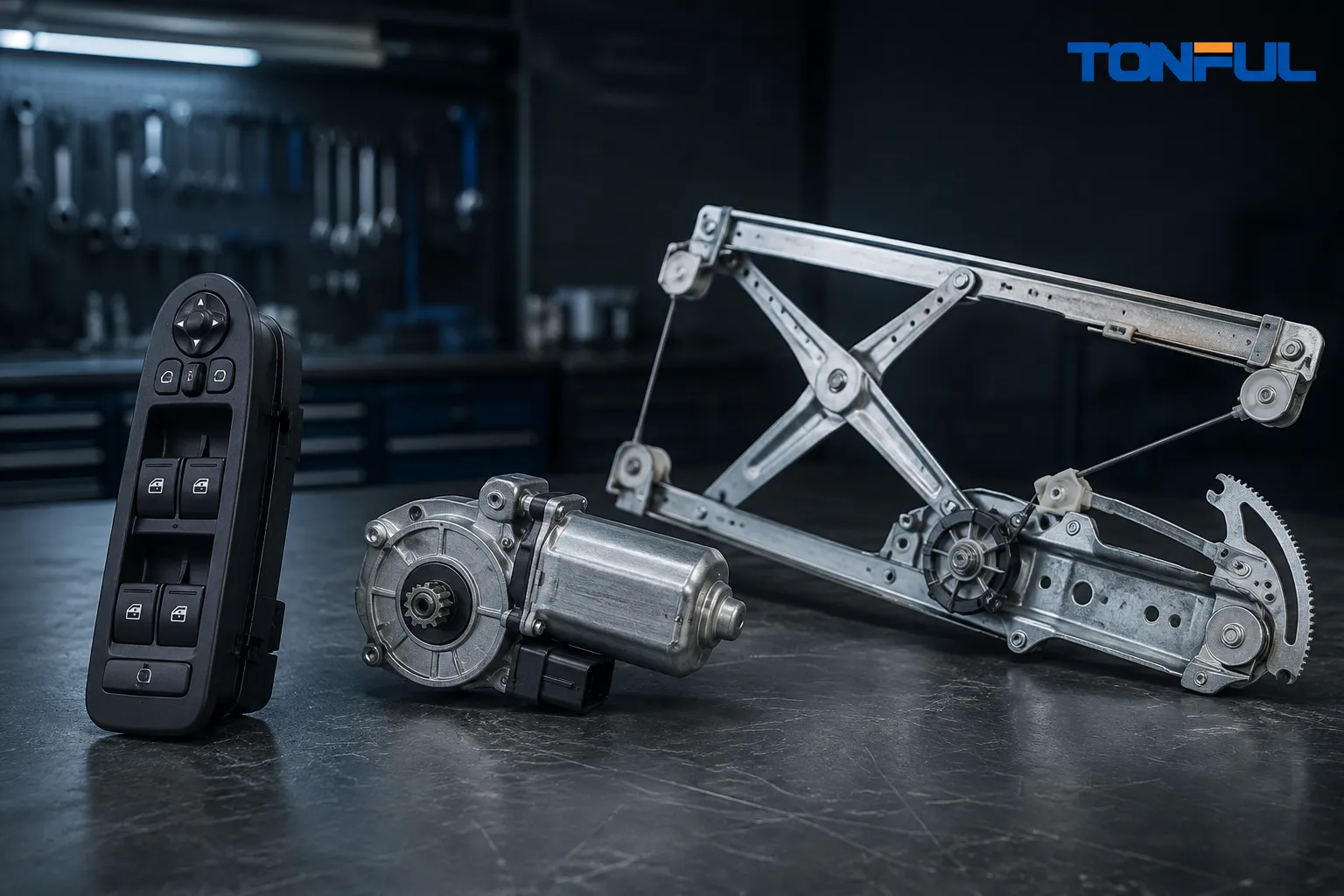
When a power window stops moving, the switch is only one possible cause. The electrical command can fail at the switch or door module, the motor can fail to convert electrical energy into rotation, or the regulator can fail to guide and lift the glass. Wiring, connectors, fuses, control modules, glass alignment, and lost initialization can produce similar symptoms.
Replacing the most visible part without testing wastes time and can leave the original fault untouched. This guide separates the switch, motor, and regulator by function, evidence, and diagnostic result. Always use the wiring diagram, connector views, service procedure, safety precautions, and acceptance values for the exact vehicle.
Quick Comparison

Conceptual system diagram—verify architecture against vehicle service information.
| Component | Primary job | Typical fault evidence | Confirmation approach |
|---|---|---|---|
| Power window switch/module | Converts driver input into an electrical command | One control position fails, rocker sticks, output or data does not change | Compare input/output, resistance, or scan data with service information |
| Window motor | Converts electrical energy into rotary motion | Correct command reaches motor but it does not run, runs weakly, or draws abnormal current | Test commanded voltage/current and motor operation per procedure |
| Window regulator | Guides and moves the glass mechanically | Motor operates but glass binds, drops, tilts, chatters, or does not travel | Inspect cable, rails, gears, carriers, fasteners, and glass alignment |
The table describes patterns, not automatic diagnoses. A high-resistance connector can reduce motor torque; a binding regulator can raise current and make a good switch appear weak; an electronic door module can block commands even when the rocker feels normal.
What the Power Window Switch Does
Older direct-control switches may route current or reverse polarity to the motor. Other designs use relays, resistance-coded outputs, or low-current signals to a door module. Networked master switches can contain a PCB, LEDs, logic, diagnostics, and communication. This is why continuity testing that works on one vehicle may be meaningless or damaging on another.
A driver master switch can control several windows plus window lock, door lock, mirrors, illumination, and one-touch functions. Passenger switches may depend on the master lock circuit or a door module. Before condemning a switch, record which control and direction fail. If a passenger window works from its own door but not from the master, the evidence points toward the master command path, connector, wiring, or module logic—not automatically the motor or regulator.
Physical signs include a loose, jammed, cracked, or inconsistent rocker; liquid contamination; corrosion; overheated terminals; or poor connector retention. Electrical confirmation still matters. A Stellantis power-window-switch technical instruction illustrates vehicle-specific diagnosis by checking physical operation and internal resistor readings against service information. Its numeric values must not be transferred to other switches.
TONFUL’s automotive combination-switch contact-resistance guide explains why method, test current, lead compensation, switch position, and acceptance source matter when evaluating contact paths.
What the Window Motor Does
The motor supplies torque to the regulator. Depending on architecture, it may be a basic reversible DC motor or an assembly containing position sensing, electronics, anti-pinch logic, or a power-window ECU. Some motors and regulators are serviced together; others are separate. Confirm service-part boundaries before ordering.
Motor-related evidence becomes stronger when the correct command is present at the motor connector under the specified condition but the motor does not respond. A motor that runs only after tapping, has dead spots, sounds rough, or performs differently by direction may have internal wear. However, low supply voltage, poor ground, terminal voltage drop, connector heat damage, or regulator binding can produce the same behavior.
Do not apply battery power directly unless the service procedure permits it and the motor is known to be a simple reversible design. Direct power can damage electronics or bypass protection. For systems with integrated modules, use the approved scan-tool and circuit tests. Record voltage, polarity, current, duration, glass position, and mechanical load under the vehicle-specific procedure.
What the Window Regulator Does
The regulator is the mechanical linkage between motor and glass. Cable, scissor, arm-and-sector, and rail designs use different guides, carriers, pulleys, gears, and attachment points. The regulator controls glass path and support; the motor only supplies motion.
Regulator faults often produce mechanical evidence: cable noise, grinding, a tilted pane, uneven travel, excessive play, glass that falls into the door, movement followed by jamming, or motor sound without glass movement. Broken carriers, frayed cable, worn gears, loose fasteners, bent rails, contaminated guides, and glass misalignment are possible causes.
A slow window is not proof of a weak motor. Measure the electrical command and investigate mechanical drag. Lubricants and adjustment must follow service information; an incompatible lubricant can affect plastics, seals, dirt retention, or cold-weather performance.
Diagnose by Symptom Pattern

Conceptual diagnostic flow—follow the exact vehicle service procedure.
All Windows Fail
Start with shared conditions: ignition state, retained-accessory-power logic, fuse or circuit protection, main supply, ground, master lockout, body controller, and network communication. One failed regulator cannot normally explain every window. Do not replace the master switch until its supply, ground, communication, and output behavior are verified.
One Window Fails from Both Controls
Check whether the motor receives the correct command from either control. If command is absent, inspect switch/module logic, lockout, wiring, and connectors. If correct command reaches the motor, evaluate the motor, regulator, glass path, and ground or voltage drop.
One Window Works from One Control Only
This pattern often narrows the fault to the nonworking control path, but shared module logic and wiring still require verification. Compare command states or outputs at both switches and the relevant module. A good passenger switch does not prove that every master-switch channel is good.
Motor Runs but Glass Does Not Move Correctly
Mechanical inspection becomes the priority. Stop repeated operation if the glass tilts, cable snaps, or the regulator binds. Continued cycling can break glass attachments, damage the motor, or create a pinch hazard.
Window Is Slow or Intermittent
Record direction, temperature, door position, vibration, glass position, and whether another control changes the result. Check supply and ground under load, connector condition, motor current where specified, and mechanical resistance. Intermittent faults require preserving evidence rather than immediately disconnecting or adjusting components.
A Reliable Fault-Isolation Sequence
- Confirm the complaint and record which windows, controls, directions, and functions fail.
- Review service information, system architecture, DTCs, initialization requirements, and safety precautions.
- Inspect the switch, connector, harness at door flex points, regulator, glass, and signs of moisture or heat.
- Verify circuit protection, switch/module power, ground, and communication as applicable.
- Measure the vehicle-specific command at the switch or scan data while operating each position.
- Check the command at the motor under the specified condition.
- Evaluate motor response, current or voltage drop where required, and regulator/glass mechanical load.
- Repair the confirmed cause, restore connectors and trim, initialize the system if required, and verify all controls and safety functions.
The NHTSA-hosted Toyota power-window master-switch recall instructions show the level of control needed for a specific resistance inspection: meter zeroing, defined points, probe-contact cautions, and switch-by-switch checks. Use that document as evidence that procedures must be specific, not as a universal pinout or limit.
Choosing the Correct Replacement
Match vehicle, market, model year, trim, door position, steering configuration, OE reference and supersession, housing and mounting, connector keying, populated cavities, pinout, functions, illumination, tactile stages, and electronic architecture. If the motor and regulator are sold as an assembly, confirm whether calibration or initialization follows installation.
Confirm the Failure at Assembly Level
A correct component choice must also address damage created by the failed system. A seized or misaligned regulator can overload a motor and place sustained current through switch contacts, relays, terminals, or module drivers. A loose terminal can generate heat that damages both connector housing and switch header. Replacing only the visibly failed part may therefore leave the initiating fault in service.
Inspect mating connectors, terminal retention, wire strain relief, glass attachment points, guides, seals, and fasteners before closing the door. Where the service procedure specifies it, compare current, voltage drop, travel time, or scan data after repair. Preserve photographs and measurements when heat, corrosion, liquid entry, or repeated warranty failure is present. TONFUL’s Power Window Switch Manufacturer product page presents power window switch references for multiple vehicle applications and provides the correct commercial destination for switch sourcing inquiries.
For fleet, aftermarket, or production sourcing, retain the application record, OE cross-reference, approved sample, drawing revision, test report, incoming-inspection result, and lot code. These records make a future complaint traceable to the vehicle, part configuration, and manufacturing batch instead of relying on appearance alone.
For connectors and harness interfaces, TONFUL’s automotive PCB connector guide and automotive terminal push-out-force guide provide useful supporting checks. TONFUL’s PA66 versus ABS automotive material guide helps frame housing-material questions without replacing the component drawing.
TONFUL currently presents automotive power window switch references for multiple vehicle applications. Confirm the OE reference, connector, pinout, functions, vehicle coverage, and approved sample before ordering. Motor and regulator supply should be discussed separately and must not be assumed from the switch catalog.
Final Decision
Replace the switch only when its input is correct but its specified output, resistance, signal, communication, or mechanical operation is not. Replace the motor when the correct command and power path are present but motor performance fails the approved procedure. Replace or repair the regulator when electrical drive is available but mechanical transfer, guidance, or glass support is defective. When evidence crosses categories, repair the root cause rather than the component with the most obvious location.
For power window switch sourcing, share the vehicle application, complete OE reference and supersession chain, front and connector-end photographs, connector and pinout source, button layout, manual and automatic functions, LHD or RHD configuration, annual demand, packaging requirements, and required validation with TONFUL. Confirm the proposed switch against an approved sample before ordering. If diagnosis identifies the motor or regulator instead, source that component through a separately verified supplier; TONFUL’s switch catalog must not be treated as confirmation that those components are available.
Related TONFUL Automotive Guides
- Review Automotive Combination Switch Contact Resistance Testing when a switch contact path requires controlled electrical evaluation.
- Use the Automotive PCB Connectors Guide when connector construction, terminal interfaces, or electronic switch architecture affects the investigation.
- Consult Terminal Push-Out Force for Automotive Connectors when loose or backed-out terminals may interrupt the window command or motor circuit.
- Compare PA66 vs ABS Automotive Connector Materials when heat damage, housing deformation, or material requirements are part of supplier review.
- Read the Wiper Switch Failure Symptoms and Replacement Guide for a related evidence-first automotive switch diagnostic workflow.