
A familiar cable-tie part number is a useful search lead, but it is not a complete design requirement. Two ties may share color, nominal length and a headline tensile class while differing in usable strap length, head clearance, installation behavior or environmental rating. Replacing one with the other on the basis of a catalog cross-reference alone can create a problem that no purchasing spreadsheet reveals.
This guide shows buyers and engineers how to qualify a second source from the actual assembly and service conditions. The objective is not to clone a competitor’s drawing or announce a universal “equivalent.” It is to define the required function, compare candidates under aligned conditions, approve a named part and control changes afterward. This is an engineering and sourcing workflow, not legal advice about intellectual-property rights. The TONFUL cable ties buying guide covers initial selection; here the challenge is replacing an already-used tie without losing a controlled requirement.
Start With a Neutral Application Requirement
Photograph the current installation, but do not stop at a photograph. Record what the tie actually does: bundle wires, position a hose, attach a harness to a panel, mark a route, or provide specified support. Identify the mounting surface, cable jackets, bundle diameter range, head orientation, service access and removal method. A tie that only organizes an indoor cabinet bundle needs different evidence from one exposed to outdoor UV or used with an integral fixing device.
Build a buyer-owned requirement from drawings, the bill of materials, equipment instructions and the completed assembly. Decide which characteristics are mandatory, which can vary without affecting function and which require a trial. Avoid filling the new specification with every dimension from a competitor’s catalog. That produces a lookalike target without explaining why those dimensions matter. Instead, state the necessary installed envelope, engagement and performance, with each limit traced to a design or customer source.
The IEC 62275:2022 scope covers metallic, non-metallic and composite cable ties and fixing devices for managing or securing wiring systems in electrical installations; support may invoke additional requirements. It does not automatically certify a candidate or give every application a common strength value. UL Solutions’ cable-tie application guide similarly emphasizes the exact product’s declared mechanical, environmental and installation use. Record the applicable category, edition and product evidence rather than pasting a standard number into an RFQ as a blanket approval.
| Buyer-owned requirement | Evidence source | Example question |
|---|---|---|
| Bundling or support role | Assembly drawing and installation rule | What actually carries cable weight? |
| Fit envelope | Measured production assembly | What head size clears the cover and connector? |
| Bundle range | Minimum/maximum configured builds | Does the strap lock at both extremes? |
| Material exposure | Site and cable specifications | Which temperature, UV or chemical conditions apply? |
| Installation | Work instruction and tool | Can the named tool set and cut it without damage? |
| Identification | BOM and labeling plan | Must color or marking carry information? |
| Release | Customer approval process | What evidence authorizes a second source? |
If the existing part has a certification required by code or contract, obtain evidence of the candidate’s own status and exact scope. A buyer’s side-by-side trial cannot transfer the original part’s certification to the alternative.
Separate Match, Difference and Unknown
Create a comparison sheet for the original installed part and each candidate. Use three states for every field: match against the buyer’s requirement, difference requiring engineering review, or unknown pending evidence. Do not label an unmeasured property equivalent. A catalog statement such as “same size” is too coarse for a tight harness channel or mounting hole.
Compare overall length, usable strap length, width, thickness, head height and direction, tooth engagement, minimum and maximum bundle range, material, color, marking, mounting interface and installation-tool compatibility. The TONFUL size and bundle-diameter guide explains why nominal length and loop strength do not define the entire fit. A longer tie can still have a head that clashes with a connector; a wider tie can concentrate pressure on a sensitive cable.
Measure samples against the buyer’s drawing with calibrated equipment. Where the original drawing is unavailable, document the assembly-derived envelope and the source of each limit. A removed field sample can help establish geometry but may have aged, deformed or been cut, so it should not become the sole master. Use production-intent samples from identified lots for both candidates and keep their photographs, revision and storage condition.
| Comparison field | Baseline part | Candidate | Disposition basis |
|---|---|---|---|
| Usable loop at minimum bundle | Measured installed result | Measured installed result | Engagement and head seating |
| Usable loop at maximum bundle | Measured installed result | Measured installed result | Required tail/tool access |
| Head and mount geometry | Controlled envelope | Drawing and sample | Mating-part trial |
| Material and claims | Approved evidence | Candidate’s own evidence | Application conditions |
| Tool and cut | Production work instruction | Candidate first-piece | Jacket and head inspection |
| Traceability | Lot and supplier record | Lot and supplier record | Containment ability |
“Unknown” is a legitimate project status. It becomes dangerous only when procurement changes it to “pass” so a purchase order can be issued.
Compare Performance Under the Same Conditions
Begin with the test property that governs the application. Minimum loop tensile strength describes a closed-tie test under specified conditions; it is not an allowable support load or an installation tension. The TONFUL cable-tie tensile-strength guide supplies the basic distinction. If strength matters, align fixture or mandrel, sample conditioning, pull direction, speed, temperature, sample count and failure definition before comparing results. A higher number from a different method does not establish equivalence.
The qualification plan may also need head engagement, mounting retention, low-temperature installation, aging, UV exposure, chemical compatibility, flame or smoke behavior, vibration and abrasion. These are conditional, not an automatic battery of tests for every tie. Select tests from the real duty and customer specification. Where a certification claim is required, verify the exact candidate SKU in the applicable documentation; do not describe a lab trial as certification.
Allocate samples deliberately. Decide whether separate specimens serve as unaged controls, environmental conditioning, destructive strength testing and installed-assembly trials. State whether the same specimen is tested sequentially or different specimens are used; sequence can change the outcome. Define replacement-sample rules and invalid-test criteria before testing. Record both individual results and failure modes. A broken strap, slipping head, separated fixing device and damaged cable jacket are different findings, even if they produce the same final load reading.
The buyer should compare candidate performance to approved acceptance limits, not merely to a single original-part sample. The existing part could be at the favorable edge of its distribution or already degraded. Conversely, the new source need not copy every material or molding detail if it meets the project-controlled function and approval criteria. Keep the logic visible in a requirement-to-test matrix:
| Required function | Test or evidence | Acceptance source | Result to record |
|---|---|---|---|
| Retain bundle | Installed movement or specified retention test | Assembly drawing/customer plan | Displacement, slip, damage |
| Preserve cable jacket | First-piece and conditioned inspection | Cable and harness requirement | Indentation, cuts, bends |
| Fit envelope | Dimensional and mating trial | Drawing and adjacent-part model | Clearance and orientation |
| Mechanical strength | Aligned loop test if specified | Product/customer specification | Individual values, failure modes |
| Environment | Relevant aging/UV/chemical test | Approved qualification plan | Initial/final change and limits |
| Identification | Color/mark inspection | Labeling specification | Readability and mix-up control |
This matrix makes a substitution review reproducible. It also exposes a missing requirement before the test lab receives a vague request to “prove equivalence.”

Conceptual workflow only, not a certification record or acceptance standard. Fill limits from the controlled project documents.
Validate the Real Installation
Bench tests cannot see every assembly problem. Install both the current and candidate ties on representative minimum, nominal and maximum bundles, including optional wires and sleeves. Use the intended operator method, tool model, nosepiece and setting. Inspect the strap route, head seating, tail cut, cable-jacket condition, clearance to latches and covers, and access for later service. A tie can pass a loop-strength test yet mark a soft data cable or interfere with a moving door.
Watch for installation-rate and error differences. Does the candidate feed smoothly through the tool? Does its tail cut cleanly without cutting into the head? Can an operator reach the head at the tightest location? Is the locking direction obvious enough to avoid reverse threading? These are process controls, not cosmetic preferences. Use the validated work instruction and tool record for the comparison.
Inspect after any relevant vibration, thermal or handling exposure. Record the installed condition with the assembly ID, cable construction and sample lot. Do not use a staged image as proof of clearance. If a candidate requires a different tie position, tool setting or tail rule, it may still be usable, but it is no longer a drop-in replacement. Revise the drawing and work instruction, then approve the changed assembly as such.
Approve Supplier, Production and Receiving Controls
A passing sample is not enough if subsequent lots cannot be identified or controlled. Ask the candidate supplier for part drawings, material identification, manufacturing location, lot traceability, packaging and change-notification terms. Review how the supplier controls mold cavities, resin and additive changes, tool maintenance, inspection equipment and labeling. Only request certificates and test reports that relate to the exact part and claimed property.
Define a production-intent sample set rather than accepting hand-selected prototypes. The supplier should identify lot, drawing revision, cavity or tool where relevant and conditioning before testing. Agree on first-article records and receiving checks for labels, dimensions, locking function and any periodic destructive tests. The TONFUL cable-tie moisture and storage guide explains why nylon handling can affect comparisons; a dried or differently conditioned sample should not be compared as though it represented routine supply.
Record the approval decision at the correct scope. Rejected means a mandatory requirement failed or required evidence is missing. Conditional means a named deviation, owner, quantity and expiry are authorized for limited use, where customer rules permit. Sample approved means identified samples met the agreed trial; it is not automatic serial-production approval. Production approved means production-intent evidence and process controls were accepted for a named part, supplier site, application and revision.
| Release record field | Required entry |
|---|---|
| Application | Assembly, location, function and drawing revision |
| Sources | Baseline and candidate part numbers, suppliers and lots |
| Differences | Fit, material, tool, head, mounting and markings |
| Test basis | Method, samples, conditioning, limits and source document |
| Results | Individual data, failure modes and deviations |
| Production control | Site, tooling, receiving plan and change notice |
| Decision | Status, approved scope, reviewer and date |
After approval, purchase orders and receiving labels must point to the approved candidate revision. Keep the original and alternative as separate controlled part identities if their processes, drawings or approved use differ. A “dual source” designation should not permit warehouse staff to substitute one into an unapproved assembly. Periodically review complaints, installation defects and supplier changes; qualification is a maintained decision, not a one-time certificate file.

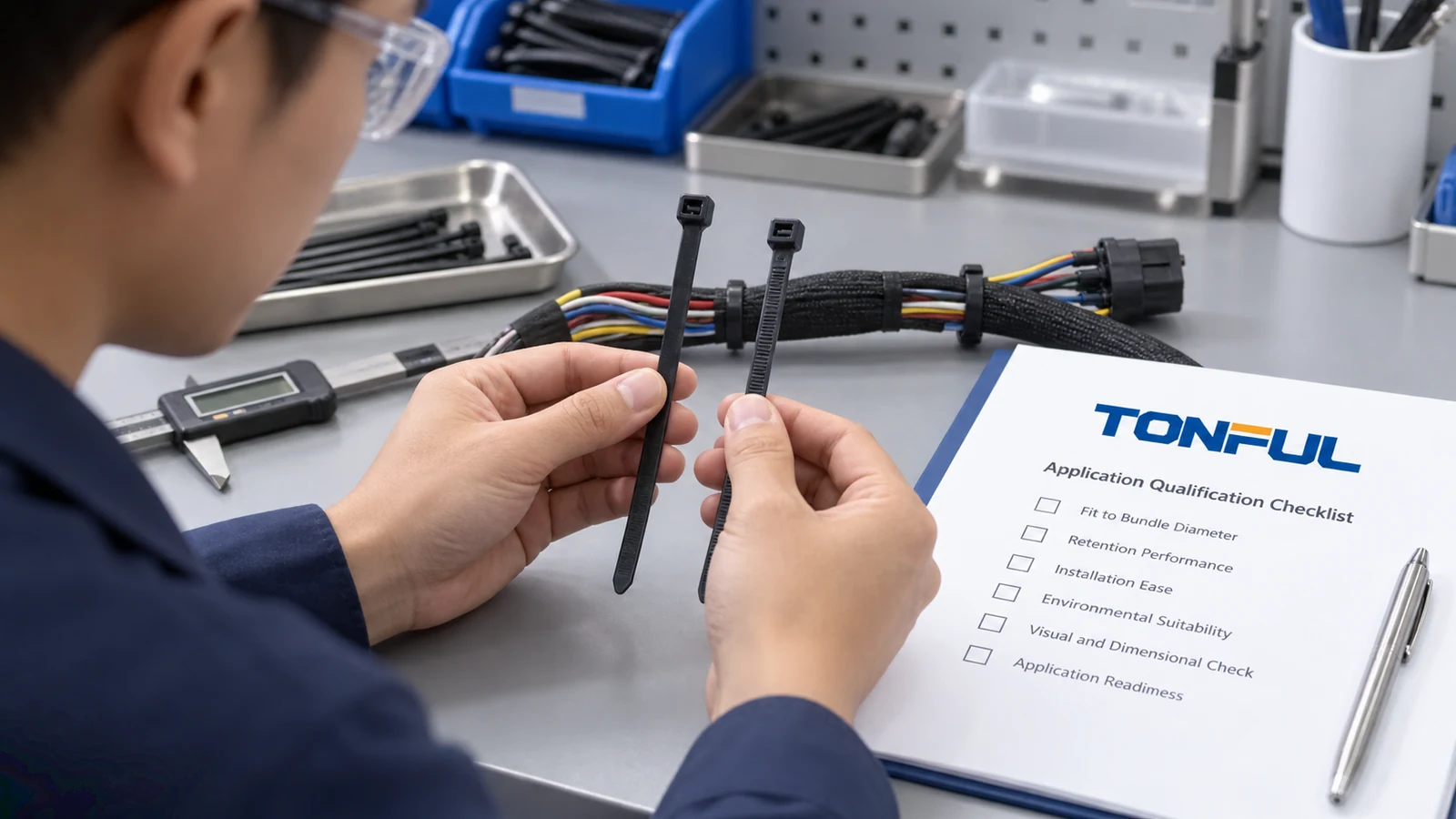
Illustrative assembly review. Real approval requires identifiable samples, test records and a named decision authority.
Request a TONFUL Candidate by Function
Send TONFUL the buyer-owned requirement matrix, actual bundle range, material environment, mounting interface, tool, test methods, target approval scope and expected volumes. Ask for a named candidate drawing and production-intent samples, not a claim that a brand part number is “identical.” The TONFUL cable-tie range can help locate families to investigate, but any alternative remains unapproved until it passes the project plan.
The strongest second-source decision has an explicit fit and performance basis, a traceable sample, a controlled supplier process and a written release boundary. It protects the assembly without depending on a copied brand specification or an unsupported equivalence claim.
Technical Sources
- IEC 62275:2022: official cable-tie and fixing-device standard scope.
- UL Solutions cable-tie application guide: product-specific certified characteristics and installation context.