
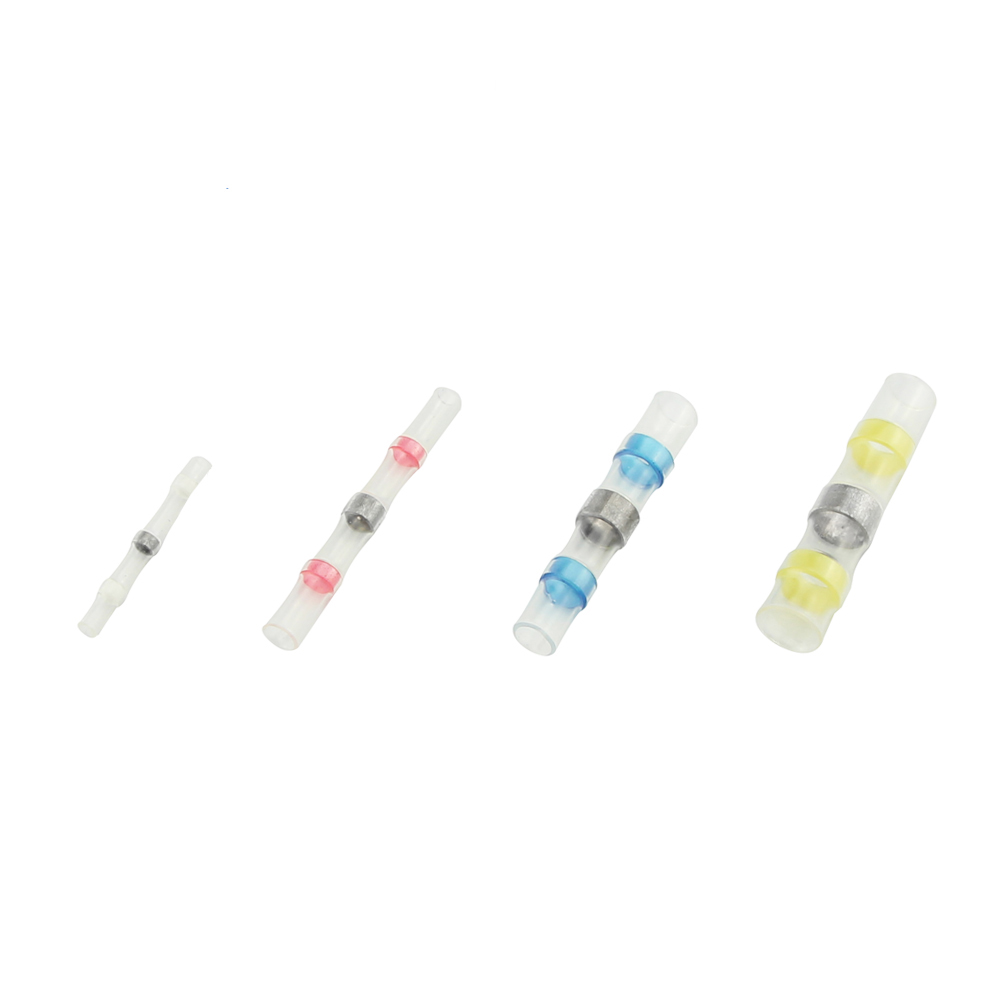
Four color-coded sizes · Transparent sleeve · Central solder ring
TONFUL ELECTRIC / WIRE CONNECTION SOLUTIONS
Solder Seal Wire Connectors Manufacturer
Source heat shrink solder connectors for wire-to-wire splicing, with clear, red, blue and yellow options. Bring your wire specification, order quantity and packaging brief to TONFUL for a product recommendation and quotation.
A transparent sleeve, central solder ring and sealing rings bring connection and insulation into one compact component. Select the right size, review the drawing and evaluate samples on your own wires before bulk supply.
04 / Size options
Clear, red, blue and yellow identification.
01 / Inline connection
A solder sleeve for joining wire ends.
B2B / Sourcing support
Discuss quantities, samples and packaging.
UNDERSTAND THE PRODUCT
A small connector. Three working elements.
Each part has a different role. Understanding the construction helps your team select a compatible wire combination and check the finished connection.
Transparent heat-shrink sleeve
The outer sleeve contracts around the splice when heated. Its transparency helps the installer see conductor placement and the solder area. Sleeve recovery alone does not establish that the solder joint is complete.
Central solder ring
The pre-positioned ring sits over the conductor joining area. Controlled heating allows the solder to flow around the prepared conductors. The selected model and its installation instructions determine the required process.
End sealing rings
The rings near the sleeve ends soften during heating and seal around compatible wire insulation. Seal quality depends on connector size, insulation diameter and installation. Request supporting data for your required exposure conditions.
PRODUCT RANGE
Choose the connector around your wire
Start with conductor size, then check insulation diameter and the space available around the splice. Color is a useful identifier; the approved drawing remains the selection reference.
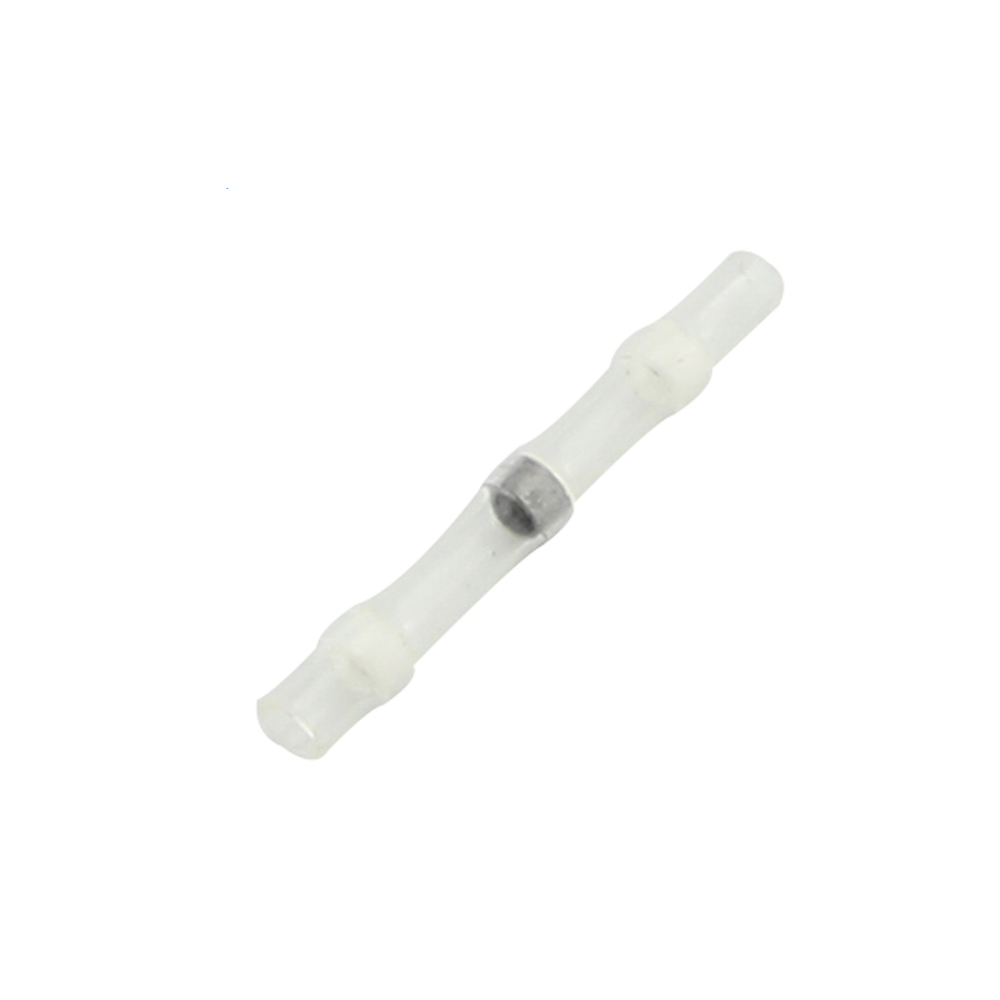
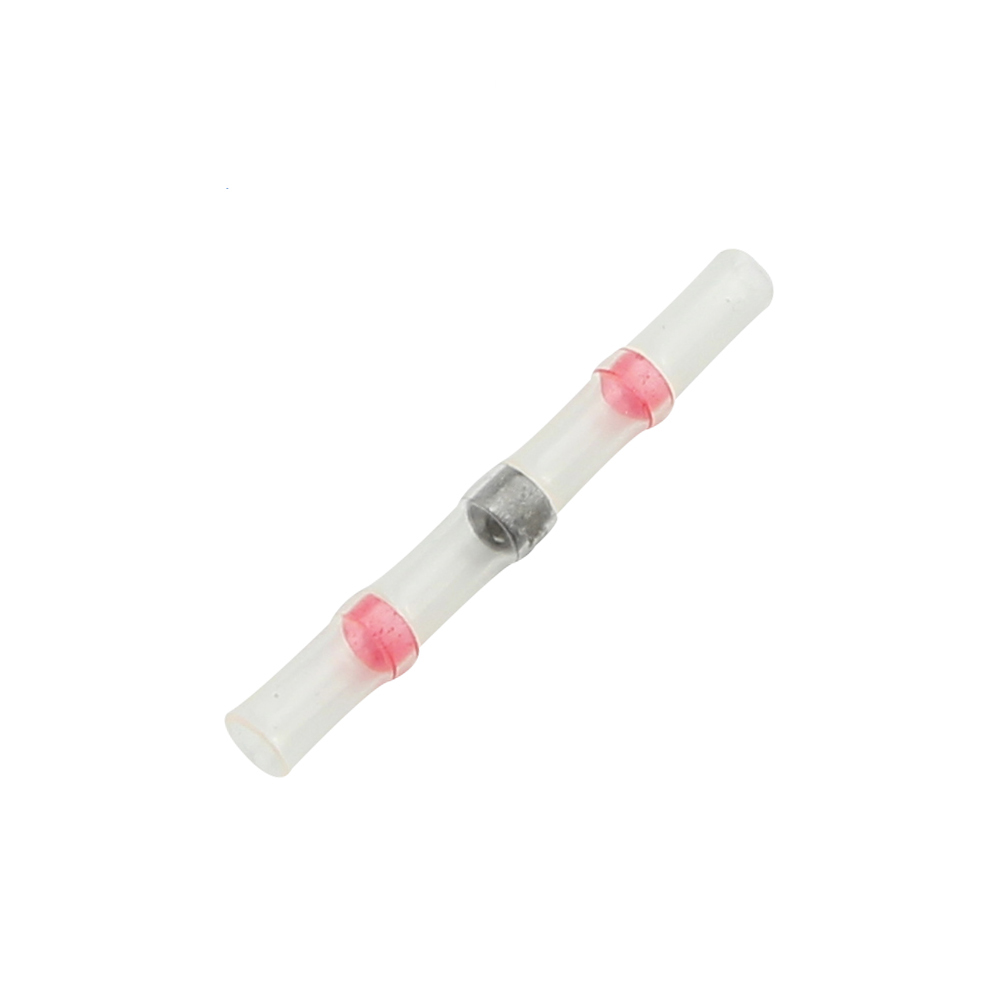

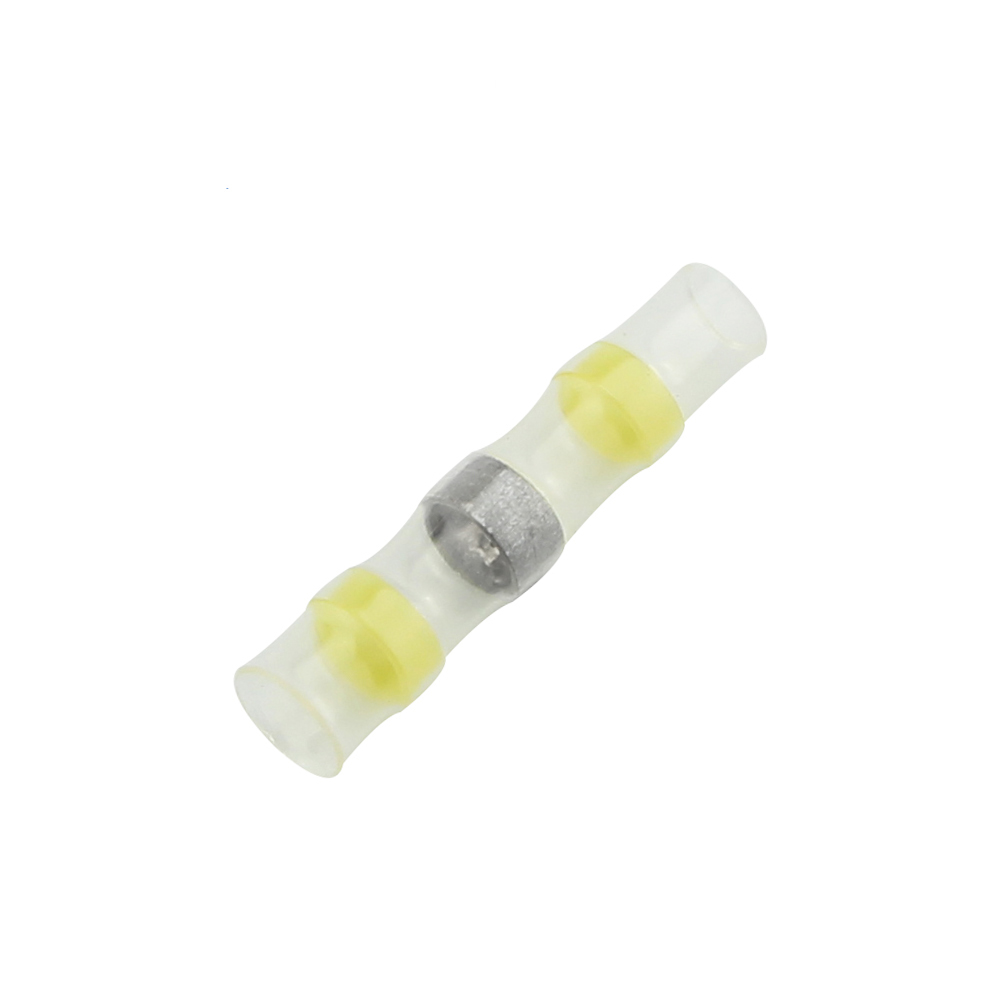
| Color | Catalog reference | Published AWG | Conductor area (mm²) | Minimum length (mm) |
|---|---|---|---|---|
| White / Clear | HXT-11 | 26–24 | 0.25–0.34 | 26 |
| Red | HXT-21 | 22–18 | Confirm against drawing | 40 |
| Blue | HXT-31 | 16–14 | 1.5–2.5 | 40 |
| Yellow | HXT-41 | 12–10 | 4.0–6.0 | 40 |
The values above reproduce the HXT table in our solder seal heat shrink butt connector listing. Confirm the current order code and dimensional drawing with your quotation. For the red size, request confirmation of the metric conductor range before ordering.
Include conductor material, strand construction, insulation material and outside diameter in your inquiry. If the two wires differ in size, send both specifications. Do not assume a sleeve that accepts the larger wire will also seal correctly around the smaller one.
TECHNICAL REVIEW
Specify the connection, not just the color
Materials & solder
Request the current sleeve material, solder alloy and adhesive specification for the selected order code. Include any restricted-substance or lead-free requirement in the purchase specification.
Heating & service conditions
Ask for the approved heating procedure and service-temperature limits. Heat-gun settings, exposure time and actual component temperature are different quantities; specify your wire insulation and available equipment.
Electrical & environmental data
Share operating voltage, current, moisture exposure and qualification requirements. Obtain model-specific documentation before assigning an electrical or ingress-protection rating to the finished splice.
Use sample assemblies to check fit and installation before approval. A result obtained with one wire construction or insulation diameter should not automatically be applied to every wire in a harness.
SOURCE WITH A CLEAR SPECIFICATION
Why work with TONFUL on your connector project?
Keep the product, installation and purchasing requirements connected from the first inquiry. Our quotation discussion starts with what you need to join and how you plan to buy it.
Focused product selection
Compare the listed sizes with your wire requirements. Send a drawing or wire data sheet so the requested connector and application can be discussed together.
A broader terminal range
If a solder sleeve does not fit your assembly process, explore TONFUL terminals and connectors for a connection method that matches the project specification.
A practical purchasing brief
Request samples, bulk quantities or a packaging proposal in one inquiry. Agree the order code, documentation, packing and delivery terms before placing an order.
APPLICATION REVIEW
Plan around the real installation environment
These are useful starting points for a product discussion, not blanket application approvals. The connector, wire, installation method and equipment requirements must be evaluated together.
Automotive & trailer wiring
Share wire gauge, routing and exposure to vibration, water or road contaminants. Check the vehicle or harness specification before selecting a soldered repair method.
Marine electrical projects
Describe the location, moisture exposure and cable type. Ask for relevant documentation and review the applicable installation requirements; a marine application claim alone does not establish approval.
Motorcycles & small equipment
Confirm space for the finished splice, heat access during assembly and protection from mechanical loading. Keep the joint supported in the completed wiring layout.
Outdoor lighting
Specify circuit conditions, enclosure and exposure. Do not assume this product is approved for direct burial or continuous immersion without the required evidence.
Wire harness assembly
Evaluate installation repeatability on representative wires. Record the chosen size, heating method and inspection criteria for operators before production approval.
Low-voltage electronics
Check conductor fit and the heat tolerance of nearby components. Fine wires and sensitive insulation need an installation process suited to the actual assembly.
INSTALLATION OVERVIEW
Prepare. Position. Heat. Inspect.
Use this sequence to plan operator guidance. Request the current product instructions before setting strip length, heating temperature, time or acceptance criteria.
01 / Select
Match the connector to the approved conductor range and wire insulation diameter. Confirm the installation instructions for that exact model. Work only on isolated, de-energized wiring.
02 / Prepare
Strip the wire ends to the length specified for the connector. Avoid cutting strands. Keep conductors clean and position the sleeve before assembling the joint.
03 / Position
Place the prepared conductors in the joining area beneath the central solder ring as shown in the approved instructions. Keep insulation inside the intended end-seal areas.
04 / Heat
Use the specified controlled hot-air process. Observe solder flow and sleeve recovery while avoiding insulation damage. Do not substitute a universal temperature or timing rule for the model instructions.
05 / Cool & inspect
Allow the splice to cool without movement. Inspect conductor placement, the solder area and both end seals. Apply the electrical and mechanical checks defined for your assembly.
If the sleeve has recovered but the solder ring has not flowed as required, the connection is not ready for acceptance. Avoid open-flame heating unless explicitly allowed by the product instructions. For a process requiring crimped connections, review our heat shrink terminal range instead of treating solder sleeves as interchangeable.
QUALITY & DOCUMENTATION
Agree the inspection plan before bulk supply
Define the checks and records your order requires. The points below form a purchasing checklist to discuss with TONFUL; availability and acceptance limits should be confirmed for the quoted product.
Incoming product checks
Review sleeve dimensions, solder-ring location, end-ring condition, color identification and quantity. Link the checks to the agreed drawing and order code.
Sample assembly review
Build samples on the intended wires. Assess heating behavior, insulation condition, solder flow and end sealing against the approved instructions and project acceptance criteria.
Records for your order
Request the applicable data sheet, material declarations, available test reports and batch-identification arrangements. Confirm document scope rather than relying on a generic certification logo.
BULK SUPPLY & PACKAGING
Build a quotation around your purchasing needs
Tell us whether you need one connector size or a mixed assortment. Include the quantity per size and your expected repeat-order demand so the quotation reflects your actual purchasing plan.
Single-size bulk orders
Specify each required size, piece count and preferred inner-pack quantity. Ask for the current MOQ and delivery estimate for that order; these should be confirmed in the quotation.
Mixed-size kits
Provide the quantities or proportions for white, red, blue and yellow connectors. State whether you need a sample assortment for evaluation or a packaging proposal for resale.
Private-label requirements
Send your label artwork, language, barcode and packing brief for feasibility review. Agree the approved artwork, pack contents and instruction requirements before order confirmation.
For wider sourcing, explore our terminals and connectors manufacturing page. Request a sample proposal with the exact sizes and wire details you want to evaluate; sample charges and shipping terms will be confirmed with the offer.
BUYER QUESTIONS
Frequently asked questions
Do these connectors need a crimping tool?
This product uses a solder ring and heat-shrink sleeve rather than a conventional crimp barrel. Follow its own installation instructions. Products combining crimping and soldering have a different construction and procedure.
Which size should I choose when my wires are different?
Send the conductor size and insulation diameter of both wires. The connector must accommodate the conductor arrangement and seal around both insulation surfaces. Do not choose by the larger wire alone.
Can I use a single heat-gun temperature for every size?
Use the instructions for the selected model and validate the process on your wire assembly. Airflow, nozzle distance and wire size affect heating; a gun display does not directly indicate solder-ring temperature.
What evidence should I request for a waterproof application?
Ask for the relevant model-specific test report, test conditions and installation requirements. Confirm the exposure in your application. Do not equate an unspecified waterproof description with continuous immersion or direct-burial approval.
Can I request samples and a mixed-size quotation?
Yes. Include the sizes, piece counts, destination and intended evaluation in your inquiry. Ask for confirmation of sample availability, assortment options, packing and shipping terms in the quotation.
What should I send for an OEM packaging review?
Send your target market, artwork, pack quantity, barcode, instruction language and required documentation. The proposal should confirm what can be supplied, the order quantity and the approval steps.
START YOUR PROJECT
Request solder seal connector samples and pricing
Send your wire sizes, quantities and application requirements. We will use them to discuss product selection, sample availability and the details needed for a quotation.
Helpful attachments to prepare: wire data sheets, connector drawings, packaging artwork and required report lists. You can email these directly after your inquiry.