
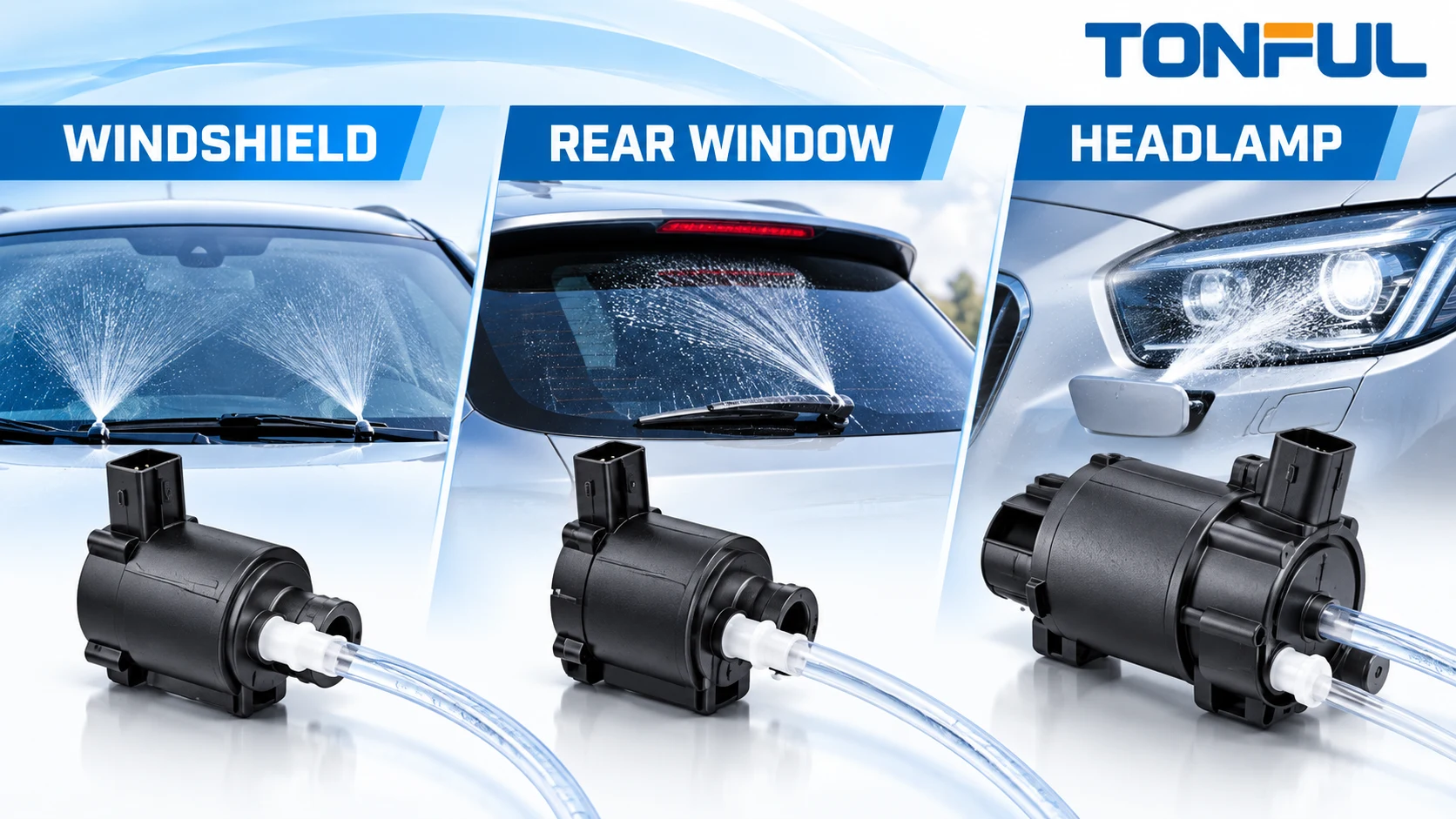
Windshield, rear-window and headlamp washer pumps may all move cleaning fluid, but they do not automatically share the same hydraulic demand, mounting interface or control strategy. A compact pump that supplies windshield nozzles may be unsuitable for a long rear hose. A headlamp-cleaning circuit may require a different pump, reservoir outlet and duty profile from either glass-washing circuit. Connector fit or nominal voltage alone cannot establish interchangeability.
The correct comparison starts with the cleaning target and then follows the entire path: vehicle request, electrical control, pump, reservoir seal, hose, valves and nozzles. This guide helps buyers and engineers define that path without inventing universal pressure, flow or current limits.
On this page: Quick comparison | Windshield | Rear window | Headlamp | Testing | Release record
Quick Comparison of the Three Applications
| Decision field | Windshield washing | Rear-window washing | Headlamp washing |
|---|---|---|---|
| Cleaning target | Front glass in the driver’s forward view | Rear glass on equipped vehicles | Lamp lens or approved lighting surface |
| Typical circuit question | Does spray cover the defined windshield zone? | Can the system prime and deliver through the rear route? | Can the circuit deliver the approved cleaning event without leakage or overload? |
| Common pump arrangement | Dedicated single outlet or one side of a reversible pump | Dedicated single outlet or opposite side of a reversible pump | Often a dedicated application-specific pump |
| Hydraulic path | Usually relatively direct, but vehicle-specific | Often longer and routed through body or liftgate | May include larger hose, telescopic jets or application-specific valves |
| Key interface risk | Outlet clocking, grommet fit and nozzle restriction | Hose length, drain-back, liftgate flex and routing | Reservoir port, outlet size, hose retention and system demand |
| Required release evidence | Installed spray, current, leakage and command | Prime time, rear spray, backflow, flex-area inspection | Controlled hydraulic test and vehicle-level operation |
These are comparison factors, not universal design rules. Vehicle platforms can use unexpected arrangements, including a single reversible pump for front and rear circuits or integrated wet-arm systems. The exact service information and physical sample remain authoritative for the application.

Conceptual illustration only—not an acceptance standard or laboratory micrograph. Hose routing, controls and pump allocation vary by vehicle.
TONFUL presents an automotive washer pump product category for sourcing discussions. Confirm the exact application, drawing and approved sample before assigning a pump to any of these circuits.
Windshield Washer Pumps
A windshield pump supplies the primary front-glass cleaning circuit. Selection must account for reservoir position, inlet stem, grommet, connector, outlet diameter and direction, plus the installed hose and nozzle arrangement. A pump that produces visible free flow on a bench may still deliver an unacceptable spray pattern when connected to the vehicle’s restrictions.
Verify the Command and Supply Path
The driver request may pass through a stalk switch, relay or body control module. Verify the approved circuit before applying power. TONFUL’s wiper switch diagnostic guide explains how command-side faults can resemble a pump problem, while the auto combination switch category provides related sourcing context. Neither page proves a specific pump pinout.
Measure voltage at the pump under the washer request when the service procedure permits. An open-circuit voltage reading does not reveal connector resistance or supply collapse under load. Record the ground test point, instrument and operating state. Do not use resistance or continuity mode on an energized circuit, and do not power unidentified terminals.
Confirm Installed Spray Performance
Evaluate start behavior, spray distribution, pump current, visible leakage and recovery after repeated requests under the customer-approved conditions. Nozzle aim, fluid, temperature, hose condition and check valves can change the outcome. Keep pump evaluation separate from nozzle adjustment and hose repair so that the actual cause is traceable.
For applicable U.S.-market vehicles, 49 CFR 571.104 addresses vehicle-level windshield wiping and washing requirements. It does not certify an individual washer pump or provide a universal component flow limit.
Rear-Window Washer Pumps
Rear-window circuits can create different installation challenges even when the pump body resembles a front pump. The route may pass through interior panels, a roof area, a liftgate hinge or flexible conduit before reaching the rear nozzle. Additional length, elevation and fittings can affect prime retention and response.
Dedicated Pump or Reversible Shared Pump
Some vehicles use a dedicated rear pump. Others use one reversible dual-outlet pump for front and rear delivery. Identify the architecture before ordering. A two-outlet body is not sufficient proof of reversibility, and a reversible pump needs a controlled polarity-to-outlet map.
When diagnosing one failed end of a shared system, test both directions. If front washing works but rear washing does not, investigate rear hose leakage, a blocked nozzle, an inactive-path valve, swapped hoses, one failed motor direction or a command issue. Replacing the pump without isolating the path can leave the fault unchanged.
Inspect the Moving Body Route
Rear hose failures often occur where the line flexes with a hatch, tailgate or trunk lid. Inspect for pinching, abrasion, loose couplings and fluid entering trim or electrical areas. Record the observation before disturbing the route. After repair, operate the closure through its movement and confirm that the hose is not tensioned or folded.
Prime retention and drain-back requirements must come from the vehicle or approved project plan. Do not add a generic non-return valve merely to shorten response; its restriction, cracking behavior, orientation, fluid compatibility and freeze performance can change system operation.
Headlamp Washer Pumps
Headlamp-cleaning systems require separate treatment because their hydraulic and functional demand can differ materially from glass washing. The circuit may use a dedicated pump, larger fluid connections, application-specific valves or deployable cleaning jets. A similar-looking windshield pump should not be substituted unless the exact system evidence supports it.
Do Not Infer Pressure From Appearance
Terms such as “high pressure” are descriptive unless the product drawing or approved test plan defines the operating point. Evaluate pressure and flow together at the specified restriction, fluid condition and supply voltage. Free-flow volume alone cannot establish nozzle performance, while a dead-head reading alone does not reproduce the cleaning event.
Also record current, startup behavior, leakage, noise and hose retention. The connector and reservoir interface must safely support the application-specific circuit. A larger outlet or motor housing does not by itself prove performance or compliance.
Vehicle and Market Scope Matters
Headlamp cleaning can be connected to lighting configuration, washer command logic and market-specific vehicle requirements. UNECE maintains UN Regulation No. 45, which concerns headlamp cleaners in its applicable approval context. The regulation is not evidence that a loose replacement pump is approved for every vehicle or market.
Release must follow the exact vehicle configuration and customer requirements. Confirm whether the cleaning request depends on headlamp state, fluid level, timed logic or module coding. Component bench success does not establish completed-vehicle approval.

Conceptual illustration only—not an acceptance standard or laboratory micrograph. The drawing compares decision factors, not universal hose lengths or pressure values.
Interfaces That Prevent Interchangeability
Reservoir and Seal
Compare inlet diameter, stem length, shoulder position, filter or pickup arrangement, installation depth and the exact grommet. Reusing a hardened or deformed seal can create leakage even when the pump body is correct. A pump that seats too deeply can contact the reservoir or place the outlet in an unusable orientation.
Connector and Terminals
Record the mating face, keying, latch, cavity population and terminal function. TONFUL’s automotive electrical connector guide is useful for interface discussions, but a matching shell does not prove polarity, terminal capacity or module compatibility. Use protected breakout leads rather than forcing oversized meter probes into terminals.
Hose and Outlet
Check outlet diameter, barb geometry, angle, clocking and clearance. The installed hose must not kink, rub or pull the pump out of its seal. For headlamp circuits, confirm the approved hose and retention method rather than adapting a smaller line without engineering review.
Vehicle Wiring
If a replacement connector or harness branch is required, document conductor size, terminal, seal, splice method and strain relief. TONFUL’s custom wire harness assembly page can support a controlled sourcing discussion, but the vehicle drawing remains the source for circuit definition.
Build an Application-Specific Validation Plan
| Validation field | Required record |
|---|---|
| Sample identity | Pump model, revision, lot and sample ID |
| Application | Windshield, rear window or headlamp circuit |
| Electrical condition | Supply range, polarity, protection, command and test points |
| Hydraulic fixture | Reservoir, grommet, hose, valves, nozzles and elevations |
| Fluid condition | Approved fluid, concentration and temperature |
| Measurements | Flow/pressure as applicable, current, leakage, noise and response |
| Environmental sequence | Conditioning and endurance required by approved plan |
| Vehicle confirmation | Intended target sprays correctly; inactive paths and diagnostics acceptable |
| Acceptance source | Drawing, customer specification, regulation or approved test plan |
| Disposition | Pass, conditional, rejected or not evaluated; approver and date |
Define sample quantity and allocation before testing. State whether hydraulic, environmental and endurance work uses independent samples or sequential aging. Reserve unaged controls and destructive teardown samples when the approved plan requires them. A replacement sample is permitted only under a documented invalid-test rule, not simply because the first sample failed.

Conceptual illustration only—not an acceptance standard or laboratory micrograph. Acceptance criteria must identify a controlled source document.
Application Release Record
Do not release a generic “washer pump” approval. Name the cleaning circuit, vehicle scope, exact pump, voltage version, connector, inlet and outlet interfaces, control architecture, test evidence and change level. If one pump serves two destinations, include the polarity or command map and inactive-path behavior.
For procurement, require packaging and labels to preserve the approved identity. Incoming inspection should compare model, revision, connector, outlet geometry and reservoir interface against the controlled sample. Any supplier change affecting motor, housing, impeller, seal, terminal, connector, valve or material requires review under the agreed change-notification process.
Discuss Application-Specific Washer Pumps With TONFUL
Send TONFUL the cleaning application, vehicle and OE reference, removed-pump photographs, connector end view, nominal electrical system, inlet and grommet dimensions, outlet layout, hose destination and expected order quantity. TONFUL can compare the request with its documented product range and arrange sample discussion. Final approval should remain limited to the exact windshield, rear-window or headlamp circuit that was validated.