
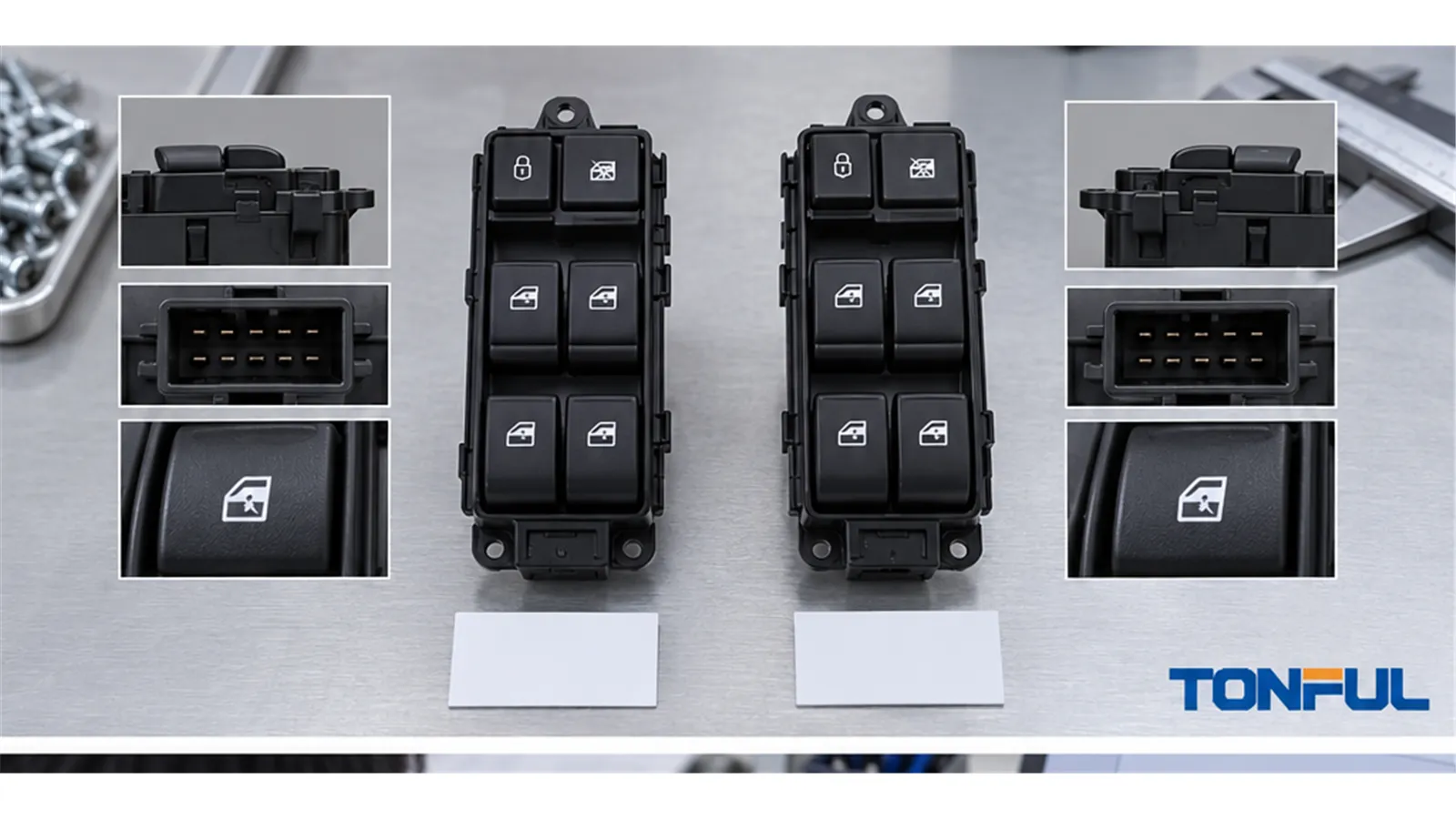
Choosing between an OEM and aftermarket power window switch should not be based on brand, appearance, or unit price alone. The correct choice depends on the exact vehicle and production range, door position, connector and pinout, electrical architecture, functions, validation evidence, supply continuity, warranty terms, and the buyer’s ability to verify the part.
A genuine service part can reduce application uncertainty when the vehicle-brand catalog clearly supports the exact configuration. A validated aftermarket switch can be a practical alternative when its supplier provides controlled fitment data, drawings, electrical and functional evidence, traceability, and change control. Neither label alone proves that a switch fits every market, model year, or option package.
On this page: Define the Product Categories | Compare Fit, Function and Validation | Choose the Appropriate Source | Calculate Risk and Release the Part
Define the Product Categories
Genuine, OE, Aftermarket, and Used Are Not Synonyms
| Name | How it should be understood | What it cannot automatically prove |
|---|---|---|
| Genuine part | Sold under the vehicle brand through its service-parts system | Universal fit across markets, years, trims, doors, or supersession conditions |
| OE production part | Used in original vehicle production or supplied to an original-production specification | Availability through the vehicle-brand service channel or compatibility outside its released scope |
| OE supplier part | Sold by a company that has supplied products to vehicle manufacturers | That this specific aftermarket model uses the same specification, materials, software, tooling, or production line as the original part |
| Aftermarket part | Developed or supplied for replacement outside the vehicle-brand service channel | Low quality, complete equivalence, or suitability for every listed application |
| Remanufactured part | Previously used core restored through a defined remanufacturing process | New-part condition, full remaining life, or replacement of every wear item unless documented |
| Used/salvage part | Removed from another vehicle and resold | Known service life, contamination history, internal wear, revision, or complete traceability |
“OEM quality,” “OE style,” and “factory replacement” are marketing expressions unless connected to a named product specification and evidence. Likewise, “made by an OE supplier” does not mean the item is identical to the original switch. Buyers should ask who owns the drawing, which revision applies, what was validated, and whether the supplied lot is controlled to that definition.

An OEM or aftermarket label cannot replace connector, pinout, application, and approved-sample evidence.
Verify the Vehicle and OE Context First
Record make, model, model year, production date or VIN range, market, trim, body, door position, and LHD/RHD. Capture the complete OE service number and supersession direction. A base number or molded housing number may identify a family or subcomponent rather than the complete switch.
The Power Window Switch OE-number verification guide explains how to separate service, supplier, engineering, housing, and unverified marketplace numbers. For U.S.-market identification, NHTSA vPIC can support manufacturer-reported vehicle data and VIN decoding. It does not confirm switch interchangeability, OE status, connector pinout, electrical equivalence, or supplier approval.
Compare Fit, Function and Validation
Side-by-Side Sourcing Comparison
| Comparison item | Genuine or vehicle-authorized service part | Validated aftermarket option | Purchasing decision |
|---|---|---|---|
| Fitment evidence | Usually supported by vehicle-brand catalog and service system | Depends on supplier application table, drawing, cross-reference, and approved sample | Verify complete OE number, market, production range, door, and LHD/RHD for both |
| Electrical architecture | Normally aligned with the released vehicle configuration | Must confirm direct reversing, relay/BCM request, resistance-coded, or networked design | Same connector does not prove electrical compatibility |
| Software/calibration | Often closely associated with vehicle revision and service procedure | May require hardware, software, coding, or relearn confirmation | Electronic master switches require stricter version evidence |
| Availability | Older applications may be discontinued or constrained | May support continued supply or additional production options | Review lifecycle, tooling condition, capacity assumptions, and change notice |
| Price | Often higher at unit level | Usually offers more price tiers and sourcing choices | Compare total installed and warranty cost, not unit price alone |
| Change control | Managed through the vehicle-brand service system | Depends on supplier’s documented configuration and process controls | Require formal notification and affected-lot identification |
| Warranty | Terms are usually standardized by the vehicle brand or authorized channel | Terms vary by manufacturer, brand, and distributor | Confirm duration, exclusions, labor, diagnostics, return freight, and claim process |
The terms “genuine or vehicle-authorized service part” and “validated aftermarket part” describe sourcing routes, not measured quality rankings. A poorly matched genuine part can still be wrong for the vehicle; a well-documented aftermarket part may be suitable within a defined approved scope. An OE production part is a separate category: it must be tied to the original-production specification, application, approval scope, and authorized supply route rather than inferred from the supplier’s identity.
Verify Mechanical and Electrical Equivalence
Use the Power Window Switch Fitment Checklist to compare bezel, mounting, housing depth, connector shell, keying, latch, populated cavities, and installed clearance. Then compare electrical and functional evidence separately.
| Verification area | Specific comparison | Acceptance source |
|---|---|---|
| Connector and terminals | Keying, cavity map, populated terminals, terminal position and retention | Drawing, connector record, approved sample |
| Switch-state output | OFF, manual UP/DOWN, AUTO stages, lockout, locks, mirrors, and illumination states | Circuit and function matrix |
| Direct-load performance | Contact path, specified load, contact resistance or loaded voltage drop, terminal heating | Product specification and approved test plan |
| Resistance-coded output | Resistance window and tolerance for every command | Controlled circuit specification |
| Rocker feel | Operation force, force-travel stages, detent, return, free play, alignment | Drawing or approved ergonomic requirement |
| Durability | Electrical load, rate, dwell, temperature, sample quantity, interim checks, failure modes | Qualification plan |
| Environment | High/low temperature, humidity, vibration, chemicals, cleaning agents, dust or ingress as applicable | Customer/OEM application requirement |
| Illumination | Polarity, color, brightness, dimming/PWM behavior, symbols and light leakage | Appearance and electrical specification |
| Electronic functions | ESD, EMC, communication, diagnostics, hardware/software revision, coding and sleep/wake behavior where applicable | Approved electronic validation plan |
| Packaging and traceability | Label identity, lot, revision, manufacturing site, protection, shipment and change history | Purchase and quality agreement |
Do not compare cycle counts without load, actuation sequence, rate, temperature, samples, monitoring, and failure criteria. Separate design qualification, routine production testing, and field-return data because each answers a different question. Specific limits must come from customer drawings, vehicle requirements, product specifications, or an approved test plan.
Define the One-Touch and Anti-Pinch Boundary
Manual glass movement does not prove complete automatic-window compatibility. One-touch closing may depend on the switch, door module, motor controller, position sensor, current detection, learned travel limits, initialization, network communication, and vehicle safety logic.
Approval of a genuine, OE production, or aftermarket switch alone does not establish compliance of the completed power-window system. Confirm which device controls one-touch closing, obstacle detection, automatic reversal, position learning, and initialization. After replacement or power interruption, follow the vehicle-specific relearn procedure and check diagnostic codes and every authorized control location.
For U.S.-market vehicles, 49 CFR § 571.118 addresses vehicle-level operating, actuation, and qualifying automatic-reversal requirements. The official NHTSA FMVSS 118 laboratory test procedure describes compliance-test methods for completed power-operated window, partition, and roof-panel systems. These sources are not stand-alone certification standards for an individual switch, and switch approval alone does not establish compliance of the completed vehicle system.
The Master vs Passenger Power Window Switch guide explains how direct contacts, resistance coding, and door modules affect control authority. The How to Test a Power Window Switch guide provides a vehicle-diagram-based diagnostic sequence rather than a universal pinout.
Choose the Appropriate Source
When a Genuine or Vehicle-Authorized Part Is Usually the Lower-Risk Choice
A genuine or vehicle-approved service option is generally more appropriate when:
- software, module coding, or vehicle configuration dependency is significant;
- the repair must follow a vehicle-brand warranty or service procedure;
- the buyer lacks resources for sample, electrical, and vehicle-level validation;
- one-touch, anti-pinch, door-module, or network functions are complex;
- an incorrect release would create high diagnostic, labor, fleet-downtime, or reputation cost;
- the official service catalog clearly supports the exact vehicle and supersession path.
This conclusion is conditional on purchasing through a traceable source and confirming the actual application. Genuine packaging alone should not override an OE-number or vehicle mismatch.
When a Validated Aftermarket Switch Can Be Appropriate
An aftermarket option can be considered when:
- the genuine service part is discontinued, constrained, or has an impractical lead time;
- drawings, connector and cavity maps, pinout, architecture, and function evidence are complete;
- identified samples have passed the buyer’s required bench and vehicle checks;
- the supplier provides production-lot traceability, change control, nonconformance response, and warranty support;
- continued supply, packaging, customization, or total cost creates measurable program value;
- approval is limited to the vehicle, market, door, revision, and evidence actually reviewed.
Use the Power Window Switch RFQ and Sample Approval Checklist to prevent a successful sample from being interpreted as unrestricted production approval. For repeat supply, the Power Window Switch Manufacturer Audit Checklist covers product-specific process controls, test coverage, traceability, and corrective-action closure.
Calculate Risk and Release the Part
Calculate Total Sourcing Cost
Convert “do not buy on price alone” into a project calculation:
Total sourcing cost = unit price + inbound inspection + installation labor + diagnostic time + return freight + warranty labor + vehicle downtime + obsolete inventory risk
Use expected quantities and the buyer’s actual labor, freight, return, and downtime assumptions. Add tooling, engineering, validation, packaging, and change-management cost where relevant. Do not insert invented industry averages. A lower-priced switch can remain the better choice when evidence and failure-control costs are acceptable; a higher-priced option can be cheaper overall when it reduces application errors and vehicle rework.
Apply Evidence and Conflict-Control Rules
Maintain one comparison record containing vehicle and market, production range, door and LHD/RHD, complete OE chain, source identity, samples and lots, photographs, dimensions, connector cavity map, pinout, architecture, function matrix, test conditions, results, deviations, warranty terms, approver, and date. This replaces repetitive reminders in every section.
If catalog, drawing, sample, or test evidence conflicts, preserve the sources and stop release until the controlling vehicle, customer, engineering, or supplier authority resolves the difference. A photograph cannot establish internal materials, software, pinout, or validation. Unknown fields remain unknown rather than being changed to pass for commercial convenience.

Receiving condition, labels, approved configuration, lot traceability, and warranty evidence should be reviewed for either sourcing route.
Release Checklist
- Exact vehicle, market, production range, door position, and LHD/RHD are confirmed.
- Complete OE reference and supersession direction are documented.
- Mechanical fit, connector, populated cavities, pinout, and architecture agree.
- Every manual, automatic, lockout, illumination, and integrated function is verified.
- Test evidence identifies samples, loads, conditions, results, failures, and acceptance sources.
- One-touch, anti-pinch, coding, and initialization responsibilities are defined.
- Packaging, traceability, warranty, supply continuity, and change notification are agreed.
- Total sourcing cost and residual risk are approved for the named application.
Work With TONFUL
TONFUL’s automotive power window switch range presents current vehicle applications and OE reference numbers. Send the exact vehicle and market, OE reference, door position, LHD/RHD, removed-part photos, connector, pinout, architecture, functions, annual demand, packaging, and validation requirements. TONFUL can review the applicable switch scope and sample requirements; final compatibility and release remain tied to controlled project evidence.