
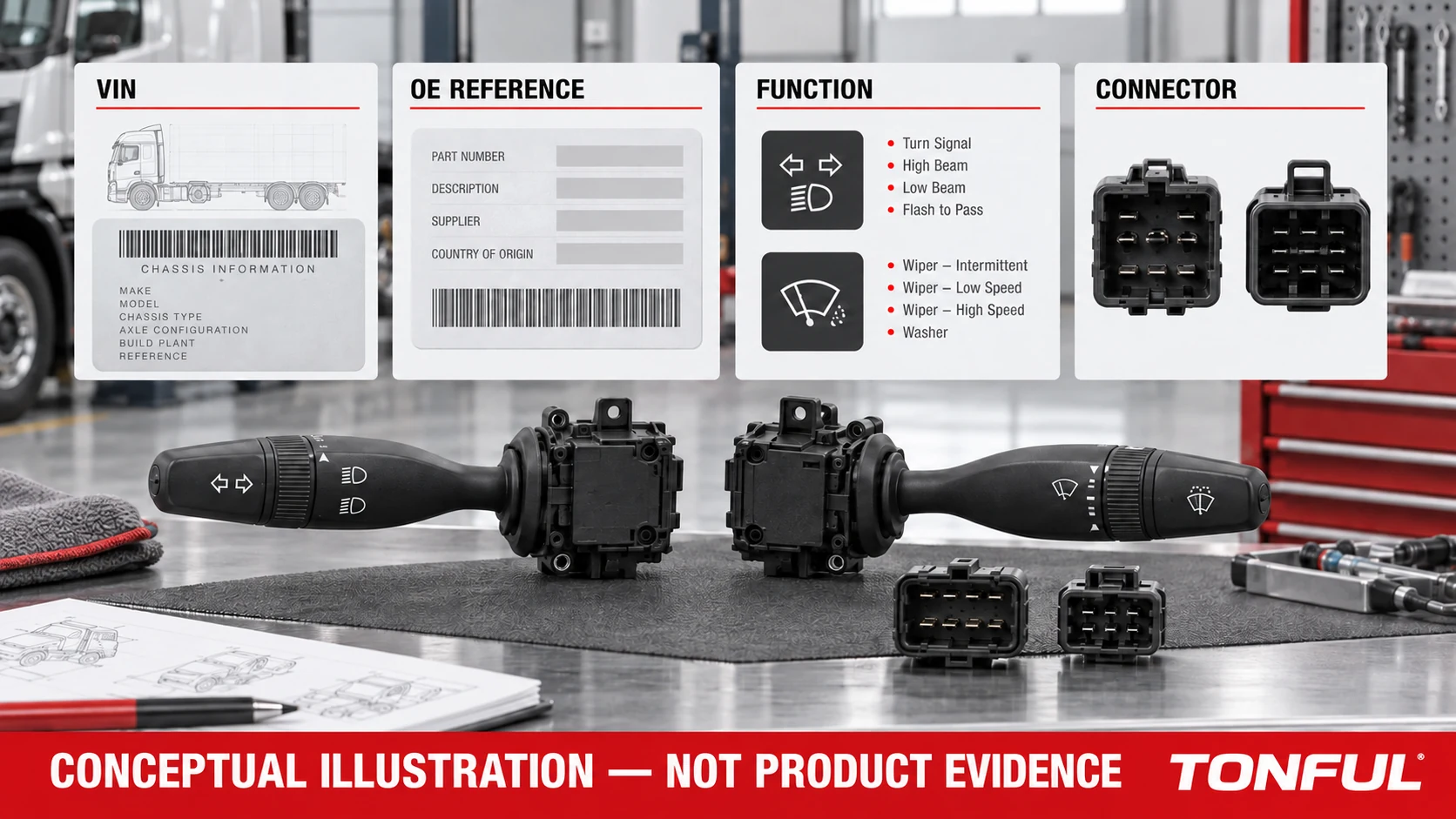
Selecting a Volvo FH or FM combination switch should not begin with a product photograph or a shortened OE number. Trucks carrying the same model badge can differ by market, production date, cab and chassis specification, LHD/RHD, stalk function, connector population, electrical architecture and software. A switch that fits the steering column can still send the wrong command or omit a required function.
TONFUL does not currently have enough controlled evidence in this article package to publish any Volvo reference family as Verified for a defined FH/FM scope. The correct process is therefore VIN- and vehicle-specific: identify the truck, classify each number and source, compare the removed part and candidate sample, verify the pinout and command matrix, and approve the installed result before adding a public application claim.
On this page: Reference Status | Vehicle and Hardware Match | Electrical and Functional Match | Approval Record
Reference Status
Verified for a Defined FH/FM Scope
No reference is currently Verified in this article package. A Verified entry requires a Volvo system or authorized-dealer VIN lookup, complete part number and supersession direction, removed-part label photograph, TONFUL sample label and drawing, connector end view, complete function test, installed-vehicle result, reviewer and verification date. An empty Verified section is more accurate than promoting a repeated aftermarket association.
Candidate—Vehicle and Sample Confirmation Required
| Candidate reference group | Source issue or current lead | Required controlled evidence | Status |
|---|---|---|---|
| 3172170 / 1624135 / 202339 | Cojali cross-references 3172170 with 1624135; TONFUL currently publishes 1625135, which appears suspect and must not be silently corrected without internal evidence |
Volvo VIN lookup, TONFUL inventory labels, drawing/SKU record, connector and function test | Unverified candidate |
| 20700927 / 3944081 / 20553738 | Reported as an FH/FM-related switch group, but function, generations and supersession direction are not controlled here | Volvo source, label chain, function matrix, connector and installed sample | Unverified candidate |
| 20953569 / 20942844 / 20466302 | Steering-column switch research lead with incomplete application and function evidence | VIN scope, supersession direction, labels, connector, architecture and installed test | Unverified candidate |
| 3172171 / 1096413 / 70481187 | Existing TONFUL product-page group without controlled FH/FM evidence in this package | Same complete evidence set | Unverified candidate |
| 3944025 / 20479584 / 20701049 | Existing TONFUL product-page group without controlled FH/FM evidence in this package | Same complete evidence set | Unverified candidate |
| 20553740 / 20700930 / 20424046 | Existing TONFUL product-page group without controlled FH/FM evidence in this package | Same complete evidence set | Unverified candidate |
| 8154792 / 1594542 / 70351706 | Platform and application boundaries unresolved | Volvo source plus physical and functional sample evidence | Unverified candidate |
| 90228194 | Single research lead with incomplete vehicle and function evidence | Volvo source plus labeled TONFUL sample | Unverified candidate |
| 20953593 / 20752919 / 20568858 | Application and replacement direction unresolved | Volvo source, labels, connector and installed test | Unverified candidate |
The Cojali product record for 3172170 lists 1624135, not 1625135, and describes FH12/NH12 applications. Cojali is an aftermarket source, so it is strong enough to trigger a data hold but not sufficient to authorize a TONFUL database correction by itself. TONFUL must inspect its physical label, drawing, supplier source and product record, then synchronize the verified result across this article and the product page.
Not Verified or Outside the Current FH/FM Scope
| Reference group | Why it is outside this page’s working scope | Required action |
|---|---|---|
| 8158723 / 70351704 | The Cojali record for 8158723 lists FL10, NL10, NL12 and several bus applications rather than a defined FH/FM scope | Remove from the FH/FM candidate matrix; create a separate platform record only after controlled confirmation |
These tables are validation registers, not published interchange guarantees. Candidate supports investigation only. Unverified must not become a catalog claim because multiple reseller pages repeat it. TONFUL’s automotive OE-number guide explains number types, supersession direction and evidence grades.
Retrieve VIN-Specific Information
Volvo Trucks states that its Customer Portal provides VIN-specific repair information, while PartsASIST can locate parts using VIN and vehicle details. These official services support a VIN-first process; their public overview pages do not prove any reference group, application or supersession without an actual vehicle-specific lookup and retained result. See the Volvo Trucks service portal overview and PartsASIST description.
Record VIN or chassis number, model designation, market, production date, cab type, LHD/RHD, stalk side, transmission, lighting and wiper options, cruise or retarder controls and any steering-column module information. Ask the authorized parts source for the complete service number, revision and supersession direction. “Fits FH/FM” is too broad to release a switch.
Vehicle and Hardware Match
Classify the Removed Part Before Comparing It
Photograph the complete label, stalk symbols, housing, mounting interface and connector. Separate the OE service number from supplier, engineering, casting and customer-stock numbers. A shared housing can carry a molded number used across several internal configurations, so that mark cannot automatically identify the full assembly.
Then classify the function family: direction indicator/beam, wiper/washer, cruise/retarder, or a multifunction assembly. Record every maintained, momentary and rotary control. A candidate with the correct primary function can still omit flash-to-pass, intermittent adjustment, rear-wiper, washer, menu or another secondary command.
Compare Mechanical Interface and Stalk Position
Check steering-column shroud interface, locating tabs, screw or clip positions, housing depth, lever reach, travel, detents, self-cancel interface where used, trim clearance, connector access and harness strain. LHD/RHD can change stalk side, symbols, driver reach or harness routing. It must be recorded even if the candidate appears to mount correctly.

Conceptual illustration only—not product evidence. Identify the removed part’s complete function family before comparing mounting and connector details.
Compare Connector End Views, Not Angled Photos
Place removed and candidate connectors in the same straight-on orientation with latch or keyway visible. Record shell family, polarization, cavity numbering source, cavity count, populated terminals, blanks, terminal type and size, seals and latch condition. Do not mirror photographs.
The 3172170 group is a useful example of why this matters: TONFUL’s published companion number conflicts with aftermarket records, and the application boundary is incomplete. Instead of choosing the more convenient listing, retain the conflict and resolve it against the TONFUL label, drawing, mating connector, vehicle diagram and installed function test. The combination-switch pinout guide provides a controlled cavity-map method without inventing a Volvo pinout.
Electrical and Functional Match
Identify the Architecture Before Probing
A Volvo stalk may use separate contacts, resistance or voltage coding, a local module, LIN/CAN communication, or a mixed architecture. Do not infer the method from the connector count. Retrieve the applicable wiring diagram and identify supply, ground, references, direct-load paths, controller inputs and communication lines.
Public Volvo portal descriptions, North American body-builder material and aftermarket catalogs do not establish FH/FM switch interchangeability. Use only the wiring and parts information returned for the identified chassis and market, and retain the source revision with the approval record.
Never apply battery voltage, ground or a test lamp to an unidentified signal. For electronic switches, preserve initial DTCs and module information before disconnection. The analog, resistive, LIN and CAN stalk guide explains architecture-specific tools and evidence.
Build a Function and Pinout Record
| Record field | Removed part | Candidate sample | Source | Result |
|---|---|---|---|---|
| Complete OE/supplier number and revision | Enter | Enter | Label and controlled catalog | Pass/Fail |
| VIN/chassis and production scope | Enter | Enter | Vehicle record | Pass/Fail |
| Function family and stalk side | Enter | Enter | Visual/function record | Pass/Fail |
| Connector view and keying | Enter | Enter | End-view photo/drawing | Pass/Fail |
| Populated cavity map | Enter | Enter | Controlled diagram/sample | Pass/Fail |
| Signal architecture by function | Enter | Enter | Wiring diagram/test | Pass/Fail |
| Turn/beam or wiper/washer states | Enter | Enter | Product-specific state table | Pass/Fail |
| Cruise, retarder or secondary controls | Enter | Enter | Function matrix | Pass/Fail |
| Software/coding/initialization | Enter | Enter | Vehicle service procedure | Pass/Fail |
| Installed function and DTC status | Enter | Enter | Identified truck | Pass/Fail |
For discrete contacts, test every state using controlled cavity numbers and viewing direction. When contacts carry load, use the approved load, switching sequence, voltage-drop and thermal method. For coded signals, record reference conditions, raw values, tolerances and module-decoded states. For networked assemblies, verify supply, wake/sleep, recognized input state, communication and software/configuration.
Use a Symptom-to-Evidence Workflow
| Symptom after installation | Investigation direction | Next evidence |
|---|---|---|
| Connector mates but several functions are absent | Different cavity population or internal variant | End-view map and complete function table |
| Turn signal works but beam/flash does not | Secondary contact, coding or wrong function variant | Command-state and cavity-path comparison |
| Wiper stages are wrong | Wrong wiper variant, coded values or module interpretation | Raw and decoded stage matrix |
| Washer does not operate | Switch command, wiring, module or pump circuit | Separate input command from downstream output |
| Lever does not cancel or contacts trim | Geometry, orientation or column interface mismatch | Mounting dimensions and installed clearance |
| New switch creates DTCs | Electronic revision, coding, network or configuration mismatch | Hardware/software data and diagnostic record |
| Function is intermittent with movement | Contact, terminal retention or harness strain | Dynamic monitoring and connector inspection |
| Bench test passes but truck rejects command | Fixture omitted module load, reference or vehicle authorization | Installed live states and configuration |
The combination-switch diagnostic guide helps keep the switch, connector, wiring, module and downstream load as separate evidence branches.

Conceptual illustration only—not product evidence. The final decision must connect the actual label and sample to VIN-specific parts, wiring and installed-function evidence.
Approval Record
Approve only the named sample, lot and vehicle scope. Retain VIN/chassis boundary, market, production date, LHD/RHD and stalk side, complete OE and supersession chain, label photos, mechanical dimensions, connector map, architecture, function results, test conditions, DTCs, required coding, reviewer and date. Unresolved reference families must remain Unverified, not silently promoted to a fitment claim.
Production release also needs change control. Require notification before changes to housing, stalk legends, connector supplier, terminal plating, contacts, springs, resistor networks, PCB, firmware, tooling, manufacturing site, end-of-line test or packaging label. Define which changes trigger document review, dimensional inspection, electrical retest or a new vehicle sample. This matters particularly when the same sales reference can cover revisions whose visible shape remains unchanged. Incoming inspection should confirm the approved label, revision, connector orientation, critical dimensions, function state and traceability rather than relying only on carton text.
Use Conditional only for a bounded deviation with an owner, due date and closure evidence. A passing bench sample is not automatic production or catalog approval. The combination-switch RFQ and sample checklist provides matching commercial and technical release fields.
Work With TONFUL
TONFUL’s automotive combination switch range currently repeats 1625135, which requires an internal data hold and evidence review. Send the Volvo VIN/chassis scope, market, production date, complete removed-part label, stalk and connector photos, LHD/RHD, required function matrix, wiring evidence and sample-validation plan. TONFUL should confirm the physical inventory label, drawing/SKU record and supplier source before changing the number to 1624135, then synchronize the verified correction across every public page.