
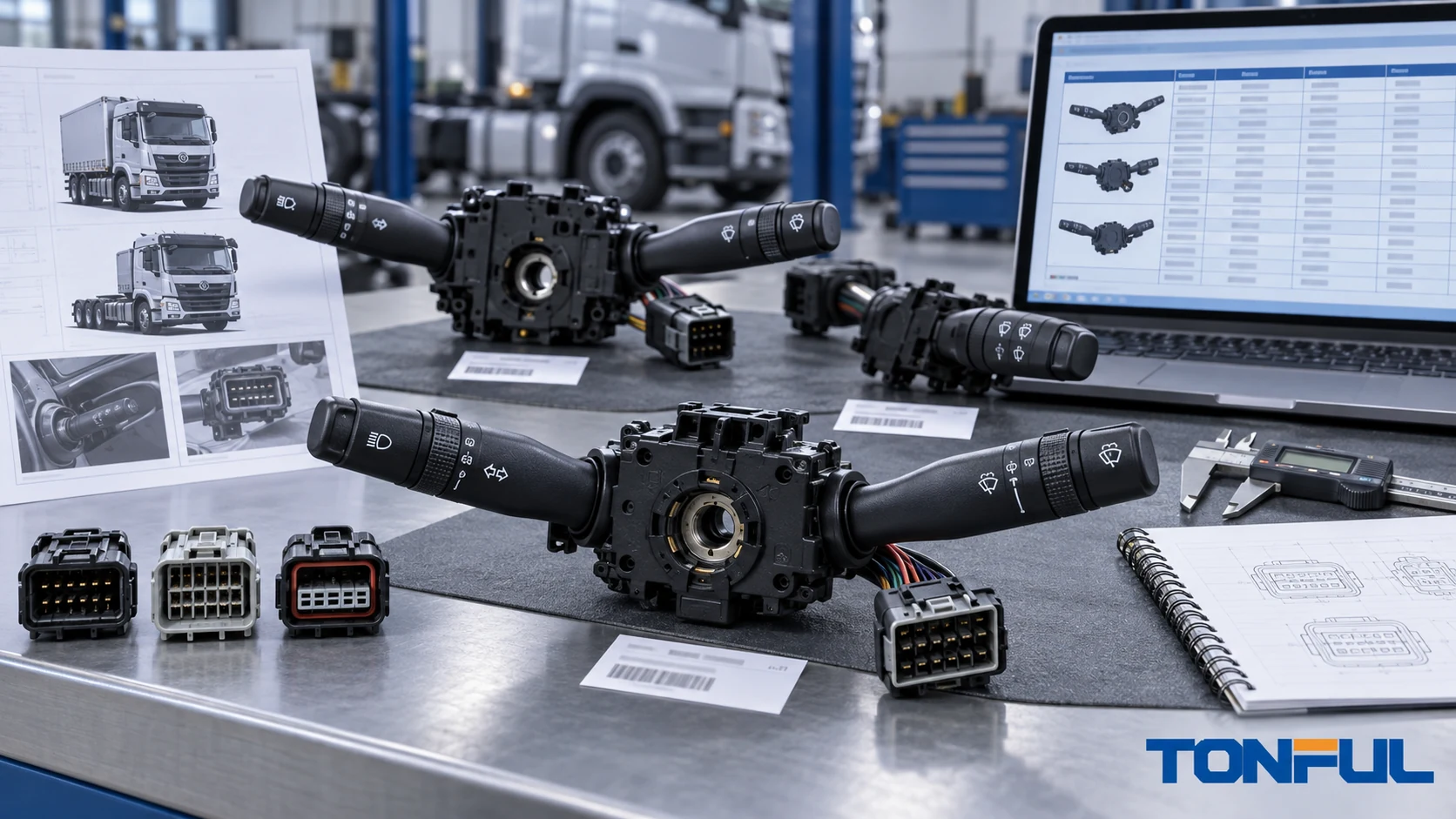
Cross-referencing an automotive combination switch should not begin and end with one OE number, a product photograph, or an unverified marketplace listing. A number can identify a complete service part, an engineering drawing, a supplier item, a molded housing, or a customer’s stock record. Even a valid service number may cover only a particular market, production period, steering configuration, connector, or function set.
This guide explains how to build and approve a traceable automotive combination switch cross-reference. It does not present unverified numbers as confirmed interchange. A valid row needs the source and replacement numbers, direction, vehicle range, LHD/RHD configuration, mounting side, connector, pinout, function matrix, architecture, validation status, and evidence owner.
On this page: Classify the Number | Build the Application Record | Verify Physical and Electrical Equivalence | Approve and Maintain the Cross-Reference
Classify the Number
Different Numbers Serve Different Purposes
Never label every molded, printed, or catalog number as an “OEM number.” Capture the characters exactly, photograph where the number appears, and assign a number type before using it as a search key.
| Number type | Practical meaning | Evidence warning |
|---|---|---|
| OE service number | Vehicle-brand service-channel number for a complete service part | Verify market, production range, options, and current supersession |
| Superseded OE number | Earlier service number replaced by a later number | Record direction and conditions; replacement may not be reversible |
| Supplier/manufacturer number | Component manufacturer’s own sale or production number | Does not automatically equal a vehicle-brand service number |
| Engineering/drawing number | Identifier for a drawing, design, or revision-controlled definition | May not be orderable and may identify only one configuration level |
| Housing/casting number | Molded or stamped number on a housing, bezel, or subcomponent | Must not be assumed to identify the complete switch assembly |
| Customer SKU | Distributor, fleet, retailer, or customer inventory code | Requires a documented link to the controlled product record |
| Unverified marketplace number | Third-party listing or seller-provided interchange | Treat as a research lead until primary evidence and a sample confirm it |
A housing number is especially risky because the same molded shell may be used with different contacts, resistor ladders, PCB revisions, illumination, button symbols, software, or populated terminals. Record both the number and its physical location: label, laser mark, molded cavity, packaging, catalog, or controlled document.
Capture the Source Without Normalizing It
Store the original string, including prefixes, suffixes, spaces, hyphens, leading zeroes, and revision characters. Keep a separate normalized search field if your catalog system needs one. Do not overwrite the source value, because a suffix can distinguish mounting position, steering configuration, market, color, or function.
For each number, retain the source organization, document or URL, publication date or revision, destination market, screenshot or file reference, and reviewer. A vehicle-brand catalog, official service bulletin, controlled supplier drawing, original labeled part, and marketplace listing do not carry equal evidentiary weight.

The number is only the starting point; housing, mounting, connector orientation, and controlled application evidence must also agree.
Build the Application Record
Define Vehicle, Market, and Installation Position
Record make, model, model year, production date or VIN range where available, cab or body type, market, trim, LHD/RHD configuration, mounting side, and steering-column arrangement. Similar housings can carry different lever directions, icons, cruise-control functions, connectors, cancel mechanisms, or electrical logic.
For U.S.-market vehicles, NHTSA vPIC can support manufacturer-reported VIN decoding, manufacturer information, and basic vehicle identification. It does not confirm automotive combination switch OE numbers, interchangeability, pinout, functions, supersession, audit compliance, test results, or product acceptance. Use it only for the vehicle fields it actually provides, then obtain part-specific evidence elsewhere.
The heavy-duty truck combination switch selection guide explains how vehicle identity, connector, pinout and installed evidence must support a candidate. Mark unavailable details as Unknown; do not convert a broad model-year listing into a confirmed production range without evidence.
Record Supersession Direction and Conditions
A supersession is a relationship, not just two numbers in one row. Record source number, replacement number, effective date, market, direction, and any associated harness, bezel, module, programming, or installation condition. Use clear direction values:
A → B: B replaces A; reverse use is not established.A ↔ B: both directions are supported by the controlling source.A → B with condition: replacement requires a named related change or procedure.Related, not superseded: numbers share an application or family but are not direct replacements.Unverified: a relationship has been reported but not confirmed.
Do not delete the old number when a new one appears. Keeping the chain helps identify installed parts, warranty returns, mixed inventory, and historical applications. Every chain needs a last-verified date and approver because catalogs and service information change.
Use a Complete Cross-Reference Record
Use the blank record structure below as a controlled working form. It contains no real OE mappings and must not be interpreted as a confirmed interchange table.
| Data field | Required entry |
|---|---|
| Source number | Exact characters and number type |
| Replacement number | Exact current candidate number |
| Direction | One-way, two-way, conditional, related, or unverified |
| Vehicle/market | Make, model, body, destination market |
| Production range | Model year plus production/VIN boundary when available |
| Installation position | Left/right stalk, steering-column module, and LHD/RHD context |
| LHD/RHD | Confirmed steering configuration or Unknown |
| Connector ID | Shell, keying, latch, cavity count, and orientation reference |
| Pinout revision | Controlled circuit or terminal-map revision |
| Architecture | Direct load, polarity reversing, relay, resistance-coded, or networked |
| Function matrix | Turn signal, lighting, flash, horn, wiper, washer, cruise, and secondary functions |
| Evidence source | Document, catalog, drawing, sample, test, and evidence ID |
| Validation status | Verified, Conditional, or Unverified |
| Last verified date | Date the complete record was reviewed |
| Approver | Named person and approval authority |
Any working template or example row should contain placeholders only. Replace every field with controlled evidence; do not interpret a blank or example record as a confirmed vehicle application. Keep Conditional and Unverified rows inside the working database. Only rows approved as Verified, with a defined vehicle and evidence scope, may feed a public cross-reference table.
Separate the Internal Research Database From the Public Page
Do not publish a specific OE mapping merely because it is labeled Conditional or Unverified. Search engines, distributors and customers can still interpret the row as a fitment claim. Keep research leads, conflicts and rejected candidates in the controlled internal database. The public page should contain only Verified records whose complete evidence supports the displayed scope.
Each internal candidate record should include:
| Evidence field | Required control |
|---|---|
| Source organization | Vehicle manufacturer, controlled supplier or other identified owner |
| Source document or URL | Catalog, bulletin, drawing or service-information reference |
| Source revision and date | Version plus access or retrieval date |
| Market and vehicle scope | Model, production/VIN range, body, options and steering configuration |
| Supersession direction | One-way, two-way, conditional or related-only relationship |
| TONFUL sample or SKU | Physical sample identity, revision, lot and photographs |
| Connector evidence | End view, keying, latch, cavities, terminals and orientation |
| Pinout revision | Controlled circuit or terminal-map source |
| Function-test evidence | State matrix, architecture, conditions and results |
| Approval | Last verified date, reviewer and authorized approver |
If TONFUL product pages, catalogs, labels or internal lists disagree about a number, product category or transcription, suspend the affected public mapping across all pages. Reconcile the original source, physical sample, connector, pinout and function evidence before correcting the shared master record. Updating only this article would leave customers exposed to conflicting catalog statements.
Verify Physical and Electrical Equivalence
Compare Housing, Mounting, and Connector
Photograph candidate and reference parts from the same front, side, rear, label, lever-symbol, mounting, and connector-end views. Record column interface, overall depth, mounting tabs, locating features, lever travel, cancel interface, connector access, and harness length where applicable. Use defined datums for dimensions.
At the connector, compare shell family, keying ribs, polarization, latch, cavity count, populated cavities, terminal size, seal interface, and terminal condition. A connector that mates physically can still have a different pin assignment. Never energize an unknown switch from wire color or cavity count alone.
Use TONFUL’s combination switch contact-resistance testing guide when electrical evidence is required, and the heavy-duty switch failure guide when a field complaint initiated the cross-reference review.
Verify Pinout, Architecture, and Every Function
Obtain the controlled circuit diagram or terminal-function table. Identify supply, ground, illumination, direct-load or relay paths, resistor-coded outputs, and LIN/CAN communication lines. Separate mechanical fit from electrical equivalence: two switches can share a connector shell but use direct contact switching, a resistance ladder, or an electronic column module.
Build a position/output matrix for left/right turn, lane-change momentary action, low/high beam, flash-to-pass, horn, mist, intermittent, low/high wiper, washer, rear-wiper, cruise, and other fitted functions. Record maintained or momentary operation, detents, polarity, resistance state, continuity, or network output according to the product-specific method. Do not publish a universal pinout or limit.
Do not infer compatibility from the plug alone. TONFUL’s combination switch terminology guide helps distinguish stalk, multifunction, turn-signal, and steering-column assemblies before cataloging them.
Approve a Controlled Sample and Vehicle Application
Identify the candidate sample by source, part number, revision, lot, date, and photographs. Compare it with the controlled requirements, then perform only approved dimensional, electrical, functional, tactile, illumination, and vehicle checks. Record equipment, fixture, conditions, raw results, limits, acceptance source, deviations, and invalid-test or retest authorization.
One successful installation supports only the recorded vehicle and configuration. It does not establish every trim, production date, door, or market in a broad catalog range. Preserve the approved sample and baseline images so receiving inspection and future changes can be compared against the released configuration.

A released cross-reference needs an identified approved sample, traceability record, application scope, and named approver.
Approve and Maintain the Cross-Reference
Follow the Complete Verification Sequence
- Capture the number exactly.
- Classify the number type.
- Identify the source and destination market.
- Verify supersession direction and conditions.
- Define vehicle, production range, mounting position, and LHD/RHD.
- Compare housing and mounting.
- Compare connector and populated cavities.
- Verify pinout and electrical architecture.
- Verify every required function.
- Approve the identified sample and vehicle application.
- Assign Verified, Conditional, or Unverified status.
If two sources conflict, retain both records, stop the release, and obtain clarification from the controlling vehicle, customer, engineering, or supplier source. Do not select the source that creates the largest application range.
Assign a Status Readers Can Understand
| Status | Minimum evidence | Publication rule |
|---|---|---|
| Verified | Source identity, application scope, physical and electrical comparison, function matrix, approved sample, date, and approver | Publish only the confirmed scope and evidence date |
| Conditional | Defined evidence gap or application condition with owner, action, and expiry | Keep internal; use only for controlled enquiry, engineering review or sample confirmation |
| Unverified | Marketplace claim, visual match, incomplete number, or unresolved conflict | Keep internal for research; do not present as confirmed interchange |
Review records after an OE supersession, supplier change, drawing revision, connector change, software update, field complaint, or vehicle application expansion. Change control should cover housing, resin, contact system, plating, resistor or PCB, software, illumination, artwork, tooling, site, sub-supplier, test method, packaging, and labels where relevant.
Use the combination switch manufacturer audit checklist to verify document control, traceability, change approval and corrective-action evidence when a supplier supports the cross-reference.
For a public catalog, keep the working evidence record separate from the customer-facing application statement. The internal record should preserve rejected candidates, expired sources, conflicting documents, and previous status so reviewers can understand why a relationship changed. The public page should show only the supported vehicle scope, qualification condition, and last review date. When evidence expires or a field complaint challenges the fitment, suspend the affected row rather than silently deleting history. Releasing an additional model year, market, steering configuration, or mounting position requires a new scope review; similarity to an already approved vehicle is not automatic evidence. This governance prevents one valid sample from gradually becoming an unsupported universal interchange claim.
Work With TONFUL
TONFUL’s automotive combination switch range presents application and OE references that can start a sourcing enquiry. Confirm the exact vehicle, OE reference, connector, pinout, functions, mounting position, LHD/RHD, approved sample, and project validation plan before ordering. Send original-part photos, the complete number, vehicle information, required quantity, packaging, and evidence expectations for review.