
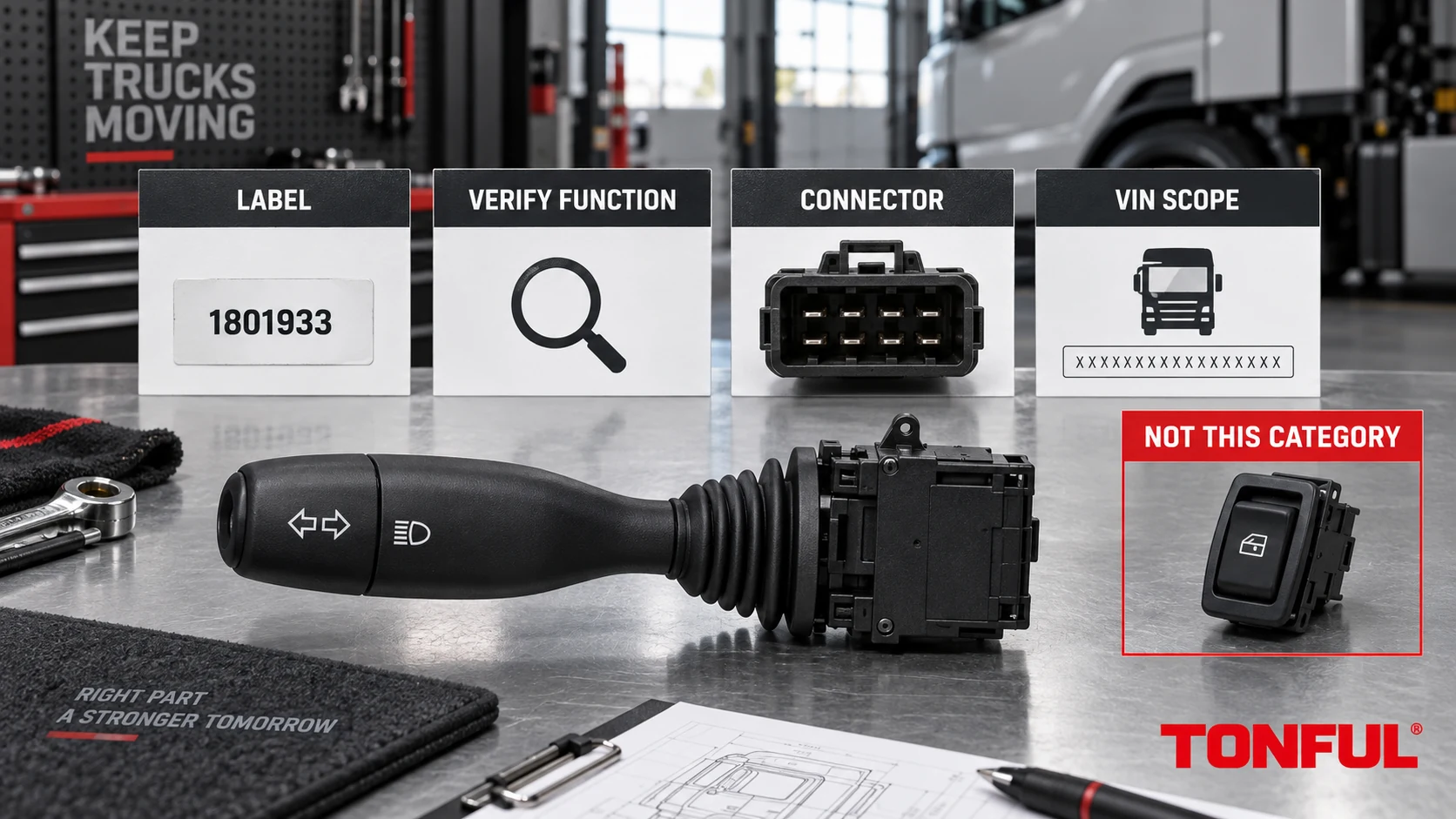
DAF reference 1801933 appears in current TONFUL research with 1669662 and 1811123 as a steering-column, turn-signal or multifunction-switch candidate group. That grouping is useful for sourcing, but it is not enough to approve every DAF CF or XF application. Exact function descriptions vary across secondary listings, and the correct vehicle boundary, connector, pinout and command matrix still need confirmation.
One data-cleaning rule is already clear: 1811131 and 1736600 are treated as left-side power-window switch references, not as combination-switch alternatives. Mixing those numbers into a stalk-switch table would create a product-category error before any electrical test begins. This guide shows how to preserve that boundary and verify the 1801933 family safely.
On this page: Reference and Category Control | Vehicle and Physical Match | Electrical Verification | Approval Record
Reference and Category Control
Current Working Status
| Reference | Current working classification | Status | Required evidence |
|---|---|---|---|
| 1801933 | DAF CF/XF steering-column/combination-switch candidate | Conditional | TONFUL label, VIN-specific parts record, function matrix, connector and approved sample |
| 1669662 | Cross-reference candidate within the 1801933 family | Conditional | Supersession/cross-reference direction and matching physical/electrical evidence |
| 1811123 | Cross-reference candidate within the 1801933 family | Conditional | Complete number, source, connector, function and vehicle scope |
| 1811131 | Left power-window switch reference | Excluded | Keep in the power-window category; do not use as stalk evidence |
| 1736600 | Left power-window switch reference | Excluded | Keep in the power-window category; do not use as stalk evidence |
The one-digit difference between 1811123 and 1811131 is easy to miss in a spreadsheet or image filename. Use exact text fields, not visual memory, and require a second-person review for imported OE data. TONFUL’s OE-number cross-reference guide explains how to classify service, supplier, engineering, housing and customer numbers before linking them.
Confirm Cross-Reference Direction
A page that lists three numbers together does not prove that substitution works in both directions. One number may supersede another only after a production break, with a harness adapter, within one market, or under a defined vehicle configuration. Record source number, replacement number, direction, conditions, source document, verification date and approver.
If the original label shows 1801933, do not shorten it or replace it with a candidate number until a controlled DAF parts source or TONFUL product record confirms the relationship. If label, catalog and sample disagree, preserve all evidence and mark the application unresolved.
Build the master-data record so another person can reproduce the decision. Include the source number, candidate replacement, source document or label image, direction of replacement, vehicle/VIN scope, market, production boundary, function family, connector identifier, revision, evidence status, last verification date and approver. Lock the 1811123 and 1811131 fields against fuzzy matching: an automated system should flag the one-digit difference rather than silently accepting it. When importing distributor data, keep the original source string and never overwrite it with a normalized value before review.
Use VIN-Specific DAF Information
DAF states that spare-parts information in its RMI system is accessed for a vehicle identified by VIN, and that VIN-specific information includes wiring diagrams, DTC and symptom resolution. See the official DAF RMI spare-parts page and information-type instructions. These services support a VIN-first workflow; they do not independently confirm that 1801933 fits an unidentified CF or XF.
Record the 17-digit VIN or DAF identification required by the applicable service source, market, production date, model and cab, LHD/RHD, stalk side, transmission and installed options. DAF’s driver-manual search also uses the last eight VIN characters for supported Euro 6 vehicles, reinforcing the importance of the exact vehicle identity rather than a broad model label.
Vehicle and Physical Match
Capture the Removed Part
Before removal, photograph the stalk in its installed orientation and record every control symbol and position. After safe removal under the vehicle procedure, photograph the complete label, housing, mounting points and connector face. Separate the OE number from supplier, engineering, casting and customer-stock identifiers.
Document turn-signal, high/low-beam, flash, horn, cruise, retarder, menu, wiper or washer controls only when present on the actual part. “Combination switch” is a broad category; the exact 1801933-family function content must come from the sample and vehicle record, not from a generic title.
Compare Mounting and Connector Geometry
Check shroud interface, housing depth, locating tabs, screws or clips, stalk reach, movement, detents, cancel interface, trim clearance, connector access and harness strain. Do not file a key, force a latch or cut the harness to make a candidate fit.
Photograph both connector faces straight-on with the latch/keyway in the same orientation. Record shell geometry, cavity numbering source, cavity count, populated terminals, blanks, terminal family, seal interface and latch. A shell that mates can still contain a different pinout or internal state table. The combination-switch connector guide provides a reusable end-view and cavity-map process.

Keep the steering-column switch evidence set separate from visually and numerically similar power-window references.
Electrical Verification
Identify the Architecture
Use the VIN-specific wiring diagram to determine whether each function uses discrete contacts, direct or relay-coil load, resistance/voltage coding, a local module, LIN/CAN, or a mixed architecture. Do not infer current capacity from terminal size or assume every stalk contact carries lamp current.
For discrete contacts, produce a state table for every maintained and momentary position. If a path carries load, use the approved electrical load, switching sequence, voltage-drop and temperature method. For coded inputs, record reference conditions, raw values, tolerance and decoded module states. For electronic assemblies, verify supply, wake/sleep, communication, software/configuration and DTC behavior. The analog, resistive, LIN and CAN stalk guide explains the method boundary for each architecture.
Complete a Copyable Verification Record
| Record field | Removed part | Candidate sample | Controlled source | Result |
|---|---|---|---|---|
| Vehicle/VIN and market | Enter | Enter | DAF vehicle record | Pass/Fail |
| Full OE number and number type | Enter | Enter | Label/parts record | Pass/Fail |
| Cross-reference direction | Enter | Enter | Controlled catalog | Pass/Fail |
| Function set and stalk side | Enter | Enter | Vehicle/sample record | Pass/Fail |
| Mounting and clearance | Enter | Enter | Drawing/installed sample | Pass/Fail |
| Connector orientation/keying | Enter | Enter | End-view record | Pass/Fail |
| Populated cavity map | Enter | Enter | Diagram/sample | Pass/Fail |
| Electrical architecture | Enter | Enter | Wiring diagram/test | Pass/Fail |
| Command/state matrix | Enter | Enter | Product-specific plan | Pass/Fail |
| Coding/initialization/DTC status | Enter | Enter | Vehicle procedure | Pass/Fail |
| Final installed disposition | Reference | Sample and lot | Approval record | Approved/Conditional/Rejected |
Diagnose Mismatches by Evidence
| Symptom | Investigation direction | Next evidence |
|---|---|---|
| Candidate is a door switch, not a stalk | 1811131/1736600 category contamination | Label, product form and master-data classification |
| Connector cannot latch | Wrong shell/keying or damaged interface | Straight connector photos and mating data |
| Connector mates but commands are wrong | Different pinout, state matrix or architecture | Cavity map and raw/decoded states |
| Main turn function works but secondary function fails | Incomplete variant or separate channel mismatch | Complete function matrix |
| Lever fits but does not cancel or contacts trim | Mechanical interface or orientation mismatch | Dimensions and installed-clearance record |
| Several functions fail intermittently | Shared supply/ground, terminal retention, contacts or harness strain | Dynamic test and terminal inspection |
| New switch produces DTCs | Electronic revision, coding or network mismatch | Hardware/software and diagnostic records |
| Bench test passes but vehicle rejects input | Fixture omitted reference, module load or authorization | Installed live data and configuration |
The combination-switch diagnostic guide helps separate stalk evidence from wiring, relays, controllers and downstream loads before assigning a warranty fault.

Installed validation should connect the exact candidate and vehicle to the controlled parts, wiring and command-state records.
Approval Record
Retain VIN and production scope, market, LHD/RHD and stalk side, complete OE/cross-reference chain, source and direction, label photos, sample and lot, function matrix, dimensions, connector map, architecture, raw and decoded results, instruments, installed test, DTC status, reviewer and date. Conditional approval must state the exact restriction, owner, expiry and closure evidence.
Control changes to housing, symbols, connector, terminals, contacts, springs, resistor network, PCB, firmware, tooling, site, end-of-line test and packaging label. A sample approval does not release every CF/XF vehicle or every number found beside 1801933. The RFQ and sample approval checklist can carry these controls into purchasing.
Incoming inspection should verify the approved number and revision, product category, stalk legends, connector orientation, critical mounting features, operation of every detent and momentary return, electrical state identity and lot traceability. Set the sample size and reaction plan from the customer’s quality plan rather than inventing a universal sampling level. If a shipment contains a window switch, mixed label, changed connector or undocumented revision, quarantine the affected lot, preserve photographs and labels, and obtain an authorized disposition before relabeling or use.
Work With TONFUL
Before ordering, state whether the vehicle retains its original column, steering-control modules and harness. Previous repairs, cab conversions or imported configurations can make a catalog-year match unreliable; photograph the installed interfaces and record any nonstandard wiring separately.
TONFUL’s automotive combination switch range presents current application references. For a DAF 1801933-family request, send VIN/vehicle scope, market, complete removed-part label, stalk and connector photos, LHD/RHD, required functions, wiring evidence and sample plan. TONFUL can compare 1801933, 1669662 and 1811123 with current product records and a production-intent sample. References 1811131 and 1736600 remain outside this combination-switch group.