
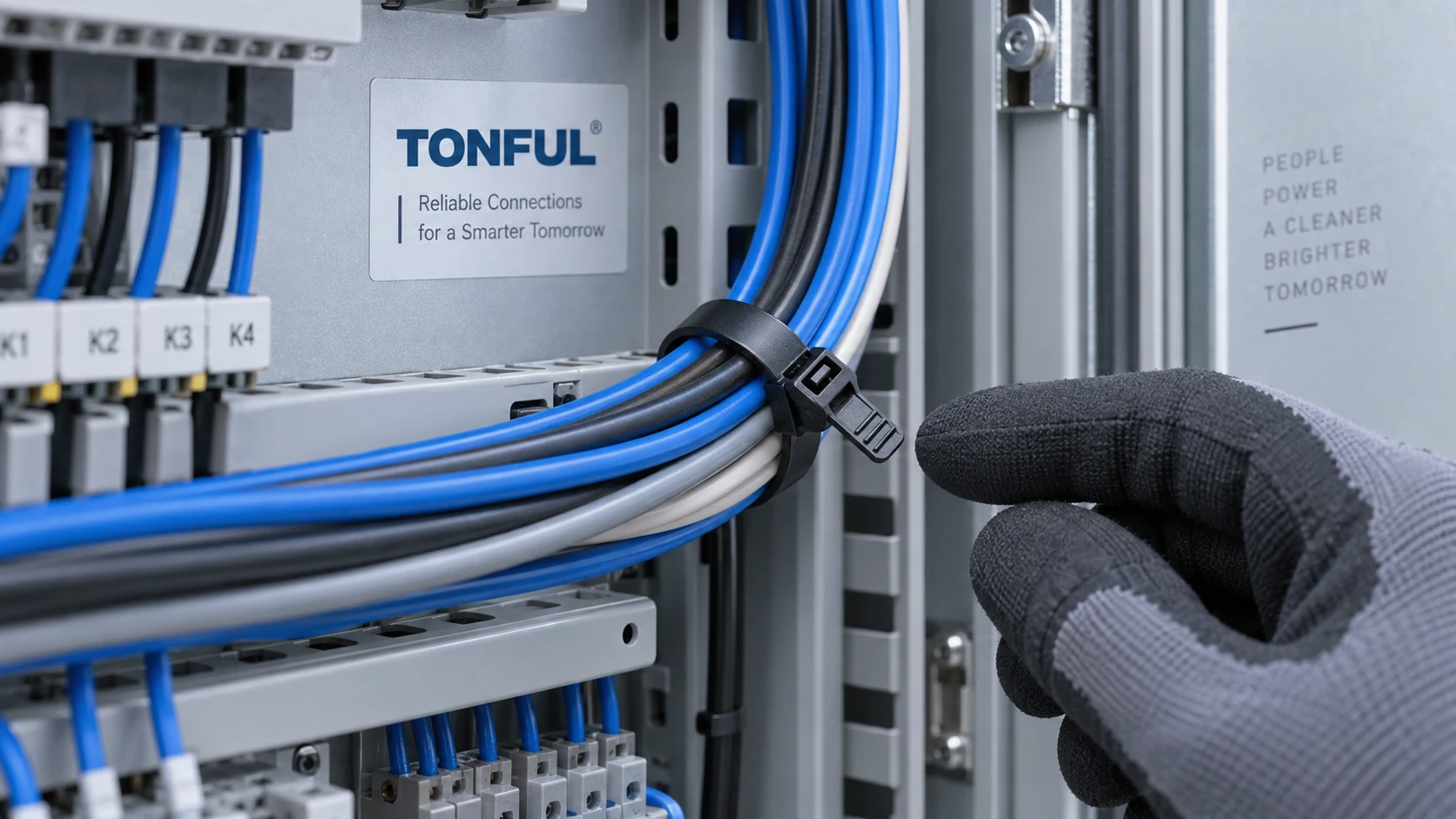
A cable tie with a release tab can be opened without cutting it, but that does not mean it can be reopened indefinitely or used for every load. Each opening bends a pawl, lever or strap segment. Repeated tightening can wear serrations, and a service technician may add a wire that changes the bundle diameter or route. Reuse is a product-and-application decision, not a property proven by the word “reusable” on a listing.
This guide helps panel builders, maintenance teams and OEM buyers select releasable cable ties, define a realistic cycle-life test and decide when a used tie should be retired. It does not invent a universal number of safe openings, a working-load factor or an environmental rating for a TONFUL model.
Separate Releasability From Reuse Approval
A releasable tie has a mechanism intended to disengage the strap from the head without destroying it. A conventional one-way tie should not be pried open and reinstalled merely because a tool can lift its pawl. The release feature may be a finger tab, lever, button or head geometry that needs a particular access direction. A two-piece strap-and-buckle arrangement may have a different service procedure.
The HellermannTyton REL product description identifies a specific lever-release tie intended where changes are anticipated. That establishes an example of product design, not a cycle rating or proof that every releasable tie has the same strength. A buyer should request the exact candidate’s drawing, instructions, test conditions and revision. The TONFUL introductory guide to releasable ties covers common forms; this article focuses on repeated-use validation and replacement decisions.
Decide whether the tie will be opened during initial assembly only, during scheduled maintenance, or repeatedly in a test bay. Those use cases need different evidence. If personnel must reach the release tab with gloves or while the panel is installed, verify actual clearance and ergonomic access. An inaccessible tab can turn a nominally reusable design into a single-use field part.
Match the Tie to the Bundle and Route
Specify the minimum and maximum bundle diameter in both initial and future configurations. Confirm strap length, width, head footprint, bend radius, cable-jacket material and whether the bundle contains soft tubing, fiber, shielding or connectors. A tie sized only for the initial bundle may have no spare strap length after a service addition. One that closes near its minimum diameter can create excessive compression on a delicate cable.
Record where the bundle is fixed and which elements may move. A releasable tie can group wires in a cabinet, but it is not automatically an approved support or a substitute for a bracket. The cable-tie sizing guide explains why rated loop strength cannot simply be converted into a safe installed load. An actual support application must also consider the fixing device, substrate, spacing and the applicable installation rules.
| Application | Why release helps | Main release/reuse concern |
|---|---|---|
| Control cabinet | Adds or reroutes conductors without cutting adjacent wires | Repeated access, tab clearance and cable pressure |
| Prototype harness | Frequent changes during development | High cycle count and mixed operator handling |
| Serviceable vehicle branch | Allows defined maintenance access | Vibration, temperature and retention after service |
| Temporary staging | Avoids disposable ties during controlled work | Misuse as final installed hardware |
| Outdoor cable bundle | Supports periodic changes | UV, heat, moisture and product-specific marking |
The release head must not interfere with a connector latch, door closure, moving mechanism or inspection line of sight. Position the tab where it can be reached without pulling wires. If a design needs a tool to release, define tool tip, permitted force and protection for nearby insulation. A finger-accessible tab can be damaged by accidental contact in a crowded panel; verify the actual installation.

Conceptual view of a release feature; use the selected product’s instructions for the correct opening direction and access space.
Compare Materials and Exposure
Polyamide ties can change behavior with moisture conditioning, temperature and aging. Other polymers may be specified for different chemical or temperature exposures, but a material label alone is insufficient for a finished tie. Check whether the release lever, pawl, strap and any mounting feature use the same material and whether one component has a lower limit than the others. Color alone is not a reliable outdoor rating.
For outdoor use, request exact-product UV evidence and intended installation markings. For cabinets near process chemicals, identify the chemical, concentration, temperature and contact time. Where the tie is touched repeatedly, include oils, cleaning agents and glove contamination in the service assessment. The TONFUL moisture and storage guide is relevant because received nylon condition can affect comparative tests and assembly feel.
The IEC 62275:2022 overview describes requirements for cable ties and associated fixing devices in electrical installations. Its scope does not supply one universal reuse-cycle count for every release mechanism or approve a tie for a particular vehicle, plant or outdoor route. Define additional cycle and environmental tests from the product specification or customer-approved plan. If a support rating is relevant, verify the exact certification and the compatible fixing device rather than treating a releasable head as proof.
Define a Cycle-Life Test That Represents Service
Begin with the expected maintenance sequence. One cycle should include a controlled close, installed dwell if relevant, release and reopening to the specified bundle size. State whether the same tie is re-tightened to the same mark or a new strap segment is pulled through the head. These are not equivalent: advancing to unworn teeth can conceal progressive damage to the earlier engagement zone.
Use the actual minimum and maximum bundle diameters, cable or representative mandrel, installation tool, release access and operators. Define tension or tightening method without inventing a general-purpose value. Include uncycled references, production-intent samples from known lots and an allocation of samples to independent and sequential environmental groups. Do not replace a cracked sample silently to finish the planned count.
At defined checkpoints, record opening force or ease, latch engagement, strap slip, visible whitening, tooth wear, head cracks and bundle retention. After the final cycle, perform the appropriate locking/loop test and inspect the cable jacket. A product may pass a simple close/open count yet fail because it loosens under vibration or becomes difficult to release after heat aging. Record both retained function and damage.
| Record field | Required entry |
|---|---|
| Product identity | Part, drawing revision, material, lot and head design |
| Test samples | Quantity, allocation, uncycled controls and replacement rule |
| Bundle | Diameter, cable/jacket type, compressibility and route |
| Cycle definition | Close, dwell, release, reclose and strap advancement |
| Installation | Tool or hand method, setting, operator and tab access |
| Environment | Temperature, moisture, UV or chemical sequence if applicable |
| Checkpoints | Cycle count, visual damage, release function and slip |
| Final verification | Retention, cable condition, failure mode and acceptance source |
| Approval | Pass/fail, reviewer, date and approved reuse scope |
Do not publish a “100-cycle” or similar guarantee unless the exact product was tested under defined conditions and the claim is approved. A cycling result on an unloaded bench sample does not validate a hot, vibrating installed harness. Report the first failure cycle and the number of failures, not only the best survivor. If the sample plan is too small to support a service-life claim, state that limitation.

A useful cycle record includes the bundle, operator method, exposure and first observed damage, not merely a final pass label.
Establish Reuse and Retirement Rules
A used tie should be rejected if the release tab or pawl is cracked, strap teeth are rounded, the head no longer clicks or holds as specified, the strap is nicked, the tie has been over-tightened, or the cable jacket shows damage. Reject a tie of unknown grade or service history when the application requires controlled traceability. Discoloration alone may not prove failure, but it warrants comparison against the specified inspection criteria.
If the bundle grows or its route changes, rerun the relevant clearance and retention checks. Do not assume that a tie approved for one branch is safe after adding a second cable or a connector. A tie that has passed its validated number of service operations should be replaced even if it still looks intact. Conversely, an apparent single scratch may trigger immediate replacement if it lies at the pawl or another critical stress point.
Keep the retirement rule simple enough for technicians to use: identify the exact tie, count or track permitted service operations where necessary, inspect the defined critical features, then either reinstall under the approved procedure or replace. For high-consequence applications, a low-cost new tie may be preferable to trying to prove the history of an unidentified used part. Retain failed examples for root-cause analysis instead of discarding every damaged sample.
Where a Releasable Tie Is the Wrong Choice
Use a permanent tie or engineered support when accidental release cannot be tolerated, the tab is exposed to unintended contact, the location is inaccessible for inspection, or the required support function is not covered by the product’s evidence. A release feature may increase the head footprint and create a snag point. In a compact enclosure, this can be more important than reuse convenience.
Do not use a releasable tie as a substitute for strain relief at an electrical termination. It should not transfer cable pull into a connector, terminal or solder joint. Similarly, a cable-support rule may require a certified support device and fixing interface; a reusable loop around a frame member may not satisfy it. The project drawing and authority determine the installation boundary.
Single-use recyclable or lower-impact materials may sometimes offer a better lifecycle result than a reusable tie that fails early or adds service time. Compare actual tie consumption, labor, scrap, replacements and field callbacks rather than assuming reuse always lowers total cost. If recycling is claimed, verify local collection and material separation; a mixed-material release head may complicate recovery.
Diagnose Failure After Repeated Use
When a tie opens unintentionally, preserve its position and the engaged tooth location before removing it. Check whether the pawl released, teeth slipped, the tab was pressed accidentally, bundle diameter decreased, or the mount failed instead. Compare the failed item with an uncycled reference from the same lot. Record cycle count, tool method, environmental exposure, operator and the last service change.
If the strap breaks, inspect whether failure started at a tooth, bend, cut or chemical-stressed surface. If the latch becomes hard to open, check debris, lever deformation and temperature rather than forcing a tool beside live or sensitive wiring. A field failure may be caused by an installation change instead of poor material. Confirm the root cause with a controlled recreation, then update the work instruction and test plan.
The TONFUL cold-weather failure guide shows why brittle fracture must be interpreted with material condition and exposure in mind. An opening-cycle claim should not be transferred from room-temperature trials to winter field service without relevant evidence.
Source a TONFUL Releasable Tie
TONFUL’s cable tie range can be screened for a release design suitable for the application. Provide bundle range, number and nature of expected service openings, cable jacket, environment, support role, installation access, required marking, sample plan and acceptance-source document. Request a controlled drawing and production-intent samples for the proposed part.
Approve the exact tie, revision, material, tool and reuse procedure for the stated application. If the head design, resin, mold, supplier or installation method changes, determine whether cycle-life and retention evidence must be repeated. A promise of “reusable” should end in a documented inspection and replacement rule.