
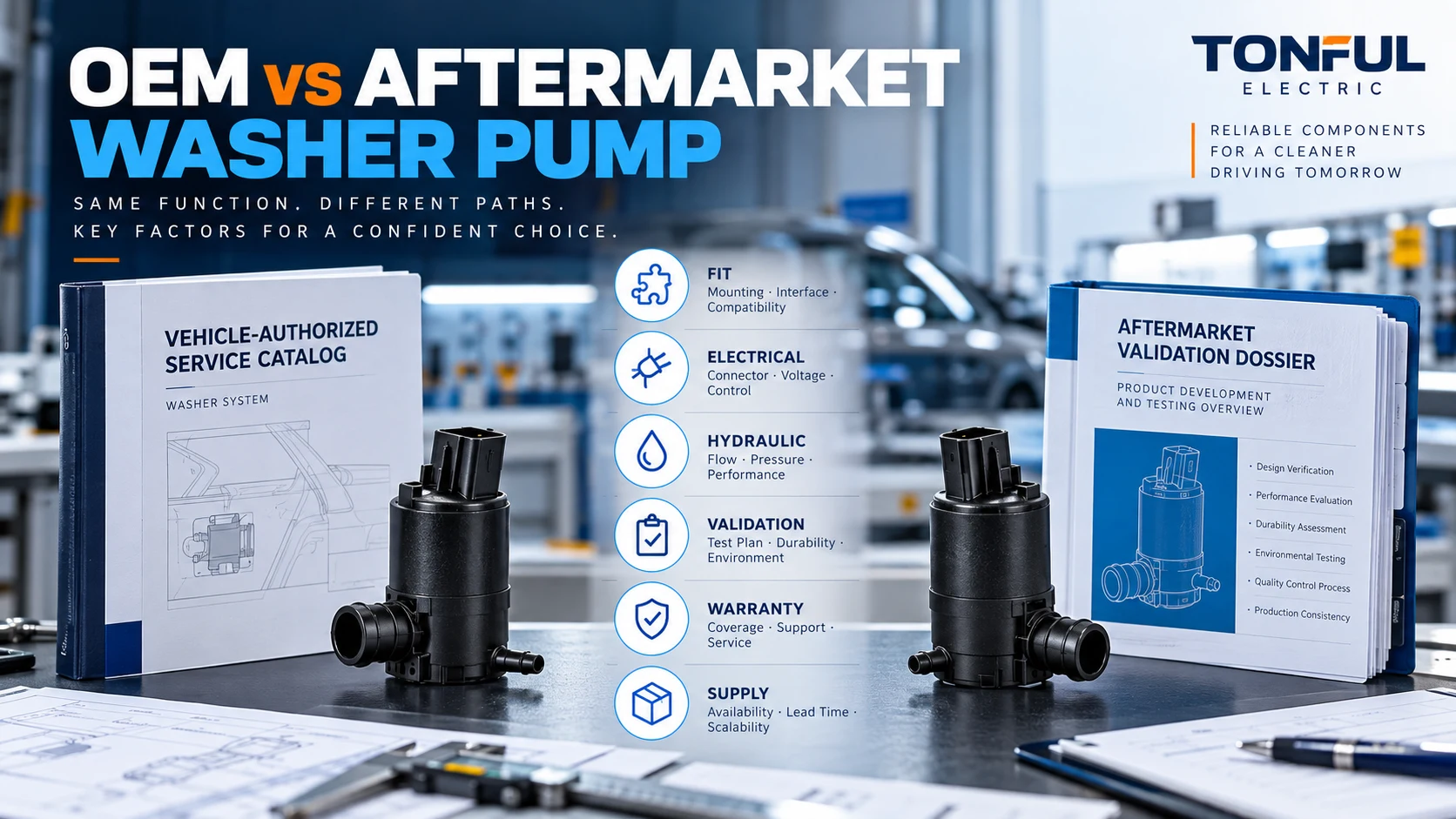
Choosing between an OEM and aftermarket washer pump should not be based on brand, appearance or unit price alone. A genuine service part may offer strong vehicle-catalog support, yet still require the correct market, production date and supersession. An aftermarket pump may improve availability or cost, but its connector, reservoir interface, outlet routing, electrical load and hydraulic performance must be verified for the defined application.
The practical question is not “Which category is always better?” It is “Which candidate has enough controlled evidence for this vehicle, use case and purchase scope?” This guide compares identity, fit, performance, validation, supply risk and total cost without assuming that every original or aftermarket product shares the same quality.
On this page: Terms | Comparison | Fit | Performance | When to choose | Release
Define OEM, Genuine and Aftermarket Correctly
Catalog terminology is often inconsistent. Classify the product and its evidence before comparing claims.
| Term | Practical Meaning | What It Does Not Automatically Prove |
|---|---|---|
| Genuine service part | Sold through a vehicle brand’s authorized service channel | Universal fit across all markets, dates or configurations |
| OE production part | Used in original vehicle production or supplied to an approved production definition | Availability through the vehicle-brand service channel |
| OE supplier part | Sold by a company associated with original-equipment supply | That this exact pump has the same drawing, material, line or approval as the original part |
| Validated aftermarket part | Replacement supplied outside the vehicle-brand channel with defined application evidence | Automatic equivalence beyond the verified scope |
| Universal replacement pump | Adaptable pump intended for multiple applications | Direct fit, correct connector, reservoir seal, outlet direction or vehicle-level performance |
| Used/salvage part | Removed from another vehicle | Remaining life, internal cleanliness, seal condition or traceable storage history |
“OEM quality” is a marketing description, not proof of OE identity, authorization or interchangeability. A buyer should request the exact manufacturer, part number, revision, evidence source and approved application. TONFUL’s automotive washer pump range presents the relevant product family; confirm every model, OE reference and vehicle sample before ordering.

Conceptual illustration only—not evidence that any pictured part has OE status or vehicle approval.
OEM vs Aftermarket Washer Pump Comparison
| Comparison Area | Genuine or Vehicle-Authorized Service Part | Validated Aftermarket Pump | Purchasing Decision |
|---|---|---|---|
| Application evidence | Usually supported by the vehicle service catalog for a defined VIN or application | Depends on supplier fitment records and sample validation | Verify complete number, market, date and supersession in either case |
| Physical fit | Normally follows the intended service configuration | Must match reservoir, grommet, orientation, connector and outlets | A similar body is not proof of fit |
| Electrical behavior | Generally aligned with the specified vehicle configuration | Must confirm voltage domain, polarity, load and control architecture | Connector mating alone is insufficient |
| Hydraulic behavior | Intended for the defined system when the correct service part is chosen | Requires controlled comparison of flow, pressure/restriction, leakage and routing | Compare under equal fluid, voltage and fixture conditions |
| Validation access | Vehicle-brand documentation may define service application; detailed test data may remain unavailable | Strong suppliers may provide drawings, test plans and batch evidence | Evaluate the evidence actually supplied, not the label |
| Availability | Older references may be discontinued or regionally constrained | May offer longer or broader replacement supply | Confirm tooling, capacity and lifecycle plan |
| Change control | Managed within the vehicle-brand service chain | Depends on supplier quality and agreement | Require advance notification and revalidation rules |
| Warranty | Usually follows authorized-channel terms | Varies by manufacturer and distributor | Compare duration, exclusions, labor and return process |
| Unit price | Often higher, but not universally | Usually more price levels and packaging options | Calculate total sourcing cost rather than price alone |
Neither column proves acceptance. A counterfeit or incorrectly cataloged “genuine” part is not lower risk, and a well-controlled aftermarket pump may outperform a poorly evidenced alternative in availability, traceability or project support.
Verify Physical and Electrical Fit
Begin with vehicle identity, complete OE/service reference and supersession direction. NHTSA vPIC can support manufacturer-reported VIN and basic identification data for applicable U.S.-market vehicles. It does not confirm washer-pump numbers, interchangeability, connector pinout or acceptance.
Compare the removed part and candidate side by side. Record the reservoir opening, grommet and seal geometry, insertion depth, retention feature, pump orientation, available clearance, outlet quantity, outlet diameter/profile and hose direction. Inspect whether a check valve, filter, level sensor or reservoir bracket belongs to the pump, reservoir or separate system component.
Electrical fit requires more than nominal voltage. Confirm connector shell, keying, cavity count, populated terminals, polarity, terminal assignment, approved operating range and current behavior under the specified hydraulic load. Identify whether direction is controlled by polarity reversal, separate outputs, a relay or a module. TONFUL’s automotive electrical connectors page can help frame connector-family discussions, while the exact housing, terminal, seal and retention evidence must match the candidate pump.
If repair requires a pigtail, review the custom wire harness assembly boundary separately. Wire size, insulation, terminal crimp, seal, splice method, strain relief and routing cannot be approved merely because the pump functions during a brief bench test.

Conceptual illustration only. Use controlled drawings, removed-part evidence and an approved vehicle sample.
Compare Hydraulic Performance Under Controlled Conditions
A pump can fit physically and still deliver poor spray coverage. Compare candidates using the same fluid or approved surrogate, fluid temperature, supply voltage measured at the pump, inlet condition, hose/nozzle restriction, measurement location and stabilization method. Record flow, relevant pressure points, current, leakage, priming behavior, noise and operation after the agreed duty cycle.
Do not compare an open-outlet flow claim with a result measured through the installed hose and nozzles. Restriction changes hydraulic load, current and noise. For reversible pumps, test both polarities and both circuits; verify routing and any check-valve behavior. Headlamp washer applications may have different hydraulic demands from windshield or rear-window circuits and should not inherit a generic acceptance value.
ISO 16750-2:2023, ISO 16750-3:2023 and ISO 16750-4:2023 provide road-vehicle electrical, mechanical and climatic load frameworks where applicable. They do not define a universal washer-pump flow, current, cycle life or acceptance value. ISO 16750-2 also does not cover EMC. Project requirements must identify the applicable edition, mounting context, severity, sample plan and pass/fail criteria.
Evaluate Quality, Traceability and Change Risk
Request evidence that links the supplied part to production. Useful records include the controlled drawing, bill of materials, resin and seal definition, motor/brush source, impeller revision, connector and terminal specification, process flow, inspection plan, end-of-line test coverage, lot marking and change history. A polished test report for an unidentified prototype does not establish control of later production.
Review the failure modes that matter for the application: leakage at the reservoir interface, poor priming, weak output under restriction, excessive current, stalled rotor, intermittent terminal contact, outlet damage, seal or fluid incompatibility, noise, and loss of performance after conditioning or endurance. Numeric limits must come from the approved source.
Circuit protection remains a vehicle-system decision. The TONFUL blade fuse page identifies fuse-product context, but neither an OEM nor aftermarket pump should be paired with a fuse selected from a generic current value. Wire capacity, inrush, fault behavior, ambient conditions and the controlling vehicle specification all matter.
System Boundary and Installed-Vehicle Approval
The washer pump is one part of a system that includes the reservoir, grommet, hose, valves, nozzles, harness, fuse, relay or module, and driver command. TONFUL’s auto combination switch range may include washer-command functions in relevant applications, but switch approval does not prove pump compatibility, and pump approval does not prove the complete washer system.
Installed validation should confirm spray target and coverage, front/rear routing, polarity, response time, leakage, hose interference, connector retention, noise transmitted into the body and diagnostic behavior. A passing open-bench test cannot reveal every reservoir, vehicle-voltage, routing or module interaction.
When Each Option May Be the Lower-Risk Choice
Choose a Genuine or Vehicle-Authorized Part When
- The vehicle is under warranty or a prescribed repair procedure requires the authorized part.
- Application variants are complex and the buyer lacks independent fitment evidence.
- The correct service part is available with reliable VIN-based catalog support.
- A wrong pump would create high diagnostic, labor or vehicle-downtime cost.
- The project requires the vehicle-brand service channel’s warranty and documentation.
Consider a Validated Aftermarket Pump When
- The authorized part is discontinued, unavailable or has an impractical lead time.
- The supplier provides controlled identity, dimensions, connector and hydraulic evidence.
- Production-intent samples pass the agreed bench and installed-vehicle validation.
- Traceability, change notification and claim handling are contractually defined.
- Total cost, packaging, availability or lifecycle support is better within the verified scope.
This is not permission to generalize one approved sample across every model year. State the exact market, production range, OE chain, pump revision and unresolved exclusions.
Compare Total Sourcing Cost
Unit price is only one input. Use a consistent observation window and calculate:
Total sourcing cost = unit price + incoming inspection + installation labor + diagnostic time + return freight + warranty labor + vehicle downtime + obsolete inventory risk.
Define each boundary to avoid double counting. If accepted-unit material cost already includes scrap and yield, do not add the same scrap again as internal failure cost. Separate confirmed pump-related returns from hose, nozzle, fluid, wiring or installation faults. Compare warranty events over equivalent service time; a newly introduced part may look better only because its observation window is shorter.

Conceptual illustration only. Use verified project costs, service data and approval criteria.
Build an Evidence-Based Release Decision
Create a comparison record with candidate identity, evidence source, physical-fit result, electrical matrix, hydraulic test conditions, environmental/endurance status, installed-vehicle result, deviations, warranty terms, total-cost assumptions, reviewer and date. Use Rejected, Conditional, Sample Approved and Production Approved as separate states.
Sample approval applies only to named samples and tests. Production approval should identify the part revision, factory, process, packaging and permitted deviations. A supplier change to the motor, brushes, impeller, seal, resin, connector, tooling, assembly line or test method may require customer notification and revalidation.
Work With TONFUL
Share the complete OE reference, vehicle context, removed-part photographs, connector end view, reservoir/grommet dimensions, outlet layout and validation expectations with TONFUL. TONFUL can support an evidence-based aftermarket comparison without claiming that every replacement is universally equivalent to an original part. Release the chosen pump only after the required technical and commercial evidence is accepted for the defined application.