
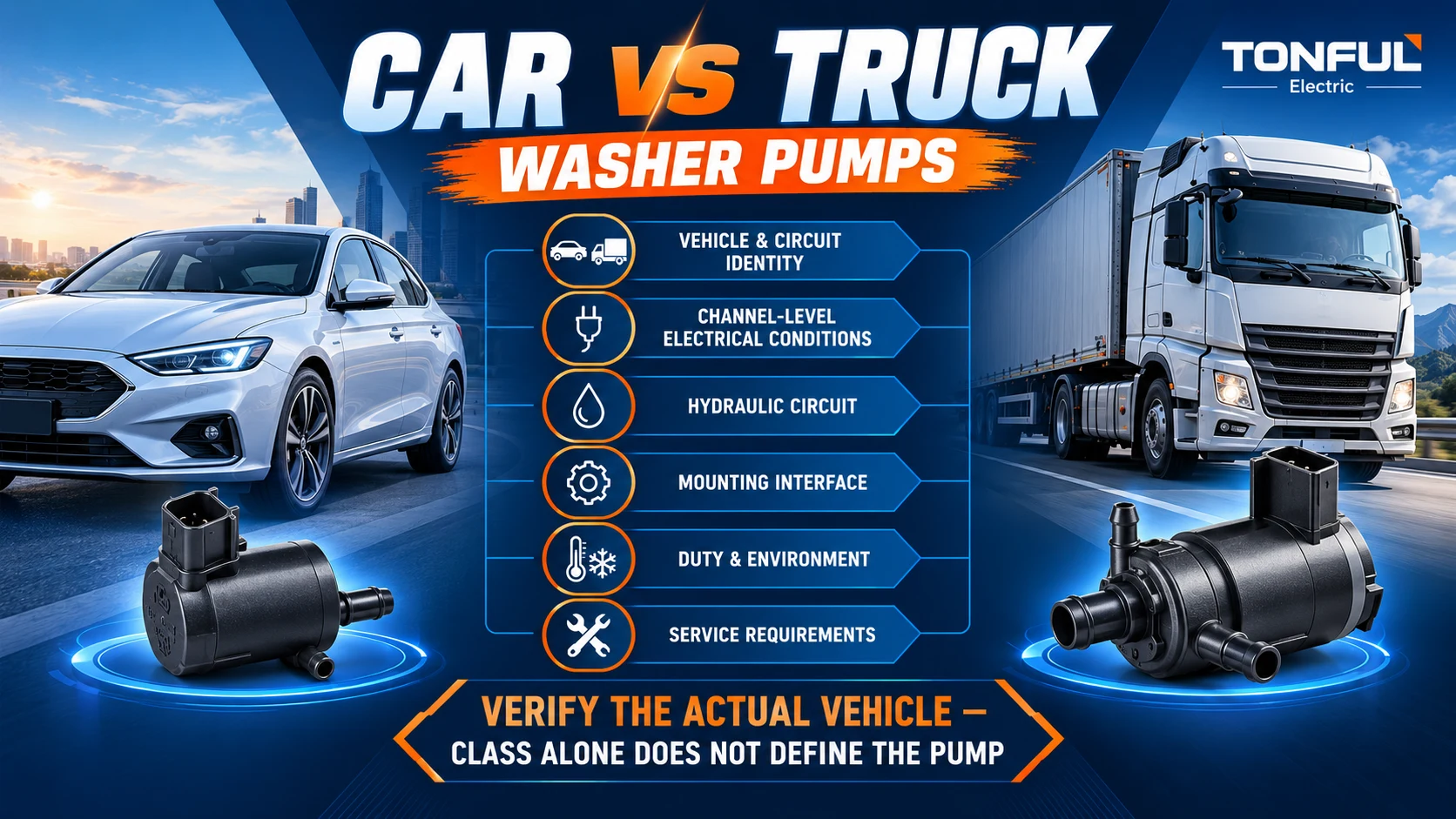
A truck washer pump is not simply a car pump with a 24 V label. Vehicle class can change the reservoir location, hose length, nozzle elevation, number of cleaning circuits, available mounting space, duty frequency, connector design, environmental exposure and service expectations. At the same time, a nominal 24 V truck does not prove that every pump, switch, relay, module input or diagnostic circuit operates directly at 24 V.
Choose the pump by the controlled vehicle system, not by a broad “car” or “truck” category. This guide compares the evidence required for passenger vehicles, light commercial vehicles, heavy trucks, buses and off-highway applications without inventing a universal flow, pressure, current or durability limit.
On this page: Quick comparison | Electrical architecture | Hydraulics | Mounting | Environment | Release
Quick Car vs Truck Washer Pump Comparison
| Selection Area | Passenger Car Context | Truck/Bus/Commercial Context | Required Evidence |
|---|---|---|---|
| Nominal vehicle system | Commonly associated with 12 V systems, but verify the exact vehicle | Often associated with 24 V systems, though subcircuits may use other domains | Vehicle diagram, pump specification and voltage measured at the pump |
| Hydraulic route | Often shorter and compact | May involve larger cab, longer hose, greater lift or multiple destinations | Controlled hose/nozzle layout and test fixture |
| Pump construction | Front, rear, reversible dual outlet or headlamp variants | Windshield, headlamp, camera/sensor or heavy-duty reservoir modules may be used | Exact circuit and production-intent sample |
| Mounting | Tight packaging around body or engine-bay reservoir | Cab, chassis or remote reservoir mounting can change exposure and access | Reservoir/grommet drawing, orientation and clearance |
| Duty and service | Consumer use and service intervals vary | Fleet operation may create more frequent use and downtime sensitivity | Customer duty profile and maintenance plan |
| Environment | Location-specific heat, water, vibration and chemicals | Cab/chassis location, washdown, dust, vibration and cold operation may differ | Mounting-location test plan, not a generic “heavy-duty” label |
| Supply priorities | Fitment, warranty and broad aftermarket availability | Fleet traceability, service stock, lifecycle and field replacement can dominate | Program volume, regional support and change control |
The table identifies questions, not default answers. Some passenger vehicles have demanding headlamp or sensor-cleaning systems; some trucks use compact cab-mounted pumps. TONFUL’s automotive washer pump range provides sourcing context, but exact vehicle, interfaces and approved sample remain controlling.

Conceptual illustration only—not a universal vehicle layout, rating or fitment record.
Separate Vehicle Voltage From Pump and Control Domains
Record the nominal vehicle system, pump supply, illumination or driver-control supply, relay-coil voltage, module reference inputs and communication interface separately. A nominal 24 V vehicle does not mean every terminal accepts 24 V. A body-control input, resistor-coded command or communication transceiver may operate in a lower-voltage domain.
Never apply nominal vehicle voltage to an unidentified pump or control cavity. Verify the power and ground terminals, polarity, operating range, protection, load profile and current limit from controlled documentation. If the pump is polarity reversing, confirm both directions and circuit routing. If it is relay or module controlled, separate the pump power path from the command and diagnostic path.
ISO 16750-2:2023 describes potential electrical loads for road-vehicle electrical and electronic equipment and states that EMC is outside its scope. It does not give a universal 12 V or 24 V washer-pump approval profile. The customer/OEM specification or approved validation plan must define operating voltage, abnormal supply conditions, transient response, reverse polarity, recovery and acceptance criteria.
Do Not Infer Contact or Motor Stress From Nominal Voltage Alone
For equal power, steady current may be lower at higher voltage, but that does not prove a 24 V pump or control circuit is easier to design. Motor winding, brushes, commutation, DC interruption, inrush/stall behavior, suppression, connector capacity and protection still require evidence. A 12 V pump connected to a 24 V supply may be damaged; a 24 V pump on a 12 V circuit may fail to start or deliver the required hydraulic output.
Adjacent controls must also match the architecture. TONFUL’s auto combination switch range may include washer commands in relevant applications, but approval of a stalk switch does not prove the pump, relay, BCM or completed washer system.
Compare the Complete Hydraulic Circuit
Vehicle size can affect hose length, elevation, bends, valves, nozzle quantity and restriction. A pump data point measured into an open container cannot predict installed spray performance. Define the fluid or approved surrogate, fluid temperature, voltage at the pump, reservoir level, inlet condition, hose/nozzle circuit, restriction, measurement locations and stabilization method.
For passenger cars, verify front and rear circuits, reversible-pump polarity, check valves and compact hose routing. For trucks and buses, examine cab height, remote reservoir position, longer line, cold-weather fluid behavior and any multi-nozzle or headlamp-cleaning demand. Off-highway machines may add dust, mud and aggressive washdown exposure. These are application questions, not automatic characteristics of every vehicle in the class.
| Hydraulic Check | Evidence to Record |
|---|---|
| Fluid and temperature | Exact fluid or surrogate, concentration, temperature and conditioning |
| Supply at pump | Loaded voltage, polarity and current measurement method |
| Circuit geometry | Reservoir level, hose length/diameter, elevation, bends, valves and nozzles |
| Performance | Flow and relevant pressure points with measurement locations and restriction |
| Functional result | Spray target, coverage, response, front/rear/headlamp routing and leakage |
| Recovery | Priming, dry or empty-reservoir event boundary and restart behavior if specified |
Do not create a generic truck flow or pressure threshold. A specific commercial-vehicle drawing or approved test plan must provide acceptance values.

Conceptual illustration only. Test the actual vehicle circuit under approved conditions.
Verify Reservoir, Mounting, Connector and Packaging Space
Compare the reservoir opening, grommet dimensions and material, pump inlet, insertion depth, retention, orientation and surrounding clearance. A truck reservoir may be remote or easier to access, but it may also expose the pump to different vibration, spray, debris or service handling. A car reservoir may impose tighter geometry and body-panel interference.
Record outlet quantity, diameter/profile and direction. Confirm that hoses do not kink, rub or pull on the outlet. Verify the connector end view, shell/keying, cavity population, terminal assignment, mating lock and harness strain relief. TONFUL’s automotive electrical connector range can support connector-family discussions, but the exact pump connector and terminal system need project-specific evidence.
Where the repair includes a pigtail or long chassis run, define the custom wire harness assembly separately. Wire size, voltage drop, terminal crimp, sealing, abrasion protection, routing and support can affect delivered pump voltage and service life. A new pump cannot correct an undersized, corroded or poorly routed harness.
Define Duty, Environment and Service Conditions
“Heavy duty” is not a test method. Build conditions from the actual mounting location and vehicle mission.
Passenger-Vehicle Questions
- Is the pump underhood, inside a fender cavity or integrated with the reservoir?
- Does one reversible pump serve front and rear circuits?
- Are package space, cabin noise or body-transmitted vibration especially important?
- Does the system include headlamp, camera or sensor cleaning?
- Is service access limited by trim, wheel-liner or bumper removal?
Commercial-Vehicle Questions
- Is the pump mounted on the cab, chassis, remote reservoir or exposed service area?
- What vibration, cab tilt, door/chassis movement or washdown reaches the pump and harness?
- What cold-start and washer-fluid conditions apply to fleet regions?
- How frequently is the pump used, and what vehicle downtime follows a failure?
- Are service stock, mixed fleets, depot installation and long program life important?
ISO 16750-3:2023 addresses mechanical loads and ISO 16750-4:2023 addresses climatic loads for applicable road-vehicle equipment. Neither supplies a generic “truck-grade” severity. Define mounting location, sample allocation, sequence, operating state, monitoring and failure criteria in the project plan.
Chemical compatibility should cover the actual washer fluids, antifreeze concentration, cleaners and nearby service chemicals. Validate housing, grommet, seal, hose and connector materials as a system. Material name alone does not prove compatibility.
Account for Fleet Service and Sourcing Risk
Commercial buyers often value traceability, field replacement time and lifecycle supply more heavily than retail packaging. Record the vehicle fleet, pump reference, reservoir version and installation position so depots do not mix visually similar 12 V and 24 V parts. Use labels and barcodes that remain readable through storage and service handling.
Compare MOQ, price breaks, packaging quantity, service stock, regional delivery, claim process, tooling status, capacity and change notification. A lower unit price can be offset by diagnostic time, repeat labor, return freight and vehicle downtime. TONFUL’s blade fuse range is relevant to adjacent circuit supply, but fuse selection must follow the wire, pump load, fault behavior and vehicle requirement—not a generic car/truck assumption.
Use a Vehicle-Class-Specific Validation Matrix
| Validation Area | Passenger and Commercial Evidence |
|---|---|
| Identity | Vehicle, market, production range, circuit, OE chain and pump revision |
| Electrical | Nominal system plus channel-level supply, loaded voltage, current and protection |
| Mechanical fit | Reservoir, grommet, retention, orientation, connector, hose and clearance |
| Hydraulic function | Controlled circuit, fluid, flow/pressure context, routing, spray and leakage |
| Environmental | Applicable electrical, mechanical, climatic, chemical and ingress plan |
| Endurance | Customer duty profile, powered hydraulic circuit, monitoring and teardown |
| Installed vehicle | Commands, diagnostics, spray coverage, noise, interference and service access |
| Production release | Factory/process, traceability, packaging, deviations and change control |
Separate sample approval from production approval. Name the vehicle and configuration represented by each installed test. Do not extrapolate a successful truck sample to every 24 V platform, or a successful car sample to every reservoir using the same connector.

Conceptual illustration only—not an acceptance standard. The approved project documents control limits and sample plans.
Work With TONFUL
Share the vehicle class, market, nominal electrical system, channel-level conditions, reservoir/grommet interface, connector end view, outlet layout, hose/nozzle circuit and duty profile with TONFUL. For commercial programs, also include fleet volume, regional environment, service packaging and lifecycle expectations. TONFUL can organize candidate and sample discussions without assuming that every car pump is 12 V or every truck pump is 24 V.