
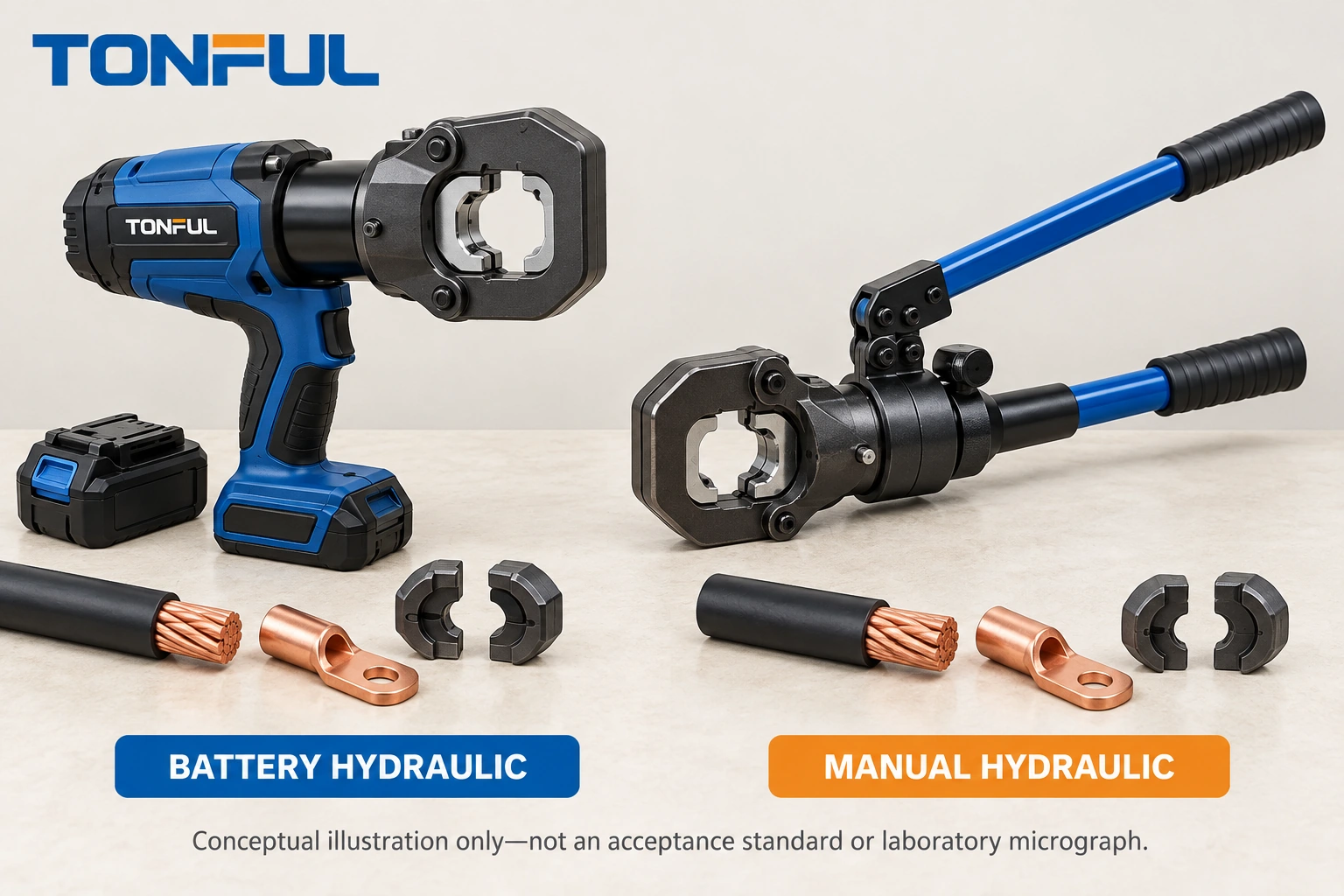
Choosing battery vs manual hydraulic crimping tools starts with the approved termination, not the trigger or handle. Both options use hydraulic force to operate crimping tooling. The battery version powers a hydraulic pump electrically; the manual version uses a hand-operated pump. A conventional ratchet crimper is a different mechanism and is not the manual comparator in this guide.
For a fair decision, hold the lug, conductor, approved die system and acceptance evidence constant. Then compare how each tool fits the work location, crew, service arrangements and job sequence. Battery assistance may reduce pumping effort or change cycle time, but those benefits depend on the actual model and task. They are not measured productivity or return-on-investment claims.
TONFUL’s hydraulic tools category identifies battery and manual tool families. Use it to frame a model-specific enquiry, not to assign one conductor range, crimp force or duty cycle to the entire category. This guide supplies a selection method without inventing those specifications.
Contents: Keep the termination constant, Compare field constraints, Control stored energy, Run a fair trial, Plan maintenance and availability, Choose a documented kit.
Keep the termination constant
Obtain the lug manufacturer’s application instructions and the approved tool-and-die combinations for the actual conductor. Record lug part number, material and plating, barrel design, conductor material, cross-section, strand construction and relevant preparation requirements. Equal nominal area does not establish equal compatibility across fine-stranded, compacted or differently shaped conductors.
Select the required crimp profile and die identities from those documents. A die that physically fits the head is not necessarily approved for the lug. Color markings, a stamped size or a similar-looking hexagon cannot replace the compatibility evidence. If the two candidate tools cannot use the same approved die set, require separately documented equivalent approved systems before calling the comparison controlled.
Record crimp count, sequence, positions and orientation from the application instructions. Do not use extra crimps to compensate for a questionable tool match. Check the completed joint’s installed envelope, bend space, stud alignment and any sealing requirements. A tool that makes the joint on an open bench may not reach the final cable position without violating cable support or bend constraints.
What stays equal in the comparison?
| Item | Controlled basis | Why it matters |
|---|---|---|
| Conductor | Same specified construction and material lot | Avoids comparing different deformation behavior |
| Lug | Same part number, revision and lot | Keeps barrel geometry and material consistent |
| Die system | Same approved set, or documented approved equivalents | Prevents mechanical fit being mistaken for approval |
| Preparation | Same documented cut, strip and cleaning method | Prevents preparation defects biasing results |
| Crimp pattern | Same approved count, position and sequence | Keeps the finished termination comparable |
| Evidence | Same acceptance documents and test plan | Avoids moving the pass criterion between tools |
Review TONFUL’s crimping tools selection page when separating terminal styles and profiles. Its broader product coverage is not proof that an ordinary ratchet tool is suitable for the cable lug in this comparison. A specified hydraulic system should not be replaced by a different mechanism simply because both tools can close around the barrel.

Compare field constraints
Battery hydraulic tools may remove repeated hand pumping, but the complete tool mass, battery position, balance and head geometry influence handling. A trigger does not remove the need to support the cable and lug. Evaluate the tool in the actual posture and access envelope rather than inferring lower strain from a photograph or an unloaded demonstration.
Manual hydraulic tools avoid charger dependence during operation, but require pumping access and repeated handle movement. A compact head can still be unusable if its handles collide with a cabinet wall. Some systems use a remote pump and hose rather than an integral pump. Treat that as a specific configuration with additional routing, connection and storage requirements, not as an inherent feature of every manual tool.
| Field question | Battery hydraulic consideration | Manual hydraulic consideration |
|---|---|---|
| Access and posture | Battery and motor body may affect clearance | Pumping handle arc may affect clearance |
| Work repetition | Powered pumping may reduce repeated manual action | Hand effort depends on mechanism and task |
| Energy logistics | Approved batteries, charger and charging location required | No battery charging for pumping; operator effort remains |
| Remote work | Assess pack condition and approved temperature limits | Assess transport, pumping posture and service access |
| Tool feedback | Completion signals and logs are model-dependent | Completion and release method are model-dependent |
| Repair support | Battery, electrical and hydraulic service may be needed | Hydraulic seals, valves and mechanical service remain necessary |
The official Klauke cordless hydraulic tool page illustrates why selection is model-specific: it provides a defined tool configuration, die information and associated instructions. Its ratings and features must not be transferred to TONFUL equipment. Obtain the corresponding documents for each proposed TONFUL model.
Consider weather, contamination, lighting, transport and permitted operating orientation. Neither a battery pack nor a hydraulic cylinder establishes suitability for rain, immersion or hazardous atmospheres. Check documented environmental limits and site rules. If a task cannot be performed safely within them, change the work arrangement or tool system rather than improvising protection in the field.
Control stored energy
These are not universal insulated live-working tools. Isolate the installation and have qualified personnel verify the safe state through approved procedures before preparing or crimping cable. Disconnected trial coupons are preferable for selection tests. Do not interpret colored grips, battery power or a hydraulic head as permission to work on energized conductors.
Keep hands clear of dies, ram travel, closing heads and trapped cable movement. Support heavy cable independently so it cannot twist the lug or load the operator’s wrist while the head closes. Inspect head locks and die retention as directed by the tool instructions. Do not attempt a crimp with an incompletely secured head or damaged retention parts.
Battery removal is not the whole procedure
Before die access, cleaning or maintenance, follow the manufacturer’s shutdown, isolation and pressure-release procedure. Removing a battery may prevent a new powered stroke but does not by itself prove hydraulic energy is released. A manual pump can also retain pressure. Never loosen a fitting or force a die out as an improvised pressure-release method.
For hose-equipped systems, check compatible components, protective routing and connection instructions. A damaged hose, leak or unexpected ram movement requires stopping and quarantining the tool under the service procedure. Never search for a pressurized leak with a hand. Repairs and pressure adjustments belong with authorized service personnel, not a hurried field workaround.
Define how a stopped or incomplete crimp will be identified and held. A tool alarm, depleted pack or interrupted stroke does not authorize an extra undocumented squeeze. Follow the tool recovery instructions and the termination disposition procedure. Let the responsible engineering authority decide whether the joint can be completed, reworked or must be replaced.
Run a fair trial
Write the trial plan before distributing tools to the crew. Use trained operators and representative safe access conditions. Agree the number of operators, configurations and specimens through the risk-based plan; do not choose a universal sample quantity from a marketing comparison. Give operators familiarization with both systems so unfamiliarity does not masquerade as a tool limitation.
Separate preparation time, positioning, hydraulic operation, release, repositioning between specified crimps, inspection and recordkeeping. Include battery changes or pumping repositioning when they belong to the real job. Record interruptions rather than hiding them in an average. A faster hydraulic stroke may not shorten a job dominated by cable handling and inspection.
Record quality before calculating productivity
| Trial record | Entry to capture |
|---|---|
| Configuration | Tool serial, die IDs, lug and wire identities, document revisions |
| Operator and setting | Training status, posture, access conditions and task sequence |
| Operation observation | Completion indication, interruption and recovery evidence |
| Handling observation | Support needs, clearance conflict and operator feedback |
| Quality result | Inspection or test method, specimen ID and raw result |
| Time observation | Clearly defined start/stop points and included activities |
| Disposition | Acceptance-source clause, decision, reviewer and open action |
Use separate allocated specimens for destructive tests. The approved plan should define pull-test fixture, pull speed, equipment range and accuracy, conditioning, invalid-test rules and retest authority. Record failure location as well as measured force. Apply lug-specific dimensional or section checks only where the governing instructions call for them; do not borrow open-barrel terminal criteria for a tubular lug.
If electrical performance is part of qualification, use isolated specimens and a specified low-resistance method. Record current, Force/Sense locations, reference wire length, ambient temperature, stabilization and offset compensation or forward/reverse measurement. Account for reference-wire resistance where the method requires subtraction. Keep initial and aged results distinct when aging is specified. Simple continuity is not a substitute for the required qualification evidence.
Do not infer equal quality merely because both tools display completion. Conversely, do not attribute a failure to the drive method until preparation, die selection, material identity and operation have been investigated. Preserve failed specimens and event records. The existing TONFUL cable-lug guide provides related reading, but the actual application documents remain the approval authority.
Plan maintenance and availability
Build availability around the complete kit. For battery hydraulic tools, establish approved pack and charger identities, charging arrangements, storage rules and a process for damaged packs. Transport and storage requirements may differ from operating conditions. Do not substitute a physically fitting battery without manufacturer approval or assume a displayed charge establishes readiness for an entire shift.
For both drive methods, follow the documented inspection and service schedule for head condition, dies, seals, release operation and hydraulic components. Manual hydraulic does not mean maintenance-free. Do not invent oil grades, service intervals or pressure settings. Record service status with the tool identity and keep overdue or suspect equipment out of the working kit.

Ask who can repair the tool locally, which wear parts are replaceable, how die condition is evaluated and what verification is required after service. Protect approved dies from mixing, damage and loss. A backup body without the correct approved die set is not a usable contingency plan. Keep replacement approval separate from physical interchangeability.
Compare ownership costs only after recording actual purchase, service, energy logistics, downtime and task data. A battery model may justify its logistics for repetitive work; a manual hydraulic kit may suit intermittent work with adequate access. Neither conclusion is universal. No measured ROI, fatigue reduction or percentage speed improvement is established by this guide.
Choose a documented kit
Use three decision gates: approved termination compatibility, safe field usability and supportable ownership. Failure at the first two gates cannot be offset by a lower price. Where both candidates pass, choose using your trial observations and service constraints. Document any application restrictions so the purchasing decision does not become an unintended approval for every cable size on site.
Assemble a release pack containing the selected tool and die identities, lug and wire scope, operating instructions, safety procedure, inspection records, training requirements and maintenance contacts. State who approves substitutions and how interrupted crimps are handled. Keep a record of configurations not evaluated; absence of a failure report is not evidence of approval.
Use TONFUL’s electrical tools product overview to coordinate related preparation equipment without assuming that one kit covers every operation. Send the lug drawing, conductor specification, required die profile, access limitations and trial record through TONFUL’s enquiry page. Request model-specific compatibility and service documents before selecting battery or manual hydraulic equipment.