
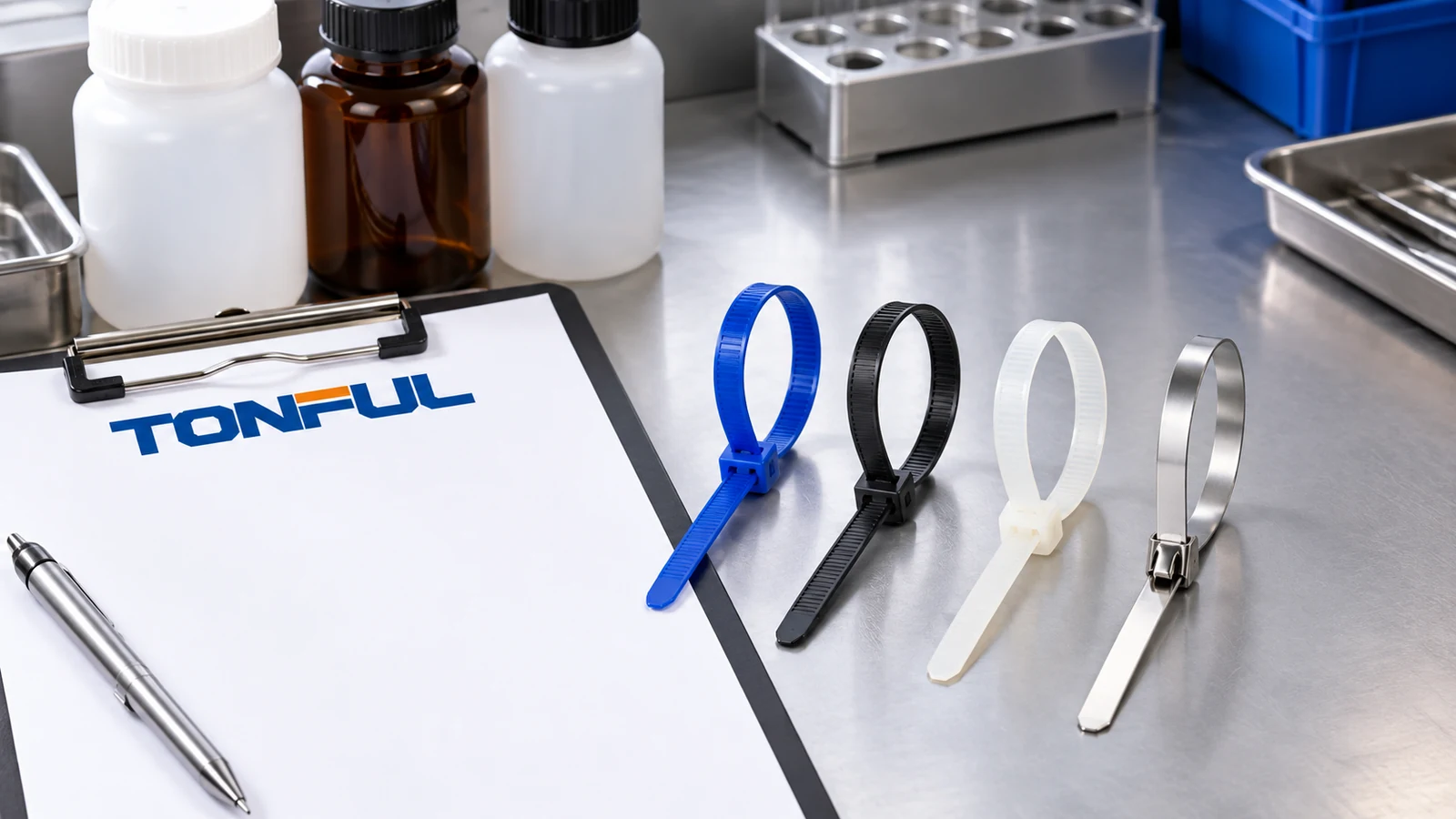
“Chemical resistant cable tie” is not a complete specification. A tie may tolerate a quick wipe with a dilute cleaner yet lose locking strength after repeated hot immersion in the same chemistry. The strap and head can also see different conditions: a tight head traps liquid, while the outer strap dries quickly. If the tie holds wiring near a process vessel, a chemical failure can become a cable-abrasion, loose-bundle or contamination problem.
This guide compares PA66, PA12, polypropylene, ETFE and stainless-steel tie candidates without pretending that one material is universally compatible. The useful outcome is a documented exposure profile, a shortlist and a test plan for the exact molded or metal part. Begin with the TONFUL cable ties buying guide for size and support needs, then apply the chemical checks below.
Describe the Real Exposure, Not a Category Name
Write the exact chemical name and concentration. “Acid,” “solvent” and “cleaner” are too broad because formulations, additives and dilutions vary. Record water content, pH where relevant, temperature, pressure or spray force, contact duration and frequency. Distinguish vapor, occasional splash, routine washdown, condensation, continuous immersion and accidental spill. A tie near a drain may sit in a concentrated residue after the surrounding equipment has been rinsed.
Include mixtures and sequence. A facility may wash with an alkaline agent, rinse, sanitize with an oxidizer and then heat-dry the equipment. A single-chemical room-temperature coupon test cannot reproduce that process. The installed tie also carries tension and may rub a cable jacket or bracket; chemical exposure can magnify a pre-existing notch or molding defect. Ask the site engineer and chemical supplier for the current safety data sheet and use conditions, but treat the sheet as hazard information, not proof of cable-tie compatibility.
Map every wetted component: tie strap, locking head, metal pawl or ball if present, coating, mounting base, adhesive, fastener and cable jacket. A solvent-resistant strap does not protect an adhesive base that softens, nor a metal lock that corrodes. If direct food or pharmaceutical contact is possible, the material’s general chemical resistance does not establish regulatory suitability; obtain a separate intended-use declaration for the exact article and jurisdiction.
| Exposure field | Minimum record | Why it matters |
|---|---|---|
| Chemical identity | Trade name, formulation, active components and revision | Similar product names can conceal different additives |
| Concentration | Normal mix and plausible maximum | Dilution can change attack and evaporation behavior |
| Contact | Vapor, splash, washdown, immersion or trapped residue | Wetted time differs across strap and head |
| Thermal profile | Fluid and component temperatures, peaks and cycles | Compatibility can worsen at elevated temperature |
| Mechanical state | Bundle size, installation tension, support load, vibration | A stressed part may fail when a loose coupon does not |
| Required life | Service interval, inspection and replacement trigger | A short test cannot directly promise multiyear life |
What the Main Material Families Suggest
PA66 and PA12: Do Not Generalize “Nylon”
PA66 is common in standard ties because it balances strength, molding and cost, but its behavior depends on conditioning, grade and chemistry. Moisture uptake can alter dimensions and mechanical properties. A dry-as-molded tie and a conditioned tie may not respond identically to a liquid exposure. The TONFUL moisture and storage guide explains why initial condition and storage history belong in the test record.
PA12 is another polyamide with different moisture and environmental behavior. The TONFUL PA66-versus-PA12 outdoor comparison can help identify material questions, but neither article grants blanket resistance to a specific solvent or cleaning solution. Ask for the exact grade, filler, colorant and molded-tie data. Do not substitute a generic polyamide chart for exposure at the actual concentration and temperature.
Polypropylene: A Candidate, Not a Universal Answer
Polypropylene ties may be worth screening where water uptake or certain process chemicals make standard PA66 unattractive. An exact HellermannTyton polypropylene tie product page positions its own PP line for higher chemical resistance than its standard PA66 line and documents part-specific properties. That statement does not make every PP formulation suitable for oxidizers, hydrocarbons or hot washdown. It also says nothing about an unidentified TONFUL PP part.
Check the locking mechanism, creep under tension, temperature, UV and installed load. Low density or low water absorption is not a substitute for head retention after repeated chemical exposure. If the route is outdoors, the PP formulation also needs the relevant UV evidence. A tie that survives a cleaner but slips under warm continuous load is not acceptable for cable positioning.
ETFE: Broad Potential, Finished-Part Proof Still Needed
ETFE may be a candidate where aggressive chemistry coincides with heat or other severe conditions. The Chemours ETFE 200 resin document describes that resin grade’s chemical resistance while warning that typical properties are not specification values and calling for end-use evaluation. An ETFE resin claim cannot replace tests on the thin strap, molded head, colorant and actual installation. See the TONFUL ETFE qualification guide for its separate heat and radiation boundaries.
Use generic “ETFE” terminology unless a supplier can prove rights to use another company’s resin trademark in its own product name. If a distributor changes source or grade, recheck the exposure evidence. Materials within the same polymer family can differ in fillers and process history.
Stainless Steel: Corrosion Is Not Binary
304 and 316 stainless ties can avoid polymer swelling or softening in some environments, but metals have their own chemical risks. The chemistry, chloride level, temperature, oxygen availability and crevice geometry all matter. Outokumpu’s corrosion explanation warns that high chloride exposure can produce localized pitting and crevice attack even in stainless steel. A 316 tie is not immune to saltwater or every cleaning chemical.
Check the strap, ball-lock or folded head, edge finish, coating and contact with dissimilar metals. A polymer coating can protect cable jackets and reduce direct metal contact, but its chemical resistance and damage at the cut edge must be evaluated separately. The TONFUL 304-versus-316 guide supports alloy selection; it does not authorize an untested chemical mixture.
| Material candidate | Useful first screening question | Evidence still needed |
|---|---|---|
| PA66 | Does conditioned finished-part performance survive the exact cleaner? | Head retention, strap properties and moisture state |
| PA12 | Does its grade and color offer the needed wet/chemical behavior? | Exposure test at temperature and installed tension |
| PP | Is the target chemistry compatible with the exact PP formulation? | Creep, lock strength, UV and temperature evidence |
| ETFE | Are the chemical and thermal benefits relevant to this route? | Finished-part grade, head/strap and combined aging |
| 304/316 stainless | Is localized corrosion or metal contact a governing risk? | Alloy trace, lock, coating and crevice inspection |
The table is a shortlist, not a compatibility rating. It intentionally avoids “good/bad” symbols that might be mistaken for permission to use a part in a particular liquid.

Conceptual illustration only—not an acceptance standard or laboratory micrograph. Validate the named finished part with the actual chemical and loading conditions.
Build a Relevant Compatibility Test
Agree on the exposure before cutting specimens. Use production-intent ties from identified lots and install them on the actual cable or a representative bundle using the approved tool and tension. Allocate unexposed baseline samples, conditioned samples and separate destructive-test samples. For liquid contact, reproduce concentration, temperature, immersion or splash pattern and drying cycles. If the head traps fluid against a bracket, include that geometry. Protect testers using the chemical supplier’s handling instructions and the facility safety program.
Measure initial and post-exposure loop retention or tensile property, head engagement, strap creep, cracks, color change, swelling, mass or dimension change where meaningful, and cable-jacket condition. Record the first failure location. A pretty appearance is not a pass when the pawl slips. Conversely, slight color change may not be the acceptance criterion unless identification or inspection contrast matters. Define limits from the product drawing or customer qualification plan, not an arbitrary blog percentage.
Run sequential tests when the site uses multiple chemicals, heat and vibration. Record the order, because a rinse may remove one agent before another arrives. Include a recovery period only if the real process allows it; otherwise a dried laboratory sample may look better than the continuously wet installation. Replacing a failed sample with a favorable retest without a preapproved rule would obscure the risk.
| Test record field | Required entry |
|---|---|
| Part identity | Supplier, SKU, resin/alloy/coating, color, revision, lot and sample ID |
| Installation | Bundle and jacket, head orientation, tool, tension and mount |
| Exposure | Chemical formulation, concentration, temperature, contact mode and sequence |
| Control sample | Baseline identity and initial mechanical/visual results |
| Final results | Retained lock/loop strength, swelling/crack/corrosion evidence, cable damage |
| Decision | Acceptance-source document, invalid-test rule, approver and date |
For a critical installation, ask whether a component-level tie test is enough or whether the complete mounted assembly and cable route must be qualified. A cable tie is not a chemical containment device, and a successful tie test cannot certify adjacent cable insulation, connectors or enclosure seals.
Prevent Problems During Installation and Service
Select a mount that drains rather than trapping chemicals behind the head. Keep the strap clear of sharp edges and moving parts, and avoid overtension that creates a stress concentration. Cut tails cleanly and account for offcuts in controlled processing zones. If a cleaning team changes chemical brand or concentration, treat it as an engineering change, not routine housekeeping, when it affects installed materials.
Inspect at a frequency based on exposure and consequence. Look for loose heads, strap creep, stress whitening, chalking, cracks, coating loss, rust staining and cable-jacket indentation. Photograph the same location over time. If multiple ties fail, trace lot, installation tool, cleaner batch and temperature history before blaming a polymer family. A replacement of the same part in the same trapped-liquid geometry may repeat the failure.

Illustrative field inspection; an approved material decision also needs the documented chemical and mechanical evidence.
RFQ and Release With TONFUL
Send TONFUL the exact chemical list, concentration and sequence, temperatures, cable/mount drawings, bundle range, installation load, expected life and customer acceptance plan. Ask for named material grades, controlled drawings, production-intent samples and finished-part exposure reports. The TONFUL cable-tie product range is a sourcing route, not proof that every listed polymer or metal tie is compatible with every cleaner.
Approve only the named SKU, color, lock, coating, mount and exposure window that has been verified. Require change notice for resin, filler, colorant, alloy, coating and supplier changes. Chemical resistance becomes a useful engineering property only when it is tied to a real formulation, tested part and installed service condition.
Technical Sources
- HellermannTyton polypropylene cable tie product data: exact-part PP positioning; not a universal PP or TONFUL rating.
- Chemours ETFE 200 resin information: grade-specific chemical context and end-use testing caveat.
- Outokumpu stainless corrosion basics: localized attack and the limits of a broad stainless claim.