
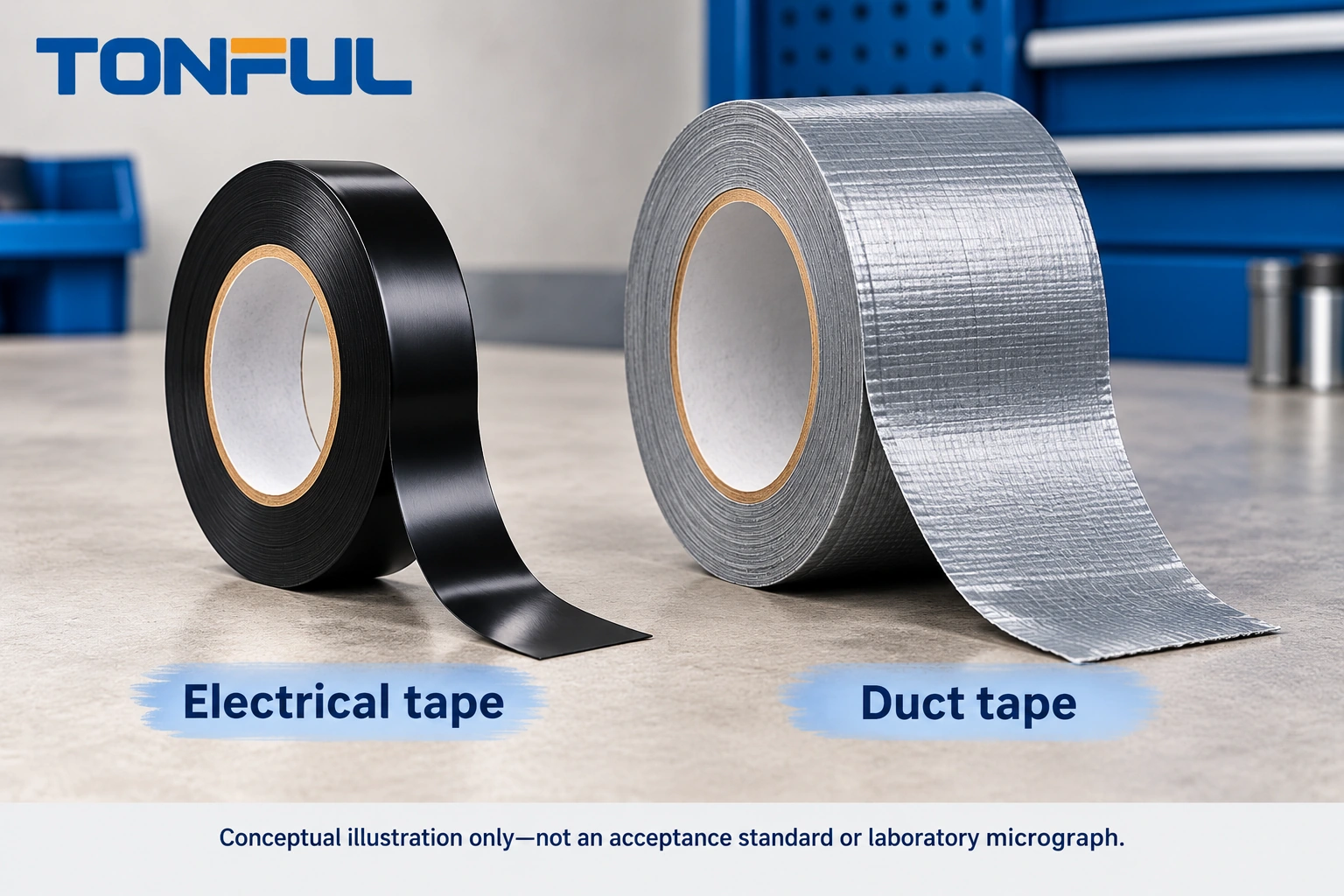
Electrical tape vs duct tape is a question of intended function, not which roll feels stronger. For insulating a conductor or approved splice, select an electrical insulation product documented for that use. Ordinary general-purpose duct tape is not a substitute. A strong adhesive, thick backing, or water-resistant surface does not establish electrical suitability.
Electrical tape is not an automatic repair authorization either. A damaged cord, loose terminal, wet connector, or overheated joint may need replacement rather than another wrap. The connection method, cable construction, equipment instructions, and installation environment determine whether tape belongs in the repair at all.
For engineers, maintenance teams, and buyers, the useful decision is therefore two-stage: identify the insulation or protection system required, then select the exact product and application process. This guide compares common vinyl electrical tape with cloth-backed duct tape and explains where that comparison stops being enough.
On this page
- Compare the actual functions
- Read product evidence correctly
- Choose tape or a different repair
- Control application and inspection
- Specify and purchase by model
- Prepare a focused sourcing request
Electrical Tape vs Duct Tape: Compare the Actual Functions
Common vinyl electrical tape combines a flexible PVC backing with a pressure-sensitive adhesive. A suitable grade can conform around irregular insulated surfaces, provide identification, or form part of a documented insulation system. Its permitted use comes from the selected product documentation, not the color black or the word professional on a carton.
Common duct tape uses a reinforced cloth carrier with a protective film and adhesive. That construction supports general holding, bundling, and surface repair. These mechanical uses do not demonstrate that it can replace conductor insulation. Conversely, cloth backing alone does not make every tape unsuitable for electrical work: specialty electrical cloth tapes are separate engineered products.
| Decision point | Vinyl electrical tape | General-purpose cloth-backed duct tape |
|---|---|---|
| Intended role | Electrical insulation, identification, or protective wrapping as documented | General mechanical repair or holding as documented |
| Evidence needed | Exact model datasheet, application instructions, and relevant approval details | Mechanical application instructions; no assumed electrical authorization |
| Fit around small irregular shapes | Elastic backing can conform; technique and grade matter | Reinforcement changes stretch and handling; not equivalent insulation |
| Moisture exposure | Check the complete installed system and exposure conditions | A water-resistant backing does not establish a sealed electrical joint |
| Mechanical connection | Does not replace an approved connector or termination | Does not replace an approved connector or termination |
| Inspection and rework | Inspect wrap coverage, ends, substrate, and underlying connection | Remove from insulation duties and reassess the underlying damage |
TONFUL’s electrical tape product families provide a starting point for discussing PVC, rubber, and other tape constructions. Treat the family name as a shortlist, then obtain the documentation for the model actually being quoted.

Read Product Evidence Without Inventing a Rating
Electrical ratings belong to a specified product under stated conditions. As a concrete example, 3M’s Scotch Super 33+ technical datasheet identifies a vinyl backing and distinguishes application ratings under different approval systems. That named-model example does not establish the rating of a TONFUL roll or of a completed repair. Select products according to their intended user, label and instructions.
Keep Test Properties Separate From Application Limits
A dielectric breakdown result is not permission to operate a hand-wrapped joint at that voltage. Test geometry, sample thickness, conditioning, and the test method affect the result. Do not multiply a laboratory property by an estimated number of wraps to invent an installation rating.
Likewise, a temperature range needs context. Installation temperature affects how the backing conforms and the adhesive bonds; service temperature concerns the material after application. Ambient temperature may differ from the temperature at a loaded termination. Ask the supplier to identify which limits apply and whether the expected substrate and exposure are covered.
Thickness also needs its own selection logic. A thicker roll changes bulk and handling, but it does not automatically solve a sealing or compatibility problem. Use the separate electrical tape thickness selection guide when comparing roll construction after the insulation method has been approved.
Verify Claims at the Product Level
If a project requires a listing, recognition, flame test, or material declaration, request the exact supporting document and confirm its scope. Company-level marketing and a printed symbol are not sufficient evidence that every color, width, or grade carries the same status. Flame retardance is not fireproofing, and tape is not protection against an overloaded or loose connection.
Decide Whether Tape Belongs in the Repair
First identify what failed. Damage limited to an outer jacket is different from cut conductor insulation, broken strands, a loose contact, or carbonized material. Do not conceal the evidence before determining whether the cable or component remains serviceable. Where equipment instructions prohibit field repair, replace the affected assembly.
Insulation Is Not a Connection Method
Twisting loose wires together and covering them with tape does not create an approved splice. Establish the specified mechanical and electrical connection using the correct connector, conductor range, and installation tooling. Add tape only if the equipment instructions or approved repair method calls for it. Extra tape cannot restore a damaged contact spring, correct crimp compression, or replace strain relief.
Where an approved process uses tape over an irregular joint, wrapping access can be useful. Where a controlled sleeve can be installed before termination, a defined tubing process may be easier to repeat. The electrical tape versus heat-shrink comparison examines that separate choice; neither option should be selected solely because it is already on the bench.
For moisture exposure, distinguish splash, condensation, immersion, and fluid contact. A neat vinyl wrap does not prove a watertight assembly. Consider a qualified sealed connector, splice kit, or suitable adhesive-lined sleeve when the application demands sealing. TONFUL’s heat-shrink tubing range is relevant to that discussion, but the installed dimensions, substrate, adhesive, and process still require confirmation.
Low voltage does not remove the need for a suitable repair. Batteries can supply damaging fault current even when shock risk is comparatively lower. Keep this guidance separate from high-voltage vehicle systems, mains installation work, and equipment with stored energy; those require the relevant service procedures and qualified personnel.
Consider two workshop situations. An intact harness needs identification inside a dry cabinet: the marking specification, adhesion to the jacket, and removal requirements guide selection. A cable has been crushed at a moving hinge: neither electrical tape nor duct tape resolves the mechanical damage or repeated flexing. Inspect the conductors and replace or repair the assembly only through an authorized method, then correct the routing or support.
For an outdoor joint, begin with the enclosure, connector, cable entry, and drainage requirements rather than the tape aisle. If the approved system includes an overwrap, record its role explicitly. This prevents a protective outer layer from being mistaken for the primary insulation or the environmental seal.

Control Application and Inspection
Work on disconnected equipment under the applicable isolation procedure. Account for batteries, alternate supplies, stored energy, and backfeed; switching off a control does not by itself prove a safe work condition. Have qualified personnel verify the required condition before disturbing electrical insulation.
Define the Process Before Wrapping
Prepare a clean, dry, compatible surface using the product and equipment instructions. An aggressive solvent can damage insulation or leave residue, so do not adopt a generic cleaner without checking compatibility. Remove sharp features or replace damaged parts through the approved repair process rather than trying to bury them under tape.
Use the specified overlap, tension, layer construction, and termination method. There is no universal wrap count for every tape, wire, voltage, and geometry. Stretching changes the backing thickness and installed shape. If the procedure does not define the necessary construction, obtain clarification rather than inventing a rule from roll thickness.
Inspect both the connection and the completed covering. Look for exposed conductive surfaces where insulation is required, gaps, wrinkles, trapped contamination, bridging over recesses, split edges, and a lifting tail. A smooth exterior does not verify the hidden termination, so retain the required pre-wrap inspection record.
Respond to Defects Without Hiding Them
If a tail lifts, contain the affected work and review substrate cleanliness, application tension, roll condition, storage history, and temperature. Confirm the cause with a controlled reapplication using the approved process. Do not simply add another roll’s material over an uncertain bond and call the problem solved.
For heat discoloration, odor, or melted insulation, stop and investigate the circuit and connection. The corrective action may involve terminal replacement, load correction, routing changes, or a different protection system. Tape condition is a symptom to examine, not proof that tape selection was the only root cause.
Specify and Purchase by Model
For procurement, replace requests such as strong black tape with a model-controlled specification. State the function first: primary insulation within a defined system, protective overwrap, identification, or harness wrapping. This prevents a mechanically attractive substitute from reaching an electrical workstation without review.
| RFQ or inspection field | Record or request | Decision supported |
|---|---|---|
| Product identity | Manufacturer, model, color, dimensions, and revision | Prevents unreviewed substitutions |
| Intended assembly | Cable, insulation, connector, geometry, and equipment instructions | Checks compatibility and repair permission |
| Electrical duty | System voltage and approved insulation construction | Avoids deriving ratings from appearance |
| Environment | Installation and service temperatures, fluids, sunlight, and moisture | Screens unsuitable grades |
| Evidence | Datasheet, applicable approval scope, and application procedure | Connects claims to the selected model |
| Receiving record | Supplier lot, delivery condition, storage limits, and shelf-life basis | Supports traceability and stock control |
| Qualification record | Sample assembly, test plan, acceptance source, and disposition | Documents release for the actual use |
Evaluate installed cost rather than roll price alone. Width influences maneuverability around a small termination; length and packaging affect dispensing and stock control. Rework access, adhesive residue, and the need to inspect the underlying joint also influence the practical choice. These are process considerations, not evidence of a universal cost advantage.
Keep duct tape and electrical insulation stock clearly identified. Separate shelf locations and controlled issue labels can reduce substitution errors, particularly when both products are black. For repeat assemblies, include an approved sample or clear work instruction and require review when the tape model changes.
Prepare a Focused Sourcing Request
Choose documented electrical tape for an approved electrical insulation duty, not ordinary duct tape. Choose another repair system when the connection, cable damage, environment, or equipment instructions require it. The right specification defines the whole assembly and process, not just the roll.
For a model-specific recommendation, contact TONFUL with your tape requirements. Share the substrate, intended function, voltage context, installation and service conditions, roll dimensions, quantity, and required documents. Request a sample and current technical information before approving the product for your assembly.