
A headlight switch OEM number is a starting point for identification, not proof that two parts are interchangeable. A complete number may be tied to a vehicle market, production period, trim, connector revision, lighting package, software strategy, or supersession chain. Shortened numbers, missing suffixes, seller-created interchange tables, and visually similar switches can lead to the wrong functions or electrical outputs.
This guide explains how to build a defensible headlight switch cross-reference for sourcing, catalog management, sample approval, and replacement. TONFUL’s headlight-switch range presents current vehicle applications and OE reference numbers. Confirm the exact vehicle, complete OE reference, connector, pinout, functions, approved sample, and project-specific validation plan before ordering.
Quick Cross-Reference Rules

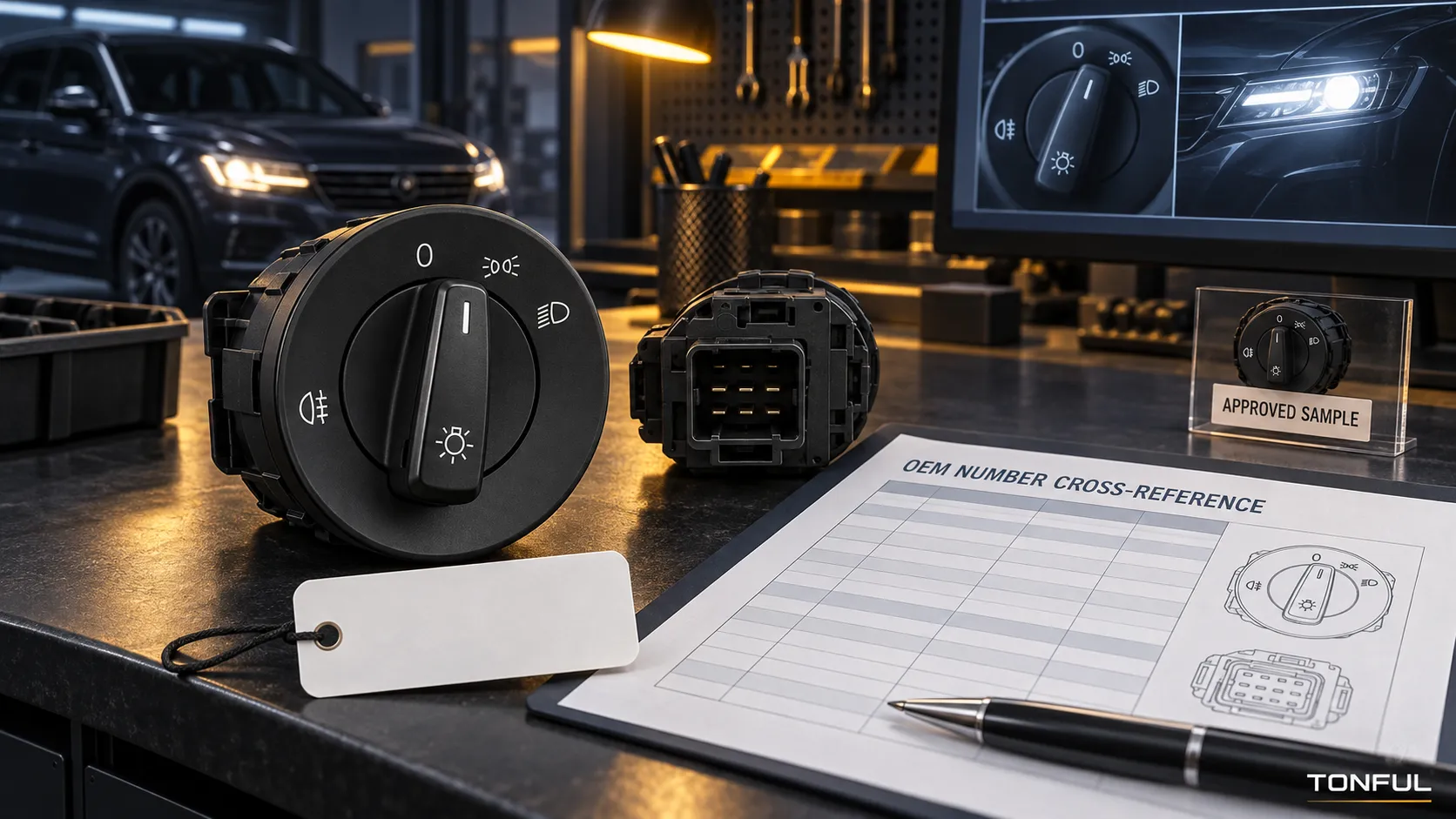
Conceptual illustration only – not an official OEM interchange table, vehicle-specific fitment record, or approval standard.
| Cross-reference field | Evidence to capture | Common error | Release condition |
|---|---|---|---|
| Complete source number | Every prefix, base number, suffix, space, hyphen, and revision mark | Searching a partial number that matches several variants | Exact number preserved with a photograph and source |
| Vehicle identity | VIN where available, make, model, market, production date, trim, body, and options | Treating model year alone as sufficient | Vehicle attributes agree with the applicable parts source |
| Supersession | Old number, new number, direction, date, and conditions | Assuming two listed numbers replace each other both ways | Direction and application limits confirmed by an authoritative source |
| Physical interface | Bezel, mounting, depth, connector shell, keying, latch, terminals, and orientation | Approving by front appearance or terminal count | Dimensions and connector views match the approved sample |
| Function matrix | OFF, parking, headlamps, AUTO, fog, dimmer, illumination, leveling, and integrated controls | Assuming unused-looking positions are equivalent | Every required action and output is verified |
| Electrical architecture | Direct load, relay request, ground-side input, resistance-coded signal, or module communication | Moving wires to imitate another switch | Pinout and operating states match controlled documentation |
| Approval status | Sample ID, test record, reviewer, date, and application scope | Publishing a seller cross-reference as confirmed fitment | Approved sample and evidence package define the released scope |
Unknown information should remain Unknown or Pending. A cross-reference becomes reliable by closing each field, not by collecting the largest number of seller listings.
OEM, OE, Aftermarket, and Supplier Numbers
OEM commonly refers to the vehicle manufacturer or the organization responsible for the original vehicle specification. OE may describe the part installed in production or validated for service use. An aftermarket supplier can assign its own catalog number to a replacement covering one or more OE references. Distributors may add inventory SKUs that have no engineering meaning outside their system.
Keep these identifiers in separate database fields. Record the issuing organization, number type, source URL or document, revision or access date, and exact written format. Do not place an OEM number, supplier number, and warehouse SKU in one undifferentiated list. That practice hides which source actually supports fitment.
The official GM Genuine Parts headlamp switch listing for part 95248626 demonstrates the value of an authoritative product record: it identifies the GM and ACDelco references, mounting position, connector and terminal information, functions, and named vehicle applications. Those details apply to that listed part and must not be copied to another headlight switch merely because the housings look similar.
Capture the Complete Number and Label Evidence
Photograph the installed label before removing, cleaning, or discarding the original switch. Capture a straight-on image, an angled image that reveals embossed characters, the complete housing, and the connector end. Record whether the identifier is printed on a label, molded into the housing, laser marked, or shown only on packaging. A molded housing number may identify a shared plastic component rather than the complete service assembly.
Preserve leading zeros, spaces, hyphens, prefixes, suffixes, color codes, and revision letters. Optical character recognition can help index photographs but should not replace manual verification. Similar characters such as 0/O, 1/I, 5/S, and 8/B are common transcription risks. If the package number differs from the switch marking, retain both and identify their source instead of choosing one silently.
Use this minimum label record:
- Original switch marking and exact character format
- Package or service label number
- Manufacturer or brand shown on each item
- Date, lot, revision, or production code
- Vehicle VIN or fleet asset ID
- Installed location and removal side
- Front, side, rear, label, and connector photographs
- Person recording the evidence and date
Verify Vehicle and Production Conditions
A model name and year may span multiple wiring revisions. Record make, model, body or cab, market, production month or range, trim, lighting option, left- or right-hand-drive configuration where relevant, and any fleet or regional package. Use the VIN to improve vehicle identification, but do not treat a VIN decoder as a parts catalog.
NHTSA’s vPIC platform provides manufacturer-reported VIN decoding and basic vehicle attributes for relevant vehicles. It can support vehicle identification, particularly for U.S.-market records, but it does not confirm headlight switch interchangeability, connector compatibility, pinout, functions, or supersession. Final part identification still requires the applicable OEM parts information, controlled supplier documentation, or customer-approved application record.
If the source catalog uses “from” or “through” production dates, option codes, VIN breaks, or market exclusions, copy those conditions into the cross-reference record. Do not publish a broad year range that removes the conditions. A number valid after a production break may physically resemble the earlier switch while using different logic or terminals.
Build the Supersession Chain in the Correct Direction
Supersession means an older service number has been replaced by another number under stated conditions. It does not automatically mean the old part can replace the new part, that both numbers fit every earlier application, or that every regional catalog follows the same chain. Record arrows, not just associations: old number -> new number, with source, date, and conditions.
Separate these relationships:
- Direct supersession confirmed by an OEM source
- Alternate service number from the same organization
- Supplier cross-reference proposed for review
- Distributor interchange without engineering evidence
- Visually similar part with no confirmed relationship
- Customer-approved substitute for a defined project
When two official sources conflict, retain both records and escalate the discrepancy. Check whether one source is newer, market-specific, VIN-specific, or limited to a service package. Do not select the convenient number and delete the contrary evidence. A supersession chain should remain auditable after the catalog page changes.
Confirm Connector, Mounting, and Physical Interface

This conceptual evidence board shows the required views; it does not establish an actual vehicle application.
Compare bezel shape, panel curvature, clips, screws, anti-rotation features, mounting depth, knob clearance, detents, and connector routing. A switch that plugs in but cannot seat or operate after trim installation is not a valid replacement.
For the connector, record shell shape, gender, keyways, latch position, terminal count, populated cavities, terminal type, seals, and component-side orientation. Connector photographs are easily mirrored, so mark the latch and cavity-numbering viewpoint. Terminal count alone is weak evidence: two twelve-position connectors can use different populated cavities and outputs.
Never move vehicle wires to make an unverified cross-reference fit. Repinning can apply battery voltage to a module input, ground the wrong circuit, omit protection, or create a latent service problem. Resolve differences through controlled wiring information and an approved engineering decision.
Freeze the Function and Architecture Matrix
List every physical action and expected system response. Typical fields include OFF, parking lamps, manual headlamps, AUTO, front fog, rear fog, dash-dimmer increase or decrease, switch illumination, telltales, headlamp leveling, and any integrated controls. Mark each as Required, Not Fitted, or Pending with the evidence source.
Then identify what each switch position electrically produces. The switch may carry lamp current, energize a relay, switch ground, change a resistance-coded input, or send a request interpreted by a BCM. The Headlight Switch, Relay or BCM Control Guide explains why these architectures require different tests and cannot share a universal pinout.
Use the Headlight Switch Functions guide to define AUTO, parking, fog, and dash-dimmer dependencies. If a replacement matches the connector but omits a pull-for-fog action, uses a different resistor ladder, or sends a different module state, it is not functionally equivalent.
Validate the Proposed Cross-Reference
Cross-reference approval should include document review, dimensional and connector inspection, controlled bench checks, and vehicle or representative-system validation as required by the project plan. Follow vehicle-specific safety procedures and use protected probes or an approved breakout harness. Never measure resistance on a powered circuit or jump unknown module terminals.
Create a record with these fields:
| Field | Required entry |
|---|---|
| Sample identity | Supplier number, OE references, lot, label photos, and approved-sample ID |
| Application | Vehicle, market, production range, trim or options, and VIN evidence where allowed |
| Mechanical result | Mounting, bezel, depth, knob clearance, retention, and connector engagement |
| Electrical setup | Architecture, source document, connector orientation, cavities, meter, range, probes, and load |
| Function result | Each switch action, expected state, actual state, downstream response, and conditions |
| Exceptions | Unknowns, deviations, affected stock, owner, due date, and closure evidence |
| Release | Approved scope, reviewer, date, drawing or catalog revision, and change-control requirement |
The Headlight Switch Multimeter Test guide provides safe measurement and record principles. Use product-specific limits from the approved drawing, OEM procedure, customer specification, or validation plan; do not invent universal resistance, current, voltage-drop, or durability values.
Control Catalog Data and Future Changes
Keep one controlled cross-reference record for each released relationship. The record should distinguish verified fitment from a sourcing lead, show the evidence owner, and identify the market and production scope. Related images, drawings, catalog extracts, correspondence, test reports, and sample approvals should use stable references.
Receiving inspection should compare the delivered label, lot, housing, connector, terminal population, symbols, functions, and packaging with the approved sample. Define a reaction plan for mismatches. A supplier change to contacts, terminals, resistor networks, electronics, LEDs, housing, tooling, manufacturing process, sub-supplier, or site may require notification and reapproval.
For fault-led replacement, review Bad Headlight Switch Symptoms and Diagnosis before assuming the original number identifies the failed component. A relay, BCM, connector, ground, lamp socket, sensor, or wiring fault can remain after a correctly cross-referenced switch is installed.
Cross-Reference Approval Checklist
- The complete source number, suffix, label, and packaging references are preserved.
- Vehicle, market, production date, trim, options, and VIN-derived attributes are recorded where relevant.
- The number type and issuing organization are identified.
- Supersession direction and conditions come from an authoritative source.
- Front, side, rear, label, mounting, and connector-end views are retained.
- Connector keying, latch, terminal population, and cavity orientation match.
- Every required function and electrical output appears in the approved matrix.
- Test results identify conditions, equipment, actual values, and acceptance sources.
- Unknowns and conflicting sources have owners and closure evidence.
- The released application scope, approved sample, catalog revision, and change controls are documented.
Work With TONFUL
Use the TONFUL Headlight Switch Manufacturer page to review current applications and OE references. For an RFQ or cross-reference review, send TONFUL the complete number and suffix, vehicle and market, production information, front and connector-end photographs, dimensions, terminal population, symbols, function matrix, wiring or pinout source, annual demand, packaging requirements, and validation plan. Final compatibility should remain tied to an approved sample and controlled project record.