
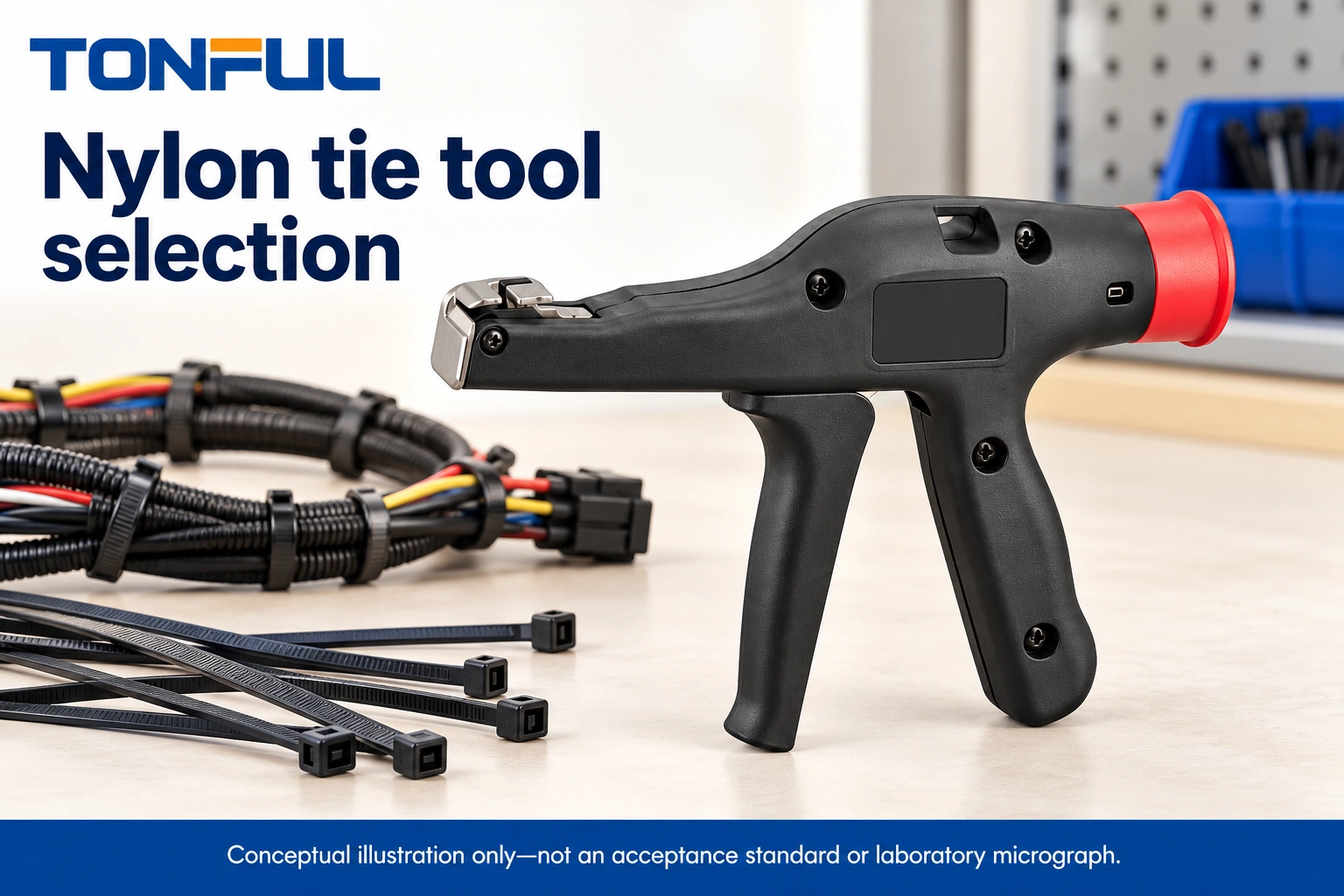
Nylon cable tie tensioning tools should be selected as part of a tie, tool and bundle combination. A strap that enters the nose is not automatically compatible: thickness, material, head geometry, gripping behavior and cutoff design still matter. The buying decision is whether the tool can install your specified tie without damaging its lock, leaving an unacceptable tail or compressing the cable bundle beyond its approved condition.
Start with the actual tie drawing and the tool’s current instructions. Then approve representative assemblies rather than purchasing by appearance or a shared width number. This guide separates catalogue screening from sample approval, explains why a tension setting is not a calibrated physical force, and provides records that procurement and production can use together.
Contents:
- Model screening
- Tie dimensions and material
- Head access and cutoff
- Tension settings
- Sample approval
- Purchasing and change control
Screen nylon cable tie tensioning tools by exact model
The current TONFUL cable tie fastening tool page identifies VSZ-800K and VSZ-800Z as tools for tensioning and cutting self-locking nylon ties. These are not terminal crimpers, conductor cutters or stainless-steel banding tools. Their selection data must remain attached to the individual model.
| Model | Catalogue reference | Listed tie width | Listed tie thickness | Buyer action |
|---|---|---|---|---|
| VSZ-800K | SV.080006 | 4.8–12 mm | 2 mm | Confirm the proposed tie and thickness interpretation with TONFUL |
| VSZ-800Z | SV.080007 | 2.8–6 mm | 1.5 mm | Confirm the proposed tie and thickness interpretation with TONFUL |
The page describes these thickness entries as catalogue limits in its selection guidance. Do not silently reinterpret them as a dimensional tolerance, a complete approved thickness range or permission to use every thinner strap. Request written confirmation for your actual tie drawing, including dimensional variation and material. Both models have catalogue data, but those data alone do not establish a validated process window.
Where the listed width ranges overlap, neither model becomes the automatic winner. Check thickness, head contact, bundle access, operating effort and the resulting cutoff on samples. Keep the wider model’s capacity separate from the smaller model’s data; specifications cannot be averaged or combined into a third imaginary tool range.
TONFUL’s broader electrical tools catalogue separates fastening tools from other tool families. Use that distinction in the purchase description so a quotation cannot substitute a visually similar crimper or a metal-tie installation tool.
Match width, thickness and material independently
Width is an entry check, not the entire specification
Width influences whether the strap can enter the feed path and whether the gripper and cutter can engage it as designed. Inspect the working strap rather than relying on bag descriptions. Obtain the nominal dimension and permitted variation from the approved drawing; do not create a receiving tolerance from a single measurement.
Thickness is a separate dimension. Two ties with similar widths may have different strap profiles, serrations and stiffness. A thicker strap can change nose clearance and cutting demand even when its top view appears identical. Measure using the drawing’s defined method and location, especially where tooth height makes an unspecified measurement ambiguous.
Nylon is a family description
Material identity includes the specified compound and any applicable conditioning or storage instructions. Color does not establish UV suitability, flame performance or tool compatibility. Avoid replacing the approved tie with a same-width alternative merely because both are sold as nylon. A supplier or compound change belongs in the review process.
The TONFUL cable tie range includes different constructions and fixing arrangements. A releasable head, mounting feature or identification flag can alter access even when the strap resembles a standard self-locking tie. Select the construction for the assembly first, then confirm that the chosen installation tool can accommodate it.
| Input | Evidence to obtain | What it prevents |
|---|---|---|
| Strap width and thickness | Drawing revision and representative measured samples | Width-only approval |
| Material and condition | Exact material designation and storage instructions | Uncontrolled substitutions |
| Serrations and tail profile | Drawing or agreed reference sample | Assuming all feed behavior is equivalent |
| Head and mounting features | Installed orientation and clearance review | Nose interference |
| Bundle construction | Cable identities, protection layers and routing drawing | Approving the tool on an unrelated bundle |

Check head geometry, access and cutoff expectations
The nose needs the intended relationship to the tie head during installation. A nearby mounting base, enclosure wall, adjacent tie or cable branch may prevent that relationship. The operator can then be tempted to tilt the tool or pull it away from the bundle. Treat this as an access problem to solve, not a technique to normalize.
Review head height, strap exit direction, locking feature clearance and the available approach envelope on an assembly sample. Include the most restricted intended position, not just an open bench location. A tool that works on a loose bundle can be impractical after the harness is installed in a cabinet.
Cutoff requirements need equally clear wording. Specify what the finished assembly must satisfy: permitted tail projection, edge condition, absence of head damage, and cable protection. Use limits from the customer drawing or an approved inspection instruction. A promotional phrase such as flush cut is not a universal acceptance standard, nor does it guarantee a harmless edge under every combination of tie, nose, setting and wear condition.
Do not assess edge sharpness by running a finger over a cut tail. Use the approved visual or guarded inspection method. Photograph the head and remaining tail at the defined orientation, retaining scale context when the acceptance document calls for measurement. Keep representative accepted and rejected examples tied to that document rather than treating an attractive illustration as evidence.
For material and bundle considerations beyond the tool itself, the cable ties buying guide provides a separate selection framework. The tool trial should use the tie selected for the actual application, not whichever sample happens to produce the smoothest demonstration cut.
Establish a setting without inventing physical force
A numbered adjustment position is a tool setting. It is not automatically a force in newtons, and it is not the tie’s published loop tensile strength. The latter is a different property measured under its own specified conditions. Neither value should be converted into installation tension by an unsupported rule of thumb.
For a manufacturer-specific example, the HellermannTyton EVO7 operating instructions qualify their own setting-to-force guidance and advise checking force because processing conditions influence results. That document applies to the named competitor tool, not to VSZ models; its force table and settings must not be transferred to TONFUL equipment.
Where installation force is a controlled requirement, obtain the selected tool manufacturer’s verification method, suitable measurement equipment and calibration requirements. Record fixture, sample condition, measurement definition and acceptance source. A force reading without that context may not represent the quantity the customer specified.
Where the process is controlled by an approved setting and installed-condition checks instead, identify the tool, tie and bundle combination explicitly. Follow its own adjustment and operating instructions. Do not keep increasing tension to hide slipping, poor seating or a worn cutter. A successful severed tail does not prove the bundle has been installed correctly.
For delicate insulation, protective sleeving or a mixed-diameter bundle, review cable condition as well as the tie. The correct setting must satisfy the approved assembly requirements, not simply prevent visible movement. If retention and cable protection cannot both be achieved, revisit the fastening arrangement with engineering rather than accepting more compression.
Approve representative samples and retain the evidence
Before a trial, isolate relevant circuits and verify a safe state through qualified site procedures. These fastening tools are not established as insulated live-work equipment. Keep hands clear of the nose and moving mechanism. Use only the operating method in the exact tool instructions; do not improvise maintenance or remove guards to improve access.
Build a sample plan that covers the combinations you intend to release. Include relevant bundle extremes, restricted access positions, tie lots and authorized operators. Engineering or the customer must define sample quantity, acceptance limits and retest rules according to application risk; a convenient handful is not automatically adequate qualification.
Run trials with known identities and examine each installed condition before changing another variable. Retain rejected samples and their settings. If a result is unacceptable, record the reason and disposition rather than repeating trials until a favorable sample appears. Any changed tie or tool condition needs a clear link to the new result.

| Record field | Information to enter |
|---|---|
| Assembly and requirement | Part number, drawing revision, acceptance instruction |
| Tie identity | Supplier, part, lot, material, width, thickness, condition |
| Tool identity | Model, asset number, nose and blade identification, service status |
| Installation | Setting, operator, access orientation, operating instruction revision |
| Inspection | Tail condition, head integrity, bundle condition, required measurements |
| Decision | Result, deviation disposition, approver and released scope |
Separate observed fit from long-term application approval. If the assembly specification requires environmental exposure, retention testing or later inspection, include those steps before final release. A clean initial cutoff cannot establish aged performance. Conversely, do not add unrelated electrical tests simply to make a mechanical fastening trial look more comprehensive.
Purchase a controlled combination, not a generic gun
The RFQ should identify the model, catalogue reference, tie drawing and intended installation. Ask TONFUL to confirm the proposed compatibility, applicable operating instructions, adjustment method, maintenance arrangements and available replacement parts. Request sample terms, packaging, quantities and delivery details in the quotation rather than assuming universal commercial conditions.
After approval, preserve the reference samples and issue a workstation instruction showing the released combination. Define who may adjust the setting, when first-piece checks are required, and what stops production. A worn blade that no longer cuts properly is a stop-use condition on the current TONFUL product page, not an invitation to compensate with extra force.
Trigger review after changes to tie supplier, material, dimensions, head design, tool model, nose, blade or assembly access. Replacement consumables should follow the exact maintenance instructions and require the specified restart checks. Keep production monitoring practical: trace tool and tie lots, retain inspection records and trend the actual reject modes.
Send the tie specification, bundle drawing, installation photographs and required cutoff criteria through TONFUL’s product enquiry channel. Request a model-specific review and representative sample trial before confirming the order. The deliverable to buy is a documented, repeatable fastening process for your assembly, not an unsupported promise that one gun suits every nylon tie.