
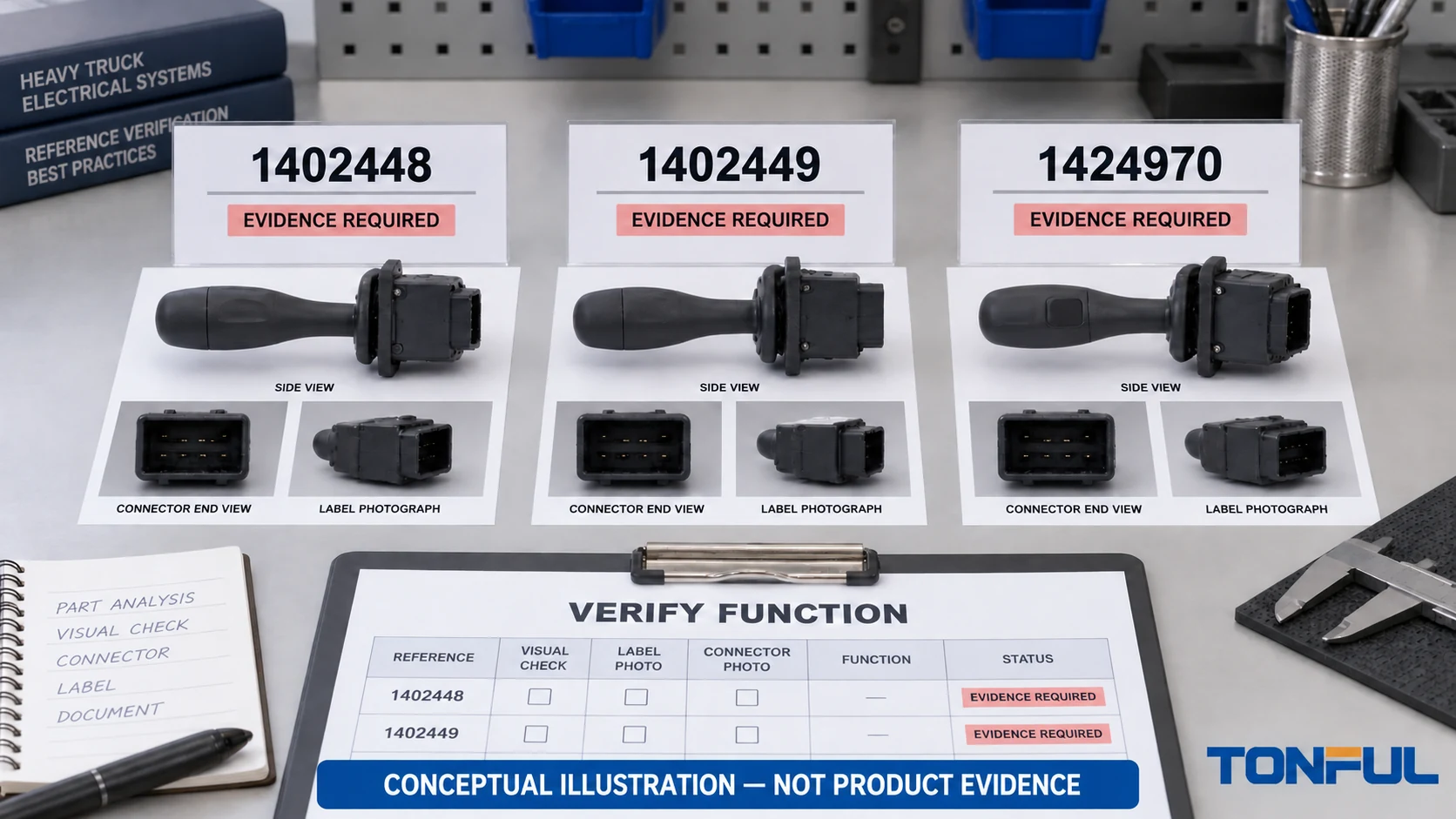
Scania references 1402448, 1402449 and 1424970 should not be treated as three cosmetic versions of one universal stalk. TONFUL’s current website records are not yet internally consistent: product pages group related numbers differently, and 14024970 may conflict with the separately researched 1424970. Until controlled product evidence resolves that conflict, this page treats every proposed function and cross-reference relationship as unverified.
This guide deliberately avoids publishing unverified years, pin counts, universal pinouts or unconditional supersession claims. A buyer should match the exact vehicle and chassis information, complete OE chain, stalk controls, connector end view, electrical state table and approved sample before releasing an order or catalog application.
On this page: Reference Comparison | Verify the Vehicle and Hardware | Test Functions and Pinout | Release Decision
Reference Comparison
Current Research Leads, Not Public Fitment Claims
| Research lead | Number/source type to confirm | Proposed relationship requiring verification | Evidence source | TONFUL label/drawing ID | Verification date | Public status |
|---|---|---|---|---|---|---|
| 1402448 / 1373189 | Proposed Scania OE/service references | Reported by aftermarket sources as one non-cruise direction-switch group | Enter controlled Scania source | Enter | Enter | Unverified |
| SWF 202647 | Supplier/manufacturer reference, subject to label verification | Reported as associated with the 1402448 research group | Enter supplier label and controlled cross-reference | Enter | Enter | Unverified |
| 1402449 / 1373190 | Proposed Scania OE/service references | Reported as one cruise-equipped direction-switch group | Enter controlled Scania source | Enter | Enter | Unverified |
| 1424970 / 1372985 / 1402450 | Number type must be confirmed individually | Reported by aftermarket sources as a possible wiper-switch group | Enter controlled Scania source | Enter | Enter | Unverified |
| SWF 202648 | Supplier/manufacturer reference, subject to label verification | Reported as associated with the proposed wiper group | Enter supplier label and controlled cross-reference | Enter | Enter | Unverified |
| 14024970 | Number type and validity unresolved | Appears on current TONFUL pages but conflicts with the 1424970 research lead |
TONFUL inventory/database investigation | Enter | Enter | Unverified; do not publish as interchange |
The table is an investigation register, not a catalog. Third-party sources such as the Marília aftermarket catalog may help locate a possible relationship, but they do not replace Scania chassis-specific documentation or TONFUL-controlled labels, drawings and sample records. SWF 202647 and SWF 202648 must be labeled as supplier/manufacturer references unless a controlling source establishes another number type.
Capture each number exactly from the removed part and TONFUL inventory sample. Record whether it is an OE service number, superseded OE number, supplier number, engineering number, housing mark or customer SKU. A molded number may identify a shared subcomponent rather than the complete switch. TONFUL’s OE-number cross-reference guide explains this classification process.
Resolve the TONFUL Website Conflict Before Publication
The current heavy-duty manufacturer page groups 14024970 and 1402450 with a multifunction stalk, while the product page lists 14024970, 1402450 and 202648 together. Those records cannot be reconciled merely by declaring 14024970 a typo. TONFUL should quarantine the affected public mappings, inspect inventory labels and product photographs, retrieve the linked drawing or supplier record, compare connectors and functions, and document the reviewer and date.
Only a record supported by the named sample, label, source document, connector evidence and function test should be promoted to Verified. A third-party cross-reference without those controls remains Unverified; a bounded project awaiting one defined closure may be Conditional in an internal inquiry, but it should not become a public fitment statement.
Compare Functions Only After Identity Is Controlled
The meaningful difference is not only the printed reference. For any candidate with cruise controls, record whether ON/OFF, SET, RESUME, CANCEL or increment/decrement controls are present and where the main cruise enable control is located. The switch may use separate contacts, a resistor-coded input, voltage coding or a module/network request. A visually similar stalk may have empty cavities or different internal electronics.
Fitting a cruise-marked stalk does not by itself add cruise control to a truck. Vehicle wiring, brake/clutch inputs, controller configuration, software authorization and other hardware may be required. The cruise versus non-cruise compatibility checklist provides the broader architecture and retrofit boundaries.
Verify the Vehicle and Hardware
Start With Chassis-Specific Information
Record vehicle family, market, model designation, cab configuration, production date, chassis number, LHD/RHD, stalk side, transmission and installed options. Avoid treating “Scania 4-Series” as one electrical specification. Production changes and option content can alter connector population, function allocation or controller interpretation.
Scania’s official repair-information overview states that the chassis number is the key to retrieving the vehicle specification and that wiring diagrams are used for electrical fault finding. This supports a chassis-first process rather than a photograph-first process. Consult the Scania repair and maintenance information package for access and coverage information; it does not itself confirm that any of the three references fits a particular truck.
Compare Stalk Controls and Mechanical Interface
For every candidate, document turn-signal positions, beam or flash controls, horn, cruise, wiper, washer and every detent or momentary action only when present on the actual labeled sample. Do not preassign a function from the number alone.
Compare mounting geometry, locating tabs, fasteners, steering-column shroud interface, lever reach, movement, cancel interface where applicable, trim clearance and harness routing. Do not force a sample into the shroud or modify a key, clip or connector to create fit. LHD/RHD and stalk-side differences can affect ergonomics and harness arrangement even when the OE number appears similar.

Conceptual illustration only—not product evidence. Each proposed relationship remains unverified until label, connector, chassis-source and function-test evidence agree.
Inspect Connector End Views
Photograph the removed and candidate connector faces straight-on with the latch or keyway in the same orientation. Record shell family, keying, cavity count, populated terminals, blanks, terminal size, seal interface and latch condition. Never mirror a photo to make two connectors look alike.
A matching shell is only one gate. Any candidate may differ in terminal population, coded electronics or function assignment and therefore requires its own state map. The connector and pinout reading guide explains cavity-view and numbering controls without assigning a universal Scania pinout.
Test Functions and Pinout
Use a Separate Function Matrix for Each Reference
| Test field | 1402448 candidate | 1402449 candidate | 1424970 candidate | Evidence source |
|---|---|---|---|---|
| Exact label and revision | Enter | Enter | Enter | Part label and controlled catalog |
| Primary function family | Enter from controlled evidence | Enter from controlled evidence | Enter from controlled evidence | Product drawing and labeled sample |
| Connector orientation | Record | Record | Record | Controlled end-view drawing |
| Populated cavity map | Record | Record | Record | Sample and diagram |
| Maintained positions | Test actual functions | Test actual functions | Test actual functions | State table |
| Momentary controls | Test actual functions | Test actual functions | Test actual functions | State table |
| Signal architecture | Identify | Identify | Identify | Vehicle diagram/test method |
| Mechanical behavior | Record actual detents and returns | Record actual detents and returns | Record actual detents and returns | Drawing/test plan |
| Module recognition | Record applicable states | Record applicable states | Record applicable states | Approved diagnostic tool |
| Installed result | Record | Record | Record | Identified truck and approver |
Do not fill a missing function with an assumption. If a sample has a symbol or control not documented in the source, mark it unresolved and obtain the drawing or vehicle record. If sources conflict, preserve both records and stop release until the controlling source resolves the conflict.
Match the Test Method to the Architecture
For discrete contacts, create a state-by-state continuity table using controlled cavity numbers and viewing direction. If the contact carries a load, use the approved load, switching sequence, voltage-drop method and thermal acceptance source. A continuity beep does not establish load capacity.
For resistance- or voltage-coded inputs, record reference conditions, test points, raw value, tolerance and module-decoded state. For LIN, CAN or a steering-column module, verify supply, wake behavior, recognized input states, communication, software/configuration and DTC behavior. Never apply battery voltage or a test lamp to an unidentified signal line.
The analog, resistive, LIN and CAN stalk-switch guide provides an architecture-specific test matrix. Use it only after the Scania chassis diagram identifies the applicable interface.
Diagnose a Mismatch Systematically
| Symptom | More likely direction | Evidence to collect |
|---|---|---|
| Connector will not latch | Wrong shell/keying or damaged latch | Straight end-view photos and mating-part data |
| Turn signals work but cruise controls do not | Incorrect candidate, missing circuits, coded mismatch or configuration | Full label, cavity map, cruise state data and controller recognition |
| Cruise input is recognized but will not engage | Vehicle authorization condition rather than stalk alone | Brake/clutch status, speed, DTCs and configuration |
| Wipers use wrong stages | Wrong candidate, pinout or coded-state mismatch | Wiper function matrix and raw/decoded states |
| Washer command is absent | Contact, cavity, harness, pump circuit or controller input | Command at switch and downstream circuit separately |
| Lever fits but contacts trim | Wrong geometry, orientation or application | Dimensions and installed-clearance record |
| Several functions fail intermittently | Connector retention, shared power/ground, worn contact or harness strain | Dynamic test and terminal inspection |
| New electronic switch creates DTCs | Hardware/software/configuration mismatch | Revisions, network evidence and diagnostic record |

Conceptual illustration only—not product evidence. Release requires agreement between the labeled reference, physical sample, chassis-specific diagram and installed function results.
Release Decision
Complete a Controlled Application Record
For each approved application, retain the full vehicle and chassis scope, market, LHD/RHD and stalk side, complete OE and cross-reference chain, label photographs, supplier/sample revision, function family, control legends, mechanical dimensions, connector end view, cavity map, pinout or coded states, architecture, instrument and fixture, installed results, DTC status, approver and date.
Use Verified only when the named sample and vehicle scope satisfy all mandatory evidence. Keep Conditional records within controlled inquiry or engineering workflows, with the exact restriction and closure owner. Use Unverified when only a catalog or marketplace association exists. Publish only Verified mappings in a public cross-reference table. A sample approval does not automatically approve another suffix, production range or market.
The combination-switch RFQ and sample checklist helps buyers keep technical and commercial release fields together.
Work With TONFUL
TONFUL’s automotive combination switch range currently contains reference information that requires reconciliation with this research register. For 1402448, 1402449, 1424970 or a related number, send the vehicle and chassis scope, market, LHD/RHD, removed-part label and connector photos, required controls, cavity map and sample-validation plan. TONFUL should confirm the inventory label, drawing ID, source type and function test before quotation or public fitment publication.