
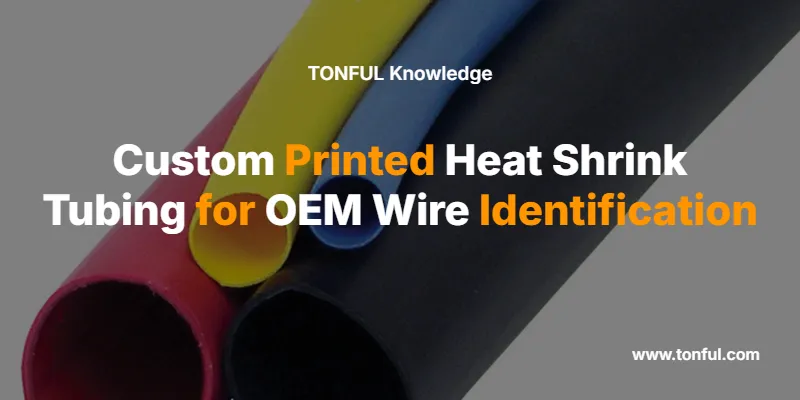
In today’s complex manufacturing environments, proper wire identification is not just a convenience—it’s a critical requirement for safety, efficiency, and compliance. Custom printed heat shrink tubing has emerged as the industry-standard solution for OEM manufacturers who demand permanent, durable, and professional wire marking systems. This comprehensive guide explores how custom printed heat shrink tubing revolutionizes wire identification in manufacturing operations.
What is Custom Printed Heat Shrink Tubing?
Custom printed heat shrink tubing is heat-shrinkable polyolefin tubing with pre-printed identifiers such as text, logos, part numbers, barcodes, or serial numbers directly on its surface. When heated to approximately 100°C (212°F), the tubing shrinks to approximately one-third to one-half its original diameter, conforming tightly around wires, cables, or components to create a permanent, tamper-evident identification label.
Unlike adhesive labels that can peel, fade, or fall off, printed heat shrink tubing becomes an integral part of the wire assembly, providing both insulation and identification in a single application. This dual functionality makes it indispensable for automotive wire harnesses, aerospace assemblies, industrial control panels, and telecommunications infrastructure.

Why OEM Manufacturers Choose Custom Printed Heat Shrink Tubing
Permanent Identification That Withstands Harsh Environments
Standard adhesive labels fail in environments with extreme temperatures, chemical exposure, UV radiation, or mechanical abrasion. Custom printed heat shrink tubing maintains legibility throughout the product lifecycle because the printing is protected by the tubing material itself. The polyolefin construction provides:
- Temperature resistance: Continuous operation from -55°C to +135°C (-67°F to +275°F)
- Chemical resistance: Withstands oils, solvents, and automotive fluids
- UV stability: Prevents fading in outdoor or high-light applications
- Abrasion protection: Resists wear from vibration and physical contact
For manufacturers producing equipment destined for automotive engine compartments, offshore marine installations, or industrial machinery, this durability translates directly into reduced warranty claims and enhanced product reputation.
Streamlined Assembly and Reduced Installation Errors
In high-volume manufacturing, every second counts. Pre-printed heat shrink tubing eliminates the need for technicians to manually apply labels during assembly, reducing labor costs and minimizing human error. Wire harness assemblers can quickly identify the correct wire for each connection, dramatically reducing assembly time and improving first-pass quality rates.
A leading automotive manufacturer reported a 40% reduction in wire harness assembly errors after switching from adhesive labels to custom printed heat shrink tubing. The improvement came from enhanced visibility and the inability to accidentally swap or misplace pre-printed markers.
Brand Recognition and Professional Appearance
Custom printing capabilities allow OEMs to incorporate company logos, part numbers, and branding elements directly onto wire assemblies. This creates a professional, cohesive appearance that reinforces brand identity and deters counterfeit replacement parts. For companies selling into competitive markets, this visual differentiation provides tangible marketing value while serving a functional purpose.

Heat Shrink Tubing Specifications: Understanding Shrink Ratios
Selecting the correct shrink ratio is fundamental to achieving proper wire identification. The shrink ratio indicates how much the tubing will reduce in diameter when heated.
Common Shrink Ratios Explained
| Shrink Ratio | Original Diameter | Recovered Diameter | Best Applications | Advantages |
|---|---|---|---|---|
| 2:1 | 10mm | 5mm | Single wires, uniform diameter cables | Cost-effective, minimal length shrinkage |
| 3:1 | 12mm | 4mm | Connectors, splices, varying diameters | Versatile, accommodates size variations |
| 4:1 | 16mm | 4mm | Large connectors, irregular shapes | Maximum flexibility, complex geometries |
| 6:1 | 24mm | 4mm | Extreme size transitions, specialized applications | Highest adaptability, premium cost |
The most commonly specified ratio for OEM wire identification is 3:1, which provides the optimal balance between coverage flexibility and cost-effectiveness. This ratio allows the tubing to fit over larger connectors while still shrinking down tightly on smaller wire gauges, making it ideal for complex harness assemblies.
Calculating the Correct Size
To select appropriate heat shrink tubing dimensions:
- Measure the largest diameter the tubing must fit over (typically a connector or splice)
- Add 20-30% clearance for easy installation
- Verify the recovered diameter will provide a snug fit on the smallest component
- Account for longitudinal shrinkage (typically 5-7% length reduction)
For example, if covering a 6mm wire with an 8mm connector, select 3:1 tubing with a 12mm expanded diameter (accommodates the 8mm connector with clearance) that recovers to 4mm (provides tight fit on 6mm wire).
Printing Technologies for Custom Heat Shrink Tubing
Thermal Transfer Printing
Thermal transfer printing is the industry standard for custom heat shrink tubing due to its exceptional durability and print quality. This process uses heated printheads to transfer pigment from a ribbon onto the tubing surface, creating marks that are highly resistant to smudging, fading, and chemical exposure.
Advantages:
- High-resolution text and graphics (up to 600 DPI)
- Excellent barcode readability for automated scanning
- Wide range of printable information (alphanumeric, symbols, logos)
- Fast printing speeds suitable for high-volume production
Ink-Jet Printing
Ink-jet technology offers flexibility for short-run custom orders and variable data printing. While less durable than thermal transfer, modern UV-cured inks provide adequate performance for many industrial applications.
Hot Stamp and Print Wheel Methods
Traditional hot stamp marking remains popular for simple alphanumeric identification where high-resolution graphics are not required. This method is extremely durable and cost-effective for large-volume, repetitive marking.

Material Standards and Certifications for OEM Applications
Military and Aerospace Specifications
For defense and aerospace applications, heat shrink tubing must meet rigorous military specifications:
- SAE-AS-DTL-23053/5 (formerly MIL-I-23053/5): General specification for electrical heat-shrinkable insulation sleeving
- Classes 1 and 3: Define specific performance requirements for different application environments
- UL 224 VW-1: Flammability rating for wire and cable insulation
- CSA OFT: Canadian Standards Association certification for electrical components
These certifications ensure the tubing meets strict requirements for flammability, thermal stability, dielectric strength, and mechanical properties. OEM manufacturers supplying to aerospace, defense, or medical device industries typically require these certifications as mandatory procurement criteria.
Industrial and Automotive Standards
Commercial and automotive applications generally specify:
- UL 224: Underwriters Laboratories approval for electrical insulation
- RoHS compliance: Restriction of Hazardous Substances for environmental safety
- REACH compliance: European chemical safety regulations
- Operating temperature: -55°C to +135°C continuous use
TONFUL Electric manufactures heat shrink tubing that meets or exceeds these international standards, ensuring compatibility with global supply chains and regulatory requirements.
Comparison: Custom Printed Heat Shrink vs. Alternative Marking Methods
| Feature | Custom Printed Heat Shrink | Adhesive Labels | Wire Tags | Hot Stamp Direct Marking |
|---|---|---|---|---|
| Durability | Excellent (permanent) | Poor (can peel) | Good | Excellent |
| Installation Speed | Fast (pre-printed) | Slow (apply during assembly) | Moderate | Very slow |
| Environmental Resistance | Excellent | Poor to moderate | Moderate | Excellent |
| Legibility | High | High initially | Moderate | Moderate |
| Customization Options | Extensive (logos, barcodes) | Extensive | Limited | Limited |
| Cost per Mark | Moderate | Low | Low | High (equipment investment) |
| Suitability for Automation | Excellent | Poor | Moderate | Poor |
| Professional Appearance | Excellent | Good | Fair | Good |
The comparison clearly demonstrates why custom printed heat shrink tubing has become the preferred choice for professional OEM manufacturing operations. While initial costs may be higher than simple adhesive labels, the long-term benefits in durability, reduced labor, and improved quality make it the most cost-effective solution for high-reliability applications.

Applications Across Industries
Automotive Wire Harness Manufacturing
Modern vehicles contain over 1,500 individual wires in complex harness assemblies. Custom printed heat shrink tubing enables:
- Part number identification for assembly verification
- Circuit identification for troubleshooting and repair
- Manufacturer branding for genuine parts authentication
- Barcode tracking for quality control and traceability
Automotive electrical connectors paired with properly identified wiring reduce installation errors and simplify maintenance throughout the vehicle lifecycle.
Aerospace and Defense Systems
Mission-critical aerospace applications demand the highest reliability. Printed heat shrink tubing provides:
- MIL-SPEC compliant identification
- Traceability for safety-critical components
- Resistance to jet fuel, hydraulic fluids, and extreme temperatures
- Long-term legibility for equipment with 20+ year service lives
Industrial Control Panels and Automation
Manufacturing facilities rely on properly identified control wiring for:
- Rapid troubleshooting during equipment downtime
- Compliance with electrical codes and safety regulations
- Simplified modifications and upgrades
- Training documentation and maintenance procedures
Telecommunications Infrastructure
Data centers and telecommunications networks use custom printed heat shrink for:
- Cable identification in dense rack environments
- Network topology documentation
- Fiber optic cable protection and marking
- Field installation and maintenance efficiency
Best Practices for Specifying Custom Printed Heat Shrink Tubing
Design Considerations
When creating custom print specifications:
- Font selection: Use clear, sans-serif fonts (minimum 8-point for legibility)
- Contrast: Black print on white or yellow tubing provides maximum visibility
- Information hierarchy: Place critical identifiers (part numbers) prominently
- Barcode standards: Ensure compliance with Code 39, Code 128, or QR code specifications
- Logo sizing: Maintain minimum resolution for brand recognition
Ordering and Lead Times
Custom printed heat shrink tubing typically requires:
- Minimum order quantities: 500-1,000 pieces depending on size and complexity
- Lead time: 2-4 weeks for custom printing and quality verification
- Artwork approval: Digital proof review before production
- Sample testing: Verify print quality and shrink performance before full production
Installation Guidelines
For optimal results:
- Cut tubing to length allowing 5-10mm overlap beyond the identification area
- Slide tubing over wire or connector before termination
- Position printed area for maximum visibility
- Apply heat evenly using a heat gun (recommended temperature: 120-150°C)
- Allow cooling before handling to ensure complete recovery
For detailed installation instructions, refer to our guide on how to use heat shrink tubing.

Quality Control and Testing Standards
Reputable manufacturers implement rigorous quality control:
- Print adhesion testing: Ensures marking withstands handling and environmental exposure
- Shrink ratio verification: Confirms dimensional specifications meet tolerances
- Dielectric strength testing: Validates electrical insulation properties
- Accelerated aging: Simulates long-term environmental exposure
- Batch traceability: Enables recall capability if quality issues arise
TONFUL Electric maintains ISO 9001 certified quality management systems and conducts 100% visual inspection of custom printed products before shipment.
Cost Considerations and ROI Analysis
While custom printed heat shrink tubing represents a higher initial investment compared to generic marking methods, the total cost of ownership typically favors custom printing:
Cost Savings:
- Reduced labor: 30-50% faster installation vs. field-applied labels
- Lower error rates: Fewer assembly mistakes and rework
- Decreased warranty claims: Improved reliability and proper maintenance
- Enhanced productivity: Faster troubleshooting and repair
ROI Calculation Example:
For a manufacturer producing 10,000 wire harnesses annually:
- Labor savings: 2 minutes per harness × $30/hour = $10,000/year
- Reduced rework: 2% error rate reduction × $50 average cost = $10,000/year
- Total annual savings: $20,000
- Custom printing premium: $5,000
- Net annual benefit: $15,000 (300% ROI)
Environmental Considerations and Sustainability
Modern heat shrink tubing manufacturing emphasizes environmental responsibility:
- Halogen-free formulations: Reduced toxic emissions in fire scenarios
- RoHS compliance: Elimination of lead, mercury, and other hazardous substances
- Recyclable materials: Polyolefin can be recycled with proper sorting
- Reduced waste: Pre-printed tubing eliminates label backing and adhesive waste
TONFUL Electric offers eco-friendly heat shrink options that meet stringent European environmental regulations while maintaining performance specifications.
Sourcing Custom Printed Heat Shrink Tubing from China
China has emerged as a global manufacturing hub for electrical components, offering competitive pricing without compromising quality. When sourcing from Chinese manufacturers:
Key Selection Criteria:
- ISO 9001 and industry-specific certifications
- In-house testing laboratory capabilities
- Minimum order quantity flexibility
- English-language technical support
- Customization capabilities (printing, colors, sizes)
TONFUL Electric specializes in custom printed heat shrink tubing for OEM applications, offering:
- Low MOQ for prototype and small-batch production
- Fast turnaround (2-3 week lead times)
- Free design and artwork support
- Comprehensive technical documentation
- Global shipping with quality guarantees
Future Trends in Wire Identification Technology
The evolution of custom printed heat shrink tubing continues with emerging technologies:
Smart Labeling Integration:
- RFID-embedded heat shrink for automated inventory tracking
- QR codes linking to digital maintenance records
- NFC tags for field service technician access to wiring diagrams
Advanced Materials:
- Higher temperature ratings (200°C+) for extreme applications
- Enhanced chemical resistance for aggressive environments
- Transparent tubing with internal printing for aesthetic applications
Digital Manufacturing:
- On-demand printing with digital thermal transfer systems
- Variable data printing for serialization and traceability
- Integration with MES (Manufacturing Execution Systems) for real-time production control
FAQ: Custom Printed Heat Shrink Tubing
Q: What is the minimum order quantity for custom printed heat shrink tubing?
A: Minimum order quantities typically range from 500 to 1,000 pieces depending on tubing size and print complexity. TONFUL Electric offers flexible MOQs for prototype and small-batch production to accommodate diverse customer needs.
Q: How long does custom printing last on heat shrink tubing?
A: When properly applied, thermal transfer printing on quality polyolefin heat shrink tubing remains legible for the entire service life of the product—typically 10-20 years in normal operating conditions. The print is protected by the tubing material itself, making it highly resistant to abrasion, chemicals, and UV exposure.
Q: Can I print logos and barcodes on heat shrink tubing?
A: Yes, modern thermal transfer printing technology can reproduce high-resolution logos, detailed graphics, and scannable barcodes (Code 39, Code 128, QR codes) on heat shrink tubing. Ensure your artwork meets minimum resolution requirements (300 DPI recommended) for optimal results.
Q: What shrink ratio should I choose for wire harness applications?
A: For most wire harness applications, 3:1 shrink ratio provides the best balance of versatility and cost-effectiveness. This ratio accommodates connectors and splices while still shrinking tightly on smaller wire gauges. For simple wire-to-wire applications with uniform diameters, 2:1 ratio is more economical.
Q: Is custom printed heat shrink tubing compliant with automotive and aerospace standards?
A: Yes, quality manufacturers offer heat shrink tubing that meets SAE-AS-DTL-23053/5 (military/aerospace), UL 224 (electrical safety), and automotive OEM specifications. Always verify certifications match your specific application requirements and request documentation from your supplier.
Q: How do I calculate the correct heat shrink tubing size for my application?
A: Measure the largest diameter component (typically a connector), add 20-30% clearance for installation, and verify the recovered diameter will fit snugly on the smallest component. For example, for a 6mm wire with an 8mm connector, select 3:1 tubing with 12mm expanded diameter that recovers to 4mm. Consult our heat shrink tubing sizing guide for detailed calculations.
Conclusion: Elevating OEM Manufacturing with Professional Wire Identification
Custom printed heat shrink tubing represents a strategic investment in manufacturing quality, efficiency, and brand reputation. By providing permanent, durable, and professional wire identification, it addresses critical challenges in assembly accuracy, maintenance efficiency, and product traceability. For OEM manufacturers committed to excellence, the transition from generic marking methods to custom printed heat shrink tubing delivers measurable improvements in productivity, quality, and customer satisfaction.
TONFUL Electric stands ready to support your wire identification needs with comprehensive custom printing services, technical expertise, and quality assurance. Whether you’re producing automotive harnesses, aerospace assemblies, or industrial control systems, our heat shrink terminal and tubing solutions provide the reliability and performance your applications demand.
Contact our engineering team today to discuss your custom printed heat shrink tubing requirements and discover how professional wire identification can transform your manufacturing operations.