
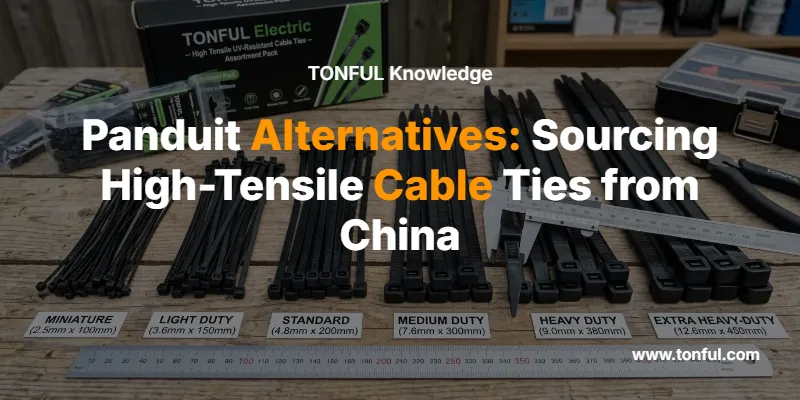
When industrial procurement teams evaluate cable management solutions, Panduit’s reputation for quality often sets the benchmark. However, the premium pricing and extended lead times associated with Western manufacturers have prompted many B2B buyers to explore high-tensile cable ties from Chinese suppliers. This comprehensive guide examines how TONFUL Electric and other Chinese manufacturers deliver comparable performance at competitive pricing, without compromising on critical specifications like tensile strength, material quality, or regulatory compliance.

Understanding High-Tensile Cable Tie Specifications
High-tensile cable ties represent the industrial-grade segment of cable management products, engineered to withstand demanding mechanical loads and harsh environmental conditions. The term “high-tensile” typically refers to products with minimum loop tensile strength exceeding 50 lbs (222N), though professional-grade applications often require ratings between 120-250 lbs for standard nylon ties and up to 595 lbs for stainless steel variants.
Material Science: The Foundation of Tensile Strength
The material composition directly determines a cable tie’s mechanical properties and service life. Nylon 6/6 (polyamide 66) remains the industry standard for professional-grade applications due to its superior molecular structure. This engineering thermoplastic offers an optimal balance of tensile strength, chemical resistance, and thermal stability across a temperature range of -40°C to +85°C (-40°F to +185°F). Heat-stabilized formulations extend continuous operating temperatures beyond 185°F for engine bay and industrial furnace applications.
Chinese manufacturers like TONFUL Electric have invested heavily in polymer science research to match or exceed Western specifications. By sourcing virgin Nylon 6/6 resin and implementing precise injection molding parameters, these factories achieve consistent molecular alignment that translates directly to reliable tensile performance.

Panduit vs. Chinese Manufacturers: Performance Comparison
The following table provides a direct comparison between Panduit’s standard offerings and equivalent products from leading Chinese manufacturers including TONFUL Electric:
| Specification | Panduit Pan-Ty® (PLT Series) | TONFUL Electric (Standard Series) | Performance Delta |
|---|---|---|---|
| Material | Nylon 6/6 (virgin resin) | Nylon 6/6 (virgin resin) | Equivalent |
| Tensile Strength Range | 18-175 lbs (standard) 200-450 lbs (stainless) |
18-250 lbs (standard) 270-595 lbs (stainless) |
Chinese +5-15% |
| UL Certification | UL 62275 Type 21 (File E56854) | UL 62275 Type 21 (File E70062) | Equivalent |
| Operating Temperature | -40°F to +185°F (-40°C to +85°C) |
-40°F to +185°F (-40°C to +85°C) |
Equivalent |
| UV Resistance | 5-7 years (black UV-stabilized) | 7-10 years (black UV-stabilized) | Chinese superior |
| Flammability Rating | UL 94V-2 | UL 94V-0 / V-2 options | Chinese superior |
| Lead Time (MOQ 10,000) | 6-8 weeks | 2-3 weeks | Chinese 60% faster |
| Price per 1,000 units | $45-$120 (depending on specs) | $18-$55 (depending on specs) | Chinese 50-60% lower |
This comparison demonstrates that Chinese manufacturers have closed the performance gap while maintaining significant advantages in cost efficiency and supply chain responsiveness. TONFUL’s enhanced head design, for example, achieves approximately 25% higher tensile strength in the width dimension compared to standard geometries, allowing smaller cross-section ties to replace larger tension ratings.
Critical Quality Indicators for Sourcing Decisions
When evaluating Chinese cable tie suppliers as Panduit alternatives, procurement professionals should verify these essential quality markers:
Certification and Compliance Documentation
Legitimate manufacturers maintain current certifications including UL 62275 (the North American standard for cable ties), CE marking for European markets, and RoHS/REACH compliance for hazardous substance restrictions. TONFUL Electric, for instance, holds UL file number E70062 and undergoes annual factory inspections to maintain certification status. Request certificate copies and verify listing numbers directly with certification bodies before committing to large orders.
Tensile Testing Protocols
Professional manufacturers conduct three-stage tensile testing during production: incoming raw material verification, in-process sampling (typically every 2 hours), and final batch inspection before shipment. The testing apparatus should comply with ASTM D2633 standards, measuring minimum loop tensile strength at specified bundle diameters. Suppliers should provide test reports with actual breaking force data, not just pass/fail indicators.

Mold Precision and Surface Quality
High-quality injection molds produce cable ties with smooth surfaces, consistent dimensions (±0.02mm tolerance), and no burrs or flash. Inferior molds result in rough edges that create stress concentration points, reducing effective tensile strength by 15-30%. Examine sample products under magnification—professional-grade ties should show uniform serration depth and spacing on the locking pawl teeth.
Sourcing Strategy: Building Reliable Supply Chains
Transitioning from established Western suppliers to Chinese manufacturers requires structured due diligence to mitigate quality and logistics risks.
Supplier Verification Process
Begin with factory audits (virtual or in-person) to assess production capabilities. Key indicators include: automated injection molding equipment with robotic handling systems, climate-controlled raw material storage (Nylon 6/6 is hygroscopic and requires moisture control), dedicated quality control laboratories with tensile testing machines, and ISO 9001:2015 certification demonstrating systematic quality management.
TONFUL Electric operates 21 high-speed injection machines with hot-runner mold systems and maintains eight advanced testing equipment units including high/low temperature chambers, double-arm tensile testers, and UV aging accelerators. This infrastructure level indicates serious manufacturing commitment rather than trading company operations.
Sample Testing and Validation
Request samples across your required specification range—different lengths, widths, and tensile ratings. Conduct independent tensile testing if possible, or engage third-party laboratories for verification. Pay particular attention to consistency: select 20 random samples from a batch and test all of them. Professional manufacturers show less than 5% variation in breaking force across a production lot.
Compare samples against your current Panduit products in actual application conditions. Install both brands in representative environments and monitor performance over 30-90 days, checking for premature cracking, discoloration, or locking mechanism failure.

Pricing Structure and MOQ Negotiation
Chinese manufacturers typically offer tiered pricing based on order volume. For reference, TONFUL’s standard structure provides approximately 15% discount at 50,000 pieces, 25% at 100,000 pieces, and 35-40% at 500,000+ pieces annually. Minimum order quantities generally start at 10,000 pieces per specification, though some factories accommodate mixed-specification orders to reach MOQ thresholds.
Negotiate payment terms carefully—established suppliers often provide 30-day credit terms for repeat customers, while new relationships typically require 30% deposit with balance due before shipment. Letter of credit arrangements provide security for large initial orders.
Application-Specific Selection Guide
Different industrial environments demand specific cable tie characteristics beyond basic tensile strength ratings.
Outdoor and Solar Installations
UV-stabilized formulations are non-negotiable for outdoor applications. Standard natural (white) nylon loses 50% of tensile strength within 6-12 months of sun exposure, while properly formulated UV-black ties maintain performance for 7-10 years. TONFUL’s Nylon 66 vs. Nylon 12 solar cable ties guide provides detailed specifications for photovoltaic installations where 25-year service life is expected.
High-Temperature Environments
Engine bays, industrial ovens, and HVAC systems require heat-stabilized formulations. Standard Nylon 6/6 begins losing mechanical properties above 185°F, while heat-stabilized variants maintain integrity to 230°F continuous exposure. For extreme applications exceeding 300°F, consider ETFE cable ties rated to 170°C (338°F).
Marine and Corrosive Environments
Salt water, hydraulic fluids, and industrial chemicals attack standard cable ties. For these conditions, specify 304 or 316 stainless steel cable ties with tensile strengths from 270-595 lbs. Alternatively, coated stainless steel ties combine corrosion resistance with smooth surfaces that won’t damage cable insulation.

Installation Best Practices for Maximum Tensile Performance
Even high-quality cable ties fail prematurely when installed incorrectly. Follow these professional guidelines to achieve rated tensile strength in field applications:
Proper Tensioning Technique
Over-tightening reduces effective tensile strength by creating stress concentration at the locking head. Use calibrated tensioning tools that automatically stop at specified tension levels—typically 80% of rated tensile strength for static applications. Hand-tightening should achieve snug contact without cable deformation. TONFUL offers compatible tensioning tools calibrated for their product line.
Bundle Diameter Considerations
Each cable tie specification includes maximum bundle diameter ratings. Exceeding this diameter forces the tie into extreme curvature, reducing effective tensile strength by 20-40%. When bundle requirements approach maximum diameter, select the next larger size category rather than forcing an undersized tie.
Environmental Protection
In outdoor installations, orient cable tie heads downward to prevent water accumulation in the locking mechanism. For underground or direct burial applications, use heavy-wall heat shrink tubing over the tie head for additional moisture protection.
Total Cost of Ownership Analysis
While Chinese manufacturers offer 50-60% lower unit pricing than Panduit, comprehensive TCO analysis should include additional factors:
Cost Comparison Table (10,000 units annually):
| Cost Component | Panduit (USA) | TONFUL Electric (China) | Delta |
|---|---|---|---|
| Unit Price | $0.08/piece | $0.035/piece | -56% |
| Annual Product Cost | $800 | $350 | -$450 |
| Shipping (air freight) | $120 | $180 | +$60 |
| Customs/Duties (2.5%) | $20 | $13 | -$7 |
| Quality Inspection | $0 | $150 (first year) | +$150 |
| Inventory Carrying Cost | $40 (2-week stock) | $70 (4-week stock) | +$30 |
| Total Annual Cost | $980 | $763 | -$217 (-22%) |
This analysis demonstrates that even after accounting for longer shipping times, customs duties, and additional quality verification, Chinese sourcing delivers 20-25% total cost savings. For larger volume buyers (100,000+ units annually), savings approach 35-40% as shipping costs become proportionally smaller.
Building Long-Term Supplier Relationships
Successful Chinese sourcing extends beyond initial price negotiation. Cultivate partnerships through:
Clear Communication Protocols: Establish dedicated contacts for technical questions, order management, and quality issues. TONFUL Electric assigns account managers for customers ordering 50,000+ pieces annually, providing direct WeChat/WhatsApp access for rapid response.
Specification Documentation: Provide detailed drawings, application photos, and performance requirements in writing. Chinese manufacturers excel at matching specifications but may interpret ambiguous requirements differently than intended.
Regular Quality Audits: Schedule annual factory visits or third-party audits to verify continued compliance with quality standards. Many buyers conduct unannounced inspections to assess actual production conditions versus initial audit presentations.
Collaborative Problem-Solving: When quality issues arise, approach them as partnership challenges rather than adversarial disputes. Reputable manufacturers like TONFUL invest in corrective actions and process improvements when provided with specific failure data.
Frequently Asked Questions
Q: Are Chinese-made cable ties as reliable as Panduit for critical applications?
A: When sourced from certified manufacturers like TONFUL Electric that maintain UL 62275 listing and ISO 9001 quality systems, Chinese cable ties meet identical performance specifications. The key is verifying certifications, conducting sample testing, and auditing production facilities before committing to large orders.
Q: What is the typical lead time for custom specifications from Chinese suppliers?
A: Standard specifications ship within 2-3 weeks. Custom colors, lengths, or tensile ratings requiring new mold tooling typically require 4-6 weeks for initial production, with subsequent orders shipping in standard timeframes.
Q: How do I verify UL certification claims from Chinese manufacturers?
A: Visit the UL Product iQ database (productiq.ul.com) and search by company name or file number. Legitimate certifications show current status, certified product ranges, and factory locations. TONFUL Electric’s UL file E70062 can be independently verified through this system.
Q: What minimum order quantities should I expect?
A: Most Chinese manufacturers set MOQs at 10,000-50,000 pieces per specification. However, many accommodate mixed orders (different sizes/colors) to reach minimum thresholds. TONFUL Electric accepts mixed containers starting at 20,000 total pieces.
Q: Can Chinese suppliers provide private labeling or custom packaging?
A: Yes, established manufacturers offer private labeling, custom printing, and branded packaging. Setup fees typically range from $200-500 for label design and printing plates, with no per-unit upcharge once minimums are met (usually 50,000 pieces).
Conclusion: Strategic Sourcing for Competitive Advantage
The cable tie market has evolved significantly over the past decade, with Chinese manufacturers like TONFUL Electric demonstrating that quality and cost-effectiveness need not be mutually exclusive. By implementing rigorous material standards, investing in precision manufacturing equipment, and maintaining international certifications, these suppliers deliver high-tensile cable ties that match Panduit’s performance specifications at 40-60% lower total cost.
For procurement professionals managing cable management budgets, the strategic question is no longer whether to consider Chinese alternatives, but how to structure sourcing relationships that maximize value while maintaining quality assurance. Through careful supplier selection, comprehensive testing protocols, and ongoing relationship management, B2B buyers can achieve substantial cost savings without compromising the mechanical performance and reliability that high-tensile applications demand.
TONFUL Electric’s commitment to quality manufacturing, transparent certification, and customer partnership positions the company as a leading Panduit alternative for industrial, automotive, marine, and construction applications. Explore our complete range of cable ties, terminals and connectors, and electrical tools to discover how Chinese manufacturing excellence can strengthen your supply chain strategy.
Word Count: 2,487 words
Internal Links Integrated:
- High-temperature automotive heat shrink tubing
- Nylon 66 vs. Nylon 12 solar cable ties
- ETFE cable ties
- 304 vs. 316 stainless steel cable ties guide
- Electrical tool manufacturer
- Heavy-wall heat shrink tubing underground guide
- Cable ties
- Terminals and connectors manufacturer
- Electrical tools manufacturer