
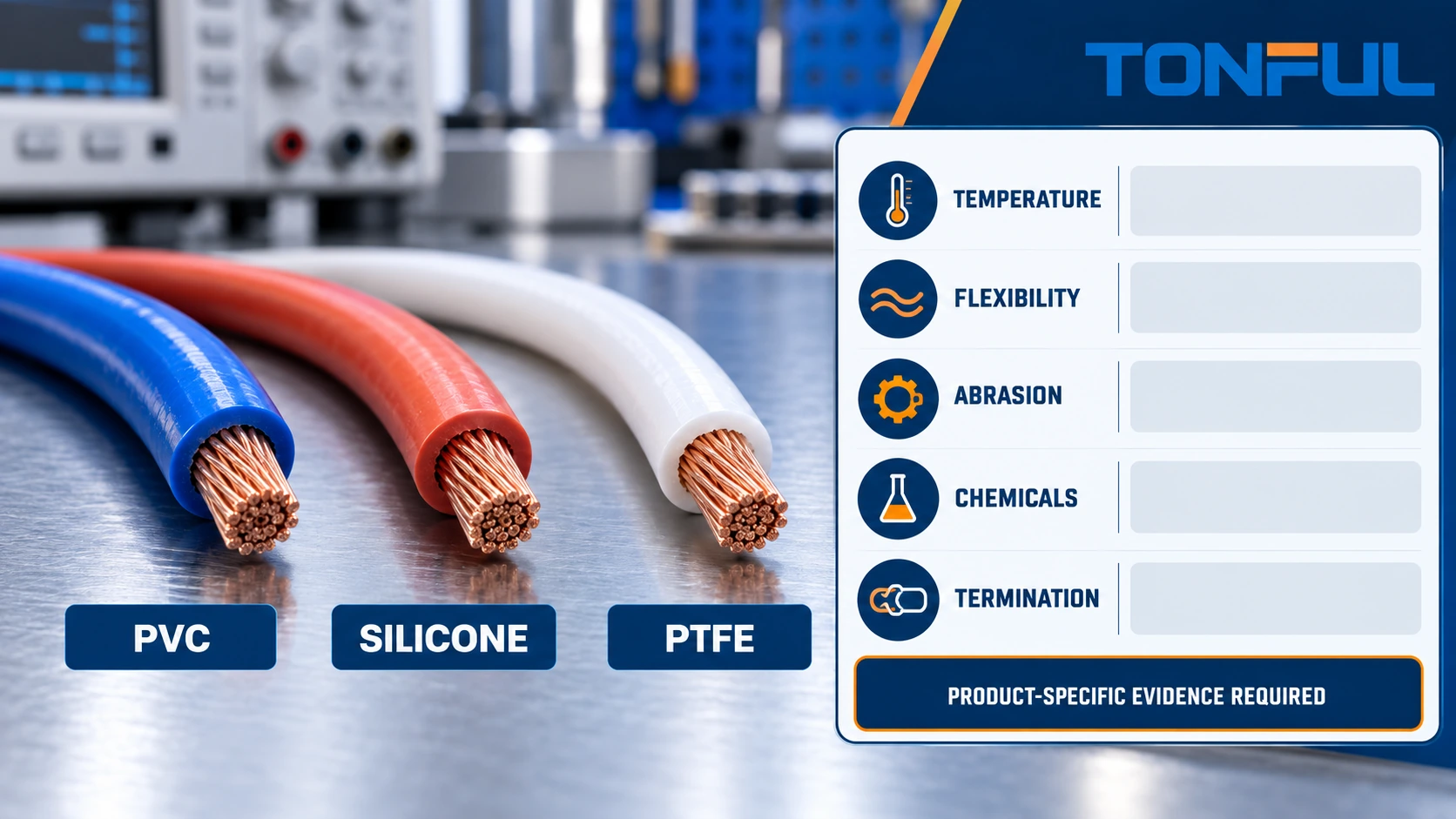
PVC, silicone and PTFE are insulation families, not complete wire specifications. Each can be useful in a custom harness, but the polymer name alone does not establish conductor size, strand construction, wall thickness, outside diameter, voltage rating, temperature range, flame performance, chemical resistance or approval. Those properties belong to an exact wire product and its controlled documentation.
The practical choice affects more than service temperature. It changes harness flexibility, routing space, abrasion protection, stripping behavior, crimp setup, seal compatibility, marking, inspection and cost. A high-temperature material can still be wrong if it is difficult to retain in a connector seal, vulnerable to local abrasion or incompatible with the approved termination. A lower-cost PVC construction can be entirely appropriate when the verified environment is moderate and the assembly controls are sound.
This guide compares the three families as engineering starting points. It does not assign universal ratings to every formulation. Use the released harness drawing, wire-manufacturer data, connector application specification and project validation plan to approve the exact construction.
Quick Comparison: PVC, Silicone and PTFE Wire
| Decision area | PVC starting point | Silicone starting point | PTFE starting point | Evidence required for release |
|---|---|---|---|---|
| Temperature | Broad general-purpose availability; exact range varies | Often selected for elevated heat and flexibility | Often selected for high heat and electrical/chemical performance | Exact wire datasheet, style/specification and derating basis |
| Flexibility | Depends on compound, wall and stranding | Commonly very flexible | Depends strongly on wall and conductor construction | Minimum bend requirement and installed-route sample |
| Abrasion/cut-through | Can be suitable with correct protection | Soft surface may need added mechanical protection | Thin-wall constructions can save space but require routing control | Abrasion, pinch and edge-contact assessment |
| Fluids/chemicals | Compound-specific | Fluid response is formulation-specific | Often considered for broad chemical resistance | Chemical list, concentration, temperature, exposure method and result |
| Termination | Familiar processing for many harness lines | Soft insulation can deform under clamps or seals | Stripping and crimp support require controlled setup | Terminal specification, strip window, crimp data and cross-sections |
| Cost/supply | Often favorable and widely available | Typically higher than basic PVC | Typically a premium option | Approved manufacturer, lead time, MOQ and change control |
Alpha Wire’s hook-up wire catalog demonstrates why family names are insufficient: its catalog includes different PVC, silicone and PTFE constructions with different standards, conductor ranges and published ratings. These values describe the listed products, not every wire made from the same polymer.
Define the Harness Environment Before Choosing Insulation
Start with a route-level exposure map. Record the normal and abnormal temperature at each branch, including hot surfaces, enclosed spaces, current-related conductor heating and nearby heaters. Separate continuous operation, short excursions, storage and assembly-process temperatures. Do not compare one supplier’s continuous rating with another supplier’s short-duration value.
Document motion and mechanical contact. Is the harness static, adjusted during service or continuously flexed? Will it touch sheet-metal edges, castings, cable ties, clamps or corrugated conduit? Identify bend radius, unsupported length, vibration, installation pull and maintenance access. TONFUL’s continuous-flex harness guide explains that flex performance depends on the complete conductor, insulation, cable construction and routing system rather than insulation softness alone.
List actual fluids and contaminants: oil, fuel, coolant, cleaning agent, disinfectant, salt, condensation, process chemical or plasticizer-containing material. Include concentration, temperature, immersion or splash, duration and repeated cycles. “Chemical resistant” is not a complete requirement. Outdoor and marine routes also require ultraviolet, moisture, salt and sealing decisions; the TONFUL marine harness guide places wire choice inside the full sealed-assembly system.
PVC Wire: Practical, Diverse and Product-Specific
PVC is widely used because suppliers offer many conductor sizes, colors, wall constructions and recognized styles at commercially practical cost. Depending on the exact compound and construction, PVC wire may provide useful flame behavior, abrasion resistance, printability and processing familiarity. Those advantages make it a strong candidate for appliances, controls and general internal wiring when the approved environment fits the selected product.
Its diversity is also the main specification risk. “PVC wire” can refer to flexible or semi-rigid compounds, different wall thicknesses, different temperature classes and different oil, moisture or flame claims. A buyer should therefore request the manufacturer, product family, part number, conductor stranding, insulation designation, outside diameter, color and applicable style or standard. The TONFUL custom automotive harness guide shows why heat zones and packaging space should be mapped before selecting any construction.
PVC may be unattractive where the verified route exceeds the product’s thermal capability, where low-temperature flex is critical, or where a specified fluid attacks the compound. Do not solve those concerns simply by writing “high-temperature PVC.” Require the exact evidence and test boundary.
Silicone Wire: Flexibility With Mechanical-Control Needs
Silicone-insulated wire is frequently considered for elevated temperature, flexible routing and applications where a soft, compliant lead is useful. The complete construction still matters: conductor stranding, insulation formulation, wall, braid or jacket, and any approval determine actual performance. Silicone should not be selected only because an operator likes its hand feel.
The soft insulation can change manufacturing behavior. Clamps, cable ties and strain-relief features may indent the surface if force and contact area are not controlled. Sharp edges or repeated rubbing can create local damage. A seal designed around a different outside diameter or surface may not grip or seal correctly. Route samples should therefore be checked after installation, vibration or flex conditioning as applicable, with particular attention to clamp marks, migration, cuts and connector wire-entry support.
Stripping requires a defined tool and blade condition so strands are not nicked and the soft insulation is not stretched into an inconsistent strip length. At the terminal, verify conductor-brush position, insulation support and crimp geometry using the terminal manufacturer’s application specification. Pull testing and cross-sectioning should follow the approved plan; do not copy a force or crimp height from a different wire construction.
PTFE Wire: High-Performance Potential With Processing Tradeoffs
PTFE is often evaluated for high-temperature, chemical and electrical performance, and thin-wall constructions can help in dense routing. It is not automatically the best wire for every harsh environment. Exact product construction, mechanical exposure, termination system, cost and production capability remain decisive.
PTFE can require specialized stripping controls. The process must remove insulation cleanly without scoring the conductor, leaving strands, pulling the insulation or creating an unacceptable edge. Tool choice, setup, maintenance and inspection should be documented by wire size and product. A process proven on PVC cannot be assumed valid for PTFE.
Connector compatibility is equally important. TE Connectivity’s MTA-156 application specification lists particular approved wire constructions and explicitly notes that selected wire should be evaluated before final application approval. That principle extends beyond one connector family: insulation material, wall, hardness, stranding and outside diameter interact with contact termination and housing support.
PTFE may also influence marking, bundling and routing. Confirm that identification remains legible, that ties or clamps do not allow sliding or concentrated pressure, and that bend or edge contact does not create cold-flow or mechanical damage concerns. Where extra protection is required, verify that tubing, braid or conduit is compatible with the wire and does not trap damaging heat or chemicals.

Compare the Finished Wire, Not an Idealized Polymer
Two products using the same insulation family can behave differently because of formulation, wall thickness, conductor stranding and manufacturing process. Build a controlled candidate table before samples are ordered.
| Record field | Candidate A | Candidate B | Candidate C |
|---|---|---|---|
| Manufacturer/product/part number | |||
| Conductor size, material and stranding | |||
| Insulation family and construction | |||
| Nominal/minimum wall and outside diameter | |||
| Published temperature and voltage scope | |||
| Flame, fluid, UV or other classifications | |||
| Bend/flex and abrasion evidence | |||
| Connector seal and terminal compatibility | |||
| Approved strip and crimp process | |||
| Source document, revision and date |
The TONFUL heat-shrink material guide is useful when adding local protection, but tubing material cannot compensate for an unsuitable primary wire. Confirm recovery temperature, installed wall, adhesive behavior and compatibility with the selected insulation.
Validate Termination and Harness Manufacturing
Run production-intent samples with the actual wire, terminals, seals, connectors and tools. First verify incoming identity: reel label, lot, conductor construction, insulation OD, color and certification markings where applicable. Keep the wire manufacturer’s certificate or controlled data linked to the lot rather than relying on a generic sales page.
Set stripping by wire and equipment. Record strip length, exposed conductor condition, insulation edge and tool identification. For crimped contacts, retain the applicator, die or hand-tool identification, setup approval, crimp-height results where specified, pull-test evidence, cross-sections when required and terminal insertion/retention checks. TONFUL’s crimp pull-force testing guide explains why test setup, failure mode and acceptance source must be recorded rather than reporting a force without context.
Then inspect the assembled route. Confirm branch length, bend control, clamp contact, tie tension, seal compression, backshell fit and service movement. If overmolding, potting, adhesive or heat processing is used, verify that the process does not distort insulation, move conductor strands, degrade a seal or exceed an approved temperature boundary.

Build a Product-Specific Qualification Plan
Qualification should reproduce the risks defined by the application, not apply every available test. Depending on the project, the plan may include thermal aging or cycling, cold bend, flexing, vibration, abrasion, fluid exposure, humidity, dielectric tests, continuity, pull/retention, seal testing and post-conditioning inspection. Specify sample identity, quantity, allocation, conditioning sequence, fixtures, measurements, acceptance criteria, destructive-analysis samples and invalid-test rules.
Do not use one set of samples indefinitely without considering sequence effects. Establish whether tests use independent sample groups, sequential conditioning or an unaged control. A harsh chemical exposure followed by flexing may be purposeful, while another plan may need isolated causes. Record failures as evidence: crack location, insulation deformation, conductor damage, seal leakage, contact movement, resistance change or dielectric failure.

Selection Rules for Buyers and Engineers
Choose PVC when an exact product meets the route’s thermal, mechanical, fluid, flame and regulatory requirements and offers the preferred processing and commercial balance. Choose silicone when the verified need favors its construction’s flexibility or temperature capability and the harness design controls abrasion, clamping, sealing and termination. Choose PTFE when its exact product evidence and performance justify the cost and specialized manufacturing controls.
Do not mix materials casually within one harness. If different zones justify different wires, define every transition, splice, identification rule and inspection point. Purchasing substitutions require engineering review because a “same gauge, same color” wire can change OD, strand count, crimp setup, seal compression, flexibility and approval scope.
The release record should identify the approved manufacturer and part number, acceptable alternates, drawing revision, qualification evidence, manufacturing parameters, incoming checks and change-notification requirements. If any field remains unknown, mark it unresolved rather than converting a family-level assumption into a product claim.
Specify Custom Harness Wire With TONFUL
Send TONFUL the circuit schedule, route and temperature map, fluid/chemical list, movement and abrasion conditions, connector and terminal specifications, applicable wire styles or standards, qualification plan and traceability requirements. TONFUL can review production-intent wire options, termination compatibility, harness protection and inspection records against the released project requirements. Final ratings and approvals remain tied to the selected wire, connector system and completed assembly evidence.