
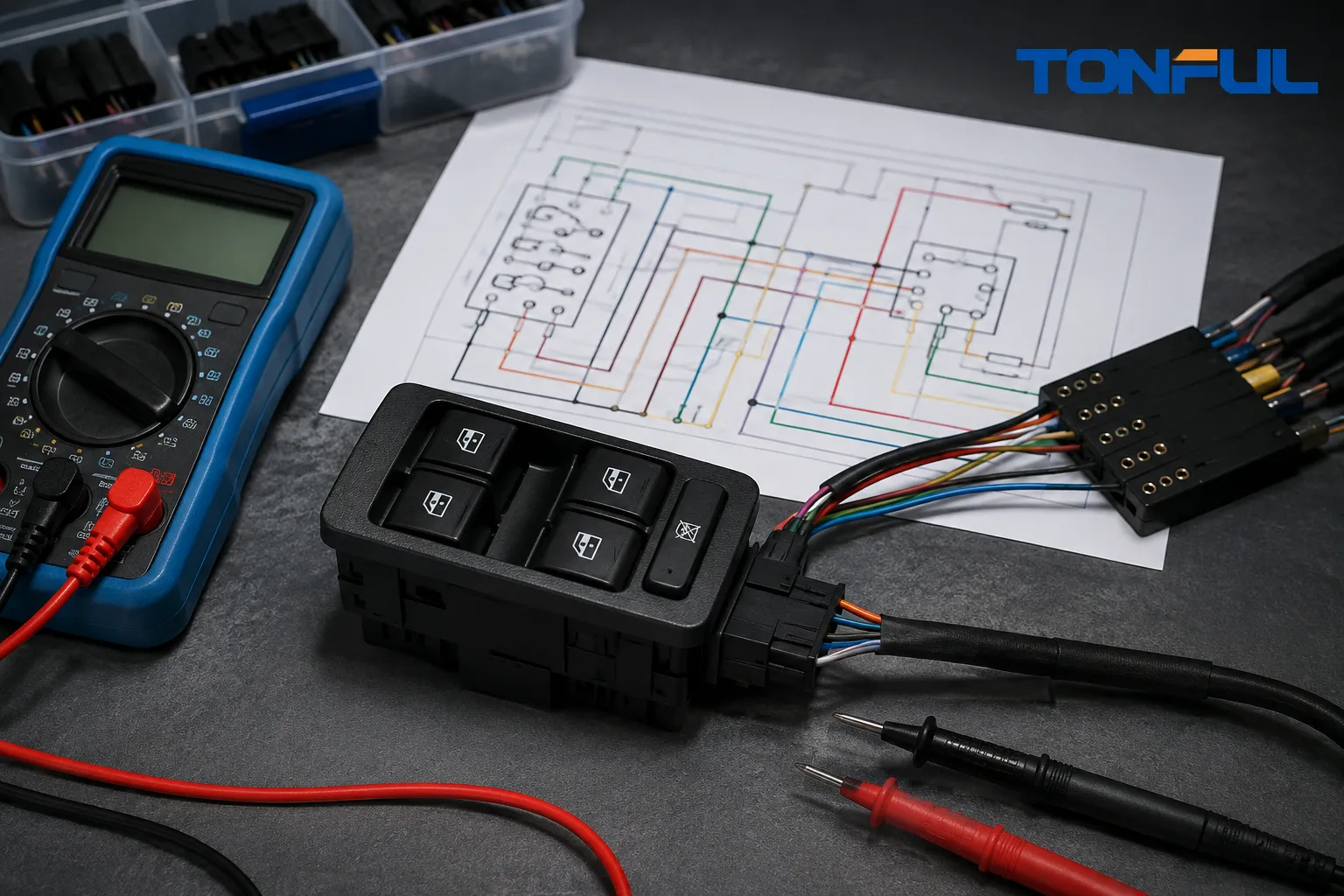
Bad power window switch symptoms can include a window that responds from one control but not another, intermittent operation, a sticking rocker, or missing lock and one-touch functions. None of these symptoms proves the switch is defective. A fuse, power or ground circuit, connector, flex harness, door module, motor, regulator, glass alignment, or lost initialization can produce similar behavior.
Use symptoms to choose the next test, not the replacement part. Record exactly which window, direction, control, ignition condition, door position, temperature, and feature fail. Then compare switch inputs and outputs with the wiring diagram and service procedure for the vehicle.
Symptoms Are Clues, Not Confirmation

Conceptual symptom matrix—symptoms guide diagnosis but do not confirm the failed part.
| Symptom | Switch-related possibility | Other important possibilities |
|---|---|---|
| One window fails from one control only | One rocker/contact/signal channel | Local switch, lockout logic, connector, harness, module |
| Window works intermittently | Worn/contaminated contact, PCB or connector | Door-flex wiring, terminal fit, motor dead spot, mechanical bind |
| Rocker is loose, sticky, or will not return | Mechanical switch damage or contamination | Trim interference or external liquid/debris |
| Auto, lock, or illumination function is missing | Master-switch channel, LED, logic or resistor path | Initialization, module coding, network, supply or ground |
| Multiple windows fail | Master supply, ground, lockout or module | Fuse, relay, body controller, network or retained-power logic |
1. One Window Works from the Local Switch but Not the Master
Observable symptom: The passenger or rear window operates from its own door but does not respond to the corresponding driver master rocker, possibly in one or both directions.
Evidence to collect: Record every master and local command, window-lock position, scan data where available, master-switch connector condition, and vehicle-specific output or signal for the failed position.
Immediate action: Avoid replacing the motor or regulator solely because the master command fails; local operation proves that at least part of the downstream system can work.
Confirmation: Verify the master switch receives correct supply, ground, and communication, then compare the failed channel with the specified output, resistance, or scan state. Inspect wiring between master, module, and target door. A missing master output with correct inputs supports a switch/module fault, but the service architecture decides which assembly is responsible.
2. One Direction Works but the Other Does Not
Observable symptom: The glass moves down but not up, or up but not down, from one or more controls.
Evidence to collect: Compare both directions from every relevant switch. Record motor command polarity or module command, connector voltage drop where specified, motor sound, current if required, and glass movement.
Immediate action: If the glass will not close, protect the vehicle from weather and unauthorized access without forcing the mechanism or bypassing protection.
Confirmation: A direct-control switch may have separate contact paths for each direction, but broken wiring, relay/module output, motor brush position, regulator load, or anti-pinch logic can also block one direction. Verify command at the switch and motor before assigning cause.
3. The Window Works Intermittently
Observable symptom: Operation changes with door movement, vibration, temperature, repeated rocker movement, or time.
Evidence to collect: Preserve the exact door angle and conditions that trigger the fault. Photograph connectors before disturbing them. Inspect terminals, liquid residue, corrosion, harness flex points, and heat discoloration. Record switch input/output and motor command during the failure, not only after normal operation returns.
Immediate action: Do not clean, bend terminals, or repeatedly disconnect the harness before capturing evidence. Those actions can temporarily restore contact and erase the cause.
Confirmation: If moving the door or harness changes the fault while the switch remains untouched, prioritize the flex harness and terminal fit. If controlled rocker movement changes an otherwise stable output, evaluate switch contacts, PCB, or mechanical actuation. A motor dead spot or regulator bind may require separate load and movement checks.
4. The Rocker Feels Loose, Sticky, or Inconsistent
Observable symptom: The button has excessive free play, binds, fails to return, lacks a manual/auto detent, or requires unusual direction or force.
Evidence to collect: Compare all rockers and an approved sample. Inspect trim interference, cracks, contamination, spilled liquid, spring return, alignment, travel, and actuation-force data if the specification defines it.
Immediate action: Stop using a control that sticks in the closing direction or causes unintended movement. Follow vehicle safety procedures.
Confirmation: Remove trim only as specified and determine whether the bezel or contamination causes binding. If the switch mechanism remains defective outside the trim and electrical behavior fails in the same position, replacement may be justified. Do not apply universal tactile-force values; use the approved drawing or service standard.
5. Auto-Up, Auto-Down, or Anti-Pinch Behavior Is Lost
Observable symptom: Manual operation remains but one-touch movement is unavailable, reverses unexpectedly, or stops early.
Evidence to collect: Check battery history, recent motor/regulator work, initialization status, DTCs, glass travel, seals, mechanical drag, position data, and operation from all controls.
Immediate action: Do not defeat obstruction protection or repeatedly force the glass through a bind.
Confirmation: Many systems require initialization after power loss or component service, and some integrate sensing or control in the motor/module rather than the rocker. Perform the vehicle-specific initialization and diagnostic sequence before replacing the switch. The official eCFR 49 CFR §571.118 addresses operation and obstruction-related safeguards for covered vehicles; compliance is a vehicle-system matter, not a diagnosis based on one component.
6. Window Lock or Other Integrated Functions Fail
Observable symptom: Passenger controls remain disabled, lockout will not engage, illumination is absent, or integrated lock/mirror functions fail while some window functions remain.
Evidence to collect: Map every master-switch function, supply, ground, illumination feed, module state, and network/DTC result. Compare failure groups because shared circuits can explain several missing features.
Immediate action: Use alternative controls only if the service information and vehicle condition permit safe operation.
Confirmation: A failed master channel is possible, but coding, network communication, shared ground, connector terminals, or a door module can affect integrated functions. Verify each function matrix instead of treating the assembly as one on/off device. TONFUL’s Power Window Switch Manufacturer product page presents current vehicle applications and OE reference numbers; the exact architecture and functions must still be confirmed for the proposed switch.
7. Multiple or All Windows Stop Working
Observable symptom: Several windows fail at once, sometimes with other door functions.
Evidence to collect: Check ignition and retained-accessory-power states, circuit protection, main switch supply and ground, window lock, body/door module communication, DTCs, and recent battery or electrical work.
Immediate action: Avoid ordering several motors or regulators. A shared failure deserves priority.
Confirmation: Verify common power, ground, fuse, relay, module, and network paths before the master switch. A single mechanical regulator cannot normally explain a simultaneous multi-window failure. If common inputs are correct but the master module fails to communicate or issue commands, follow the specified module/switch replacement and programming process.
8. The Switch or Connector Becomes Hot, Discolored, or Smells Burned
Observable symptom: Heat, softened plastic, odor, darkened terminals, or intermittent operation appears around the switch connector.
Evidence to collect: Preserve connector photos, terminal retention, mating force, current/load data where specified, contact voltage drop, corrosion, contamination, and regulator/motor mechanical load.
Immediate action: Stop operation and isolate the circuit according to service instructions. Heat damage can progress beyond the switch.
Confirmation: High resistance at a loose/corroded terminal and excessive downstream current can both create heat. Replacing only the switch while retaining damaged mating terminals or a binding regulator can cause recurrence. TONFUL’s terminal push-out-force guide helps explain why secure terminal retention matters.
9. The Window Moves Slowly, Tilts, Clicks, or Makes Grinding Noise
Observable symptom: Glass movement is slow or uneven, or the door contains cable, clicking, scraping, or grinding sounds.
Evidence to collect: Record motor sound, current or voltage drop if specified, glass alignment, rail and cable condition, movement by direction and position, temperature, and seal drag.
Immediate action: Stop cycling a tilted or binding pane to prevent glass, regulator, and motor damage.
Confirmation: These symptoms usually strengthen the case for motor, regulator, glass, or supply-path diagnosis rather than the switch alone. Confirm that the switch produces the correct command, then inspect mechanical load. The Power Window Switch vs Motor vs Regulator fault guide provides the component-level comparison needed before choosing a replacement part.
Evidence-Based Diagnostic Order

Conceptual diagnostic flow—follow vehicle service information.
- Record which windows, controls, directions, and features fail, including operating conditions.
- Review system architecture, DTCs, initialization, technical bulletins, and safety procedures.
- Verify fuses, circuit protection, switch/module power, ground, and communication.
- Inspect the switch, trim, connector, terminals, moisture, and door-flex harness.
- Measure vehicle-specific switch inputs and outputs or scan states.
- Confirm the command at the motor and inspect motor/regulator/glass response.
- Identify root cause, repair every affected mating component, initialize as required, and retest all functions.
The NHTSA-hosted Toyota master-switch inspection procedure demonstrates controlled meter zeroing, defined measurement points, and switch-by-switch inspection. It is evidence for method discipline, not a universal pinout. Follow TONFUL’s How to Test a Power Window Switch for a structured diagnostic record, while the automotive contact-resistance guide explains product-level resistance evidence.
When Replacement Is Justified
Replace the switch only after confirming correct required inputs and a repeatable failure of its specified mechanical or electrical output. Match vehicle, market, model year, trim, door position, steering configuration, OE supersession, housing, mounting, connector keying, populated cavities, pinout, functions, illumination, resistance coding, communication, and programming needs.
For sourcing, request controlled drawings, application data, approved samples, function matrices, test reports, lot traceability, packaging, warranty handling, and change notification. The Power Window Switch Buying Guide explains the fitment and purchasing evidence that should accompany an inquiry.
TONFUL’s power window switch range presents current vehicle applications and OE reference numbers. Confirm the exact vehicle, OE reference, connector, pinout, functions, approved sample, and project-specific validation plan before ordering.
Share the vehicle application, OE number, connector, pinout source, symptoms, DTCs, measurements, photos, forecast, and validation requirements with TONFUL for feasibility review. Do not replace a switch simply because the symptom sounds familiar.
Related TONFUL Automotive Guides
- Use How to Test a Power Window Switch for the detailed circuit, connector, measurement, and test-record workflow.
- Review the Power Window Switch vs Motor vs Regulator fault guide before selecting the failed component.
- Consult the Power Window Switch Buying Guide when checking OE references, connectors, functions, and fitment evidence.
- View the Power Window Switch Manufacturer product page for current vehicle applications and OE reference numbers.
- Read Automotive Combination Switch Contact Resistance Testing for controlled low-resistance measurement principles.
- Use the Automotive PCB Connectors Guide when connector construction or electronic architecture affects the diagnosis.
- Compare PA66 vs ABS Automotive Connector Materials when heat damage, deformation, or housing material is under review.