
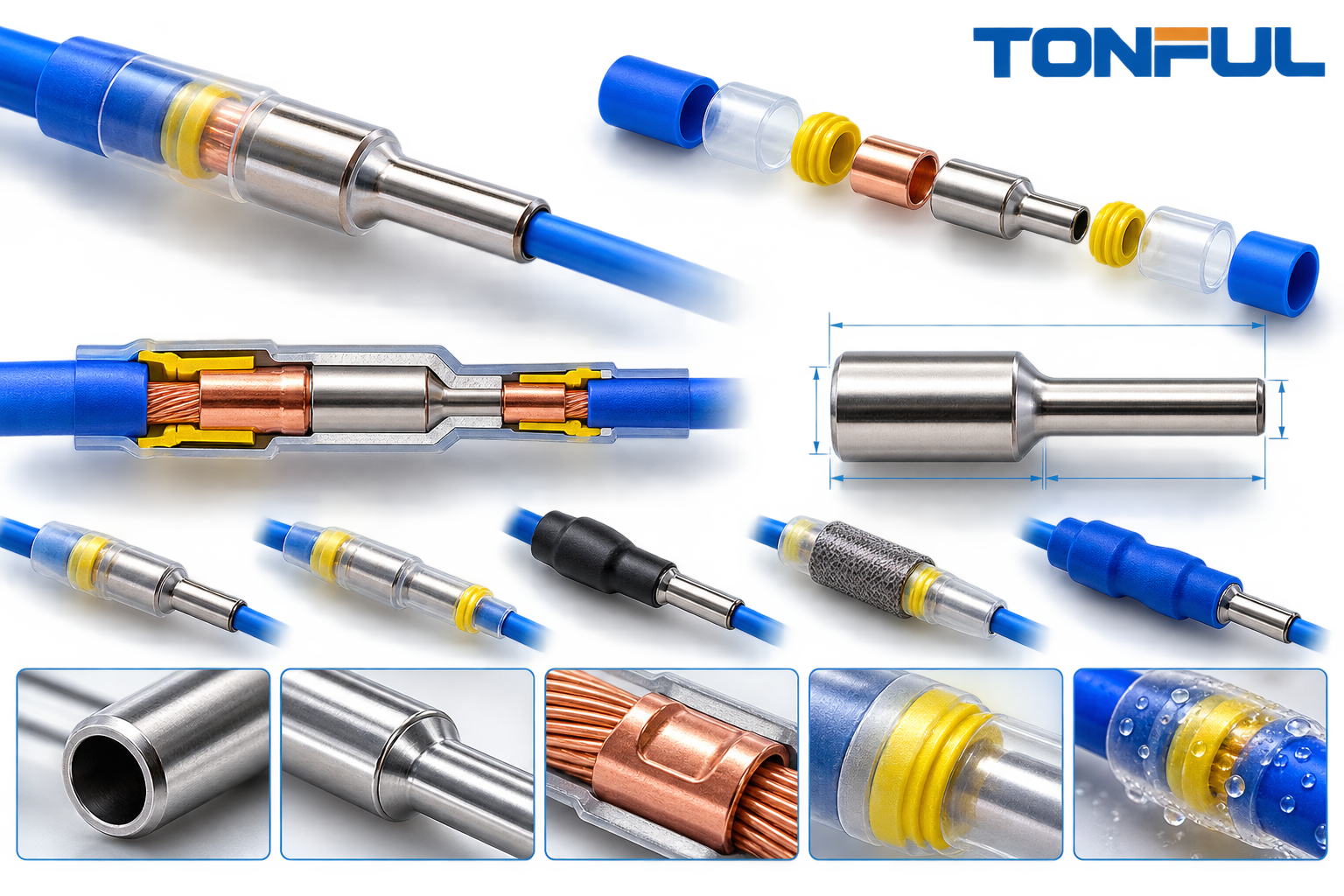
A custom step-down butt connector project begins with a validated wire pair, not a preferred color or catalog photo. The large barrel, small barrel, insulation system, crimp tooling, application environment, sample plan, order quantity, and packaging all influence cost and feasibility.
The purpose of customization is not simply to place two different barrel diameters in one sleeve. It is to create a controlled connection system in which the connector, both conductors, stripping process, dies, inspection method, packaging, and change rules work together. This guide shows what an OEM or distributor should define before asking for samples or a quotation.
Define the AWG Combination
Provide both wire specifications:
- AWG or actual conductor area
- Conductor material and plating
- Strand count and construction
- Insulation material and outside diameter
- Operating environment and temperature requirement
- Strip length constraints
- Single-wire or multi-wire insertion on each end
Use TONFUL’s AWG-to-metric selection guide for conversion context, but validate real wire samples.
Nominal AWG or mm² alone is insufficient. Two wires with the same nominal area can differ in strand diameter, strand count, conductor plating, compaction, and insulation outside diameter. Those differences affect insertion, strand capture, compression, sealing, and tool selection. Attach manufacturer wire datasheets and representative production samples. If either side accepts multiple conductors, identify every conductor and calculate the equivalent wire size under the governing specification rather than assuming that two wires fit because they enter the barrel.
Create a wire-pair matrix before design starts:
| Input | Large end | Small end | Why it matters |
|---|---|---|---|
| Conductor size and tolerance | Buyer entry | Buyer entry | Establishes required metal capacity |
| Material and plating | Buyer entry | Buyer entry | Influences deformation and compatibility |
| Strand construction | Buyer entry | Buyer entry | Affects compaction and strand capture |
| Insulation OD and material | Buyer entry | Buyer entry | Controls entry, support, and seal geometry |
| Strip-length window | Buyer entry | Buyer entry | Prevents exposed conductor or incomplete insertion |
| Single or multiple wires | Buyer entry | Buyer entry | Changes effective wire-size evaluation |
Choose the Connector Architecture

Decide whether the project needs an uninsulated barrel, nylon or vinyl insulation, heat-shrink insulation, adhesive sealing, or another customer-approved construction. Confirm the center stop, insertion depth, barrel overlap, overall length, and marking needs.
TONFUL’s comparison of PVC and nylon insulated terminals and guide to heat-shrink terminals help frame material choices.
Architecture decisions should be converted into drawing requirements. Define conductor-barrel length, inside diameter, wall thickness, transition geometry, center stop, bellmouth or entry condition, seam construction, overall length, insulation support, and acceptable burr direction. For sealed versions, identify tubing material, recovered dimensions, adhesive coverage, installation method, and environmental validation. A request for “waterproof” is incomplete unless the buyer defines the applicable exposure and acceptance test.
Material choices also need evidence. State the base metal, temper or applicable material specification, plating material and thickness requirement, insulation resin, color tolerance, flame or chemical requirements where applicable, and restricted-substance documentation. Require approval before a supplier changes raw-material source, plating subcontractor, resin grade, adhesive, or manufacturing location.
Tooling Development
Custom geometry may require new forming tools, crimp dies, applicator parts, gauges, or inspection fixtures. Clarify ownership, maintenance, expected life, replacement responsibility, storage, and whether the customer can use existing field tools.
A reducing splice needs separate process evidence for each end. Ask for nominal crimp heights, tolerance development, pull-force results, resistance data, and cross-sections using the actual wires.
The Molex Quality Crimp Handbook is a useful public reference for crimp process measurement concepts.
Separate production tooling from customer application tooling. Forming dies create the connector; crimp dies install it. The quotation should identify which tools are new, who owns them, where they are stored, how revisions are controlled, expected maintenance responsibility, and what happens if a tool becomes damaged or obsolete. Do not accept an unsupported tooling-life number. Ask for the basis, maintenance triggers, wear measurements, and replacement plan.
For application tooling, record the tool, die, cavity, orientation, locator, and setting for each end. One die set may contain two validated cavities, or production may require two controlled operations. Either approach can work if mistake-proofing prevents the large and small ends from being processed with the wrong cavity. The work instruction should include strip length, insertion, crimp sequence, crimp-height measurement, visual criteria, sampling, and reaction to an out-of-limit result.
Samples and Validation
Use staged approval:
- Drawing review
- Material and color sample
- Connector dimensional sample
- Crimped samples using both wires
- Mechanical and electrical validation
- Environmental testing where required
- Packaging and label approval
- Pilot lot before mass production
The validation plan must identify the requirement source, sample quantity, conditioning, equipment, method, acceptance limit, and responsibility for every test. Dimensional inspection confirms the part matches the controlled drawing. Crimp-height studies and cross-sections help establish process windows. Pull testing evaluates mechanical retention, while four-wire resistance measurement may be appropriate when the qualification plan requires low-resistance evidence. Environmental testing should be selected from the real application, such as thermal exposure, temperature cycling, vibration, humidity, fluids, or corrosion; it is not automatically required in the same form for every project.
Record both ends independently. A pass on the large end cannot qualify the small end. Validation should use production-intent material, tooling, wire, operators, and settings. Define how failures, invalid tests, deviations, and retests are handled before testing begins. After design approval, retain approved samples and baseline measurements so later lots and changes can be compared with the qualified state.
Design Freeze and Change Control
Agree on the documents that constitute approval: drawing, bill of material, approved wire matrix, tooling list, work instruction, inspection plan, validation report, packaging specification, and signed sample approval. Revision identifiers must match across documents. A golden sample can aid communication, but it cannot replace dimensional and performance requirements.
Define notification and requalification rules for changes to geometry, tolerance, base metal, plating, insulation, adhesive, colorant, tooling, process parameters, factory, sub-supplier, inspection method, or packaging. The buyer should decide whether each proposed change needs document review, dimensional sampling, partial validation, or full requalification before shipment.
MOQ and Cost Drivers

MOQ depends on material purchasing, forming setup, insulation processing, color matching, printing, packaging, inspection, and changeover efficiency. Do not assume one universal MOQ. Ask the supplier to separate tooling, sample, unit, test, and packaging costs.
MOQ and price should be reviewed against the complete demand pattern. Provide prototype quantity, first production order, annual forecast, order frequency, expected growth, and service-part demand. Ask whether the quoted MOQ is driven by raw-material purchase, color batch, plating batch, machine setup, packaging print quantity, or commercial policy. This reveals which requirement could be adjusted without changing product performance.
Request a cost breakdown for one-time engineering, production tooling, application tooling, inspection fixtures, validation, samples, unit price, private-label packaging, freight, and future tool maintenance. Clarify Incoterm, currency, tax treatment, quote validity, payment terms, sample timing, production lead time, and capacity reservation. These are project-specific commercial fields; they should never be presented as universal Tonful values.
Packaging Options
Common B2B formats include bulk bags, counted inner bags, labeled cartons, compartment kits, and private-label retail packs. Define quantity tolerance, lot traceability, barcode, language, warning, date code, shelf-life information where relevant, and protection against barrel deformation.
TONFUL’s private-label packaging guide offers transferable packaging questions even though the product family differs.
Packaging approval should use a controlled artwork and pack specification. Include product number, revision, quantity, lot or date code, barcode format, country or language requirements, handling warnings, and shelf-life information only where supported. Define bag and carton materials, inner quantity, carton quantity, acceptable quantity tolerance, sealing method, and protection from bent barrels, damaged insulation, contamination, moisture, or mixed variants.
Run a label-to-product trace during the pilot lot. Select a finished package and trace it backward to inspection, machine, tooling, operator or shift, connector material, plating or insulation lot, and approved drawing. Then trace the same lot forward to every package and shipment. This exercise is more useful than simply asking whether the factory “has traceability.”
Custom Project Checklist
| Topic | Required decision |
|---|---|
| Wire pair | Complete large- and small-side wire specifications |
| Construction | Barrel, plating, insulation, seal, dimensions |
| Tooling | Production and customer crimp system |
| Validation | Height, pull, resistance, cross-section, environment |
| Commercial | Forecast, MOQ, tooling, lead time, incoterm |
| Packaging | Pack count, label, barcode, traceability |
| Changes | Notification and requalification rules |
Supplier Feasibility Response
A useful feasibility response should classify every buyer requirement as accepted, accepted with clarification, proposed alternative, or not feasible. It should list assumptions rather than burying them in a price. Any proposed alternative should explain its effect on geometry, tooling, validation, MOQ, price, lead time, and approval documents.
| Review gate | Required output | Release decision |
|---|---|---|
| Requirement review | Completed wire and application matrix | Inputs complete |
| Design review | Controlled drawing and material proposal | Design authorized for samples |
| Tooling review | Tool list, ownership, cavities, maintenance plan | Tool build authorized |
| Sample review | Dimensional and visual report | Validation authorized |
| Validation review | Approved results for both ends | Pilot production authorized |
| Pilot review | Capability, traceability, packaging evidence | Mass production authorized |
Do not release the next gate while critical inputs remain open. Record owners and due dates for every unresolved item. If a supplier proposes an existing standard part instead of a custom design, compare total installed performance and tooling compatibility before deciding; avoiding new tooling can be valuable only when the standard part genuinely meets the application.
Before nomination, apply TONFUL’s step-down butt connector manufacturer audit checklist to the proposed product, process, and production location.
Request a Feasibility Review
Send TONFUL the two wire datasheets, annual forecast, target construction, existing tools, required tests, packaging artwork, and sample timeline. Include the required document revisions and change-notification period. The result should be a controlled feasibility response and validation plan, not only a unit quotation. This preparation lets engineering, quality, and procurement compare the same scope and reduces expensive redesign after tooling begins.