
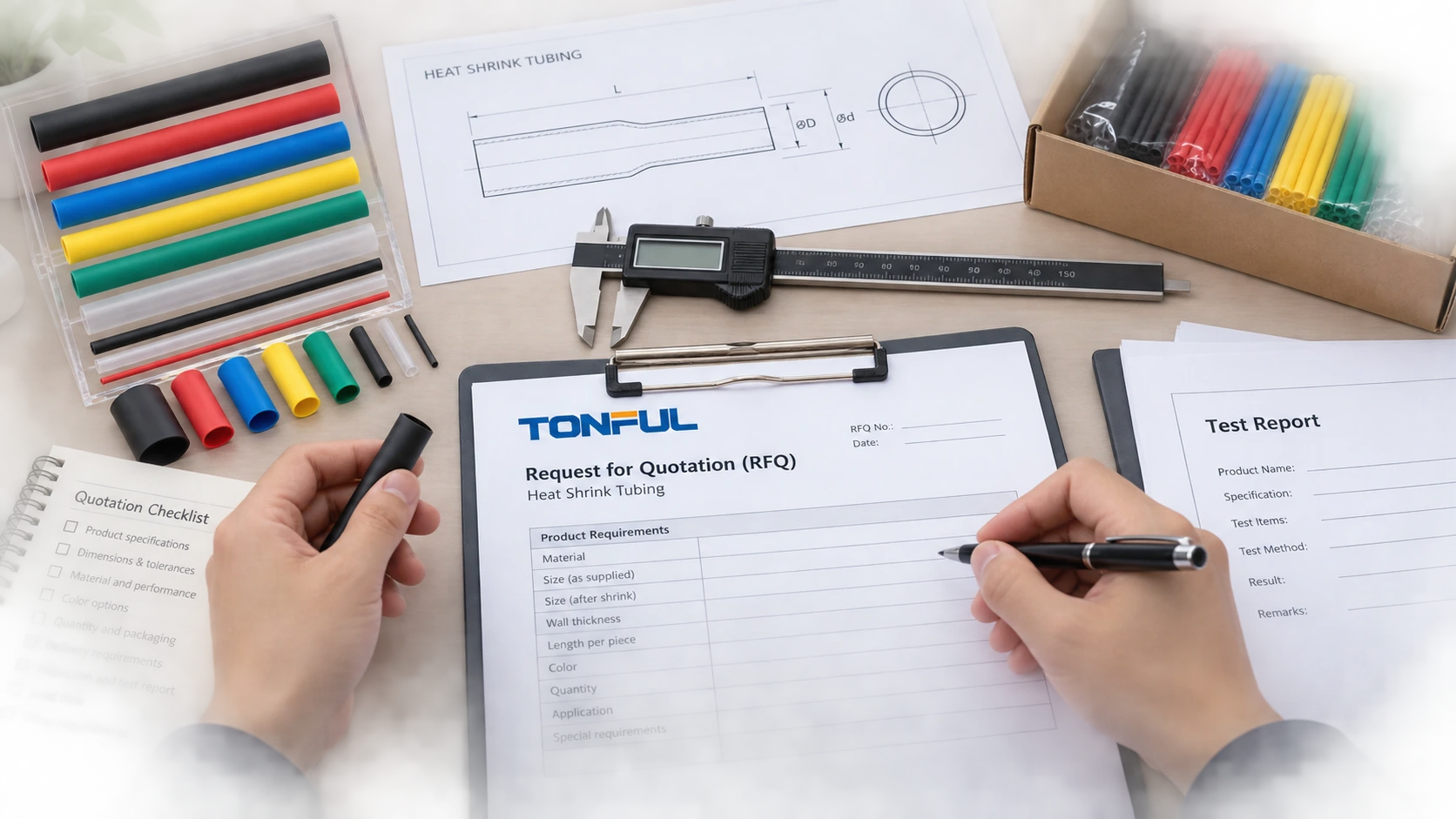
A useful heat shrink tubing RFQ should let every supplier quote the same technical and commercial scope. “Black 3:1 heat shrink” is not enough: it leaves material, pass-over size, recovered fit, wall construction, environmental exposure, markings, evidence, packaging and approval conditions unresolved. The lowest quotation may therefore describe a different product rather than a lower price for an equivalent product.
This checklist helps buyers convert an application into a controlled request for quotation. It does not prescribe universal material, voltage, temperature or test values. Enter those requirements from the product drawing, customer specification, applicable standard or approved validation plan.
On this page: Application | Technical fields | Evidence | Samples | Commercial fields | Template
Define the Application and Scope
Identify the project, end product, assembly location and function of the tubing. State whether it provides identification, electrical insulation, abrasion protection, strain transition, environmental sealing, bundling or several functions. Describe the substrate: wire insulation, cable jacket, terminal, splice, connector backshell, busbar, braid or molded component.
Record the installation location and service exposure. Include indoor or outdoor use, fluids, cleaning agents, UV, humidity, salt, vibration, flexing, abrasion, thermal cycling and expected service temperature only when relevant. Avoid vague labels such as “automotive grade,” “marine grade” or “industrial grade.” Translate them into controlled requirements and evidence.
Define the quotation boundary. Is the supplier quoting bulk tubing, precut pieces, printed markers, adhesive-lined sleeves, a kit or installed assemblies? State annual forecast, order quantities and expected project duration without representing forecasts as guaranteed purchases.
The heat shrink tubing buying guide can help establish the selection logic before the RFQ is released.
Specify the Product
Dimensions and Fit
Provide the largest feature the tube must pass over and the smallest substrate it must recover onto, including tolerance. State nominal supplied inside diameter, maximum recovered inside diameter, recovered wall thickness, cut length and permitted longitudinal change when these are controlled characteristics. Define units and measurement method.
Do not select by shrink ratio alone. The proposed supplied ID must clear the maximum assembly, and the recovered ID must provide the intended fit on the minimum substrate without excessive recovery demand. Use the heat shrink size guide and calculator for dimensional checks and the shrink-ratio guide for 2:1, 3:1, 4:1 and 6:1 boundaries.
Material, Wall and Color
State the required polymer or ask the supplier to propose one against documented conditions. Polyolefin, PVC, PTFE, FEP, PVDF, silicone and fluoroelastomer products are not interchangeable. If the material is open, require the supplier to identify the exact compound family and explain how its evidence addresses the application.
Specify single-wall, dual-wall adhesive-lined, heavy-wall or another defined construction. For lined tubing, include substrate compatibility, liner type, liner coverage or amount when controlled, sealing geometry and assembly-level validation. The single-wall versus dual-wall guide supports that decision.
Color can affect identification, formulation and certification scope. List the required color and tolerance or reference standard. For printed tubing, provide text, font or artwork, orientation, repeat position, contrast, permanence requirement and serialization rules. Do not assume approval of black tubing automatically covers every color.

The dimensional section connects the maximum pass-over feature and minimum recovered substrate to controlled tubing dimensions.
Define Compliance and Test Evidence
List every requested standard, edition, classification and customer specification. Separate mandatory requirements from preferences. Ask for the exact product, size, color, construction and manufacturing site covered by a certificate or report. A generic logo, family brochure or unrelated sample report is insufficient.
UL’s official insulating tubing testing and certification overview shows that tubing categories, properties and conditions of acceptability differ. Therefore, an RFQ should request the file/category, covered product designation and relevant conditions rather than asking only whether the supplier is “UL approved.”
Define required test evidence for recovery dimensions, longitudinal change, tensile strength and elongation, dielectric behavior, heat aging, fluid resistance, flammability or other project characteristics. State method edition, conditioning, sample quantity, acceptance source and report format. The heat shrink tubing testing guide explains how to prevent test results from becoming detached from their methods.
Claim-to-Evidence Record
| Requested claim | Exact product scope | Required evidence | Supplier response | Deviation/status |
|---|---|---|---|---|
| Material and construction | Part, size, color and wall | Controlled drawing/data sheet | Enter | Enter |
| Dimensions and recovery | Supplied and recovered states | Inspection/test report | Enter | Enter |
| Temperature or voltage rating | Exact quoted product | Certificate/report and conditions | Enter | Enter |
| Flammability classification | Exact construction and color scope | Current certification/test evidence | Enter | Enter |
| Fluid, UV or environmental resistance | Defined exposure and endpoint | Applicable report | Enter | Enter |
| Assembly sealing | Defined substrates and geometry | Approved assembly validation | Enter | Enter |
An IP rating or immersion demonstration must not be inferred from adhesive flow alone. If sealing is required, identify whether the claim applies to tubing material, a specified splice system or the completed customer assembly.
Plan Samples, Validation and Approval
State sample quantity, lengths, colors, identification and delivery date. Require production-intent material and process unless prototypes are explicitly accepted. Record any difference between sample and planned production, including tooling, site, liner, printing and packaging.
Define the validation matrix before samples arrive. Assign independent samples or a controlled sequential exposure, preserve unaged references when required and identify destructive tests. Record equipment, conditions, raw results, failure mode and acceptance source. Do not replace a failed specimen without an approved invalid-test rule.
Approval status must be unambiguous:
| Status | Meaning | Purchase consequence |
|---|---|---|
| Rejected | Mandatory function or evidence failed | No release |
| Conditional | Defined deviation has owner, scope and expiry | Limited purchase only within written condition |
| Sample approved | Named samples met the agreed review | Not automatic mass-production approval |
| Production approved | Production-intent evidence accepted | Purchase only within approved product/site/revision scope |
Confirm first-article requirements, production validation, retention samples and document retention. Define who approves deviations and whether installation trials are required. Approval of tubing does not by itself approve a completed splice, harness, busbar or enclosure.

A controlled approval path prevents a passing development sample from being treated as unrestricted production approval.
Commercial, Packaging and Supply Terms
Request MOQ and price breaks at realistic quantities. State currency, Incoterm, delivery location, quotation validity and tax or duty assumptions. Separate tubing price, cutting, printing, special packaging, sample charges, tooling and non-recurring engineering costs. If sample charges may be credited, document the condition rather than assuming it.
Ask for sample lead time, production lead time and capacity assumptions, including peak-season limits. Define tooling ownership, maintenance and disposition. Request warranty and claim boundaries, return-material process, replacement responsibility and support for field investigations without inserting terms not yet agreed.
Packaging should specify reel, spool, stick, bag or precut format; quantity per package; maximum joints per reel; length tolerance; liner blocking prevention; moisture or shelf controls where applicable; label fields; barcode; lot identity; manufacturing date; storage guidance and pallet requirements. Include destination-specific transport and compliance documents.
Define change notification for resin, formulation, additive, pigment, adhesive, dimensions, tooling, cross-linking method, expansion process, site, sub-supplier, test method, packaging or label. State notice period and whether review, samples or requalification are required. The manufacturer audit checklist can support supplier-control planning.
Copyable Heat Shrink Tubing RFQ Template
Copy the following table into the buyer’s controlled RFQ form. “Open” fields require a documented supplier proposal, not an unstated assumption.
| RFQ field | Buyer requirement | Supplier response/evidence | Deviation/status |
|---|---|---|---|
| Buyer, project and end application | Enter | Enter | Enter |
| Drawing/specification and revision | Enter | Enter | Enter |
| Tubing function and installation location | Enter | Enter | Enter |
| Substrates and assembly geometry | Enter | Enter | Enter |
| Maximum pass-over diameter | Enter value/tolerance | Enter | Enter |
| Minimum recovered substrate diameter | Enter value/tolerance | Enter | Enter |
| Supplied ID, recovered ID and wall | Enter or request proposal | Enter drawing | Enter |
| Shrink ratio and longitudinal change | Enter requirement | Enter | Enter |
| Material, grade and construction | Enter or open | Enter exact designation | Enter |
| Adhesive/liner and substrate compatibility | Enter if applicable | Enter | Enter |
| Color and printing/marking | Enter artwork and tolerance | Enter | Enter |
| Operating and installation conditions | Enter controlled range | Enter | Enter |
| Fluids, UV, vibration and abrasion | Enter exposures | Enter evidence | Enter |
| Standards, classifications and editions | Enter | Enter certificate/report | Enter |
| Required tests and acceptance sources | Enter | Enter report plan | Enter |
| Sample quantity and validation plan | Enter | Enter | Enter |
| First article and approval status | Enter | Enter | Enter |
| Annual forecast and quotation quantities | Enter | Enter | Enter |
| MOQ and price breaks | Enter requested breaks | Enter | Enter |
| Samples, tooling and NRE | Enter terms | Enter | Enter |
| Currency, Incoterm and delivery location | Enter | Enter | Enter |
| Sample and production lead time | Enter requested dates | Enter | Enter |
| Capacity and contingency | Enter requirement | Enter evidence | Enter |
| Packaging, labels and traceability | Enter | Enter | Enter |
| Warranty, claims and returns | Enter required terms | Enter | Enter |
| Change-notification requirement | Enter | Enter acceptance | Enter |
| Open assumptions and deviations | None hidden | List all | Resolve |
| Supplier name, approver and date | Enter | Sign/confirm | Enter |

A four-column RFQ form makes unanswered fields and supplier deviations visible before quotation comparison.
Compare Quotations on an Equivalent Basis
Normalize unit of measure, package length, cut loss, setup charges, freight, duty, inspection, sample validation and expected scrap before comparing price. Confirm whether each quotation meets the same dimensional and evidence scope. A lower unit price can create a higher total sourcing cost if it requires extra incoming inspection, repacking, rework, expedited freight or repeated approval.
Record unresolved assumptions and assign an owner. Do not award business while critical fit, material, certification or change-control questions remain hidden in email threads. The final purchase specification should identify the approved product, revision, site, evidence and deviations.
Work With TONFUL
Send TONFUL the completed RFQ fields, drawing, application geometry, annual demand, required documents, sample plan, packaging and commercial terms. TONFUL can review available heat shrink tubing options and prepare a project-specific response. Final ratings, certifications, MOQ, capacity and lead time must be confirmed in the exact quotation and approved documentation.
—