
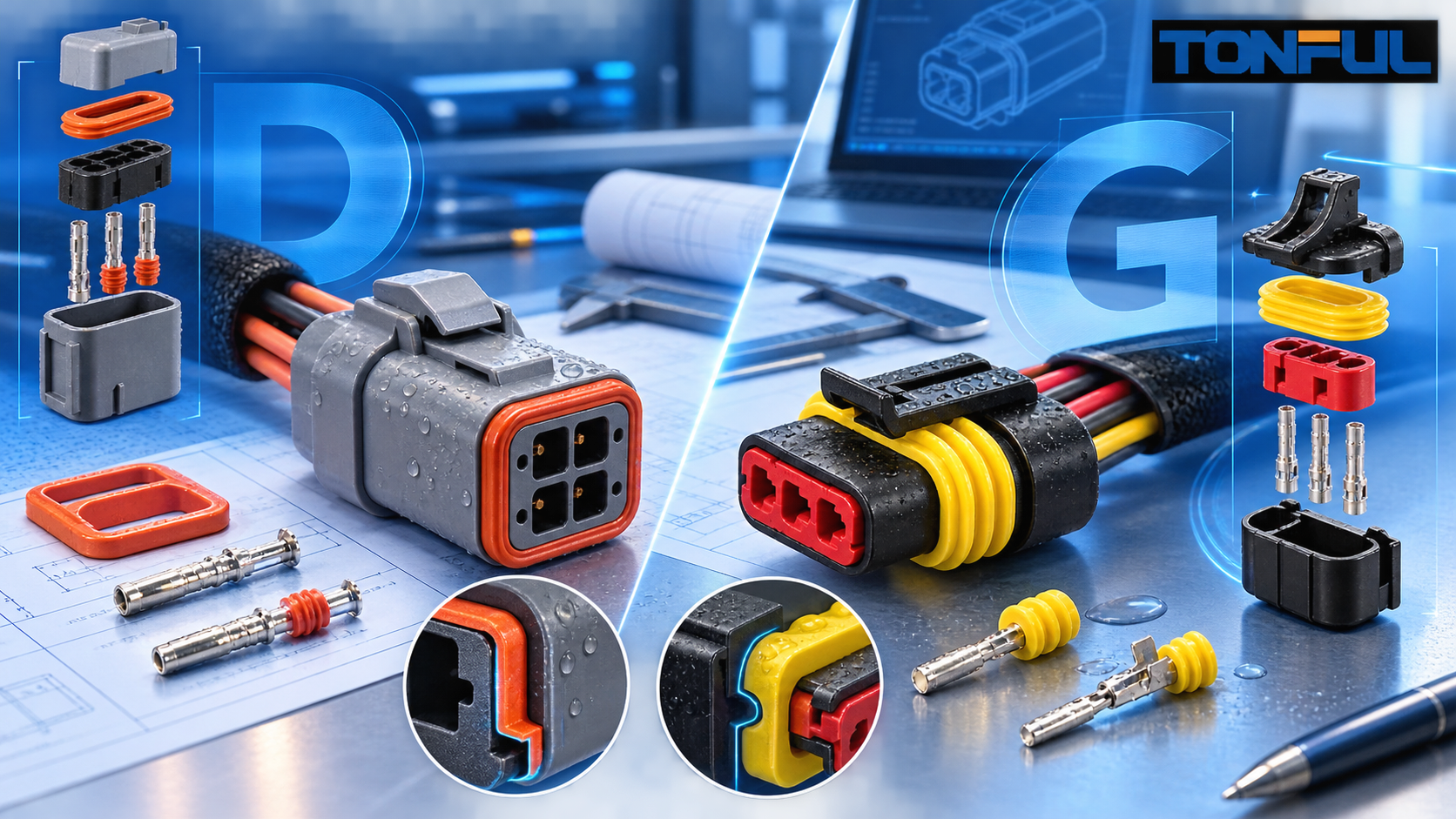

UL 486D and UL 486G both relate to sealed electrical connections, but they are not interchangeable labels. UL Solutions identifies UL 486D and UL 486G as standards for Sealed Wire Connector Systems and Sealed Twist-on Connecting Devices, respectively.
That distinction matters in sourcing. A system that seals a separate splice inside a tube or enclosure is not necessarily evaluated in the same way as a prefilled twist-on device that makes and seals the splice in one component. Buyers should verify the exact standard, certification file, model, conductor combinations, and conditions of use.
UL 486D vs. UL 486G at a Glance
| Question | UL 486D | UL 486G |
|---|---|---|
| UL Solutions category description | Sealed Wire Connector Systems | Sealed Twist-on Connecting Devices |
| Typical architecture | A sealed system that may combine a connector with a tube, housing, sealant, or other parts | A twist-on connecting device incorporating its sealing function |
| Selection focus | Complete system and all required components | Complete twist-on device and approved wire combinations |
| Substitution risk | Omitting or changing one system component | Assuming every prefilled twist-on connector has the same certification |
| Buyer action | Verify system assembly and instructions | Verify device model, wire table, and instructions |
This is a functional overview, not a reproduction of either standard. Current requirements must be obtained from UL Standards & Engagement or confirmed through UL Solutions certification information.
What UL 486D Covers

UL Solutions lists UL 486D under sealed wire connector systems. The word system is important. A product may rely on a defined connector, sealing enclosure, compound, assembly sequence, conductor preparation, and conditions of use.
A familiar example is a direct-bury kit that places a twist-on splice inside a grease-filled protective tube. The electrical connector and moisture barrier work together. Replacing the specified connector, removing the tube, changing the compound, or using an unapproved conductor combination can move the installation outside the evaluated system.
When reviewing a UL 486D product, request:
- Complete catalog number
- All required system components
- Approved wire combinations
- Voltage and temperature ratings
- Wet, direct-bury, or submersion conditions
- Enclosure and orientation requirements
- Strip length and installation instructions
- Certification file and current listing status
TONFUL’s UL 486D direct-burial guide explains how sealed systems relate to underground wiring applications.
What UL 486G Covers

UL Solutions describes UL 486G as covering sealed twist-on connecting devices. In this architecture, the device that grips the conductors also incorporates the environmental sealing function. A prefilled shell, internal spring, wire-entry geometry, and sealing compound form a single product.
The standard name should not be interpreted as approval for every wet or underground application. The certified model’s markings and instructions still define where and how it may be used.
For a sealed twist-on product, verify:
- Whether the model is actually certified to UL 486G
- Copper-only or other conductor restrictions
- Solid, stranded, or mixed combinations
- Number and size of conductors
- Installation torque or tightening instruction
- Required enclosure, if any
- Approved environmental locations
- Single-use or reuse instruction
TONFUL’s current waterproof wire nut product range provides model-level specifications, but the relevant certification evidence should be checked before a standard claim is placed on packaging or a customer cross-reference.
Why the Standard Number Alone Is Not Enough
Certification applies to a product, not a general design idea
A silicone-filled cap that resembles a listed device is not automatically covered by the same certification. Verify the manufacturer, model, certification file, and status through an authoritative database such as UL Product iQ.
Wire combinations are part of the qualification
Minimum and maximum wire sizes do not approve every possible bundle. Obtain the tested conductor-combination table and follow it exactly.
Installation instructions are part of the product
Strip length, conductor alignment, pre-twisting, connector tightening, seating depth, and enclosure requirements can affect both mechanical contact and environmental sealing.
“Waterproof,” “IP68,” and “direct burial” are not synonyms
An IP classification describes ingress performance under defined conditions. A direct-burial or sealed-connector certification addresses a specific product scope and installation. One claim does not automatically prove the other.
TONFUL’s broader guide to waterproof connector standards helps separate UL connector standards from ingress-protection terminology.
Procurement Checklist
Use this checklist before approving a sealed connector:
- Record the exact standard and edition claimed.
- Obtain the certification file or database record.
- Match the model number on product, packaging, and quotation.
- Compare the complete conductor combination.
- Confirm voltage, temperature, and location.
- Review every required installation component.
- Validate samples in the production wire and enclosure.
- Require change notification for material, compound, tooling, or certification changes.
For supplier qualification, combine document review with TONFUL’s waterproof wire nut manufacturer audit checklist.
Common Mistakes
Treating UL 486D and UL 486G as quality grades
They describe different product scopes, not a simple lower-versus-higher ranking.
Using an old certificate without checking status
Certification scope and product availability can change. Verify current records at the time of sourcing.
Copying a competitor claim onto an alternative product
A cross-reference candidate needs its own evidence. Similar dimensions or sealant do not transfer certification.
Publishing standard claims before matching packaging
Website, datasheet, label, carton, and certificate should identify the same model and conditions. Conflicting claims create technical and commercial risk.
Frequently Asked Questions
Is UL 486G newer or better than UL 486D?
It covers a different category: sealed twist-on connecting devices rather than sealed wire connector systems. Choose according to the product architecture and application, not the letter sequence.
Does UL 486D always mean direct burial?
Do not assume so from the standard number alone. Check the certified product’s specific location markings and installation instructions.
Can an IP68 connector replace a UL 486D or UL 486G product?
Not automatically. IP and UL connector evaluations address different requirements. The project may require both, one, or another applicable approval.
Build Claims from Current Evidence
TONFUL supports waterproof connector sourcing and OEM/ODM programs. Before publishing or printing a UL claim, provide the target model, market, wire combinations, and application so the current certification scope can be checked and matched to the product documentation.
Related TONFUL reading includes the UL 486 versus UL 310 comparison for a broader view of connector and terminal standards.