
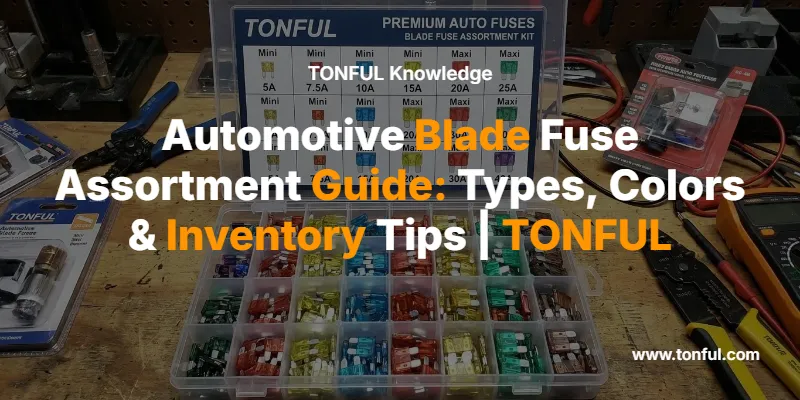
In the competitive landscape of automotive aftermarket parts, retailers face a constant challenge: balancing inventory efficiency with the ability to meet diverse customer needs immediately. Among the most critical yet often overlooked components are circuit protection devices. An Automotive Blade Fuse Assortment is not just a convenience product; it is a strategic inventory essential for auto parts stores, repair shops, and fleet maintenance distributors.
As vehicle electrical systems become increasingly complex—evolving from standard internal combustion engines to sophisticated EVs—the variety of fuses required has expanded exponentially. For retailers, stocking comprehensive variety packs is the key to capturing sales and ensuring customer satisfaction.
Understanding Automotive Blade Fuses: The First Line of Defense
Before diving into assortment strategies, it is crucial to understand what these components are. Automotive blade fuses are sacrificial devices designed to protect electrical circuits from overcurrent, preventing damage to sensitive electronics and reducing the risk of fire. Unlike older glass tube fuses, blade fuses feature a plastic body and two metal prongs that fit into sockets, offering better durability and color-coded amperage identification.
For a deeper dive into the fundamentals, read our guide on What Are Automotive Fuses?.
Modern vehicles utilize a mix of fuse types to handle different electrical loads and space constraints. Understanding these distinctions is vital for curating the right Automotive Blade Fuse Assortment. You can explore the full spectrum of types in our Automotive Blade Fuse Types Guide (ATO, Mini, Micro, Maxi).

Types of Blade Fuses Essential for Assortment Kits
A high-value assortment kit must cover the most prevalent fuse types found in vehicles on the road today.
1. Standard (ATO/ATC) Fuses
The Standard blade fuse, often referred to as ATO (Open) or ATC (Closed), is the most common type found in vehicles manufactured from the 1980s to the present. Measuring 19.1mm in width, they typically handle currents from 1A to 40A.
- Retail Tip: These are the “bread and butter” of any fuse inventory.
- Learn more: Standard vs. Mini Automotive Blade Fuse Guide
2. Mini (ATM/APM) Fuses
As vehicle electronics became more compact, the Mini fuse was introduced. Measuring 10.9mm in width, it offers similar protection characteristics to the Standard fuse but in a smaller footprint (2A to 30A). These are ubiquitous in modern passenger cars.
- Comparison: Mini vs. Micro vs. Standard Blade Fuses
- Deep Dive: Complete Guide to Automotive Mini Blade Fuses (ATM/APM)
3. Maxi Fuses
Maxi fuses are the heavyweights of the blade fuse family. Measuring 29.2mm, they are designed for high-current applications (20A to 120A) such as starter motors and alternator protection. While sold in smaller quantities than Standard or Mini fuses, their critical nature makes them essential for professional repair kits.
- Technical Details: Maxi Blade Fuse Complete Guide
4. Micro2 and Micro3 Fuses
The newest generation of vehicles utilizes Micro2 and Micro3 fuses to pack more circuits into smaller fuse boxes. These are increasingly requested by owners of late-model vehicles and are a differentiator for forward-thinking retailers.

Color-Coding System and Amperage Ratings
One of the most user-friendly features of blade fuses is the industry-standard color-coding system. A comprehensive Automotive Blade Fuse Assortment relies on this visual language to help technicians and DIYers quickly identify the correct replacement.
For a detailed breakdown of how to interpret these ratings, visit our Automotive Blade Fuse Amp Ratings & Color Codes Guide.
Universal Blade Fuse Color Code Table
| Amperage (A) | Color Code | Typical Application |
|---|---|---|
| 1A / 2A | Black / Gray | Low-power electronics, ECU signals |
| 3A / 4A | Violet / Pink | Parking sensors, interior lights |
| 5A | Tan | Radio, signals, license plate lights |
| 7.5A | Brown | Airbags, turn signals |
| 10A | Red | Headlights, horn, central locking |
| 15A | Blue | Wipers, fuel pump, hazard lights |
| 20A | Yellow | Power windows, radiator fan |
| 25A | Clear / Natural | HVAC blower, seat heaters |
| 30A | Green | ABS, main relays, ignition |
| 40A | Orange | Defrosters, cooling fans |
Reference: How to Read Automotive Blade Fuse Labels

Why Retailers Need Variety Packs
Stocking individual fuse packs (SKUs) for every single amperage and type is inefficient and consumes valuable shelf space. Here is why prioritizing Automotive Blade Fuse Assortment packs is a superior strategy for B2B retailers and distributors:
1. Meeting Diverse Customer Needs
A customer walking into a store often doesn’t know exactly which fuse they need until they compare it with the blown one. A variety pack ensures they leave with the right solution, plus spares for the future.
2. Inventory Efficiency
Instead of managing 40 different SKUs for every amperage of Standard, Mini, and Micro fuses, a retailer can stock 3-4 well-configured assortment kits. This simplifies reordering and reduces “dead stock” of less common amperages.
3. Reduced Stockouts
It is difficult to predict whether 7.5A or 25A fuses will be in higher demand next week. An assortment kit buffers against demand fluctuations, ensuring you never miss a sale due to a missing specific rating.
4. Higher Profit Margins
Variety packs offer a higher average transaction value (ATV) compared to blister packs of 5 fuses. Customers perceive high value in a reusable organizer box filled with 100+ fuses, allowing for healthy retail margins.
5. Competitive Advantage
Offering professional-grade assortments positions your brand as a serious supplier for mechanics and serious DIYers, rather than just a convenience stop. Check out TONFUL’s range of Assorted Boxes designed for retail shelves.

Market Demand and Trends
The global automotive fuse market is projected to grow significantly, driven by the increasing electronic content in vehicles.
- EV Adoption: Electric Vehicles (EVs) require more circuits for battery management systems, sensors, and infotainment, driving demand for Micro and Low-Profile Mini fuses.
- Aging Vehicle Fleet: As the average age of vehicles on the road increases, electrical maintenance becomes more frequent, sustaining demand for Standard and Mini fuse replacements.
- DIY Market Growth: More vehicle owners are performing basic maintenance, such as checking and replacing fuses, to avoid costly dealership visits.
Retailers must align their inventory with these trends by stocking kits that include both legacy (Standard/ATO) and modern (Micro2/3) fuse types.
What to Look for in Quality Assortment Kits
Not all variety packs are created equal. To protect your reputation and your customers’ vehicles, ensure the assortments you stock meet rigorous standards.
1. Compliance with ISO 8820
Fuses must meet international standards for current handling and blow time. Poor quality fuses may not blow when needed (causing fires) or blow too early (nuisance). TONFUL, as a leading Blade Fuses Manufacturer, ensures strict adherence to ISO and SAE standards.
2. Material Quality
- Terminals: Look for Zinc alloy or silver-plated terminals for corrosion resistance and conductivity.
- Housing: High-temperature Polycarbonate (PC) or PA66 nylon is essential to prevent melting under load.
- Clarity: The housing must be transparent enough to easily see the fusible link element.
3. Smart Organization
A good assortment comes in a durable, compartmentalized box with a clear map or label indicating which fuse is in which slot. This organization adds significant value for the end-user.

Applications Across Vehicle Types
A comprehensive Automotive Blade Fuse Assortment serves a wide range of sectors:
- Passenger Cars: The primary market, requiring a mix of Mini and Standard fuses.
- Commercial Vehicles & Trucks: Heavy-duty trucks often utilize Maxi fuses for main power distribution and Standard fuses for body electronics.
- Marine & RVs: These applications require corrosion-resistant fuses. See our Blade Fuse vs. Glass Fuse Comparison to understand why blade fuses are preferred in modern marine setups.
- Motorcycles: Space is at a premium, making Mini and Low-Profile fuses the standard.
Comparison: Choosing the Right Assortment Configuration
Retailers should offer tiered options to cater to different customer segments.
Blade Fuse Types Comparison
| Feature | Standard (ATO/ATC) | Mini (ATM) | Micro2 | Maxi |
|---|---|---|---|---|
| Dimensions (WxH) | 19.1 x 18.5 mm | 10.9 x 16.3 mm | 9.1 x 15.3 mm | 29.2 x 34.3 mm |
| Amperage Range | 1A – 40A | 2A – 30A | 5A – 30A | 20A – 120A |
| Primary Use | General Auto (1980s-2010s) | Modern Auto (1990s-Present) | Compact/New Vehicles | High Current / Main |
Recommended Assortment Kit Configurations
| Kit Level | Target Audience | Contents Recommendation |
|---|---|---|
| Basic Emergency Kit | Glovebox / DIY | 10-20 pcs (Mixed 10A, 15A, 20A, 30A Standard & Mini) + Puller |
| Pro Retail Kit | Home Mechanic | 100-150 pcs (Full range 2A-35A Standard & Mini) + Tester |
| Master Workshop Kit | Professional Shop | 300+ pcs (Standard, Mini, Low-Profile, Micro2, Maxi) + Pullers |
For top-tier manufacturing partners, check our list of Top 10 Blade Fuse Manufacturers.
FAQ: Automotive Blade Fuse Assortments
Q1: What sizes should be included in a standard automotive fuse assortment?
A balanced assortment should heavily favor 10A, 15A, and 20A fuses, as these are the most common ratings for accessories like lights, wipers, and power outlets. However, it must also include lower (5A, 7.5A) and higher (30A, 40A) amp ratings to be truly useful.
Q2: How do I know if a fuse in the assortment is blown?
A blown blade fuse will have a visible break in the metal wire loop inside the plastic housing. For a definitive test, use a multimeter.
- Guide: How to Test a Blade Fuse with a Multimeter
- Guide: When to Replace a Blown Blade Fuse in Your Car
Q3: Are OEM fuses better than aftermarket assortments?
OEM fuses are excellent but expensive. High-quality aftermarket fuses from reputable manufacturers like TONFUL meet the same ISO/SAE standards as OEM parts but at a more competitive price point, making them ideal for retail variety packs.
Q4: Can I use a Mini fuse in a Standard fuse slot?
No, the physical dimensions and pin spacing are different. This is exactly why retailers need to sell variety packs that clearly distinguish between types.
- Read more: Blade Fuse Amperage Color Codes
Q5: What is the shelf life of a fuse assortment kit?
Blade fuses have an indefinite shelf life if stored in a dry environment. The metal terminals are plated to resist corrosion, making them a low-risk inventory item for retailers.
Conclusion
For automotive retailers and distributors, the Automotive Blade Fuse Assortment is a staple product that drives consistent sales and high customer satisfaction. By understanding the technical differences between Standard, Mini, and Maxi fuses, and stocking high-quality, well-organized variety packs, you position your business as a reliable resource for every electrical repair need.
As vehicles continue to evolve, so too must your inventory. Partnering with a specialized manufacturer like TONFUL ensures you have access to the latest fuse technologies, from robust Maxi fuses to space-saving Micro types, all packaged to meet the demands of the modern market.
Ready to upgrade your electrical inventory? Explore TONFUL’s range of professional Assorted Boxes and secure your supply of premium automotive fuses today.