
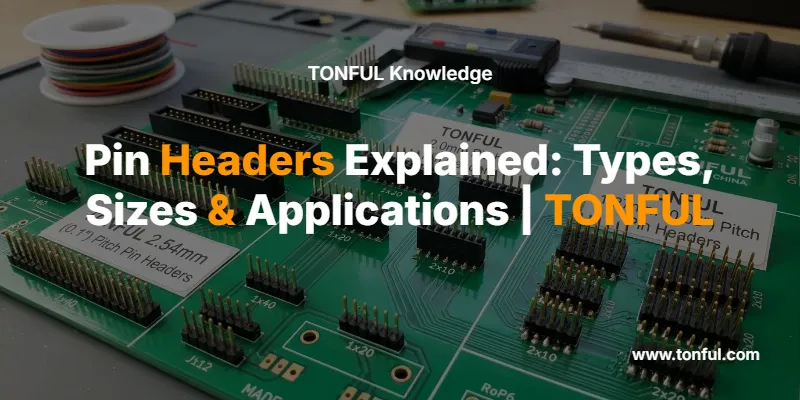
Pin headers are fundamental electrical connectors that serve as the backbone of modern electronic design, enabling reliable board-to-board and board-to-wire connections across countless applications. As a leading B2B manufacturer of electrical products, TONFUL Electric specializes in producing high-quality pin header connectors that meet the demanding requirements of industrial automation, automotive electronics, and consumer devices. This comprehensive guide explores the types, specifications, and applications of pin headers to help engineers and procurement professionals make informed decisions.
What Are Pin Headers?
A pin header is a form of electrical connector consisting of one or more rows of metal pins molded into a plastic base. These connectors provide cost-effective, reliable connection points between printed circuit boards (PCBs) and other electronic components. The pins are typically made from copper alloy—usually brass or phosphor bronze—chosen for their excellent conductivity and mechanical strength.
Pin headers work in conjunction with female header connectors to create secure, removable connections. The male pins insert into the female receptacles, establishing both mechanical stability and electrical continuity. This mating system allows for easy assembly, maintenance, and modular design—critical advantages in prototyping and production environments.

Types of Pin Headers
Pin headers come in several configurations, each designed for specific mounting methods and application requirements. Understanding these types is essential for selecting the right connector for your PCB design.
By Mounting Style
Through-Hole (THT/DIP) Pin Headers
Through-hole pin headers feature long pins that pass through drilled holes in the PCB and are soldered on the opposite side. This mounting method creates exceptionally strong mechanical connections, making THT headers ideal for connectors that will be frequently mated and unmated. The robust solder joint can withstand significant mechanical stress, vibration, and pull forces—critical in industrial and automotive applications.
Surface Mount Technology (SMT) Pin Headers
SMT pin headers have pins bent at a 90-degree angle to be soldered directly onto pads on the PCB surface. For single-row SMT headers, the pins alternate bending to one side or the other; for dual-row SMT headers, the pins simply bend outwards. This design eliminates the need for drilling holes, reducing manufacturing costs and enabling higher component density on the board. SMT headers are particularly valuable in compact, high-density designs where board space is at a premium.
TONFUL Electric utilizes advanced high-temperature plastics such as LCP, PA6T, and PA9T for SMT pin headers, ensuring the insulators maintain structural integrity and withstand reflow soldering temperatures up to 260°C without melting or blistering.

By Pin Orientation
Straight (Vertical) Pin Headers
Straight pin headers mount perpendicular to the PCB surface, with pins extending vertically upward. This is the most common configuration, used extensively in development boards, Arduino shields, and modular systems. Straight headers maximize vertical stacking capability and are ideal for board-to-board connections where space allows for vertical clearance.
Right-Angle Pin Headers
Right-angle headers have pins parallel to the PCB surface, extending horizontally. This orientation saves vertical space and facilitates side connections—particularly useful in space-constrained enclosures or when connecting two PCBs horizontally. Right-angle headers are commonly found in edge connectors and applications where low-profile designs are required.
By Row Configuration
Single-Row Pin Headers
Single-row headers feature a single line of pins, typically ranging from 2 to 40 pins for standard pitches like 2.54mm and 2.0mm, or up to 50 pins for finer pitches like 1.27mm and 1.0mm. These headers are ideal for simple signal connections and low-density applications.
Dual-Row Pin Headers
Dual-row headers contain two parallel rows of pins, effectively doubling the pin count in the same linear space. This configuration is standard for ribbon cable connections and high-density applications. The dual-row design provides better mechanical stability and is commonly used in box header connectors with shrouded housings.
Multi-Row Pin Headers
For applications requiring even higher density, triple-row and quad-row pin headers are available, though less common than single and dual configurations.
Specialized Types
Shrouded/Box Headers
Pin headers with a plastic guide box around them are known as shrouded headers or box headers. These feature a polarizing key—a square notch in the shroud—that prevents incorrect insertion of the mating connector. Shrouded headers are typically used with insulation-displacement connectors (IDC) for ribbon cables and provide enhanced mechanical protection and alignment.
Latching Headers
Latching pin headers incorporate a locking mechanism that engages with the mating socket to prevent accidental disconnection. This feature is essential in high-vibration environments such as automotive and industrial machinery, where connector reliability is critical.
Machine Pin Headers
While standard pin headers are formed from stamped and folded sheet metal, machine pin headers are precision-tooled into shape. This manufacturing process produces more robust connectors with better electrical joints and longer operational life, though at a higher cost. Machine pin headers are preferred for applications requiring maximum reliability and durability.

Pin Header Sizes and Pitch Specifications
Pitch—the center-to-center distance between adjacent pins—is the single most critical dimensional parameter when selecting pin headers. A mismatch of even 0.1mm renders connectors completely incompatible. The three most prevalent pitches in modern electronics are 2.54mm, 2.0mm, and 1.27mm, each serving distinct application requirements.
Common Pitch Sizes Comparison
| Pitch Size | Imperial | Typical Pin Count | Current Rating (per pin) | Primary Applications | Key Advantages |
|---|---|---|---|---|---|
| 2.54mm | 0.100″ | 2-40 pins | 3A @ 80°C | Arduino, development boards, prototyping, general PCB connections | Universal breadboard compatibility, robust mechanical strength, easy hand assembly |
| 2.0mm | 0.079″ | 2-40 pins | 2-3A | Industrial modules, motor drivers, legacy equipment | Balance of density and current capacity, good for compact designs |
| 1.27mm | 0.050″ | 2-50 pins | 1.5-2A | IoT devices, medical equipment, industrial sensors, high-density boards | “Sweet spot” between density and usability, better than 1.0mm for assembly |
| 1.0mm | 0.039″ | 2-80 pins | 1A or less | Smartphones, wearables, miniaturized devices, ultra-compact electronics | Maximum pin density, smallest footprint |
| 0.8mm | 0.032″ | 2-80 pins | <1A | Specialized miniature devices | Extreme miniaturization |
2.54mm Pitch: The Industry Standard
The 2.54mm (0.100″) pitch pin header is the most widely deployed connector pitch in PCB design history. This spacing became the de facto standard because it aligns perfectly with breadboard hole spacing, making it ideal for prototyping and development work. Standard 2.54mm headers typically support 3A per pin at 80°C ambient temperature when used in stacking configurations.
TONFUL’s 2.54mm pin headers are compatible with Arduino boards, Raspberry Pi GPIO headers, and countless development platforms. The robust pin size allows for frequent mating cycles without degradation—critical for prototyping environments where connections are repeatedly made and broken.
1.27mm Pitch: The Sweet Spot
Often considered the optimal balance between density and usability, 1.27mm pitch connectors are popular in industrial equipment, medical devices, and IoT hardware. They offer better current handling than 1.0mm connectors (around 1.5-2A per pin) while remaining compact enough for modern designs. The footprint is also less prone to soldering defects during manufacturing compared to finer pitches.
Pin Length and Insulator Height
Beyond pitch, pin headers vary in pin length (typically 2mm to 12.7mm or more) and insulator height. TONFUL Electric offers customizable dimensions to accommodate specific PCB thicknesses and stacking requirements. The mating length (the upper portion that plugs into the female header) and solder tail length can be specified to ensure secure connections and proper PCB clearance.

Materials and Plating Options
The performance and longevity of pin headers depend heavily on the materials used for both the contact pins and the insulator housing.
Contact Materials and Plating
Pin header contacts start as copper alloy—typically brass or phosphor bronze—selected for excellent electrical conductivity and spring properties. However, copper alloys oxidize rapidly when exposed to air, which would degrade electrical performance. To prevent oxidation and enhance durability, manufacturers apply surface plating.
Gold vs. Tin Plating Comparison
| Characteristic | Gold Plating | Tin Plating |
|---|---|---|
| Contact Resistance | Lowest and most stable (remains constant over time) | Higher; oxide layer forms and increases resistance |
| Corrosion Resistance | Excellent; does not oxidize | Moderate; forms tin oxide layer |
| Mating Cycles | High (100+ cycles); suitable for frequent plugging | Limited (50-100 cycles); oxide layer wears contact |
| Operating Environment | Harsh environments, high humidity, industrial floors, outdoor cabinets | Climate-controlled indoor environments |
| Contact Force Required | Low; gold stays clean | Higher; must break through oxide layer |
| Vibration Resistance | Excellent; maintains stable connection | Poor; oxide reforms under vibration (fretting corrosion) |
| Typical Thickness | 15-30 microinches (0.38-0.76 microns) over 50μ” nickel underplate | 100-150 microinches (2.5-3.8 microns) |
| Cost | Higher (premium applications) | Lower (cost-sensitive applications) |
| Best Applications | Automotive ECUs, industrial sensors, medical devices, high-reliability systems | Consumer electronics, indoor equipment, low-cycle connections |
| Solderability | Poor (requires separate tin-plated tails) | Excellent |
Selective Plating Strategy
Many high-performance pin headers use selective plating: gold in the contact/mating area for superior electrical performance, and tin on the solder tails for excellent solderability. This approach optimizes both reliability and manufacturability.
Nickel Underplating
Industry standards (IPC/WHMA-A-620 Class 3, EIA-364) require a nickel underplate (typically 50 microinches) between the copper base metal and gold plating. This nickel barrier prevents gold diffusion into the copper substrate, which would cause expensive coating loss over time.
Insulator Materials
The plastic housing of pin headers must withstand soldering temperatures, provide electrical insulation, and maintain dimensional stability. TONFUL Electric uses high-performance thermoplastics rated UL94 V-0 for flame retardancy:
- Nylon 6T / PA6T: Excellent mechanical strength and heat resistance
- Nylon 9T / PA9T: Enhanced thermal performance for demanding applications
- LCP (Liquid Crystal Polymer): Superior dimensional stability and high-temperature resistance up to 260°C for SMT reflow processes
- PBT (Polybutylene Terephthalate): Good mechanical strength and stable heat resistance

Electrical Specifications
Understanding the electrical characteristics of pin headers is essential for ensuring reliable operation and preventing failures due to overheating or voltage breakdown.
Current Rating
The current-carrying capacity of pin headers depends on several factors: pin cross-sectional area, plating material, ambient temperature, pin length, and the number of adjacent pins carrying current simultaneously.
Standard Current Ratings:
- 2.54mm pitch headers: 3A per pin (typical) at 80°C ambient
- 2.0mm pitch headers: 2-3A per pin
- 1.27mm pitch headers: 1.5-2A per pin
- 1.0mm pitch headers: 1A or less per pin
Derating Considerations:
Current ratings are typically specified with a temperature rise of 30-50°C above ambient temperature. When all pins carry current simultaneously, heat generation increases, requiring derating. A single pin carrying 3.3A in isolation generates less heat than when all adjacent pins also carry current, as heat dissipation becomes limited.
Longer pins have higher resistance, generating more heat at the same current level. Therefore, shorter pins can carry more current than longer ones.
Voltage Rating
Standard pin headers are typically rated for 250V AC/DC maximum operating voltage. This rating depends on the insulator material, pin spacing, and environmental conditions.
Other Electrical Parameters
- Contact Resistance: 20mΩ maximum (typical specification)
- Insulation Resistance: 1000MΩ minimum
- Withstanding Voltage: 600V AC for one minute (dielectric strength test)
- Operating Temperature Range: -40°C to +105°C (standard); -40°C to +125°C (industrial/automotive grade)
Applications of Pin Headers
Pin headers are ubiquitous in electronics, serving critical interconnection roles across diverse industries and applications.
Prototyping and Development
Pin headers are the standard connector for development boards including Arduino, Raspberry Pi, ESP32, and countless other platforms. The 2.54mm pitch aligns with breadboard spacing, enabling rapid prototyping without soldering. Engineers can quickly test circuit designs, swap modules, and iterate on concepts using jumper wires and headers.
Consumer Electronics
In consumer devices—smartphones, wearables, computers, and appliances—pin headers facilitate internal connections between PCBs, display modules, battery packs, and sensor arrays. The trend toward miniaturization drives adoption of finer pitches (1.27mm, 1.0mm) to maximize functionality in compact form factors.
Industrial Automation
Industrial control systems, programmable logic controllers (PLCs), sensors, and automation equipment rely on pin headers for reliable connections in harsh environments. The connectors must withstand vibration, temperature extremes, dust, and humidity. Gold-plated pin headers with shrouded housings are preferred for their durability and resistance to fretting corrosion.
TONFUL’s automotive terminals and connectors complement our pin header offerings for comprehensive industrial connectivity solutions.
Automotive Electronics
Modern vehicles contain dozens of electronic control units (ECUs) managing engine performance, infotainment, safety systems, and sensor networks. Pin headers in automotive applications must meet stringent reliability standards, operating across temperature ranges from -40°C to +125°C while resisting vibration, shock, and exposure to automotive fluids. Gold-plated contacts and high-temperature insulators (PA6T, PA9T, LCP) are standard for automotive-grade headers.
Medical Devices
Medical equipment demands exceptional reliability and often requires compliance with biocompatibility standards. Pin headers in medical devices must maintain stable electrical performance over long service lives, resist sterilization processes, and meet regulatory requirements. The 1.27mm pitch is particularly popular in medical applications, balancing density with assembly reliability.
Aerospace and Defense
High-reliability applications in aerospace and defense require precision-machined pin headers with gold plating, capable of withstanding extreme temperatures, shock, vibration, and harsh environments. These connectors often undergo rigorous testing and qualification processes.
IoT and Embedded Systems
Internet of Things devices and embedded systems extensively use pin headers for modular connectivity. The ability to easily swap sensors, communication modules, and processing units accelerates development and enables field upgrades. Compact pitches (1.27mm, 2.0mm) are common in IoT applications where space is constrained.
Selecting the Right Pin Header
Choosing the appropriate pin header requires careful consideration of multiple factors:
- Pitch Compatibility: Ensure the pitch matches your PCB footprint and mating connector. Verify compatibility with existing system standards.
- Mounting Method: Select through-hole for maximum mechanical strength and frequent mating, or SMT for high-density designs and automated assembly.
- Pin Count and Row Configuration: Determine the number of signals/power connections required and available board space.
- Current and Voltage Requirements: Calculate maximum current per pin, considering derating for ambient temperature and simultaneous pin usage. Verify voltage rating meets application needs.
- Operating Environment: For harsh environments (industrial, automotive, outdoor), specify gold plating and high-temperature insulators. For benign indoor environments, tin plating may suffice.
- Mating Cycles: High-cycle applications (>100 matings) require gold plating and potentially machine pin construction.
- Mechanical Requirements: Vibration-prone applications benefit from latching headers or shrouded box headers with polarization.
- Standards Compliance: Verify compliance with relevant standards (UL, RoHS, REACH, automotive IATF16949, medical ISO13485).
TONFUL Electric provides expert technical consultation to help you select optimal pin header specifications for your application. Our electrical PCB connectors portfolio includes pin headers, female headers, wafer connectors, and FPC/FFC connectors to meet diverse interconnection needs.
Quality and Manufacturing Standards
TONFUL Electric maintains rigorous quality control throughout the pin header manufacturing process:
- UL94 V-0 Flame Retardant Insulators: All housings meet flammability standards for electrical safety
- Precision Tooling: Tight tolerances ensure consistent pitch, pin alignment, and mating reliability
- Automated Optical Inspection (AOI): Verifies pin straightness, plating quality, and dimensional accuracy
- Electrical Testing: 100% continuity testing and sample testing for contact resistance, insulation resistance, and withstanding voltage
- Environmental Testing: Salt spray testing (ASTM B117), temperature cycling, and vibration testing for high-reliability applications
- RoHS and REACH Compliance: Conflict-free materials and compliance with environmental regulations
Our manufacturing capabilities support both standard catalog products and custom OEM/ODM solutions tailored to your specifications.
Frequently Asked Questions (FAQ)
Q: What is the difference between a pin header and a female header?
A: A pin header (male header) features protruding metal pins, while a female header (socket header) contains internal spring contacts that receive the pins. They work together as mating pairs to create electrical connections. TONFUL manufactures both pin headers and female headers for complete connectivity solutions.
Q: Can I use a 2.54mm pin header on a standard breadboard?
A: Yes, 2.54mm (0.1″) pitch pin headers are specifically designed to be breadboard-compatible. This is the standard pitch for prototyping and development work. Other pitches like 2.0mm or 1.27mm require adapter boards for breadboard use.
Q: How do I choose between gold and tin plating for my application?
A: Choose gold plating for applications with frequent mating cycles (>100), harsh environments (humidity, vibration, temperature extremes), or critical reliability requirements (automotive, medical, industrial). Choose tin plating for cost-sensitive applications in climate-controlled environments with infrequent mating. For optimal performance, consider selective plating: gold on contacts, tin on solder tails.
Q: What current can a standard 2.54mm pin header safely carry?
A: Standard 2.54mm pitch pin headers are typically rated for 3A per pin at 80°C ambient temperature. However, this rating decreases when multiple adjacent pins carry current simultaneously due to heat buildup. Always consult the manufacturer’s datasheet and consider derating factors for your specific application.
Q: Are SMT pin headers as strong as through-hole headers?
A: Through-hole headers generally provide stronger mechanical connections due to pins passing completely through the PCB. However, modern SMT headers with proper PCB pad design and solder joint quality can provide adequate mechanical strength for most applications. For connectors subject to frequent mating or high mechanical stress, through-hole mounting is preferred.
Q: Can pin headers be used in outdoor or high-vibration environments?
A: Yes, but specify gold-plated contacts, high-temperature insulators (LCP, PA9T), and consider shrouded or latching headers for additional mechanical security. TONFUL’s industrial-grade pin headers are designed for harsh environments and can be customized for specific environmental requirements.
Conclusion
Pin headers remain essential interconnection components across the electronics industry, from prototyping benches to production automotive systems. Understanding the types, sizes, materials, and specifications enables engineers to select connectors that optimize reliability, performance, and cost for their specific applications.
TONFUL Electric’s comprehensive range of pin header connectors—spanning 1.0mm to 2.54mm pitches in through-hole and SMT configurations—provides the flexibility and quality required for modern electronic design. Our commitment to precision manufacturing, rigorous testing, and customer support ensures your interconnection needs are met with products that perform reliably over their entire service life.
For technical specifications, custom connector solutions, or assistance selecting the right pin header for your application, contact TONFUL Electric’s engineering team. Explore our complete line of electrical PCB connectors, terminals, and wire harness assemblies to discover comprehensive connectivity solutions for your projects.
TONFUL Electric – Your Trusted Partner for High-Quality Electrical Connectors and Components