
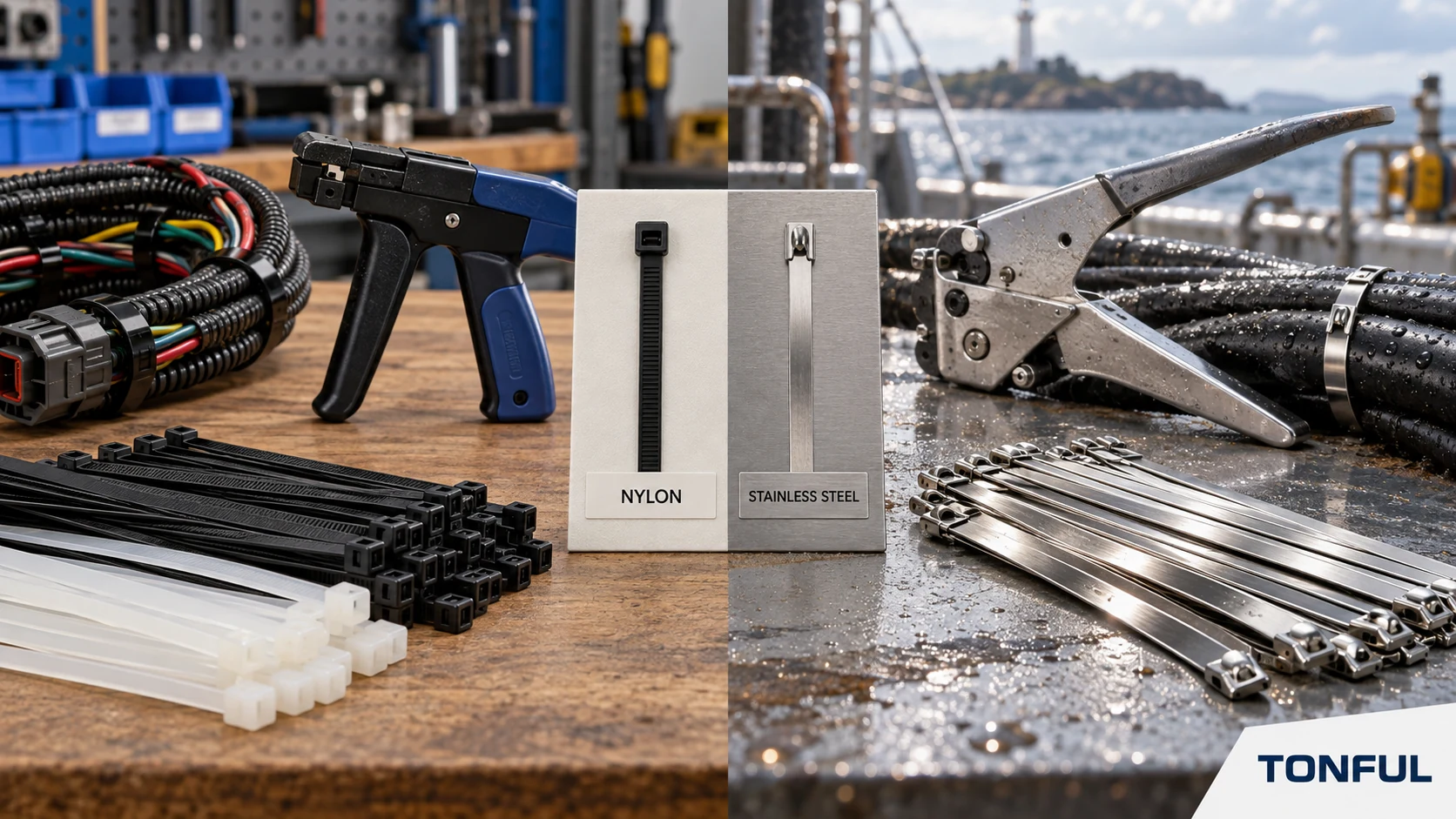
Choosing between nylon and stainless steel cable ties is not simply a question of price or strength. The tie interacts with cable insulation, mounting surfaces, installation tools, heat, moisture, chemicals, vibration and future maintenance. A metal tie may solve one environmental problem while creating a pressure, conductivity or galvanic-corrosion concern. A nylon tie may protect soft insulation and simplify installation but require tighter control of polymer grade, moisture condition and outdoor exposure.
This guide gives engineers and buyers a practical comparison. It does not assign universal ratings to either family. Approve the exact part number using the product drawing, applicable standard, test method, production-intent samples and the real installed assembly.
Quick Decision Table
| Decision factor | Nylon cable tie | Stainless steel cable tie | Evidence required |
|---|---|---|---|
| Electrical behavior | Polymer is normally nonconductive, but construction still matters | Conductive metal can contact grounded or energized structures | Assembly drawing, insulation and clearance review |
| Bundle contact | Flexible strap can be gentler when tension is controlled | Thin metal strap can concentrate pressure or damage soft surfaces | Installed sample and tension setting |
| Temperature | Depends on resin, additives and exposure duration | Metal can tolerate conditions beyond many polymers, but lock/coating remain limiting | Product-specific operating and test evidence |
| UV and weather | Requires suitable formulation and validation | Not degraded by UV like a polymer; corrosion still depends on alloy and environment | Material declaration and exposure plan |
| Corrosion | No metallic rust, but chemicals and water can affect polymers | 304, 316, coatings and surface condition behave differently | Alloy certificate, corrosion environment and test plan |
| Fire context | Polymer behavior depends on formulation and classification | Metal is noncombustible, but installation system requirements still apply | Applicable installation requirement and product classification |
| Service | Usually cut and replaced; releasable designs exist | Usually cut with controlled tools; cut edges need management | Maintenance procedure and access review |
| Installation | Manual or tensioning/cutoff tools | Dedicated tensioning and cutoff tools often needed | Tool, setting and operator instruction |
IEC 62275 addresses metallic, non-metallic and composite cable ties and associated fixing devices used for wiring management and support in electrical installations. Its scope confirms that material families require defined requirements and test methods; it does not make every nylon or stainless product equivalent.
Begin With the Installed Function
First define what the tie must do. Is it only organizing a harness during assembly, positioning a branch away from abrasion, securing a cable to a support, or providing support under an applicable installation rule? These functions are not interchangeable. Record the bundle diameter range, cable construction, routing clearance, tie spacing, expected movement and access for installation and removal.
A selection based only on nominal tie length misses usable length, head size, strap flexibility and minimum loop behavior. A wide stainless strap may be impossible to route through a narrow feature. A thick nylon tie may not conform around a small bundle. Compare full controlled drawings and build a representative assembly before release.
For a broader workflow covering design family, size and environment, use the cable ties buying guide. The types of cable ties guide also distinguishes standard, releasable, mounting and marker functions from the material decision.
Nylon Cable Ties: Advantages and Boundaries
Insulation Protection and Assembly
Nylon ties are lightweight, flexible and available in many head and mounting designs. Controlled tension can distribute pressure around typical cable bundles, and the polymer does not create the same conductive path as bare metal. These qualities often suit internal harnesses, cabinets, equipment and general industrial routing.
However, “nylon” is not a complete material specification. Resin family, grade, additives, colorant, UV stabilization, moisture condition, molding quality and storage history can affect behavior. PA66, PA12 and specialty polymers should not be treated as synonyms. The cable tie materials guide compares those options without assigning one universal service limit.
Moisture conditioning deserves attention. Some nylon materials absorb moisture, and properties can differ between dry-as-molded, conditioned and service-exposed states. Qualification, incoming inspection and production handling should identify the conditioning state used for dimensional and mechanical evidence. Do not compare one supplier’s conditioned test value with another supplier’s dry test value as if the methods were identical.
Environmental Limits
Outdoor black color does not by itself prove UV resistance. Require the exact formulation or product classification, aging method, test duration and post-aging acceptance criteria. Likewise, a generic temperature range does not explain continuous versus short-term exposure, applied load, thermal cycling or contact with hot surfaces.
Chemicals can soften, swell, embrittle or stress-crack a polymer. Define actual fluids, concentrations, temperature, contact time and whether the tie is under tension. Water exposure alone does not establish resistance to cleaners, fuels, oils or process chemicals. If the application is outdoors, the UV-resistant cable tie guide provides a focused validation path.
Stainless Steel Cable Ties: Advantages and Boundaries
Heat, Fire and Mechanical Exposure
Stainless steel ties can be appropriate where polymer degradation, severe heat, UV exposure or demanding mechanical conditions rule out a nylon product. They are also used where an installation requirement calls for a metallic or specifically classified fixing method. The exact requirement must be read in context; “metal” is not a substitute for the product’s evidence or correct installation.
Metal straps can have high loop capability, but higher capacity does not authorize higher installation tension. Excess tension can crush insulation, deform hoses or create a stress concentration. Bare edges and cut tails require inspection, and a coated design may be preferable where direct contact with a vulnerable bundle is permitted by the application.
Stainless steel conducts electricity and heat. Review proximity to live conductors, grounding, creepage and clearance, induction or fault-current conditions as applicable. Do not assume the cable jacket alone resolves every electrical concern. The final assembly and local installation rules govern the decision.
Alloy and Corrosion Selection
Stainless steel is a family, not a single corrosion-proof material. The official worldstainless corrosion overview explains that stainless corrosion resistance comes from a passive chromium-rich film and that pitting, crevice, stress-corrosion and galvanic mechanisms can still occur. Chlorides, temperature, deposits, crevices, surface damage and dissimilar-metal contact all matter.
Type 316 is often considered for chloride exposure because its composition improves resistance relative to 304 in many such environments, but neither grade is universally immune. Confirm actual atmosphere, immersion or splash, cleaning, drainage, maintenance and mating metals. The 304 versus 316 stainless cable tie guide provides the deeper alloy comparison.
Coatings can reduce direct metal contact and improve handling, but coating identity, thickness, coverage, adhesion, temperature and chemical compatibility become additional controlled characteristics. A coated tie should not be approved from photographs alone.

Conceptual material comparison only; verify the exact construction, environment and controlled acceptance evidence.
Evaluate Installation and Maintenance Risk
Tension and Cutoff Control
Both families can damage a bundle when installed incorrectly. Define the tool, tension setting or method, cutoff condition and inspection criteria. Nylon tools should produce a controlled flush cut without damaging the head. Stainless tools should tension and cut the strap without a projecting sharp tail, distorted lock or damaged coating.
Validate settings on production-intent cables, not on a rigid mandrel alone. Inspect soft insulation, small wires, corrugated conduit and hoses after installation and after relevant aging or vibration. Record tool identity, calibration or verification status, operator authorization and sample results. A tool setting is not transferable between different tie widths, materials or head designs unless documented evidence supports it.
Removal also differs. Cutting tools must not contact conductors beneath the tie. Plan access and specify whether protective barriers are needed. Removed ties should normally be discarded unless a releasable design has an approved reuse rule. For maintenance-heavy assemblies, compare lifetime labor and damage risk rather than only unit price.
Mixed Materials and Contact Surfaces
Where a stainless tie contacts painted steel, aluminum or another metal in a wet environment, assess galvanic and crevice conditions. Where either tie touches cable insulation, examine pressure, sliding and thermal expansion. Sleeves, coatings, saddles or edge protection may help, but each added component needs its own material and retention control.
Do not route a tie head or lock where it interferes with a connector latch, sealing boot, service loop or moving mechanism. Orientation is part of the drawing and work instruction, not a cosmetic choice.
Use a Controlled Qualification Matrix
| Qualification field | Required entry |
|---|---|
| Application and function | Bundle, position, fixing or specified support |
| Candidate identity | Part number, revision, material, color/coating and site |
| Assembly | Cable types, bundle range, contact surfaces and tie spacing |
| Environment | Temperature profile, UV, water, chemicals, salt, vibration and fire context |
| Electrical review | Conductivity, grounding, clearance and nearby energized parts |
| Installation | Tool, setting, cutoff, head orientation and operator method |
| Test evidence | Method, conditioning, sample quantity, equipment and acceptance source |
| Post-aging checks | Locking, slip, damage, corrosion, coating and insulation condition |
| Maintenance | Removal access, replacement rule and inspection interval |
| Approval | Scope, deviations, approver, date and retained sample |
Allocate samples before testing. Decide whether the same specimens receive sequential conditioning or independent groups are used, retain an unaged reference and identify destructive-analysis samples. Define invalid-test and replacement-sample rules in advance. Acceptance criteria must come from the drawing, customer specification, approved qualification plan or applicable standard rather than a blog value.

Compare production-intent samples under the actual assembly and environmental conditions before release.
Receiving Inspection and Change Control
At receiving, verify labels, part number, revision, lot, quantity, dimensions, material or alloy declaration, coating, color, head geometry and packaging. Inspect representative samples for molding defects, damaged teeth, brittle handling, burrs, sharp edges, lock damage or coating gaps. Functional sampling should use a defined method and product-specific acceptance source.
Require notification for resin grade, additives, colorant, alloy, strip source, coating, dimensions, lock design, mold or forming tool, manufacturing site, conditioning, test method and packaging when they can affect approval. Keep retained samples and trace evidence to the incoming lot. An unchanged commercial name does not prove unchanged construction.
Practical Selection Rules
Choose nylon when its documented environmental range, insulation interaction, strength and maintenance characteristics fit the application. Choose stainless when the approved alloy and construction address heat, weathering, fire context, corrosion and mechanical demand that a polymer option cannot satisfy. Consider coated stainless where direct bundle contact requires added protection and the coating itself is validated.
Do not choose stainless only because it sounds stronger, and do not choose nylon only because it is cheaper or easier to install. The correct decision minimizes assembly damage and lifecycle risk while meeting the controlled technical requirement.
Work With TONFUL
TONFUL’s cable tie range includes polymer and stainless options for different routing and environmental needs. For a useful review, provide bundle range, cable construction, installation drawing, operating environment, material preference, required evidence, tool method, quantity and packaging. TONFUL can compare available designs and production-intent samples; final release remains limited to the approved part, process and application.